Act I
“It didn’t touch your bike.”
The young woman stood beside the metal bicycle rack, one hand gripping the handlebar of her battered old bicycle. Her light blue hoodie was slightly faded, her jeans were worn at the knees, and a small backpack hung from one shoulder. Beside her stood a sleek electric bike that looked as though it had just rolled out of an expensive showroom.
The two bicycles were close.
But they had never touched.
“Trash. Your bike makes this place look cheap.”
The insult came from Vanessa Cole, a thirty-six-year-old resident who had turned owning expensive things into a personality. Her black designer coat was perfectly fitted, her white pants were spotless, and her expensive sneakers looked untouched by the concrete floor beneath them.
Vanessa adored her electric bike. She spoke about its custom features as though they were achievements of her own, and she treated the shared storage room like a private showroom.
To her, the problem was not that another bicycle had damaged hers.
The problem was that the old bicycle existed beside it.
The young woman, Emily Carter, was twenty-two and attending college while working part-time to cover her living expenses. Her bicycle had belonged to her late grandfather, who had taught her to ride it when she was a child. The paint had chipped over the years, the bell occasionally stuck, and the seat had been repaired twice.
But Emily loved it.
It had carried her through early classes, late shifts, rainy mornings, and the months when paying for public transportation meant sacrificing money she needed elsewhere.
She had locked it in the designated rack that morning, leaving enough space between it and Vanessa’s electric bike.
She had done nothing wrong.
“I parked where the signs say we’re allowed to park,” Emily replied, keeping her voice calm. “There’s plenty of room.”
Vanessa looked at the old bicycle as if it were something that had crawled out of a dumpster.
“Do you even understand what this place is supposed to look like?”
Emily glanced at the storage racks.
“A bike room?”
A resident near the doorway almost smiled, then quickly looked away.
Vanessa noticed.
Her face tightened.
“This is a luxury building. People pay a lot of money to live here. We shouldn’t have to look at junk every time we come downstairs.”
“It’s my bike,” Emily said. “And it isn’t touching yours.”
Vanessa stepped closer.
“Then move it.”
“Why?”
The question was quiet, but it stripped away the easy superiority Vanessa had expected to enjoy.
She was accustomed to people backing down when she raised her voice. The concierge knew her complaints by heart. Neighbors had learned that disagreeing with her could mean weeks of hostile messages to the homeowners association.
Emily, however, had no intention of apologizing for using a space that belonged to every resident.
She reached for the lock.
“I’ll finish locking it and leave. I have class.”
Vanessa moved directly into her path.
“People like you always have an excuse.”
Emily stared at her.
“People like me?”
Vanessa gave a thin, contemptuous smile.
“People who drag cheap things into expensive places and expect everyone else to pretend it’s normal.”
Emily’s fingers tightened around the bicycle handle.
She could have argued. She could have insulted Vanessa back. Instead, she tried one last time to end the conversation.
“Please just let me leave.”
That should have been the end of it.
Instead, Vanessa’s expression hardened into something colder.
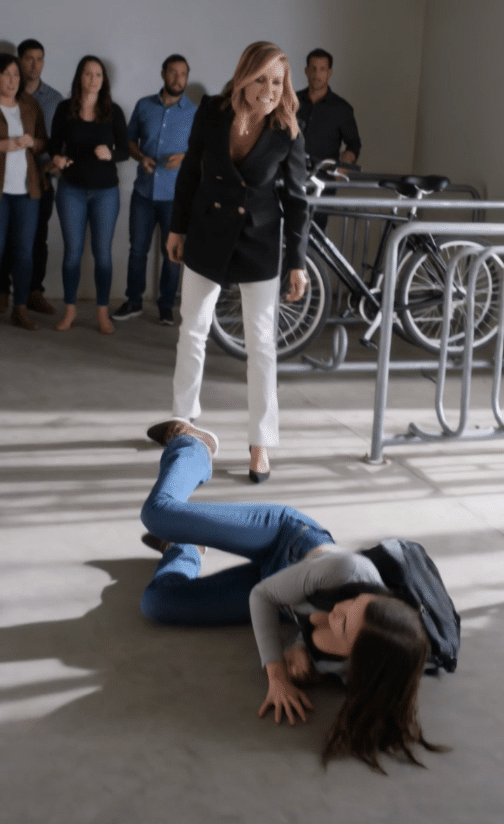
She stepped forward and kicked Emily directly in the chest.
Emily stumbled backward and fell beside the metal rack. Her backpack slipped off one shoulder, and her forearm scraped against the concrete, leaving a thin trace of blood. The old bicycle clattered against the rack as she struggled to catch her breath.
Before she could get up, Vanessa stepped closer and kicked her twice more in the back and ribs.
A resident gasped.
Someone else covered her mouth.
Nobody intervened.
Vanessa straightened, brushing at her coat as though the confrontation had left an unpleasant stain on her morning.
“Park it where people can’t see it.”
Emily curled around herself, trying to protect her ribs. Her bicycle lay beside her, its front wheel still turning slowly.
Vanessa glanced at the security camera mounted above the door.
Then she looked away.
She believed the camera would prove nothing important. At worst, she assumed, it would show a disagreement between two residents, and she knew exactly how to tell that story.
What she did not know was that the homeowners association had been waiting for a very particular kind of evidence.
And she had just provided it.
Act II
Vanessa Cole had lived in the building for nearly five years.
She had moved in after a lucrative divorce settlement and quickly established herself as one of the residents who seemed to know every rule, every board member, and every detail of the building’s internal politics.
She knew which delivery drivers could enter without signing in. She knew which residents left bicycles outside their assigned spaces. She knew how to turn a minor inconvenience into a formal complaint that consumed hours of management time.
She also knew how to make herself sound reasonable.
When she complained about a neighbor’s shoes left outside an apartment door, she called it a safety issue. When she objected to a family’s children playing near the lobby, she described it as a matter of preserving the building’s atmosphere. When a resident challenged her, she claimed she was simply protecting everyone’s property values.
Her complaints were rarely about the rules themselves.
They were about control.
Over time, several residents began avoiding her. Some stopped using shared facilities when she was around. Others quietly moved their belongings rather than risk another confrontation.
Vanessa interpreted their silence as agreement.
She had convinced herself that the building’s luxury status entitled her to decide what belonged there.
Emily had no idea how extensive the problem had become.
She had moved into the condominium with her mother two years earlier, after her mother found a more affordable arrangement through a family acquaintance. Emily contributed to household expenses, worked weekends at a neighborhood café, and spent most of her time studying.
She was not interested in the building’s social hierarchy.
She barely knew the names of the people who lived on the upper floors.
What she did know was that her grandfather’s bicycle had survived far worse than Vanessa’s insults.
When Emily was twelve, her grandfather, Robert, had taught her how to repair a punctured tire in his garage. He showed her how to tighten a chain, adjust a brake, and recognize when a machine was unsafe to ride.
He had been a practical man who believed that expensive things were not necessarily better things.
“Never confuse the price of something with its value,” he used to tell her.
When he died, Emily inherited the bicycle.
Her mother suggested selling it and buying a newer one, but Emily refused. The bicycle reminded her of afternoons spent in the garage, of grease on her hands, and of a man who had taught her that independence was worth more than appearances.
She had kept it running ever since.
The irony was that Emily’s family had a deeper connection to the condominium than she realized.
Her grandfather had once served as a volunteer technical adviser during the early development of the neighborhood. He had helped residents understand the proposed building rules, reviewed maintenance plans, and raised concerns about how the original management company handled shared spaces.
He had also been involved in the formation of the homeowners association.
But those events had happened years before Emily was born. The documents were stored in boxes, the people involved had moved away, and the family’s connection to the building had become little more than an occasional story told at dinner.
Emily knew her grandfather had helped people.
She did not know how much his work still mattered.
Meanwhile, the homeowners association had been facing a growing crisis.
Residents had filed complaints about harassment, intimidation, and selective enforcement of the building’s rules. Several people claimed that Vanessa used formal complaints to pressure neighbors into abandoning shared spaces she disliked.
The board had reviewed the reports, but the evidence was inconsistent. Some incidents had been witnessed only by people who were reluctant to speak publicly. Others had been dismissed as personality conflicts.
The board manager, Michael Grant, had begun reviewing the building’s security footage whenever a complaint involved a common area.
Michael was forty-nine, experienced, and careful about distinguishing unpleasant behavior from actual violations. He understood that the board could not punish residents simply because other people disliked them.
It needed evidence.
Then came Emily’s complaint about Vanessa’s attempts to force her to remove the bicycle.
Michael had received the report only days earlier. He had asked security to preserve the relevant footage, expecting perhaps to document another heated exchange.
He had not expected to find an assault.
And he had certainly not expected the video to connect Vanessa’s behavior to a much larger problem involving the building’s governance.
Because the board was not merely deciding where Emily could park her bicycle.
It was deciding whether one resident had been using threats and intimidation to control the property that belonged to everyone.
Act III
The first person to move after the assault was not a resident.
It was Michael Grant.
The board manager stepped into the bicycle storage room carrying a tablet. His expression was serious, and his eyes went immediately to Emily lying beside the rack.
He crossed the room, placed himself between her and Vanessa, and crouched beside the injured student.
“Don’t try to get up yet,” he said, signaling for someone to call emergency services.
Emily nodded weakly.
Michael checked that she was conscious, then turned toward the residents gathered near the doorway.
“Please give her space. We need medical assistance here.”
This time, people moved.
One resident hurried toward the lobby desk. Another stepped closer to help keep Emily’s bicycle from falling onto her. A third began explaining what she had seen, speaking rapidly as though the words had been trapped inside her for too long.
Vanessa folded her arms.
“Michael, thank goodness. You need to deal with this.”
He looked at her.
“I’m dealing with it.”
“She was being aggressive. She refused to move her bicycle when I asked her.”
Michael glanced at Emily, then at the rack.
“Was her bicycle touching yours?”
Vanessa hesitated.
“That isn’t the point.”
“Was it touching yours?”
“No. But—”
Michael raised the tablet.
“Then let’s look at the recording.”
For the first time, Vanessa seemed uncertain.
She looked up at the security camera, then back at the tablet. Her expression suggested she had only just remembered that the device had been recording the entire confrontation.
Michael tapped the screen.
The footage showed Emily locking her old bicycle into an assigned space. It showed Vanessa approaching, pointing toward the electric bike, and gesturing angrily at the other woman’s bicycle.
It showed Emily stepping back.
It showed Vanessa blocking her path.
And it showed the attack.
There was no ambiguity about who had initiated the violence.
No missing seconds.
No convenient angle that concealed what happened.
The video recorded the kick that sent Emily to the floor, followed by the two additional kicks while she was already down.
Michael stopped the playback.
The room was silent.
Vanessa swallowed.
“You’re taking that out of context.”
Michael looked at her with disbelief.
“The camera recorded the entire interaction.”
“You don’t know what she said to me before that.”
“We can hear what was said.”
Vanessa glanced toward the residents.
Nobody came to her defense.
Then Michael rose to his feet, still holding the tablet.
“You just gave the board exactly what it needed.”
The words landed harder than a threat.
Vanessa stared at him.
“What are you talking about?”
Michael did not answer immediately.
He looked at the old bicycle, then at the woman who had been assaulted beside it. His expression carried a mixture of concern and grim recognition.
The board had been investigating Vanessa’s conduct for months. The complaints had included intimidation, repeated harassment, and attempts to pressure other residents into abandoning common areas she considered unsuitable.
Until that morning, Vanessa had been able to characterize each incident as a misunderstanding.
Now the board had direct evidence of what she was willing to do when another resident refused to obey her.
The footage would not automatically decide every earlier complaint. Each allegation still required its own review, and the board could not simply declare someone guilty of every accusation because of one incident.
But the recording established something important.
Vanessa’s behavior was no longer a matter of competing stories.
There was a clear, documented act of violence in a shared space.
And it had occurred in front of a security camera.
Michael glanced down at the tablet again.
There was another reason the footage mattered.
The board had recently begun reviewing whether Vanessa had been improperly influencing enforcement decisions through her repeated complaints and private communications with individual board members. Several residents believed she had been using the threat of formal action to force people out of common areas.
Michael had requested a complete record of the complaints and the relevant security footage before the board’s next meeting.
The assault had transformed that review.
Now the board could examine her conduct alongside the pattern of documented disputes, rather than relying entirely on the competing accounts of residents who feared speaking against her.
Vanessa stared at the screen.
“The board?” she repeated.
Michael’s expression did not change.
“Yes. The board.”
She looked at the security camera again.
For the first time, she seemed to understand that the device above her head had not been watching Emily.
It had been watching her.
And it had recorded every second.
Act IV
The medical team arrived and began assessing Emily’s injuries.
Michael stayed nearby while the paramedics carefully helped her onto a stretcher. She was frightened and in pain, and her first concern was whether her bicycle had been damaged.
“Don’t worry about the bike right now,” Michael told her. “We’ll make sure it’s safe.”
Emily looked toward the rack.
The old bicycle’s front wheel was crooked from the fall, but the frame appeared intact. One handlebar grip had been scraped, and the lock lay on the floor beside the rack.
She swallowed hard.
“My grandfather gave it to me.”
Michael followed her gaze.
“Then we’ll take care of it.”
Vanessa stood near the doorway, visibly struggling to regain control of the situation.
“This is absurd,” she said. “I expect the board to understand that I was trying to protect my property.”
Michael turned toward her.
“You had every right to raise a concern if you believed your bicycle was at risk. You did not have the right to attack another resident.”
“She was disrespectful.”
“Disrespect is not a justification for assault.”
Vanessa’s eyes narrowed.
“You know who I am. I’ve served on committees. I’ve helped this building.”
“And those contributions will be considered separately from the evidence of what happened today.”
She stared at him.
For years, Vanessa had relied on the idea that her involvement in the building’s affairs made her indispensable. She knew how to navigate its procedures, how to make herself useful to certain board members, and how to present her complaints as the concerns of a resident protecting the community.
She had assumed those relationships would shield her.
Michael had no intention of allowing them to interfere with the review.
He informed her that the incident would be documented and referred to the appropriate authorities. The board would also review her conduct under the condominium’s governing documents, including the rules governing violence, harassment, and access to shared facilities.
Vanessa immediately threatened to sue.
Michael listened without interrupting.
Then he said, “You are entitled to seek legal advice. The recording will be preserved.”
Her expression changed.
She looked at the tablet again.
“What happens to the video?”
“It becomes part of the official incident record. Access will be handled according to the building’s policies and applicable law.”
“People can’t just watch that.”
“It’s not a question of whether people want to watch it. It’s evidence.”
Vanessa’s voice rose.
“You’re making me look like a criminal!”
Michael held her gaze.
“I’m documenting what happened.”
The residents watched in silence.
Several of them had lived through Vanessa’s complaints for years. They had seen neighbors remove belongings from shared spaces to avoid arguments. They had heard her threaten to contact management over trivial matters. Some had even apologized for things they had done nothing wrong to avoid becoming the next target.
Now, for the first time, they began describing those experiences openly.
One resident recalled being threatened over a pair of running shoes left beside a storage locker. Another described receiving repeated messages after refusing to move a stroller from a permitted area. A third said Vanessa had complained about his daughter’s bicycle because she believed it made the room look untidy.
Michael took notes.
He did not promise that every complaint would result in punishment. He explained that the board would review each report, preserve the relevant evidence, and follow the procedures required by the association’s rules.
That restraint made his next statement even more powerful.
“The board is not going to decide this based on who has the most money, the nicest belongings, or the strongest opinions. We’re going to decide it based on the evidence.”
Vanessa looked as though he had struck her.
Then she noticed something on the tablet.
The security system had captured more than the assault.
It had recorded her standing beside Emily’s bicycle before the argument began, pointing at it, inspecting the space around her own electric bike, and deliberately blocking Emily’s path when the younger woman tried to leave.
The sequence contradicted Vanessa’s claim that she had merely reacted to an unexpected threat.
She had approached Emily.
She had initiated the confrontation.
And she had escalated it long after it was clear that the bicycles were not touching.
Michael turned the screen toward her.
“You can explain your account during the formal review. But the footage will not be altered, and no one is going to pretend it shows something different from what happened.”
Vanessa’s confidence finally gave way to panic.
She looked around the room, searching for a sympathetic face.
There was none.
Then Michael added one final detail.
“The board’s next meeting is already scheduled. This incident will be included, along with the previous complaints and the records we’ve been collecting.”
Vanessa stared at him.
“Previous complaints?”
Michael said nothing.
That silence frightened her more than an argument would have.
She had believed each incident disappeared after she had pressured someone into backing down. She had assumed that every frightened neighbor would remain frightened forever.
She had never considered that the complaints might be accumulating.
That the people she had intimidated might eventually compare their experiences.
Or that the board might finally have the evidence needed to recognize the pattern.
For the first time, Vanessa realized that the old bicycle had never been the real problem.
The real problem was that Emily had refused to surrender her place simply because someone wealthier demanded it.
And now the entire building was watching what happened next.
Act V
The consequences unfolded over the following weeks.
Emily recovered from her injuries, though the experience left her shaken. For a while, she hesitated before entering the bicycle storage room. Every time she heard footsteps behind her, she remembered the moment Vanessa had blocked her path.
Her mother urged her to use a different place to store the bicycle.
Emily considered it.
But she eventually decided that she would not give up a space she was entitled to use simply because someone had tried to frighten her out of it.
The homeowners association preserved the security footage and began a formal review of the incident. Witnesses were interviewed, the prior complaints were examined, and Vanessa was given the opportunity to respond through the association’s established procedures.
The video was clear.
So were the witnesses.
The board determined that Vanessa had violated the community’s rules through her conduct in the shared storage area. Following the applicable process, it imposed the penalties authorized by the governing documents and restricted her access to certain shared facilities while the matter was resolved.
The assault was also referred to the appropriate authorities, separate from the association’s internal proceedings.
Vanessa’s threats of legal action did not make the recording disappear.
Nor did her expensive belongings or years of involvement in the building’s committees change what the evidence showed.
Her reputation among the residents deteriorated quickly.
People who had once smiled nervously when she approached began setting boundaries. Neighbors who had quietly endured her complaints started documenting their own experiences. The board introduced clearer procedures for reporting harassment and emphasized that no resident could use status or personal relationships to override the rules.
The building did not become a perfect community overnight.
But the atmosphere changed.
People began using the shared spaces more confidently. Residents stopped moving permitted belongings merely because Vanessa disliked how they looked. The bicycle storage room became what it had been intended to be: a place where neighbors could keep their bicycles safely, regardless of their price.
And Emily’s old bicycle remained in its rack.
A few weeks after the incident, Michael visited her apartment to return a copy of the incident report and confirm that the board had completed the initial review.
He found Emily sitting at the kitchen table, repairing the handlebar grip that had been damaged during the fall.
“Your grandfather taught you how to fix that?” he asked.
Emily smiled faintly.
“Pretty much everything I know about bikes.”
Michael glanced at the bicycle.
“It’s a good thing you kept it.”
“He used to say that if something still works and still matters to you, you shouldn’t throw it away just because somebody else thinks it’s old.”
Michael considered that.
“Sounds like he understood people, too.”
Emily laughed softly.
For the first time since the assault, she felt that the memory of her grandfather was no longer tied entirely to what had happened in the storage room. The bicycle was still hers. The stories attached to it were still hers.
Vanessa had not taken those things away.
She had only revealed how desperately she needed everyone else to believe that value could be measured by appearance.
Several months later, Emily rode the bicycle to class on a bright morning.
The paint was still chipped. The frame still showed signs of age. The repaired handlebar grip was a slightly different shade from the original.
But the brakes worked, the chain ran smoothly, and the tires were properly inflated.
When she returned that afternoon, another resident was standing beside the storage rack with a brand-new electric bike.
He glanced at Emily’s bicycle, then moved his own bike a little farther away to make room.
“Plenty of space here,” he said with a friendly smile.
Emily smiled back.
“Thanks.”
There was no argument.
No inspection of designer shoes.
No demand that one person prove she belonged before being allowed to use a shared space.
Just two residents making room for each other.
From the management office, Michael watched the exchange and thought about the recording that had changed the board’s understanding of the situation.
The camera had not made Vanessa cruel.
It had not created the pattern of intimidation or forced the residents to speak.
It had simply captured what happened when she believed no one could hold her accountable.
And once the truth became impossible to deny, the building finally had a chance to address it.
Emily never became secretly wealthy. She did not inherit a fortune, reveal a powerful family connection, or discover that the bicycle was worth millions.
She remained a college student with a part-time job, a small backpack, and an old bicycle she refused to abandon.
That was what made the ending matter.
She did not need to become richer than Vanessa to deserve respect.
She did not need a powerful relative to defend her.
She had been entitled to dignity from the beginning.
Vanessa’s mistake was believing that the world belonged to people who could afford the most impressive things. She had mistaken luxury for authority, intimidation for strength, and other people’s silence for permission.
But the homeowners association had rules. The building had cameras. The residents had memories. And the young woman she had dismissed as unimportant had refused to accept that her place in the community could be taken away by someone else’s contempt.
In the end, the old bicycle became more than a bicycle.
It became a reminder that shared spaces belong to everyone, that status does not excuse cruelty, and that even the smallest act of arrogance can become impossible to hide when the evidence is finally seen.
Vanessa had looked at Emily’s bicycle and decided it made the building look cheap.
Then she attacked the woman who owned it, certain that her wealth would protect her.
Instead, she gave the board the clearest evidence it had ever received.
She thought the old bicycle was the problem. The security camera revealed that she was.