Act I
“I’m sorry. I didn’t mean to touch your shoe.”
The elderly man stood beside the marble newspaper table, clutching the morning edition against his brown coat. The corner of the paper had brushed the toe of a younger resident’s immaculate white shoe, leaving no visible mark, no stain, not even a crease.
But the younger man reacted as though someone had deliberately destroyed something priceless.
“Trash. Keep your dirty paper away from me.”
His name was Brandon Hale. At thirty-eight, Brandon lived in one of the most expensive apartments in the city, drove a car that cost more than most people’s homes, and treated every public space as though it belonged to him personally.
He wore a black polo shirt, tailored white pants, and spotless designer sneakers. His watch flashed beneath the lobby lights whenever he moved his hands, and he had developed a habit of inspecting his reflection in the building’s glass doors before leaving each morning.
Brandon believed appearance was everything.
People who wore expensive clothes deserved respect. People who carried worn newspapers and dressed in ordinary coats deserved to stay out of his way.
The older man, Arthur Bennett, had made the mistake of doing neither.
Arthur was sixty-six, with silver beginning to show at his temples and the quiet, slightly stooped posture of someone who had spent much of his life working with his hands. He had been reading the newspaper near the leather sofa when he turned to leave, unaware that its loose edge had brushed Brandon’s shoe.
He had apologized immediately.
Most people would have accepted it.
Brandon leaned closer instead.
“Do you have any idea how much these cost?”
Arthur glanced at the shoe.
“No, sir. But I’m sorry if I scuffed them.”
“You think an apology fixes everything?”
Brandon lifted one foot slightly, inspecting the pristine leather as if searching for invisible damage. Then he looked at Arthur’s coat, his gray trousers, and the folded newspaper in his hand.
A contemptuous smile spread across his face.
“People like you shouldn’t be hanging around the lobby.”
Arthur tightened his grip on the newspaper.
“I live here.”
That answer seemed to offend Brandon more than the accidental contact had.
“You live here?”
“Yes.”
Brandon gave a short laugh and looked around the lobby, inviting the other residents to share his disbelief. A woman waiting near the elevators lowered her eyes. A man sitting on the leather sofa pretended to become fascinated by his phone.
Arthur noticed their reactions.
He had lived long enough to recognize the difference between people who disagreed with cruelty and people who were simply afraid of becoming its next target.
“I don’t want any trouble,” Arthur said quietly. “I’ll move.”
He turned toward the sofa.
Brandon stepped directly into his path.
“Read outside with the rest of the trash.”
Arthur stopped.
For a moment, something changed in the older man’s expression. Not anger exactly, but disappointment, as though he had just discovered something unpleasant about a person he had hoped might be better.
“There’s no reason to speak to me like that.”
Brandon’s face hardened.
He stepped forward and delivered a forceful kick into Arthur’s chest.
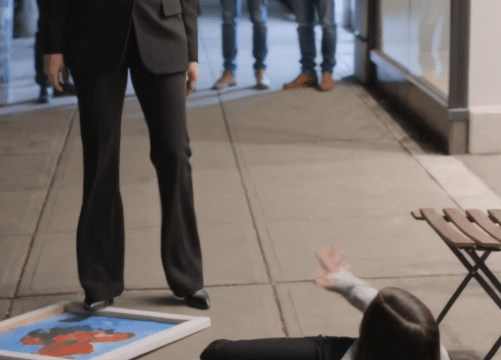
The older man fell backward beside the leather sofa, striking the marble floor hard. His newspaper slipped from his hands, scattering pages across the lobby. A thin trace of blood appeared on one elbow as he struggled to catch his breath.
A woman gasped.
Someone whispered, “Oh, my God.”
Brandon barely glanced at them.
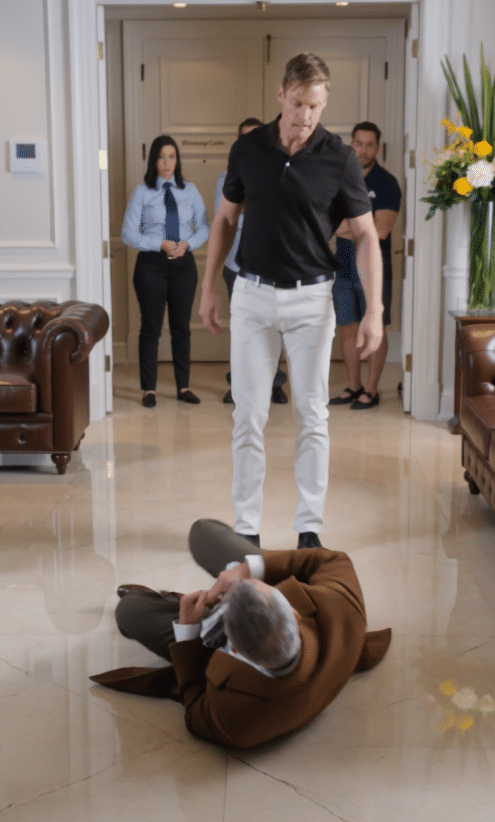
He stepped closer and kicked Arthur twice more in the back and ribs while the elderly man curled around himself, desperately clutching the newspaper that had fallen beside him.
The lobby fell silent.
Arthur lay on the floor, breathing unevenly, one hand pressed against his chest.
Brandon straightened his polo shirt.
“Read outside with the rest of the trash,” he repeated, looking down at him.
Then he nudged one of the scattered newspaper pages with the toe of his expensive shoe.
He had no idea what was printed on it.
He had no idea why the older man had been reading it so carefully.
And he certainly had no idea that the paper he had just treated like garbage contained information that could expose a secret buried beneath the very building where he lived.
Because the moment the management office door opened, Brandon’s entire world was about to change.
Act II
The man who emerged from the management office was not wearing a uniform.
He wore a navy suit, a pale blue shirt, and the expression of someone who had just witnessed something he had spent years hoping never to see.
His name was Charles Whitaker, the owner of the entire residential complex.
At sixty, Charles had built his reputation on restoring aging properties and transforming neglected buildings into safe, desirable homes. He was known for being measured in business, demanding about construction standards, and almost impossible to impress with superficial displays of wealth.
Unlike Brandon, Charles rarely needed to announce his status.
People who worked for him understood that he cared less about how a building looked on the day it opened than whether it would still be standing fifty years later.
And the sight in the lobby stopped him cold.
Arthur was on the floor.
The newspaper was scattered around him.
Brandon stood above him, immaculate and untroubled, as though the entire incident had been nothing more than a minor inconvenience.
Charles moved immediately toward Arthur.
“Don’t try to get up,” he said, kneeling beside him.
He carefully helped the older man remain still, then looked toward the frightened residents.
“Call for medical assistance. Now.”
This time, someone obeyed without hesitation.
A young woman hurried toward the reception desk. Another resident stepped away from the elevator, finally looking directly at Arthur rather than pretending not to see him.
Brandon folded his arms.
“Mr. Whitaker, I’m glad you’re here. This man caused a problem, and I had to make it clear that—”
Charles looked up.
“Stop talking.”
Brandon blinked.
He had expected sympathy, perhaps a private discussion, maybe even a warning about the lobby’s reputation. He had been a resident for years and had always assumed that his wealth gave him a certain amount of influence over the building’s management.
Charles had never spoken to him like that.
“I think there’s been a misunderstanding,” Brandon said, forcing a smile.
Charles did not respond.
His eyes had moved to the newspaper in Arthur’s hand.
One page was folded inward, protecting a section of dense print and a black-and-white photograph. The paper had been creased from repeated reading, and several handwritten notes appeared along its margin.
Charles reached toward it, then stopped.
He recognized the document referenced in the article.
More importantly, he recognized the name written in Arthur’s careful handwriting.
For several seconds, he seemed unable to decide whether to speak.
Arthur noticed his expression.
“You found it,” the older man murmured.
Charles looked at him sharply.
“You brought the original?”
Arthur gave the smallest nod.
Brandon stared between them.
“What original?”
Neither man answered him.
Charles carefully lifted the newspaper page, keeping it away from the small trace of blood on Arthur’s elbow. He scanned the headline, then the highlighted passage beneath it.
His face lost its color.
For years, the building had been celebrated as a triumph of modern engineering. Its developers had promoted the reinforced foundation, the upgraded structural supports, and the extensive inspections that supposedly guaranteed the property would remain safe for generations.
Residents had paid extraordinary prices for the promise of security.
But there had been a problem during construction.
A problem that could have changed everything.
Decades earlier, a junior engineer had raised concerns about a section of the original foundation. The engineer claimed that the contractor had substituted inferior materials and concealed the discrepancy in its inspection records.
The warning had disappeared into a maze of corporate correspondence.
The building was completed.
The apartments sold.
The residents moved in.
And the engineer who had challenged the project was publicly discredited.
Charles had spent the past year quietly investigating inconsistencies in the original construction files after discovering that several inspection records were missing from the company’s archives.
He had suspected that the official story was incomplete.
He had not expected Arthur Bennett to walk into his lobby carrying the missing piece of the puzzle.
Nor had he expected to find him lying on the floor because a wealthy resident had objected to a newspaper brushing his shoe.
Charles looked at Arthur.
“Where did you get this?”
Arthur closed his eyes briefly.
“From the man who tried to warn everyone.”
Brandon laughed nervously.
“Are we seriously discussing a newspaper while this guy is making a scene?”
Charles slowly rose to his feet.
He held the page in one hand and looked at Brandon with an expression that made the younger man take an involuntary step backward.
“Do you know what you’re standing in?”
Brandon glanced at the marble floor.
“An apartment lobby.”
“No,” Charles said. “You’re standing in a building whose safety may depend on the documents you just kicked across the floor.”
For the first time, Brandon looked down at the newspaper.
The scattered pages no longer seemed like trash.
They looked like evidence.
And the elderly man he had attacked was suddenly the only person in the room who understood why.
Act III
Arthur Bennett had once been one of the most respected structural engineers in the region.
Thirty-four years earlier, he had worked on a major residential development that would eventually become one of the city’s most prestigious addresses. He was younger then, newly married, and raising a daughter who believed her father could solve almost any problem with a pencil, a ruler, and enough patience.
Arthur had loved his work because buildings were honest in a way people often were not.
A beam could not be persuaded to carry more weight than it was designed to bear. A foundation could not be bribed into becoming stronger. If someone ignored a warning, the consequences might remain invisible for years, but the truth would eventually emerge.
During the development of the complex, Arthur discovered that a subcontractor had replaced specified reinforcement materials with cheaper alternatives.
The substitution reduced costs.
It also compromised the safety margin of a critical section of the structure.
Arthur documented the discrepancy, photographed the affected components, and submitted a formal warning. He expected an investigation. At the very least, he believed the contractor would be required to correct the work before the building was completed.
Instead, the warning disappeared.
A senior project manager accused Arthur of misunderstanding the specifications. A revised report appeared with his name attached to an approval he insisted he had never signed.
Within weeks, his employer suspended him.
Within months, his professional reputation was in ruins.
He tried to challenge the decision, but the company had money, influence, and access to lawyers he could not afford. Former colleagues stopped returning his calls. Potential employers heard rumors that he was unreliable, difficult, and prone to exaggerating technical problems.
Arthur’s wife urged him to keep fighting.
His daughter, still a child, asked why he no longer went to work.
He had no answer that would not frighten her.
Eventually, the family moved away.
Arthur found work repairing smaller structures and inspecting older properties. He lived modestly, raised his daughter as best he could, and carried the memory of the project like a stone he could never put down.
The building continued to stand.
For years, that fact was used against him.
People argued that if his concerns had been legitimate, something would already have happened.
But Arthur understood the difference between a building that had not failed and a building that had been proven safe.
Those were not the same thing.
He kept copies of his original calculations, handwritten notes, photographs, and correspondence. Some documents had been preserved in storage boxes. Others had been given to a trusted colleague who promised to keep them safe if anything happened to him.
The colleague died before the investigation could be reopened.
Arthur thought the evidence had been lost.
Then, several months earlier, an old envelope arrived at his home.
Inside was a letter from the colleague’s daughter, who had been sorting through her father’s belongings. She had found the original project records and recognized Arthur’s name.
She wanted him to have them.
Arthur spent weeks reviewing the material, matching the documents against public records and archived news reports. He discovered that the missing inspection file was not merely an old professional dispute.
It was the key to understanding how the original warning had been suppressed.
And one signature appeared repeatedly in the correspondence.
The signature belonged to Richard Hale, a senior executive who had represented the construction consortium at the time.
Richard Hale was Brandon’s father.
Brandon had grown up hearing that his father was a brilliant businessman who had helped build the city’s skyline. He had inherited not only the family fortune but also the conviction that people who questioned successful men were usually jealous, incompetent, or both.
He had never heard the story from Arthur’s side.
He had never seen the original documents.
And he had never considered that the wealth supporting his lifestyle might have been built, in part, on decisions that endangered other people.
Arthur had not come to the building that morning to confront Brandon.
He had come to meet Charles Whitaker.
The two men had arranged a discreet meeting after Charles learned that an independent researcher had located a former engineer connected to the original construction dispute. Arthur wanted to deliver the documents personally and explain the technical details before they were submitted for a formal review.
He had arrived early.
While waiting, he picked up the morning newspaper from the lobby table and noticed an article about a recent inspection of aging residential towers. The article mentioned the building’s original developer and quoted a company spokesperson who insisted that all historical safety concerns had been resolved decades earlier.
Arthur had marked the passage.
He wanted Charles to understand that the old assurances were being repeated without the complete evidence.
Then he had turned away from the newspaper table.
The paper brushed Brandon’s shoe.
And the meeting that might finally restore his reputation became the scene of a public assault.
Back in the lobby, Charles studied the documents with growing disbelief.
The pages were authentic-looking, but he refused to draw conclusions before they were independently verified. Arthur had spent too many years being dismissed by people who treated confidence as a substitute for evidence.
This time, Charles would make sure the process was different.
He looked toward Brandon.
“Your father was involved in this project, wasn’t he?”
Brandon’s expression tightened.
“My father has been involved in dozens of projects.”
“Then this should be easy to clarify.”
Charles held up the newspaper.
“Because these papers suggest that a safety warning was suppressed before this building was completed.”
Brandon stared at the page.
His first instinct was to laugh again.
His second was to deny everything.
But the name on the document was unmistakable.
His father’s name.
And beneath it was a signature Brandon had seen countless times on family contracts, framed awards, and corporate correspondence.
For the first time in his life, he wondered whether the family story he had been taught was missing something important.
Then Arthur spoke from beside the sofa.
“Your father knew the building wasn’t as safe as the reports claimed.”
Brandon turned sharply.
“You don’t know anything about my father.”
Arthur met his eyes.
“I knew the man who signed those papers.”
The lobby fell silent.
Brandon looked at the documents again, searching for some detail that would prove the old man was lying.
Instead, he found a date.
A date from a year before his father had received a public award for completing the development ahead of schedule and under budget.
The award had always been displayed in the Hale family home.
Brandon remembered his father telling him that the project had been his greatest professional achievement.
Now, for the first time, Brandon wondered what it had cost.
Act IV
The ambulance arrived, and the medical team carefully assessed Arthur before taking him for further evaluation.
Charles remained beside him until the paramedics were ready to leave. Before Arthur was moved, he asked Charles to secure the documents and ensure that no original pages were lost.
“I didn’t keep these all these years so someone could bury them again,” Arthur said.
“You have my word,” Charles replied.
This time, Arthur believed him enough to let go of the newspaper.
The lobby had changed.
Residents who had once watched in frightened silence began offering statements. A woman described seeing Brandon kick Arthur in the chest. Another witness confirmed the two follow-up kicks. The receptionist retrieved the security footage, while the building manager contacted the appropriate authorities.
Brandon stood near the flower vase, his white shoes still spotless.
He looked around at the people who had witnessed the assault.
“You’re all making this into something it isn’t,” he said. “He touched my property. I reacted. That’s all.”
Nobody answered.
Charles turned toward him.
“Your shoes are not the issue anymore.”
Brandon’s face flushed.
“You can’t threaten me because of some old paperwork. I know people who have worked with your company for years.”
“Then they’ll be welcome to cooperate with the investigation.”
“My father built half the properties in this city.”
“Your father’s reputation will not decide whether these documents are authentic.”
Brandon stepped forward, lowering his voice.
“You should think very carefully before making accusations about my family.”
Charles did not move.
“I am thinking carefully. That’s why the records are going to independent engineers and investigators instead of being judged by you or me.”
He paused.
“And that’s why the assault will be handled separately.”
Brandon’s confidence began to fracture.
For years, he had treated consequences as something that happened to other people. If a waiter offended him, he complained until a manager intervened. If a neighbor challenged him, he threatened legal action. If someone questioned his behavior, he reminded them of his family connections.
The system had always seemed to bend just enough to accommodate him.
But now the evidence was preserved, the witnesses were speaking, and the building owner was refusing to offer him the private escape he expected.
He looked at the newspaper again.
“What papers?” he asked, his voice suddenly less certain.
Charles stared at him.
“The papers that may explain why your father was so eager to close that project before anyone could look too closely.”
Brandon swallowed.
He wanted to demand more information, but something stopped him. If the documents were false, why was Charles taking them so seriously? If Arthur was merely a disgruntled former employee, why had the building owner arranged to meet him privately?
And if the old man was telling the truth, what else had Brandon misunderstood about the world he thought he knew?
Charles stepped closer, lowering his voice enough that only Brandon and the nearest residents could hear.
“Your father may have spent decades protecting his reputation. You don’t have to make the same mistake.”
Brandon stared at him.
For a fleeting moment, he looked less like a wealthy resident accustomed to getting his way and more like a frightened son who had just discovered that the story of his family might be incomplete.
Then his arrogance returned, desperate and defensive.
“My father is dead. You can’t hold me responsible for anything he might have done.”
“I’m not holding you responsible for your father’s actions,” Charles said. “I’m holding you responsible for yours.”
The distinction struck harder than an accusation.
Charles continued.
“You chose to assault a sixty-six-year-old man because a newspaper brushed your shoe. Whatever the investigation finds about the building, that choice belongs to you.”
Brandon had no answer.
The authorities arrived shortly afterward to document the assault and interview the witnesses. The security footage clearly showed the sequence of events, and the residents’ accounts were consistent with what the recording captured.
The building’s management began the formal process of terminating Brandon’s residency under the applicable rules and lease provisions. His conduct was referred to the authorities, while the historical construction records were sent for independent technical review.
The investigation into the old project took months.
It found serious discrepancies between the original specifications and the materials documented in certain construction records. Investigators also uncovered evidence that the engineer’s warning had been mishandled and that the final inspection paperwork did not adequately address the concerns he had raised.
The findings did not mean that the building was certain to collapse, nor did they establish that every allegation against Brandon’s father was true. But they were serious enough to trigger a comprehensive structural assessment, additional testing, and a review of the original approvals.
Several areas were examined. Engineers recommended repairs and monitoring measures, and the building owner funded the necessary work while the broader investigation continued.
The building did not become a symbol of inevitable disaster.
It became something more uncomfortable: proof that a structure could stand for decades while the truth about its construction remained buried.
And Arthur Bennett, the man who had been dismissed as an unreliable troublemaker, was finally recognized as the engineer who had tried to raise the alarm.
But the most important consequence was not the damage to Brandon’s reputation.
It was what happened when the original evidence reached the people responsible for deciding whether anyone would listen.
Act V
Six months later, the lobby looked almost exactly as it had on the morning of the assault.
The marble floor gleamed beneath the bright lights. The leather sofa had been restored to its original position. Fresh flowers stood in the tall vase beside the management office, and the morning newspaper rested on the familiar table near the entrance.
But the building’s residents had changed.
They had watched the security footage. They had read the independent findings. They had learned that an elderly engineer’s warning had been buried beneath years of confident assurances and carefully polished reputations.
Some were angry.
Others were embarrassed that they had spent so long assuming the building’s prestige was proof of its safety.
And many remembered the morning when they had watched Arthur fall without stepping forward to help him.
The building owner introduced new procedures for reporting safety concerns and preserving technical records. Independent engineers reviewed the relevant structural elements, and the recommended repairs were completed under professional supervision.
The investigation into the original construction practices continued through the appropriate channels.
Arthur’s name was formally restored to the professional record connected to the project. Former colleagues who had once avoided him began reaching out, some offering apologies, others admitting that they had suspected something was wrong but had been too afraid to challenge the company.
Arthur accepted a few of those apologies.
Others he did not.
He had spent too many years living with the consequences of other people’s silence to pretend that a belated expression of regret could erase them.
Brandon, meanwhile, faced the consequences of the assault and lost his place in the building. His family connections could not make the footage disappear, and his father’s reputation could not persuade the witnesses to change their statements.
As the construction investigation expanded, Brandon also had to confront questions about the legacy he had inherited. He had not been responsible for the decisions made decades before his birth, but he could no longer pretend that wealth placed his family beyond scrutiny.
For the first time, he had to distinguish between defending someone he loved and defending a version of the past that might not be true.
He did not suddenly become a different man.
Real change rarely arrives as neatly as a dramatic revelation.
But the certainty with which he had once judged other people was gone.
One morning, Arthur returned to the building.
He wore the same brown coat, the same white shirt, and the same gray trousers. Under one arm, he carried a newspaper folded neatly to the day’s headlines.
Charles met him near the management office.
“How are you feeling?” he asked.
“Better,” Arthur replied. “Not quite as fast getting up in the morning, but better.”
Charles smiled faintly.
Then he looked at the newspaper.
“Anything important today?”
Arthur glanced down at the page.
“There’s always something important. The trouble is getting people to look at it.”
Charles nodded.
For a moment, they stood together beside the table where everything had begun.
Then Arthur sat on the leather sofa and opened his paper.
A young resident passed through the lobby, noticed him, and offered a polite greeting. An older woman asked whether he needed help carrying the newspaper to the elevator. Arthur thanked her, smiling as she continued toward the reception desk.
No one stared at his coat.
No one inspected his shoes.
No one asked whether he belonged.
The lobby had not become perfect, and the people inside it had not become saints. But the morning’s quiet routines carried a different meaning now, because everyone knew how easily a person’s appearance could conceal a history worth hearing.
Charles paused at the management office door and looked back at Arthur.
“There is one thing I’ve wanted to ask you,” he said.
Arthur lowered the newspaper.
“What is it?”
“Why did you keep the documents all those years? After everything that happened to you, why not throw them away and move on?”
Arthur considered the question.
Outside, sunlight fell across the marble entrance. A delivery driver carried a stack of packages through the glass doors, and somewhere near the elevators, a resident laughed at something on his phone.
“Because I knew the building was still standing,” Arthur said. “And I knew that wasn’t the same as knowing it was safe.”
Charles listened without interrupting.
Arthur folded the paper carefully.
“I couldn’t make people believe me. I couldn’t force anyone to reopen the records. But I could make sure the evidence survived long enough for someone to examine it honestly.”
He looked toward the management office.
“You gave me that chance.”
Charles shook his head.
“You brought us the evidence. You earned the chance.”
Arthur smiled, then returned to his newspaper.
The two men understood something that the building’s wealthiest resident had never learned.
Truth did not become less important because it arrived in an old coat. Evidence did not become worthless because it was carried by someone without influence. And a person did not become disposable simply because another person believed he was beneath them.
That morning, Brandon had seen an elderly man holding a newspaper and assumed he was looking at someone who could do nothing to him.
He had been wrong.
The newspaper contained a history that powerful people had tried to bury. The man carrying it had spent decades protecting evidence that could finally correct the record. And the owner of the building had understood its significance before Brandon even realized there was anything to understand.
But the deepest reversal had nothing to do with money, status, or the fate of a famous development.
It was the moment a man who had been dismissed by nearly everyone finally received what he had deserved all along: the chance to be heard.
Arthur Bennett had never needed expensive shoes to prove his worth.
He had needed only the courage to keep the truth alive.
And in the end, the paper Brandon had called trash became the one thing no amount of wealth could make him ignore.
Because the most dangerous person to underestimate is not the person with the greatest power. It is the person carrying the truth you have spent your entire life trying not to see.