Act I
“Sir, he says the donor line stays closed until the families are seated.”
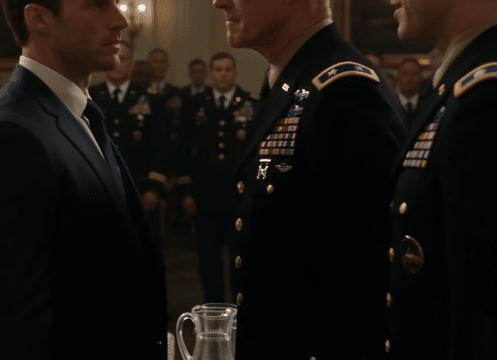
The Captain’s complaint cut through the noise of the military chapel fundraiser. Folding chairs scraped across the community hall floor, volunteers arranged food packages along the walls, and military families waited patiently near the donation tables. At the center of it all stood a silver-haired volunteer in a simple vest, one hand resting on a donation ledger and the other guarding a charity box.
The Major General turned toward him, his expression hardening.
“They come first,” the elderly man said.
For a moment, the General simply stared at him. He was accustomed to people stepping aside when he entered a room, accustomed to having his decisions accepted before anyone considered questioning them. In his mind, a volunteer who delayed a donor line was not protecting families. He was challenging authority.
The General snatched the ledger from the man’s hands and crumpled its pages.
“Do you know who you’re speaking to?”
The volunteer didn’t answer. His eyes moved toward a row of folding chairs where several military families were still trying to find seats. A young mother was holding a toddler against her shoulder while an older veteran helped his wife navigate the crowded aisle.
“They’re waiting,” the volunteer said quietly.
That was all it took.
The General struck him across the face.
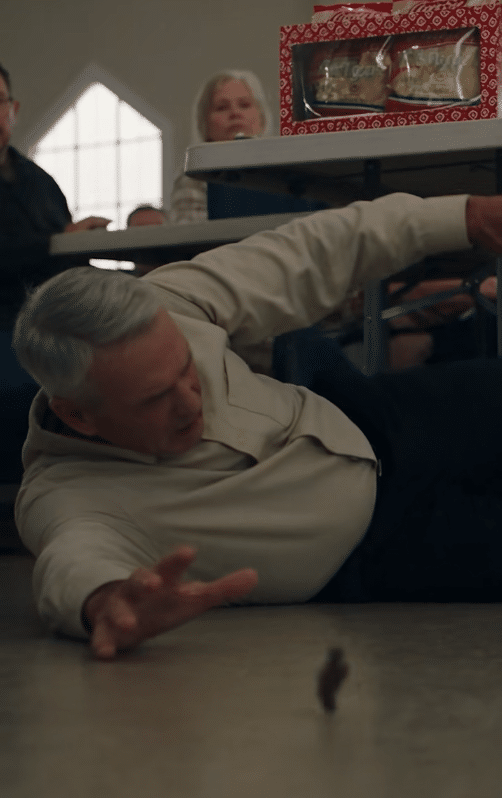
The sharp sound silenced the room. The elderly man staggered, one hand rising instinctively to his reddening cheek. Before he could regain his balance, the General drove a forceful kick into his torso, sending him down beside the charity table.
Someone gasped. A chair toppled. The donation box rocked dangerously close to the edge.
The volunteer reached for it before he reached for himself.
“Church volunteers don’t direct generals,” the officer said, standing over him.
His voice carried across the entire hall.
The Captain who had reported the dispute suddenly found something fascinating about the floor. Around him, veterans and military families remained frozen, their faces registering the kind of disbelief that comes when an act of cruelty happens somewhere people expect honor.
The General straightened his uniform.
He believed he had restored order.
He had no idea that, lying near the fallen ledger, an object had just slipped from the elderly man’s vest—and that one person in the room recognized it immediately.
Act II
The volunteer’s name was Thomas Bennett.
At seventy-four, Thomas had learned that people often mistook quietness for weakness. His silver hair, plain clothes, and unhurried movements made him look like someone who had spent his life far from command centers and military operations.
That was exactly what he preferred.
He had arrived at the chapel early that morning, long before the donors, bringing a handwritten list of families who needed assistance. Some had recently returned from overseas assignments. Others were dealing with medical bills, interrupted employment, or the financial strain of raising children while a spouse served far from home.
Thomas knew their names. He remembered which families needed groceries, which veterans had trouble climbing stairs, and which children always looked for the same cookies at the refreshment table.
To him, the fundraiser was not a ceremonial gathering where important people deserved the best seats.
It was a promise.
The families had endured enough uncertainty. They shouldn’t have to stand aside while a powerful officer and his entourage claimed the first place in a line intended to help everyone.
Thomas had spent decades learning the difference between authority and responsibility. Authority could make people obey. Responsibility required someone to consider what happened after the orders were given.
He had watched too many people confuse the two.
The Major General, meanwhile, had arrived with several donors and junior officers in tow. He was a man who measured a room by its hierarchy: who stood when he entered, who spoke first, who waited, and who dared to disagree.
The closed donor line had offended him because it suggested that, for once, his rank did not determine the order of events.
When Thomas refused to move the families aside, the General saw an opportunity to make an example of him.
He had not asked why the volunteer wanted the families seated first. He had not checked the fundraiser’s schedule or consulted the organizers. He had simply decided that the old man needed to be reminded of his place.
Now Thomas was pushing himself upright beside the table.
His breathing was strained. One cheek had begun to swell, and a faint trace of blood marked his lower lip. Yet his attention remained fixed on the charity box, which he carefully steadied before straightening his jacket.
He picked up the crumpled ledger.
Then he looked at the General.
There was no pleading in his eyes. No desperate attempt to explain himself. Just a level, almost sorrowful patience that seemed to irritate the officer more than an angry argument would have.
The General expected fear. Thomas offered none.
And as the old man shifted his vest back into place, a small object rolled across the floor.
It stopped beside the polished shoes of a retired military chaplain sitting near the front row.
The chaplain looked down.
His expression changed so suddenly that the man beside him turned to see what had happened.
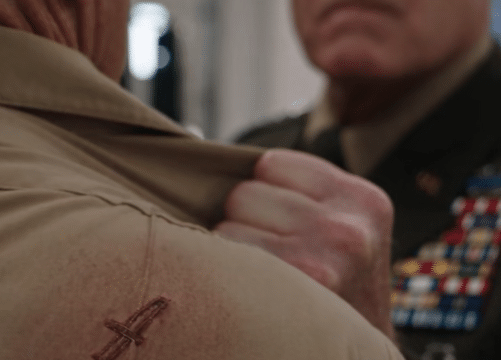
The object was a worn, cross-shaped coin.
And the retired colonel knew it was no ordinary souvenir.
Act III
The coin was small enough to disappear inside a closed fist. Its edges had been softened by years of handling, and its surface carried the dull shine of something kept for its meaning rather than its appearance.
It had no place among the polished medals and decorative awards displayed at military ceremonies.
It belonged to another kind of history.
The retired Chaplain-Colonel slowly rose from his chair.
For years, he had served alongside men whose names were rarely mentioned outside closed briefings and old unit reunions. Some had returned home with decorations. Others had returned with injuries that never appeared on official photographs. A few had never returned at all.
He had learned to recognize certain symbols without needing anyone to explain them.
The cross-shaped coin was one of those symbols.
His hand tightened around the back of the chair. He stared at Thomas, then at the General, and finally at the coin resting between them.
The General noticed the movement.
“What?” he demanded.
The retired chaplain stepped forward, his face drained of color.
“General… leave that coin alone.”
The room seemed to contract around those words.
The Major General looked down at the object and gave a short, dismissive laugh.
“It’s a souvenir.”
He said it loudly enough for the surrounding volunteers to hear. He wanted the room to understand that he remained in control, that an old man in a volunteer vest and a retired chaplain with memories from another era could not dictate his actions.
But the chaplain didn’t laugh with him.
He looked almost frightened.
That frightened the Captain more than the assault itself. The young officer had spent years watching senior commanders navigate disputes, reprimand subordinates, and manage public embarrassment. He knew the difference between anger and genuine alarm.
The retired colonel was not angry.
He was warning the General about something he believed the General did not understand.
Thomas bent carefully and retrieved the coin. His movements were slow, partly because of the pain in his torso, but he handled the object with remarkable gentleness. He rubbed a thumb over its worn cross before closing his fingers around it.
The General watched him.
“What is that supposed to prove?”
Thomas raised his eyes.
“He remembers the men who carried it.”
The answer was quiet.
It contained no rank, no unit designation, no list of accomplishments. Thomas did not explain where the coin had come from or why the retired chaplain looked as though he had just witnessed a ghost walk into the room.
He didn’t need to.
The chaplain’s reaction had already changed the atmosphere. The veterans near the back exchanged uncertain glances. One older man slowly stood, his gaze fixed on the coin. Another stopped halfway through lifting a chair.
The General looked from face to face, searching for someone who would reassure him that this was ridiculous.
Nobody did.
For the first time since arriving, he seemed unsure what to say.
But the most disturbing part wasn’t that the coin had been recognized.
It was that the man holding it had never tried to make anyone recognize him.
Act IV
The Major General recovered his voice first.
“You’re telling me I should be concerned because an old volunteer carries a coin?”
He directed the question toward the retired chaplain, but the challenge lacked its earlier force. His eyes kept returning to Thomas, whose face remained composed despite the swelling along his cheek.
The chaplain didn’t answer immediately.
He looked at the General’s insignia, then at Thomas’s vest, then at the cross-shaped coin. His expression suggested that he was weighing the consequences of saying too much in front of a room full of strangers.
Finally, he spoke.
“I’m telling you that you should be very careful about what you think you know.”
It was not an explanation. It was worse.
The General had spent his career relying on clear chains of command. Every problem had a superior officer, a regulation, or a formal process that could be invoked to establish who possessed the final authority.
This was different.
No one had shown him an official document. No one had announced a higher rank. There had been no dramatic entrance by a decorated commander or a staff officer carrying sealed orders.
There was only an old man, a battered coin, and a retired chaplain who appeared unwilling to let the General take another step toward either.
Thomas tucked the coin into his vest.
Then he turned toward the donation table.
The General stared at him, almost offended that the conversation seemed to be ending without his permission.
“I’m not finished with you.”
Thomas paused.
He didn’t turn around immediately. Instead, he checked that the charity box was secure, gathered the loose pages of the ledger, and placed them neatly beside the remaining donation forms.
Only then did he face the officer.
“You’ve made your point,” Thomas said. “Now let the families sit down.”
There was no threat in the sentence.
That made it harder to dismiss.
The General’s jaw tightened. He glanced at the chaplain again, perhaps expecting the retired colonel to explain the mystery and restore a familiar order to the room.
But the older man remained silent.
Thomas’s words had done something the General’s shouting could not undo. They had redirected everyone’s attention to the people who had been waiting before the confrontation began.
A mother quietly guided her child toward an empty chair. An elderly veteran helped his wife sit. One of the volunteers picked up the fallen ledger, while another moved the donation box away from the edge of the table.
The fundraiser was beginning to move again.
The General, who had used violence to force the room to revolve around him, was suddenly no longer its center.
Then the retired chaplain looked directly at him.
“Do you really want to make this worse?”
The General opened his mouth.
No answer came.
He looked at Thomas’s vest once more, as if the hidden coin might somehow reveal its entire history through the fabric. His confidence had depended on believing the old man was insignificant.
Now he was beginning to suspect that insignificance was exactly what Thomas had chosen to appear.
And the officer had made his decision before he understood the man standing in front of him.
That realization was only beginning to settle in.
Act V
The room grew quieter as the General searched his memory.
The cross-shaped coin. The retired chaplain’s expression. The way several veterans had reacted without exchanging a single word.
He had seen old military keepsakes before. He had dismissed stories about forgotten units and long-ago operations as sentimental attachments to a past that no longer affected the present.
But he had also attended briefings where senior officers lowered their voices when certain names appeared. He remembered fragments of conversations about men whose actions had altered the course of missions, people whose records were incomplete by design, and units whose members carried obligations that outlasted their service.
He had never connected those stories to a quiet elderly volunteer at a chapel fundraiser.
Now the connection seemed impossible to ignore.
Thomas adjusted his vest, wincing slightly as the movement pulled at his injured torso. The chaplain noticed and stepped closer, offering an arm without making a spectacle of it.
Thomas accepted the support only long enough to steady himself.
Then he returned his attention to the tables.
“Are the families seated?” he asked one of the volunteers.
The volunteer nodded.
“Most of them, sir.”
“Good. Open the line.”
The simple instruction sent people back into motion. Donors began approaching the tables. Volunteers distributed food packages and checked names against the ledger. Children who had been watching from behind their parents started talking again.
Nothing about the room looked like a battlefield.
Yet the General stood as if the ground beneath him had shifted.
He had struck an elderly man because he believed a uniform gave him the right to decide whose dignity mattered. He had treated a charity volunteer as an obstacle, humiliated him in front of families, and used violence to enforce a preference that had never deserved his rank in the first place.
And now he couldn’t even bring himself to ask the question that had begun forming in his mind.
Who had carried that coin?
The retired chaplain seemed to hear the question without needing it spoken. He glanced once at Thomas, then lowered his eyes in a gesture that carried more respect than any formal salute could have conveyed.
Thomas noticed.
He gave the older man a small nod, nothing more.
The General watched the exchange. He understood that he had missed something important, but he could not tell whether the coin represented a past sacrifice, an extraordinary act of service, or a debt that had never been publicly acknowledged.
The uncertainty was eating away at him.
He took a half step toward Thomas.
“Sir—”
Thomas didn’t turn.
He was helping a volunteer straighten the chairs near the entrance, making room for the last families still coming through the door.
The General stopped.
For once, no one rushed to rescue him from his own mistake. The Captain remained silent. The retired chaplain offered no explanation. The veterans continued watching, their expressions carrying a quiet judgment that no reprimand could have produced.
The General’s gaze dropped toward the volunteer’s vest.
The coin was hidden again.
But he could still picture its worn cross, and he could still hear Thomas’s words.
He remembers the men who carried it.
The officer’s face slowly lost its color.
“Those men…?”
The question escaped him in a tight, uncertain whisper.
Thomas did not answer.
He didn’t have to.
The General had wanted everyone in the room to understand his authority. Instead, he had given them a glimpse of his character—and discovered that the past he had dismissed might be the one thing he could not afford to misunderstand.
Across the hall, the families finally began receiving their packages.
And beside the donation table, an old man in a plain volunteer vest continued doing the work he had come to do.
He had never asked the room to honor him.
He had only asked it to put the families first.
For the first time that morning, the General understood that the difference between those two things could be the difference between wearing a uniform and deserving the respect it represented.