Act I
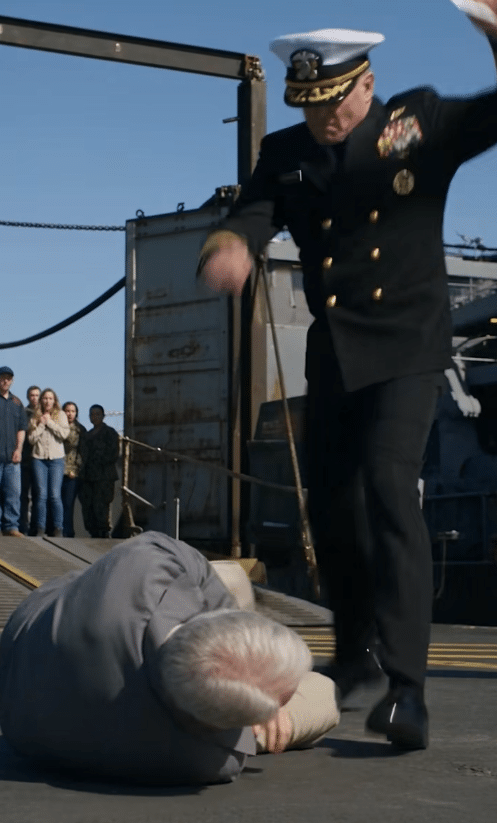
The Rear Admiral crumpled the elderly man’s boarding pass, punched him across the face, and kicked him twice while he lay on the dock. Dozens of sailors and military families watched as the old man struggled to rise, refusing to beg even when the officer standing over him sneered that people like him had no business boarding with flag officers.
Then a senior naval aide came running through the gate.
“Sir… forgive me. I was supposed to meet you at the gate.”
The aide wasn’t looking at the Rear Admiral.
He was looking at the injured old man.
And when he turned toward the officer in the immaculate naval uniform, his next question made the entire dock fall silent.
“Admiral, do you have any idea who this gentleman is?”
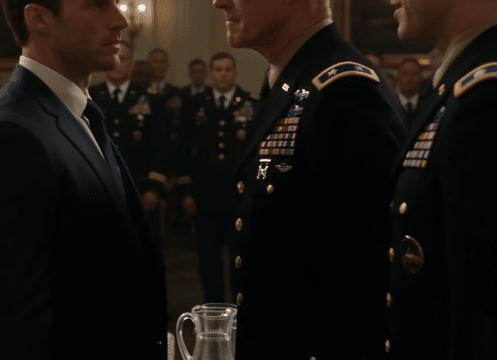
Three minutes earlier, the morning ferry terminal had been moving with its usual military precision. Sailors loaded supply crates beside the boarding ramp, officers checked passenger manifests, and families gathered behind the painted lines separating ordinary boarding from the priority lane reserved for flag officers and invited guests.
The elderly man stood quietly inside that lane.
He was seventy-six, dressed in a simple gray jacket, a light shirt, and dark trousers. His silver hair was neatly combed, his walking shoes were practical, and nothing about his appearance suggested wealth or influence.
He held an official boarding pass between two fingers.
Lieutenant Andrew Miller noticed him first.
The young officer checked the boarding list, glanced at the man, and frowned. Rather than verify the pass immediately, he approached Rear Admiral Nathaniel Whitmore, who was supervising boarding from beside the ramp.
“Admiral, he won’t leave the priority line.”
Whitmore turned.
At fifty-two, he had perfected the kind of commanding presence that made people move before he finished speaking. His uniform was immaculate, his insignia polished, and his expression carried the impatience of a man who considered delays an insult.
He looked the elderly passenger up and down.
“You need to move to the general boarding line.”
The old man glanced at his pass.
“My pass puts me here.”
Whitmore held out his hand.
“Let me see it.”
The man offered the pass, but Whitmore snatched it from his fingers and examined it with open contempt. Whatever he saw on the document did nothing to improve his mood.
“This lane is reserved for flag officers and authorized guests.”
“I understand.”
“Then why are you standing here?”
“Because my pass puts me here.”
The answer remained calm, almost courteous.
Whitmore heard something else entirely: a civilian refusing to be intimidated by a senior naval officer in front of his subordinates.
He crumpled the boarding pass in his fist.
“I’m not going to argue with you.”
The old man watched the paper wrinkle.
“Then check it.”
For an instant, Whitmore seemed unable to believe what he had heard.
The lieutenant looked away.
Several people in the queue stopped talking. A sailor carrying a supply crate slowed his steps, while a mother standing with her family drew her child closer.
Whitmore stepped forward.
The elderly man did not retreat.
And that was when the Rear Admiral decided that humiliation alone would not be enough.
He struck the man hard across the cheek.
The old man’s head snapped sideways, and he fell onto the dock. A restrained gasp passed through the crowd as his shoulder hit the concrete.
Before he could rise, Whitmore delivered two forceful kicks to his back and side.
Then the Rear Admiral threw the crumpled pass beside him.
“Old passengers don’t board with flag officers.”
Nobody moved.
The elderly man remained conscious, breathing through the pain. His cheek reddened, a faint trace of blood appeared at his lip, and his hands trembled slightly as he pushed himself upright.
He did not plead.
He did not curse.
He reached for his boarding pass.
And while Whitmore stood over him, certain he had restored his authority, the sound of hurried footsteps approached from the terminal entrance.
Someone had finally arrived to meet the old man.
Someone who recognized him immediately.
Act II
The elderly passenger sat back briefly on one knee, steadying himself against the dock.
His breathing was uneven, and every movement appeared to cost him something. Yet his eyes remained focused on the crumpled pass lying near his shoe.
He picked it up carefully.
With deliberate fingers, he began smoothing the paper against his thigh.
It was a small gesture, almost painfully ordinary. He treated the damaged document with more care than Whitmore had shown the man who carried it.
Lieutenant Miller watched in silence.
He had initially believed he was correcting a simple boarding irregularity. The old man’s plain clothing had seemed inconsistent with the privilege of the priority lane, and the lieutenant had trusted his first impression more than the document in front of him.
Now the consequences of that assumption lay on the concrete.
Miller glanced at Whitmore, hoping the Rear Admiral might recognize the seriousness of what had happened.
Instead, Whitmore adjusted his uniform.
“Get security over here,” he ordered.
“For what, sir?” Miller asked before he could stop himself.
Whitmore turned slowly.
“For allowing an unauthorized passenger to disrupt boarding.”
The lieutenant swallowed.
He wanted to point out that the man had produced an official pass. He wanted to ask why nobody had verified it before the assault. But the Rear Admiral’s expression warned him that any objection would be interpreted as disloyalty.
So he said nothing.
That silence seemed to satisfy Whitmore.
The Admiral had spent decades learning how to manage people through confidence and intimidation. He knew how to make a subordinate question his own judgment simply by raising an eyebrow.
He also knew how to turn an uncomfortable incident into a procedural problem.
If the old man was described as disruptive, the assault could be reframed as a response to disorder. If the boarding pass was treated as suspicious, Whitmore could claim he had been protecting the integrity of the priority lane.
It was a familiar pattern.
He had used it before whenever admitting a mistake threatened his standing.
But this time, too many people had seen what happened.
The elderly man slowly got to his feet. He winced as he straightened, then brushed dust from his jacket.
A nearby sailor finally approached, keeping a respectful distance.
“Sir, would you like me to call medical personnel?”
The old man nodded once.
“Please. After the pass is verified.”
Even now, he refused to let the incident become an excuse for chaos at the gate.
Whitmore scoffed.
“You’re still pretending you belong here?”
The old man looked at him.
“I don’t have to pretend.”
There was no anger in the answer. No attempt to provoke him.
Only certainty.
Whitmore stepped closer, but the sound of hurried footsteps interrupted him.
A naval staff officer appeared at the gate, moving quickly enough that the sailors nearby turned to look. He was in his late thirties, wearing the uniform of a senior aide assigned to Admiral Cole’s staff.
His eyes swept across the boarding lane.
Then he saw the elderly man.
He stopped abruptly.
For a fraction of a second, all the composure left his face.
He hurried forward, moving past Whitmore without acknowledging him. When he reached the old man, his expression was filled with alarm and unmistakable remorse.
“Sir… forgive me. I was supposed to meet you at the gate.”
The elderly passenger studied him briefly.
“You’re late.”
“Yes, sir. I am.”
The aide’s voice tightened as he noticed the swollen cheek and the man’s guarded posture.
He offered an arm, waiting for permission before helping him stand more comfortably.
Only after the assault had ended did the elderly man accept the assistance.
The aide then turned toward Whitmore.
His expression hardened.
“Admiral, do you have any idea who this gentleman is?”
For the first time that morning, Whitmore found himself without an immediate answer.
But instead of admitting uncertainty, he did what arrogant men often do when the truth threatens to expose them.
He dismissed it.
Act III
Whitmore gave the aide a contemptuous look.
“He’s nobody. Just an old passenger who thinks rules don’t apply to him.”
The words were loud enough for the people nearest the gate to hear.
The aide’s jaw tightened.
He looked at the crumpled boarding pass in the elderly man’s hand, then at the red swelling across his cheek. His gaze moved back to Whitmore, and the anger in his expression became difficult to conceal.
“Nobody?”
Whitmore folded his arms.
“You heard me.”
The aide took a slow breath.
He was accustomed to working around senior officers, managing schedules, coordinating sensitive meetings, and ensuring that the people responsible for major naval decisions reached the right places at the right times.
He understood rank.
He understood protocol.
And he understood that some of the most important people in the Navy did not need to display their importance in public.
The elderly man beside him was one of those people.
Yet the old man had not offered his name. He had not announced his connection to Admiral Cole or demanded that the aide explain it to the crowd.
He simply stood with one hand resting lightly against his injured side, waiting for someone to verify a boarding pass that should have been checked in the first place.
Whitmore mistook the silence for uncertainty.
“Take him to the general line,” he ordered. “And find out who authorized that pass.”
The aide stared at him.
“Sir, I would be very careful about what you say next.”
Whitmore’s expression sharpened.
“Are you threatening me?”
“No.”
“Then watch your tone.”
The aide did not look away.
“I am trying to give you a chance to understand the situation before you make it worse.”
A murmur passed through the surrounding crowd.
Whitmore had expected the aide to apologize for the delay and quietly escort the old man away. Instead, the younger officer seemed more concerned about protecting the passenger than preserving the Rear Admiral’s authority.
The old man finally spoke.
“You’ve been waiting three weeks for his signature.”
The sentence was quiet.
Whitmore blinked.
“What?”
The elderly man carefully flattened the boarding pass between his fingers.
“You’ve been waiting three weeks for his signature.”
This time, the aide said nothing.
He did not need to.
Whitmore looked at him, then at the old man. Something about the wording disturbed him. The signature was not a casual reference to paperwork. It was a direct reminder of a matter he had been desperate to resolve.
For three weeks, Whitmore had been waiting for approval connected to a major naval appointment and the command structure surrounding it. The document had passed through several channels, but one final signature remained outstanding.
He had been told that the matter depended on Admiral Cole.
The delay had frustrated him, threatened his plans, and left him increasingly anxious about the next stage of his career.
He had complained privately about the process. He had questioned the timing. He had even asked senior staff members whether anything could be done to accelerate the decision.
But he had never met the person whose signature was holding everything up.
Or so he believed.
Whitmore looked again at the elderly man.
Plain jacket.
Silver hair.
Walking shoes.
An official boarding pass he had never bothered to verify.
The old man met his gaze without offering an explanation.
The aide remained beside him, his posture formal and his expression severe.
A strange uneasiness began spreading through Whitmore’s chest.
“Why would you know anything about that?” he asked.
The elderly passenger smoothed another crease from the paper.
“Because signatures matter.”
Whitmore stared at him.
The answer sounded almost trivial, yet it struck directly at the weakness in his own behavior. He had treated an official document as worthless because he disliked the person holding it.
Now that same document was the least important piece of paper in the conversation.
The aide glanced toward the ferry’s boarding gate.
“We should get you somewhere medical staff can examine you,” he said to the old man.
“In a moment.”
The passenger’s gaze returned to Whitmore.
“You’ve spent three weeks waiting for one person’s approval,” he said. “But you couldn’t spend thirty seconds checking mine.”
Nobody in the queue spoke.
The lieutenant lowered his head.
Whitmore felt the eyes of the crowd turning toward him. He wanted to demand an explanation, to insist that the aide clarify the relationship between the old man and Admiral Cole.
But he could no longer bring himself to call the passenger nobody.
Not when the aide had arrived apologizing for being late.
Not when the signature had been mentioned with such quiet certainty.
And not when the old man had shown no interest in using his apparent importance to threaten anyone.
Then the aide made a small adjustment to his posture and addressed the elderly passenger with unmistakable respect.
“Sir, Admiral Cole is expecting you.”
Whitmore’s expression changed.
The name struck him like a sudden blow.
Admiral Cole was not merely another senior officer. He was the commander whose approval Whitmore had been waiting for, the man whose decision could determine whether his plans moved forward or collapsed.
And the aide standing beside the injured passenger belonged to Cole’s personal staff.
Whitmore looked from the aide to the old man.
For the first time, he began to understand that the man he had assaulted was connected to the very signature he had been desperate to obtain.
But he still had one terrible question to answer.
Why had Admiral Cole’s aide been sent to meet this elderly civilian personally?
Act IV
The ferry’s engines rumbled beneath the dock.
Boarding had slowed to a crawl, with sailors waiting beside the ramp and families watching the confrontation unfold. Nobody wanted to be the first person to break the silence.
Whitmore attempted to straighten the situation with a command.
“Lieutenant, verify his credentials.”
Miller moved immediately toward the boarding station.
“Yes, sir.”
But the aide stopped him.
“The pass has already been issued through the proper channel.”
The lieutenant froze.
Whitmore turned sharply.
“Then why wasn’t that established before he entered the priority lane?”
The aide’s expression hardened.
“That is exactly the question you should be asking yourself.”
The words were measured, but they carried an accusation Whitmore could not dismiss.
The Rear Admiral looked at the old man again. The injured passenger had not moved toward the ferry. He stood beside the aide, carefully holding the boarding pass he had spent the morning trying to protect.
He seemed less interested in the privilege of the priority lane than in the principle behind it.
An authorized pass should have been enough.
A person’s appearance should not have determined whether that authorization was respected.
And a uniform should never have given anyone permission to assault a civilian.
Whitmore understood all of this in the abstract. He had sat through briefings about professional conduct and attended ceremonies celebrating the Navy’s commitment to service.
But abstract principles were easy to admire when they did not inconvenience him.
This morning, the old man’s presence had challenged his control of the boarding line. Whitmore had responded as though his authority mattered more than the facts.
Now the facts were catching up.
The aide glanced at the passenger’s cheek.
“Sir, I apologize. We should have been here to meet you.”
The old man shook his head slightly.
“You were delayed. That isn’t the problem.”
He looked toward Whitmore.
“The problem is what happened while I waited.”
The aide’s expression tightened.
“Yes, sir.”
Whitmore felt a chill pass through him.
The elderly man still had not said his name. He had not explained his connection to Cole. Yet every sentence made it clearer that the situation was far more serious than a dispute over boarding privileges.
Whitmore tried one last time to regain control.
“I was enforcing access rules.”
“No,” the aide replied. “You were given a chance to verify a pass. You chose not to.”
“That man refused to move.”
“Because he was authorized to stand there.”
Whitmore opened his mouth.
Nothing came out.
The aide turned slightly toward the boarding station.
“Please make sure the incident is documented accurately. The pass should be preserved, and the witnesses should be identified.”
Miller nodded, his face pale.
Whitmore stared at the lieutenant.
“You’re taking instructions from him now?”
The aide met his eyes.
“I am making sure the facts are recorded.”
The distinction was devastating.
Nobody had stripped Whitmore of his rank. Nobody had ordered the sailors to turn against him. The aide was simply insisting that the assault be treated as an actual event rather than an inconvenience to be explained away.
The old man watched quietly.
He could have demanded immediate consequences. He could have revealed his identity and watched Whitmore scramble to apologize.
Instead, he waited.
The aide seemed to understand why.
The elderly passenger did not want his importance to become the only reason people cared about what had happened. He wanted the truth documented because it was the truth.
Whitmore looked at the boarding pass again.
He remembered the three weeks he had spent waiting for the signature. He remembered how carefully he had chosen his words in messages to Cole’s office, how often he had checked for updates, and how urgently he had wanted the approval to arrive.
Now he realized that the person he had attacked might be the one individual who could explain why the signature had taken so long.
The old man adjusted his jacket, wincing slightly as the fabric brushed his injured side.
The aide immediately offered support.
This time, Whitmore did not interrupt.
He watched as the elderly passenger placed the boarding pass in a safe pocket, then looked toward the ferry ramp.
“Is the vessel ready?” the man asked.
“Yes, sir,” the aide answered.
“Then let’s not hold everyone up.”
The simple concern for other passengers unsettled Whitmore more than an angry speech would have.
The old man had been humiliated in public, injured in front of dozens of witnesses, and treated as though his presence were an inconvenience.
Yet he was still thinking about everyone else waiting to board.
The aide guided him toward the ramp, staying close enough to assist if necessary.
Before they left the gate, the elderly man turned once toward Whitmore.
His expression was neither triumphant nor vindictive.
It was tired.
“Three weeks is a long time to wait for a signature,” he said.
Whitmore swallowed.
“Yes, sir.”
The old man held his gaze.
“Long enough to learn patience.”
Then he turned away.
Whitmore stood motionless as the aide accompanied the passenger toward the ferry.
The lieutenant began collecting witness details. A sailor returned to the boarding line, and the staff at the gate resumed their duties with a new seriousness.
But Whitmore remained beside the crumpled impression of the morning’s mistake, unable to escape the words he had just heard.
He had spent three weeks trying to gain the attention of Admiral Cole.
And he had assaulted someone who might have known Cole longer than Whitmore had even worn a uniform.
The final piece was still missing.
Then the aide glanced back from the foot of the ramp and spoke to the elderly man in a tone that left no doubt about the importance of their meeting.
“Admiral Cole has been looking forward to seeing you, sir.”
Whitmore’s face went pale.
He finally understood why the aide had apologized at the gate.
And why the old man had mentioned the signature.
Act V
The elderly passenger paused at the foot of the boarding ramp.
The morning sunlight reflected off the water, and the ferry’s engines vibrated through the steel beneath his shoes. He looked out across the dock for a moment before turning toward the aide.
“Has the document been prepared?”
“Yes, sir. Everything is ready for Admiral Cole’s review.”
The passenger nodded.
“Good.”
Whitmore stood several yards away, listening despite himself.
The document.
The signature.
Three weeks.
Each detail connected to the next, forming a picture he could no longer ignore.
His pending appointment had been tied to an approval that required Admiral Cole’s attention. Whitmore had been assured that the matter was moving through the appropriate channels, but the final decision remained unresolved.
He had assumed the delay was administrative.
He had never considered that the person whose signature mattered might have a personal connection to the commander whose name appeared on every relevant document.
The aide turned back toward Whitmore.
“Admiral, I strongly recommend that you remain available for questions about this incident.”
Whitmore nodded mechanically.
“Yes.”
The answer sounded strangely small coming from a man who had spent the morning issuing commands.
The elderly passenger looked at him one last time.
“You should have checked the pass.”
Whitmore lowered his eyes.
“Yes, sir.”
“And you should never have put your hands on me.”
The words were quiet, but there was no ambiguity in them.
Whitmore had no defense.
He could blame his temper, the pressure of the schedule, the lieutenant’s report, or the apparent mismatch between the old man’s clothes and the priority lane. None of those explanations changed what he had done.
The passenger had presented an official pass.
Whitmore had chosen contempt over verification.
Then he had used violence to punish someone for refusing to surrender a right he actually possessed.
The old man did not wait for an apology.
He turned toward the ferry and began walking, supported lightly by the aide. His movements were slower than before, and the pain remained visible in the careful way he carried himself.
Yet he continued without complaint.
The aide stayed beside him, speaking quietly about the meeting awaiting them aboard the vessel.
Whitmore watched them approach the entrance.
Then he heard the aide say something that made the final connection unmistakable.
“Your grandson will be relieved when he sees you, sir. He’s been asking whether you’ve arrived.”
The elderly man gave a faint, tired smile.
“He worries too much.”
The aide smiled in return.
“Admiral Cole has always worried about you.”
Whitmore stopped breathing for a moment.
Grandson.
The word explained everything the old man had refused to explain himself.
Admiral Cole was not merely expecting a distinguished guest. The elderly passenger was his grandfather, the family member whose signature and presence had become intertwined with the decision Whitmore had been waiting three weeks to receive.
The aide had not arrived to escort an ordinary civilian.
He had arrived to meet the Admiral’s family.
And Whitmore had struck that man in public because he had mistaken plain clothing for insignificance.
The Rear Admiral stared at the boarding ramp, his face drained of color.
His pending approval suddenly seemed impossibly distant. He could no longer imagine walking into a meeting with Admiral Cole and discussing his future as though nothing had happened.
He had wanted the signature so desperately that he had forgotten the most basic rule of leadership: the people standing in front of you were never just obstacles to your ambition.
Some carried responsibilities he could not see.
Some had earned trust he could not measure.
And some deserved dignity simply because they were human beings.
The elderly passenger disappeared through the ferry entrance.
The aide followed.
Whitmore remained on the dock as the lieutenant approached with a request for his statement. Around them, boarding resumed, but the atmosphere had changed. Sailors no longer looked at the Rear Admiral with uncomplicated deference.
They had seen the pass.
They had witnessed the assault.
And they had heard the aide apologize to the old man before challenging the officer who had attacked him.
Whitmore looked toward the ferry one final time.
His lips parted, and the name escaped him in a breathless whisper.
“Admiral Cole…?”
The words contained no authority.
Only fear.
Because the signature he had waited three weeks to obtain was no longer the only thing at stake.
Now Admiral Cole would have to decide what to do about the officer who had beaten his grandfather at a boarding gate—and called him nobody.
And for the first time that morning, Rear Admiral Whitmore understood that a uniform could open almost any door in the Navy.
But it could not protect a man from the consequences of what he had done once he stepped through it.