Act I
The tire shop was too small for a fight.
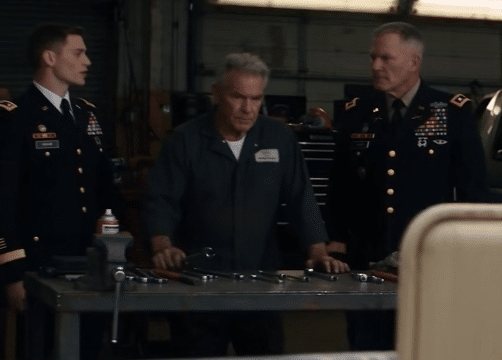
Two pickups occupied most of the cramped service bay. Stacks of tires crowded the walls, an air compressor rattled in the corner, and a military SUV sat outside with one flat tire.
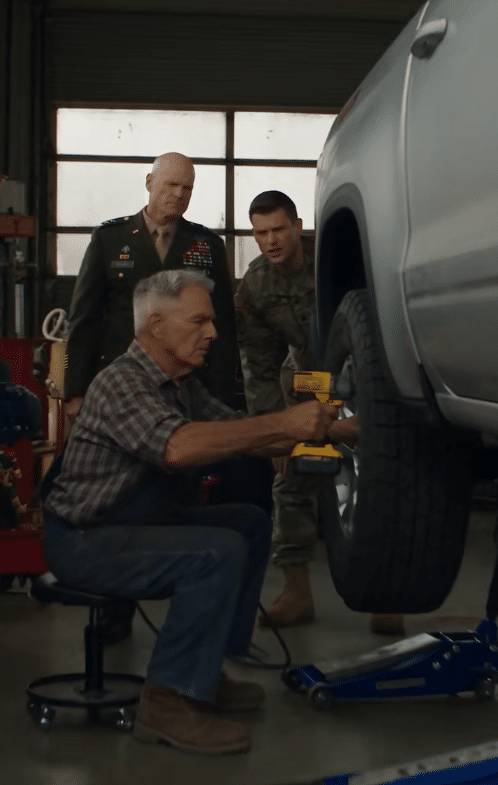
The elderly owner was still working beneath the wheel well of another truck.
Then a Brigadier General walked in.
His uniform was immaculate.
His patience was not.
The General’s Major aide had already tried to solve the problem.
He returned from the service bay with an apologetic expression.
“Sir, he says finishing that truck comes first.”
The old mechanic didn’t even look up.
“I finish the job I started.”
The General stared at him.
The mechanic was seventy-three, silver-haired, wearing a flannel shirt beneath a stained work apron. His sleeves were rolled to the elbows, his boots were worn, and there wasn’t a single thing about him that suggested he cared about military rank.
The General stepped closer.
“My vehicle is outside.”
The mechanic tightened a lug.
“I heard you.”
“You know who I am?”
“I know you have a flat tire.”
The Major looked away.
The General’s jaw tightened.
For a man accustomed to officers moving when he spoke, the old mechanic’s calmness felt like an insult.
“You’re going to make me wait?”
The mechanic finally looked at him.
“Until I’m finished.”
That was the moment the General decided the conversation was over.
He stepped into the bay and kicked the floor jack aside.
Metal scraped violently across the concrete.
The mechanic turned.
“Don’t touch my equipment.”
The General grabbed his attention with one hard gesture.
Then his fist struck the old man’s cheek.
The impact sent him sideways into the stacked tires.
Rubber shifted beneath his shoulder.
He dropped to one knee.
The shop froze.
The pickup owner stopped breathing.
The other soldier near the entrance went completely still.
The General looked down at the mechanic as though he had just demonstrated a lesson.
“Tire men don’t keep generals waiting.”
The old man didn’t answer.
He drew one controlled breath.
Then he stood.
He straightened his apron.
And instead of looking at the General, he turned back toward the unfinished wheel.
The movement pulled his flannel collar loose.
Something silver slipped into view against his chest.
An old dog tag.
The older Colonel traveling with the General saw it.
His face drained of color.
He stopped breathing for a beat.
Then he whispered the one question that made the General turn.
“General… what exactly is on that tag?”
But the Colonel wasn’t looking at the General.
He was looking at the symbol on the metal.
And whatever he recognized, he desperately wished he hadn’t.
Act II
The old tire shop had been there for years.
Long before the General’s current command.
Long before the military vehicles began using the road outside.
It was the kind of place people passed without noticing.
A hand-painted sign.
A faded service counter.
Stacks of tires with different shades of black from years of dust and weather.
The owner liked it that way.
He had no interest in impressing anyone.
He fixed tires.
He replaced brakes.
He repaired what could be repaired.
And he finished what he started.
That last principle was the one that had caused the trouble.
The military SUV outside was important to the General.
But the pickup already inside was important to the person who had arrived first.
To the mechanic, that was enough.
The Major had interpreted the refusal differently.
“He’s holding up a General.”
The old man had never responded to the title.
He had responded to the work.
Now, after the punch, he was doing exactly the same thing.
His cheek hurt.
His breathing was slightly shallow.
But his hands were steady.
He checked the wheel hub.
Then reached for the impact wrench.
The General watched him.
“You’ve got nerve.”
The mechanic didn’t look back.
“I’ve got a customer.”
The Major shifted uneasily.
The General’s anger hadn’t produced the submission he expected.
Instead, it had produced something worse.
Indifference.
The old man wasn’t trying to prove he was brave.
He simply refused to let another man’s rank determine how he did his job.
Across the shop, the older Colonel remained motionless.
His eyes stayed on the dog tag.
The metal was old.
Worn.
Almost dull.
There was a small symbol etched into it, partly damaged by years of use.
It wasn’t the sort of insignia someone wore for decoration.
The Colonel knew that.
He had spent enough years in uniform to recognize the difference between something that was meant to be displayed and something that was meant to be carried.
The General noticed his silence.
“What?”
The Colonel didn’t answer.
The Major looked at him.
“Sir?”
Still nothing.
The mechanic reached beneath his flannel and closed his fingers around the tag.
He didn’t hide it.
He didn’t explain it.
He simply held it for a moment, then let it fall back against his chest.
The Colonel swallowed.
The General scoffed.
“Probably some antique.”
The Colonel’s eyes lifted.
He looked at the General.
Then at the old mechanic.
Something about the situation had changed.
And nobody had announced why.
Act III
Military history was full of things that never made it into official photographs.
There were operations that became reports.
Names that became memorials.
Commands that disappeared into classified files.
And symbols that meant everything to the people who had once served beneath them, while meaning nothing to everyone else.
The dog tag belonged to that world.
The Colonel knew it.
But he couldn’t understand why it was around the neck of a seventy-three-year-old tire mechanic.
He had seen similar symbols decades earlier.
Not often.
Never casually.
The memory was incomplete, but the feeling wasn’t.
Respect.
Fear.
Obedience.
The kind of reaction that didn’t come from a piece of metal.
It came from the person who had been allowed to carry it.
The Colonel stared at the old man’s hands.
They were rough from years of mechanical work.
There was grease beneath the fingernails.
A faded burn mark crossed one knuckle.
Nothing about him looked ceremonial.
Nothing about him looked like a senior commander.
And yet the Colonel couldn’t shake the feeling that he had seen those hands somewhere before.
Not in a tire shop.
Somewhere else.
Years earlier.
The General grew impatient with the silence.
“What exactly are you staring at?”
The Colonel finally spoke.
“That tag.”
The General glanced down.
“Probably some antique.”
The Colonel didn’t smile.
The mechanic did.
Not because the General’s joke was funny.
Because he understood exactly what the Colonel was struggling to remember.
The General looked between them.
“What?”
The mechanic wiped his hands on his apron.
“Ask him why he stopped breathing.”
The words were quiet.
Almost casual.
But they landed harder than the punch had.
The Colonel’s face tightened.
He had stopped breathing because recognition had arrived before certainty.
He knew the symbol.
He knew what kind of person might have carried it.
But the memory was buried beneath years of promotions, transfers, retirement ceremonies, and changing commands.
He didn’t dare say the thought aloud.
The General saw only hesitation.
To him, the Colonel was behaving strangely over an old piece of metal.
He couldn’t understand it.
And because he couldn’t understand it, he became more irritated.
“You’re telling me a dog tag scares you?”
The Colonel didn’t answer.
His eyes remained fixed on the mechanic.
The old man returned to the wheel.
That was somehow the most unsettling part.
He didn’t demand respect.
He didn’t reveal anything.
He didn’t even seem interested in the General’s growing confusion.
He simply continued working.
As though the truth had never needed an announcement.
The Colonel’s silence became heavier.
Then the General finally noticed the one thing he had ignored from the beginning.
The old mechanic wasn’t behaving like someone who had been humiliated.
He was behaving like someone who had survived humiliation before.
And knew it would eventually pass.
Act IV
The Major moved closer to the General.
“Sir, we should probably—”
The General cut him off with a glance.
“No.”
The word was sharp.
The General wasn’t leaving.
Not now.
He wanted an explanation.
“Who are you?”
The mechanic tightened another lug.
“Someone finishing a job.”
“That’s not what I asked.”
“I know.”
The Colonel’s expression tightened again.
He understood the answer.
The old man was giving the General exactly as much information as he deserved.
No more.
The General looked toward the dog tag.
“What’s the symbol?”
The mechanic didn’t respond.
The Colonel did.
“Don’t.”
The General turned.
“Don’t what?”
“Ask him again.”
The General stared.
The Colonel had served long enough to understand military hierarchy.
But there was something in his voice that wasn’t ordinary caution.
It sounded like fear.
Not fear of the old mechanic attacking him.
Fear of what might happen if the General forced the truth into the open.
The General looked at the mechanic.
The old man remained perfectly calm.
The tire shop seemed smaller now.
The compressor clicked off.
The air became strangely quiet.
The General’s uniform suddenly looked almost absurd against the grease-stained walls.
His ribbons represented authority.
The dog tag represented something nobody was naming.
The Colonel looked at it again.
His memory sharpened.
A command.
An old operation.
A man whose presence had once changed the behavior of entire rooms.
The Colonel had been younger then.
He remembered standing at attention.
He remembered receiving an order.
He remembered never questioning it.
But he could not yet connect that memory to the old man in the apron.
Or perhaps he could.
And simply didn’t want to.
The mechanic finally straightened.
He wiped his hands.
Then looked directly at the Colonel.
The Colonel instinctively straightened his own posture.
The General saw it.
His expression changed.
Why would a retired Colonel unconsciously straighten when a tire mechanic looked at him?
The mechanic didn’t say anything.
He didn’t need to.
The Colonel’s reaction had already said too much.
The General looked at the dog tag again.
The worn symbol suddenly seemed less like an antique.
More like a door.
And the Colonel was standing on the other side of it.
Act V
The military SUV remained outside.
Its flat tire had not been touched.
The pickup inside the bay was almost finished.
The mechanic checked the wheel one last time.
Then lowered his tools.
He had never asked the General to apologize.
Never demanded that anyone acknowledge what had happened.
Never used the hidden tag to frighten him.
The General had done all of that himself.
The old man straightened his apron.
His cheek was still faintly red.
The pain was still there.
But his posture remained completely controlled.
The Colonel watched him.
There was something almost reverent in the older man’s silence now.
Not because the mechanic had threatened anyone.
Because the Colonel remembered enough to know that certain kinds of authority didn’t disappear simply because the uniform did.
The Major stood quietly beside the General.
He had stopped making comments.
The General looked at him.
Then at the Colonel.
Then at the dog tag.
“What’s so special about it?”
No answer.
The Colonel’s eyes remained on the silver metal.
The mechanic slipped the tag beneath his flannel.
The symbol vanished.
But the effect remained.
The General had entered the shop believing rank entitled him to immediate service.
He had struck an elderly man because that man refused to abandon another customer.
Now he stood surrounded by people who suddenly seemed to know something about his victim that he didn’t.
The old mechanic returned to the wheel.
The Colonel didn’t move.
The General’s expression hardened as he tried to reconstruct the mystery.
An old symbol.
A reaction from a veteran officer.
A dog tag carried in secret.
And a mechanic who seemed completely uninterested in explaining any of it.
The General looked once more at the place where the silver tag had disappeared.
His confidence faltered.
Then his voice dropped.
“That tag…?”