Act I
The room went silent before anyone understood why.
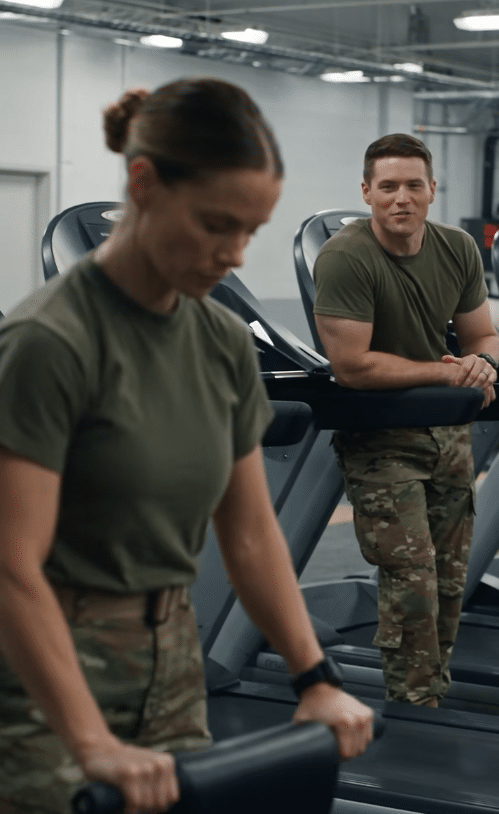
The officers’ gym was supposed to be one of the few places on base where rank could be set aside for an hour. Treadmills hummed beneath bright ceiling lights, weights rested against metal racks, and a recovery bench sat beside a stack of neatly folded towels.
But that morning, one soldier’s presence was enough to turn the room hostile.
The thirty-six-year-old woman stood beside an injured soldier on a workout mat, guiding him through a controlled recovery exercise. Her brown hair was tied high, her black training shirt damp at the shoulders, and every movement was deliberate.
She wasn’t there to compete.
She was there because the room had been booked for recovery training.
A junior officer beside the treadmill glanced at her and smirked.
“She shouldn’t be in the officers’ gym.”
The Lieutenant Colonel looked up.
He was forty-eight, physically imposing, and accustomed to being the loudest person in any room. Several junior officers immediately straightened when his attention shifted toward the woman.
She didn’t.
She simply adjusted the injured soldier’s position and answered.
“This room is booked for recovery training.”
The words were calm.
That made them worse.
The Colonel’s jaw tightened.
He had heard a correction.
The room had heard a fact.
And the difference was about to become painfully clear.
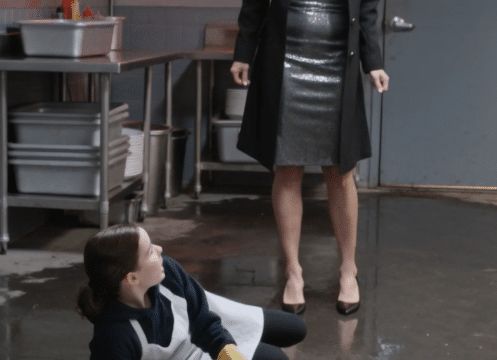
He grabbed a wet workout towel from the bench and hurled it at her.
It struck her across the face and shoulder.
Before she could fully pull it away, he stepped forward and drove a kick into her abdomen.
She was thrown backward into the recovery bench.
The bench scraped sharply across the floor as she fell to one knee.
A tiny scrape marked her knee.
Pain tightened her face.
But when she looked up, there was no fear in her eyes.
The Colonel stood over her.
“Recovery is where weak soldiers hide.”
Nobody moved.
Then her sleeve shifted as she braced herself against the bench.
And the old scar beneath it became visible.
Act II
The recovery trainer saw it first.
He was fifty-eight and had spent enough years around military injuries to recognize scars that carried stories people didn’t talk about.
His eyes fixed on the back of her arm.
A long, old scar ran beneath the sleeve.
Near her elbow was a small symbol, partially concealed by the fabric.
The trainer went completely still.
The junior officer’s smirk disappeared.
The woman slowly rose.
Her abdomen hurt with every breath, but she straightened anyway. She picked up the wet towel from the floor and placed it back on the bench as though restoring order mattered more than the humiliation she had just endured.
The trainer took one careful step forward.
“Colonel… look at her arm.”
The Colonel barely glanced over.
“I don’t care about scars.”
The trainer said nothing.
That silence carried more weight than an explanation could have.
The junior officer looked between them.
Only moments earlier, he had been the one mocking her for entering the room. Now he seemed suddenly uncomfortable standing anywhere near the Colonel.
The woman noticed.
She said nothing.
Instead, she helped the injured soldier sit safely on the recovery bench.
That was what made the Colonel angrier.
She wasn’t performing defiance.
She wasn’t trying to embarrass him.
She was simply continuing the work he had tried to stop.
“Did you hear me?” he demanded.
She finally looked at him.
“I heard you.”
“Then act like it.”
She held his gaze.
“You’ve interrupted a recovery session because you didn’t like being corrected.”
His expression hardened.
“You don’t tell me what happens in my gym.”
She glanced around.
“This isn’t your gym.”
The words landed softly.
Several people looked away.
The Colonel’s face darkened.
He had expected fear.
Instead, he had found someone who seemed more concerned with keeping an injured soldier on his feet than protecting herself from his temper.
The recovery trainer watched the scar again.
He knew that symbol.
Not its entire history.
Not everything it represented.
But enough to understand why it should never have been dismissed.
He looked at the Colonel.
Then at the woman.
Then back at the Colonel.
Something from years ago was standing in this gym.
And the man who needed to recognize it was the last person willing to look.
Act III
The Colonel turned away from the trainer.
“Everyone back to work.”
The treadmills remained silent.
Nobody moved.
His authority had always depended on immediate obedience. A command spoken loudly enough usually ended every discussion.
This time, the room seemed to be waiting for something else.
The woman stood beside the recovery bench, one hand resting lightly against its edge.
Her sleeve had fallen back into place.
But the scar remained partly visible.
The Colonel noticed.
His eyes narrowed.
There was something familiar about it.
Not the scar itself.
The pattern.
The small symbol near the elbow.
A memory stirred at the edge of his mind, but he pushed it away.
He had spent years building a career around forgetting certain moments.
Moments when other people had made difficult decisions.
Moments when someone had stepped forward when others hesitated.
Moments when survival had depended on a person whose name was rarely spoken afterward.
The trainer broke the silence.
“Colonel…”
The Colonel snapped around.
“What?”
The trainer stopped.
He looked frightened now.
Not of the Colonel.
Of what the Colonel might remember.
The woman saw that hesitation.
She didn’t rescue him.
She didn’t explain the scar.
Instead, she rolled her sleeve down halfway, covering the symbol again.
The Colonel watched the movement.
“What’s so important about her arm?”
No answer.
His voice rose.
“I asked a question.”
The woman finally spoke.
“You don’t need the answer yet.”
The Colonel stared at her.
For the first time, his anger was mixed with uncertainty.
The junior officer shifted backward.
The recovery trainer lowered his eyes.
And suddenly the Colonel understood that the room wasn’t afraid of him anymore.
They were waiting for him to remember something.
Something he had once needed.
Something that had left a permanent mark.
He looked at the woman again.
Her expression hadn’t changed.
Pain was still visible around her eyes, but her posture remained steady.
She wasn’t asking him for mercy.
She was waiting for him to understand.
Then she said the sentence that broke the last piece of his confidence.
“You cared when you needed someone with one.”
The gym went completely still.
The Colonel stared at her arm.
And somewhere behind his eyes, the past finally began to open.
Act IV
He remembered the sound first.
Not a voice.
Not a name.
A warning alarm.
Years earlier, during a training operation that had gone badly, there had been a moment when everyone had been moving in different directions. Orders had conflicted. Visibility had collapsed. The kind of confusion that could turn a routine exercise into something much more serious.
He remembered being trapped.
He remembered needing someone to come back.
And he remembered a soldier stepping forward when others had already started pulling away.
The memory was incomplete.
That was what made it terrifying.
The Colonel stared at the scar.
His breathing slowed.
Then stopped for half a second.
The small symbol near the woman’s elbow suddenly looked different.
Not like a tattoo.
Not like decoration.
Like a mark from another chapter of his life.
The recovery trainer saw the recognition begin.
He didn’t say a word.
The junior officer looked toward the mirror.
The reflection showed something none of them had expected to see.
The Colonel was backing away.
Only one step.
But it was enough.
The woman noticed.
She remained perfectly still.
“You remember something,” she said.
The Colonel’s eyes stayed fixed on the scar.
“I don’t…”
He stopped.
The denial sounded weak even to him.
She didn’t press him.
That was somehow worse.
She didn’t need to.
The symbol had already done the work.
He had built his authority on the belief that the past belonged behind him. That old mistakes disappeared beneath promotions, new assignments, polished uniforms, and enough time.
But scars didn’t care about rank.
They remained.
The Colonel’s gaze dropped.
He remembered the person who had been there.
The person whose help he had once needed.
The person whose absence had been quietly explained away.
The person he had never expected to see standing in front of him again.
The gym seemed smaller now.
The mirrors reflected every face.
The junior officer no longer looked amused.
The recovery trainer looked almost relieved.
And the woman stood in the center of the room with the same controlled expression she had worn before the assault.
She had never needed to threaten him.
She had only needed him to remember.
The Colonel’s arrogance was gone.
What remained was the realization that the person he had just humiliated might be connected to the one moment in his career he had spent years refusing to face.
And then he understood why the trainer had gone pale.
Act V
Nobody spoke.
The injured soldier sat quietly on the recovery bench.
The woman checked his posture one more time, making sure he was steady before turning back toward the Colonel.
Her abdomen still hurt.
Her knee still carried the faint trace from the floor.
But none of that seemed important anymore.
The Colonel stood beneath the bright gym lights, surrounded by mirrors that gave him nowhere to hide.
He looked at the scar.
Then at the symbol.
His mind raced through fragments of an old operation, an old emergency, an old decision.
He remembered needing help.
He remembered someone refusing to leave.
And he remembered the mark.
Not clearly enough to explain it.
Not yet.
But clearly enough to understand that he had made a terrible mistake by treating it as meaningless.
The recovery trainer remained silent.
So did everyone else.
The woman didn’t explain the history.
She didn’t have to.
Whatever happened years ago had already begun speaking for itself.
The Colonel’s eyes lifted toward her.
For the first time, he wasn’t looking at a subordinate who had challenged his authority.
He was looking at someone connected to a part of his past that rank could never erase.
His mouth opened.
His voice came out almost as a whisper.
“Needed…?”
The word hung in the gym.
No one answered.
The mirrors reflected his face from every angle.
And for the first time that morning, the man who had demanded everyone else be afraid was the only person in the room who looked afraid.