Act I
The supply checkpoint was already running late when the driver laughed.
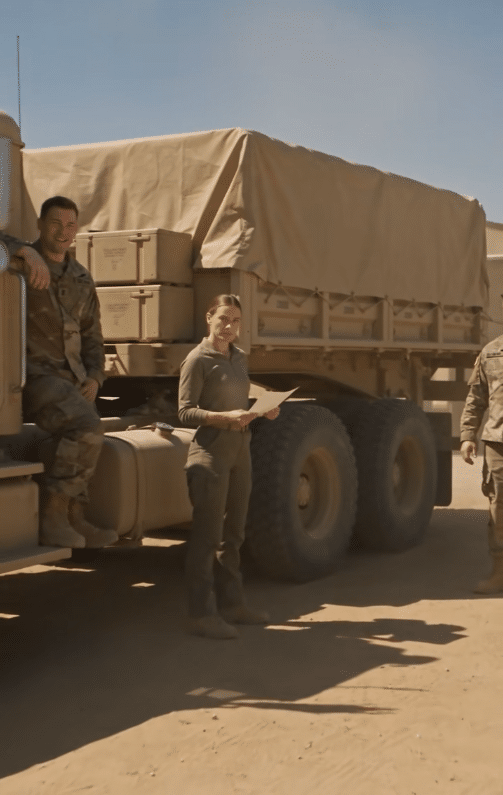
Dust rolled beneath the tires of the military trucks, turning the morning sunlight into a pale haze. Soldiers moved between sealed crates with clipboards in hand, checking numbers, signatures, and tamper seals while engines rumbled impatiently in the background.
The logistics Major stood beside the lead truck, broad-shouldered and perfectly comfortable in the chaos.
He was the man everyone waited for.
The man who could wave a convoy through with one gesture—or hold it for hours with another.
Then the truck driver glanced toward the woman holding the inspection report and smirked.
“She’s acting like a crate queen.”
A few soldiers looked down.
Nobody laughed.
The woman didn’t even turn toward him.
At thirty-seven, the military inspector had learned that people who relied on rank often expected everyone else to react emotionally. She had also learned that silence could be more powerful than an argument.
She looked at the crate seal again.
Then she looked at the Major.
“This seal was already broken before arrival.”
That was all.
No accusation.
No raised voice.
Just a fact.
But the Major’s expression changed immediately.
The delay wasn’t what angered him.
It was the fact that she had corrected him in front of his own people.
His eyes narrowed.
He reached for the report.
She didn’t release it.
For one suspended second, the checkpoint went quiet except for the distant growl of another truck.
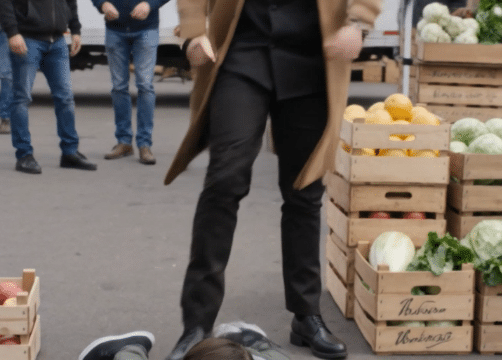
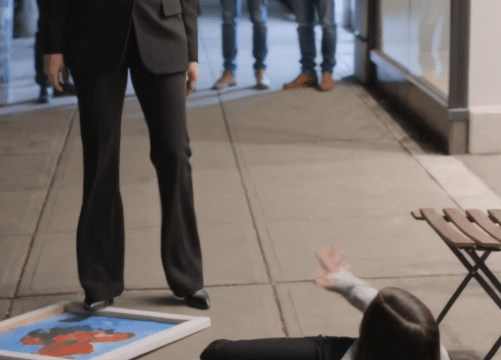
Then the Major ripped the seal report from her hand and threw it into the dust beside the truck wheel.
The gray paper landed face down.
The broken seal rolled several inches away.
She bent to retrieve both.
That should have ended the confrontation.
Instead, the Major stepped backward.
He took one hard step forward.
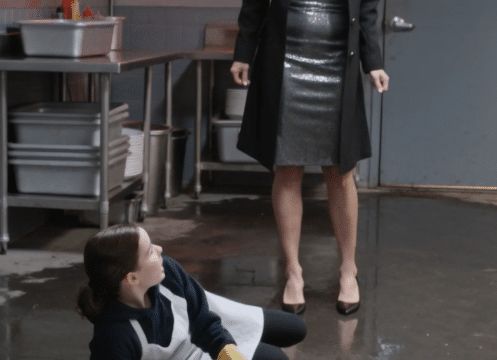
And kicked her directly in the abdomen.
She was thrown into the edge of the crate.
Her shoulder struck first. Then she went down near the wheel, one palm scraping lightly against the dusty ground.
Several soldiers flinched.
She didn’t cry out.
She didn’t plead.
Her breathing tightened for a moment, but her hand closed around the broken seal.
The Major looked down at her.
“Paper rats don’t stop my supply line.”
And for a moment, everyone believed the scene was over.
They were wrong.
Because the gray paper beside the wheel had just opened.
And someone standing near the crates had seen what was printed on it.
Act II
The young inventory soldier was the first person to notice.
He had been watching the confrontation from only a few yards away, inventory tablet pressed against his chest. At first, he had looked just as frightened as everyone else.
Then his eyes dropped to the ground.
The gray seal document had unfolded when it hit the dirt.
A small mark appeared near the bottom corner.
It wasn’t large.
It wasn’t dramatic.
There was no bold warning stamped across the page.
Just a symbol unlike anything the soldier had seen on ordinary logistics paperwork.
His face changed.
The truck driver noticed.
The mocking smile disappeared from his mouth.
The inspector slowly pushed herself upright.
Pain moved through her abdomen with every breath, but she refused to let it control her posture. She brushed the dust from her palm and kept the broken seal in one hand.
Then she picked up the gray paper.
The young soldier stared at it.
“Major… that paper.”
The Major turned toward him.
For the first time since the confrontation began, his expression showed something other than contempt.
Irritation.
He hated uncertainty.
He hated being interrupted.
Most of all, he hated seeing one of his own soldiers look frightened by something he didn’t understand.
“It’s paper. I move trucks.”
The young soldier said nothing.
His eyes remained fixed on the document.
The Major stepped closer to the inspector.
“Do you understand what you’ve done?” he demanded.
She said nothing.
“You’ve delayed an entire supply line over a broken seal.”
She finally looked at him.
“No.”
Her voice was quiet.
“I delayed it because the seal was broken before the truck arrived.”
The distinction mattered.
The Major simply didn’t want it to.
Behind them, the trucks continued idling.
Engines vibrated through the checkpoint.
Dust blew across boots and tires.
But the soldiers weren’t watching the convoy anymore.
They were watching the gray paper.
The inspector held it without trying to hide the strange mark.
The young inventory soldier swallowed hard.
He knew enough to recognize that this wasn’t ordinary paperwork.
He also knew enough not to explain it.
Not here.
Not in front of the Major.
And certainly not before the woman holding it decided what happened next.
The Major reached toward the document.
She moved it just out of reach.
His jaw tightened.
“You’ve got five seconds to hand that over.”
She stared directly at him.
The young soldier took one involuntary step backward.
Because he had suddenly realized something the Major hadn’t.
The paper wasn’t evidence of a problem with the truck.
It was evidence of something much bigger.
And if the Major discovered what it meant too late, his entire supply operation might already be standing on borrowed time.
Act III
The checkpoint changed without anyone giving an order.
The soldiers stopped moving.
The driver stopped leaning against the truck.
Even the men farther down the line began glancing toward the gray document.
The inspector stood in the middle of them all, one hand holding the broken seal, the other gripping the paper that had somehow transformed the atmosphere.
The Major looked around.
He saw fear.
That irritated him more than anything.
“What’s wrong with all of you?”
Nobody answered.
The young inventory soldier kept his eyes down.
The Major pointed toward him.
“You. Tell me what’s on that paper.”
The soldier hesitated.
His lips parted.
Then closed.
That hesitation was enough.
The Major’s face hardened.
“You work in my supply yard. You answer when I ask a question.”
The inspector spoke before the soldier could.
“Don’t.”
The Major looked at her.
She wasn’t afraid.
That was becoming impossible to ignore.
Her shoulder was beginning to stiffen from the impact against the crate. Her breathing remained careful, controlled. Yet she stood there as though the pain belonged to someone else.
“You’ve made your point,” she said.
“No,” the Major replied. “I haven’t.”
He stepped closer.
“You think a piece of paperwork makes you untouchable?”
She looked at the gray page.
Then back at him.
“I never said that.”
“Then stop acting like it.”
The driver shifted uneasily beside the cab.
Only minutes earlier, he had called her a crate queen.
Now he wouldn’t meet her eyes.
The inspector lowered the document slightly.
A corner of the unusual mark remained visible.
The young soldier saw it again.
His face drained of color.
The Major noticed.
“What?”
Silence.
“What are you seeing?”
Still nothing.
The inspector finally turned toward the young soldier.
Their eyes met.
It lasted only a second.
But something passed between them.
Recognition.
Caution.
And a silent agreement that whatever the paper meant, neither of them would explain it for him.
The Major’s voice dropped.
“I said, what are you seeing?”
The inspector looked back at him.
Then she gave him the answer he least expected.
“And that paper stops them all.”
Nobody moved.
The sentence seemed to hang over the checkpoint longer than the sound of the idling engines.
The Major blinked.
His eyes dropped to the paper.
For the first time, he actually looked at it.
Not as paperwork.
Not as an inconvenience.
As authority.
Something in the small gray mark had finally connected with a memory he had spent years avoiding.
His breathing changed.
His shoulders stiffened.
The arrogance that had filled his posture moments earlier began to disappear.
Because there were documents that recorded shipments.
There were documents that delayed shipments.
And then there were documents that could make an entire chain of command stop moving.
He suddenly wasn’t sure which kind he was looking at.
Act IV
The Major didn’t touch the paper.
That alone told everyone enough.
A man who had just kicked an inspector into a truck wheel was now standing perfectly still, staring at a document he had dismissed as worthless seconds earlier.
The supply line waited behind him.
Truck after truck.
Crate after crate.
Every driver expecting the order to move.
But no order came.
The young inventory soldier remained frozen beside the crates.
The truck driver had stopped smiling altogether.
The inspector slowly straightened her jacket.
She was still hurting.
She didn’t hide it.
But she didn’t give the pain any power over her either.
The Major looked at the gray document again.
There were no dramatic seals covering the page.
No obvious threat.
Just that small, unfamiliar mark.
Something from an older system.
Something connected to an authority that existed above the schedule he had spent the morning defending.
He suddenly remembered an old rule.
A rule that wasn’t discussed in routine logistics briefings.
A rule associated with certain documents that were never supposed to be ignored once they appeared.
His eyes returned to the woman.
“Where did you get this?”
She didn’t answer.
The Major’s voice became sharper.
“Who gave you that?”
Still nothing.
The silence was unbearable.
Because the power structure had changed without anyone announcing it.
A few minutes earlier, he had controlled every movement at the checkpoint.
Now nobody was moving because he couldn’t decide whether he was still allowed to.
The inspector looked toward the trucks.
Then toward the broken seal in her hand.
She had been right from the beginning.
The seal had already been broken.
That fact had been enough to stop the shipment.
But the gray document suggested that someone had known the shipment might need to be stopped before it ever arrived.
The Major’s eyes narrowed.
He understood only part of it.
That was worse than understanding nothing.
The woman stepped forward.
Not aggressively.
Not triumphantly.
Just one measured step.
The Major instinctively stepped back.
Several soldiers noticed.
Nobody commented.
The driver looked toward the ground.
The young inventory soldier lowered his tablet.
The checkpoint had become silent enough to hear the wind moving dust across the pavement.
The inspector held the gray paper between them.
She didn’t explain its origin.
She didn’t need to.
The Major had finally realized that the paper didn’t need his permission.
It carried its own.
And whatever was written behind that tiny mark was powerful enough to bring every truck in his command to a halt.
But there was one question he couldn’t stop himself from asking.
How had she come to possess it?
Act V
The Major stared at the document.
His face no longer carried the certainty of a man who controlled the supply line.
It carried something far more dangerous to him.
Recognition.
The woman remained motionless.
The broken seal rested in her hand.
Dust moved around her boots.
Behind her, the soldiers stood rigidly silent.
Nobody stepped forward.
Nobody needed to.
The evidence was already there.
The gray paper.
The unusual mark.
The broken seal.
And the fact that a young inventory soldier had recognized something the Major had initially refused even to look at.
The Major’s eyes moved slowly across the document.
Whatever memory had surfaced was now impossible for him to dismiss.
He had spent the morning believing that rank could settle the argument.
That a supply schedule mattered more than procedure.
That the woman standing in front of him was merely another inspector slowing down his operation.
He had treated the paper as trash.
He had treated her as an obstacle.
Now he understood that the paper might be the very thing capable of stopping every truck under his command.
The inspector said nothing.
Her silence was stronger than another accusation would have been.
The Major looked at her.
Then at the document.
His lips parted.
For the first time, his voice was no longer powerful.
It was uncertain.
Almost afraid.
“Stops them…?”
The checkpoint went silent.
And the trucks remained exactly where they were.