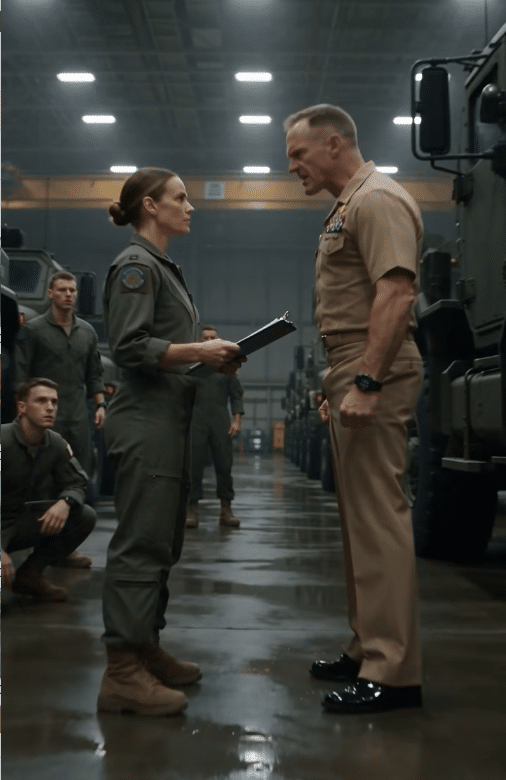
Act I
The convoy was supposed to leave in seven minutes.
Inside the armored vehicle bay, technicians moved between enormous trucks beneath harsh white lights. The air smelled of oil and hot metal, boots echoed across stained concrete, and inspection boards were being checked one final time before the vehicles rolled out.
One armored truck sat ready near the bay doors.
Its giant tires were clean.
Its engine was running.
But one woman refused to sign it off.
She was thirty-five, a technical officer with brown hair tied back, an olive coverall, and black boots. An inspection board rested firmly in her hands as she studied the front assembly.
A subordinate standing near the vehicle looked toward the Captain and shook his head.
“She’s holding the convoy because of one scratch.”
The Captain turned.
Forty-four, sharp-uniformed, impatient, and obsessed with the schedule, he had already spent too much of the morning dealing with delays.
He walked toward her.
The woman didn’t step aside.
She simply lifted the inspection board slightly.
“It’s not a scratch. The brake line is leaking.”
The words were simple.
Technical.
Impossible to misunderstand.
The Captain looked at the vehicle, then at her.
His face hardened.
Around them, several technicians suddenly found reasons to stare at their tools instead of the confrontation.
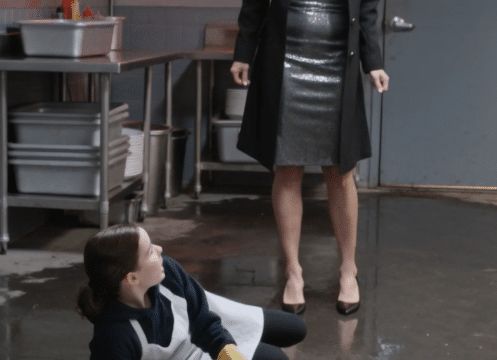
The Captain reached out and kicked the inspection board from her hands.
Pages scattered across the oil-stained floor.
She immediately bent down, gathered them, and found the brake-line report.
She stood.
The Captain stepped back.
Then he drove his boot into her abdomen.
The impact sent her backward into the armored vehicle’s enormous tire.
She hit it hard and dropped onto the concrete, one elbow scraping against the floor.
But her hand never released the inspection board.
For a moment, she stayed still.
Then she pushed herself upright.
The Captain stood over her.
“Garage girls don’t stop convoys.”
The woman looked at the leaking brake line.
Then at the Captain.
She said nothing.
A page slid loose from the inspection board.
It flipped open.
And on the last page, beneath the technical findings, a small red seal suddenly caught the light.
One young technician saw it.
His face changed immediately.
And the Captain had no idea why.
Act II
The young technician had been smirking only moments earlier.
Now his expression had completely disappeared.
His eyes were fixed on the inspection board.
More precisely, they were fixed on the final page.
A small red seal sat beside a partially covered signature.
It wasn’t large.
It wasn’t dramatic.
But the technician knew it.
He had seen that mark before.
The woman was still recovering from the impact, one hand pressed briefly against her abdomen. Pain showed in her face, but she refused to let it control her posture.
She stood again.
Straight.
Steady.
Still holding the report.
The Captain interpreted her silence as defeat.
That was his mistake.
He had spent years learning how to intimidate people into changing their decisions. He understood rank, schedules, orders, and consequences.
What he didn’t understand was someone who would accept his anger without surrendering a professional judgment.
The convoy mattered.
The vehicles mattered.
The people who would ride inside them mattered.
And she had found a mechanical fault that could not be dismissed simply because the clock was running.
The young technician finally spoke.
“Captain… maybe read the last page.”
The Captain turned toward him.
There was something unusual in the young man’s voice.
Not defiance.
Fear.
The Captain’s expression became colder.
“I don’t read excuses from mechanics.”
The young technician fell silent.
The instigator near the vehicle no longer looked amused either.
The Captain glanced down at the papers scattered around his boots.
He saw maintenance notes.
Inspection numbers.
The brake-line notation.
Then his eyes moved toward the woman.
She was already standing fully upright.
Her elbow had a small scrape.
Her cheek was flushed from exertion.
But her gaze remained clear.
The Captain had wanted to prove that rank could move the convoy forward.
Instead, he had created a room where everyone was suddenly wondering who had authorized the report he had just dismissed.
And the answer was sitting on the last page.
Act III
The woman turned the final page toward him.
Not dramatically.
Not like a threat.
She simply made sure he could see it.
The red seal remained partly obscured beneath the edge of another sheet.
The Captain frowned.
The young technician looked at the seal again.
The woman finally spoke.
“Then you won’t know who signed it.”
Silence.
The Captain stared at her.
Something in the sentence unsettled him.
He reached for the page.
She didn’t pull it away.
He looked at the red seal.
Then at the signature beneath it.
Only part of the name was visible.
But apparently, part was enough.
The Captain’s expression changed.
The arrogance didn’t disappear immediately.
It cracked.
A small fracture first.
Then another.
He leaned closer.
The woman watched him without saying another word.
The technician who had warned him remained frozen near the tire.
He knew what the Captain was beginning to understand.
The inspection wasn’t merely a junior mechanic’s complaint.
The final page carried a formal seal.
And someone with authority had already attached a name to the finding.
Someone whose signature mattered.
Someone whose approval could not simply be brushed aside because a convoy was behind schedule.
The Captain looked toward the armored vehicle.
The leaking brake line suddenly seemed much more serious.
Not because the mechanical problem had changed.
Because he had finally realized that somebody important had already noticed it.
His gaze returned to the woman.
For the first time, he looked at her differently.
Not as a mechanic.
Not as someone slowing him down.
But as someone who had walked into the bay already knowing that the paperwork behind her was stronger than his temper.
She had never needed to challenge his rank.
She had simply refused to falsify reality for it.
The Captain swallowed.
The young technician lowered his eyes.
Nobody spoke.
And the tiny red seal on that final page suddenly felt heavier than every medal on the Captain’s uniform.
Act IV
The Captain picked up the inspection board.
His hands were noticeably slower now.
He turned the final page.
There it was.
The red seal.
The partial signature.
He studied it again.
Then again.
The woman remained beside the vehicle.
She didn’t rush him.
She didn’t celebrate.
She didn’t demand that anyone apologize.
That restraint made the moment even more uncomfortable.
The Captain had wanted a quick victory.
He had wanted the convoy moving.
He had wanted everyone to remember that he was the officer in charge.
Instead, he was standing in an armored bay surrounded by people who had watched him attack the one person who had correctly identified a dangerous fault.
And now he was discovering that her inspection had already passed through another level of authority.
The instigator shifted uncomfortably.
A few technicians stepped back.
Nobody wanted to be associated with the mockery anymore.
The Captain noticed.
He also noticed the woman wasn’t looking at any of them.
She was looking at the brake line.
Still.
Even after everything.
That was when something inside him finally broke.
She hadn’t been trying to embarrass him.
She hadn’t been trying to delay his convoy.
She had been trying to keep the convoy from moving with a known mechanical fault.
The report had recorded it.
The seal had authenticated it.
And the signature had given it weight.
The Captain stared at the partially hidden name.
His breathing changed.
His eyes narrowed as he tried to read what remained visible.
Then his face lost some of its color.
The power in the room had shifted without a single order being given.
The woman stood there with a scraped elbow and a battered inspection board.
The Captain stood with the report in his hands.
But now he was the one afraid of what the paperwork might say.
And the question wasn’t whether the brake line was leaking anymore.
It was whose authority had already agreed with her.
Act V
The armored bay became almost unnaturally quiet.
The engines still rumbled.
The fluorescent lights still buzzed overhead.
Somewhere outside, another vehicle waited for the convoy to move.
But nobody moved.
The Captain stared at the final page.
The red seal seemed almost insignificant at first glance.
Now he couldn’t look away from it.
The young technician remained silent.
The old inspection notes lay across the concrete.
The woman stood beside the armored vehicle, her posture controlled despite the pain in her abdomen.
She had no reason to explain herself.
The evidence was already there.
The Captain looked once at the leaking brake line.
Then back at the signature.
His mind was moving rapidly now.
He remembered names.
Old inspections.
Orders.
Signatures.
People who could authorize a convoy stop.
People who could demand an investigation.
People who could make one careless decision become a permanent mark on an officer’s career.
His fingers tightened around the edge of the inspection board.
The woman watched him.
Still calm.
Still silent.
Still refusing to give him the answer he suddenly needed.
The Captain looked at the red seal one final time.
His expression had changed completely.
The impatient officer who had been furious about losing seven minutes was gone.
In his place was a man staring at a piece of paper as though it had just become a warning from someone he could not afford to ignore.
His lips parted.
The question came out quietly.
“Who signed…?”