Act I
The drone was already moving when she told them to stop.
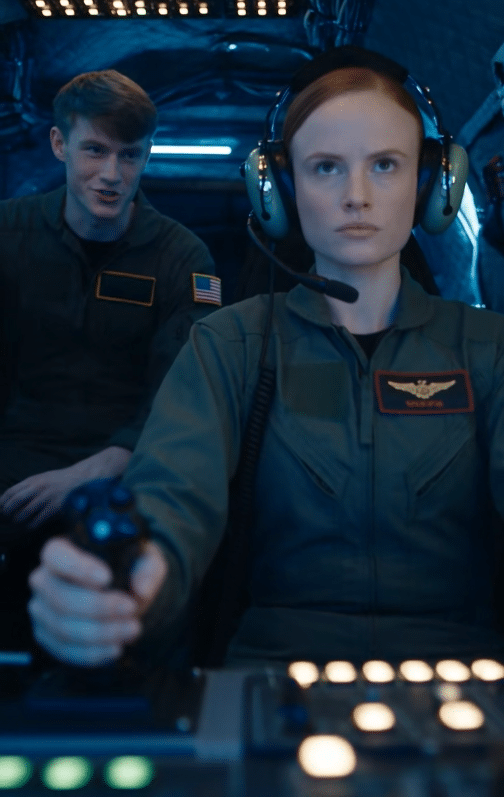
Inside the narrow control trailer, cold blue light spilled across the operators’ faces. Monitors showed a night-flight feed, a restricted-zone map, and a thin white line representing the drone’s planned route.
The trailer was cramped enough that every movement felt amplified. Headsets hung from hooks, cables ran beneath the consoles, and the low electrical hum of the equipment mixed with the distant sound of generators outside.
At the primary station, the 33-year-old operator kept one hand near the controls.
Her brown hair was tied low. An olive field jacket covered most of her uniform, and her headset rested around her neck. She wasn’t shouting. She wasn’t arguing.
She was watching the map.
The junior operator glanced toward the Major and smirked.
“She’s just stalling the launch again.”
The Major turned toward her.
He was forty-six, immaculate in his field uniform, the kind of officer who seemed to carry his rank into every room before he entered it. The launch schedule mattered to him. The mission mattered to him.
But more than either of those things, his authority mattered.
The woman didn’t even look at him when she answered.
“The flight path crosses a restricted civilian zone.”
For half a second, nobody moved.
The warning on the monitor was clear. The restricted area wasn’t theoretical. It was marked directly across the projected flight path.
The Major’s jaw tightened.
To him, her refusal wasn’t a safety correction.
It was defiance.
His hand struck hers away from the controls.
The joystick shook violently. Her headset slipped from her neck and hit the trailer floor.
Then he stepped forward.
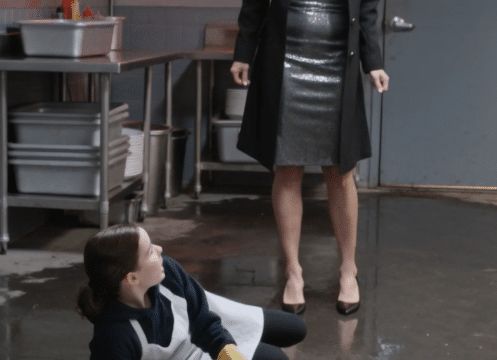
The kick came fast and deliberate, driving into her abdomen and sending her backward into the console chair. She lost her balance and collapsed sideways onto the narrow floor.
A few startled breaths escaped around the trailer.
She was clearly in pain.
But she didn’t plead.
Instead, her eyes immediately went back to the monitor.
The restricted zone was still there.
The Major stood over her.
“Button pushers don’t decide missions.”
She pushed herself up against the console, one hand briefly pressing against her abdomen.
Her sleeve had ridden upward.
And something on the inside of her wrist caught the blue light.
It was only a small mark.
But one person in that trailer recognized it.
And suddenly, the Major’s victory didn’t look like a victory anymore.
Act II
The junior operator had been smiling only seconds earlier.
Now he wasn’t.
His eyes had locked onto the woman’s wrist.
The small pilot code tattoo was normally hidden beneath her sleeve, invisible unless her arm was exposed at exactly the wrong moment.
She noticed his expression.
She didn’t cover it.
The Major hadn’t noticed anything yet. He was still standing beside the console, breathing hard, convinced the room had just witnessed another demonstration of rank.
The junior operator swallowed.
“Major… wait. Her wrist.”
The words changed the atmosphere immediately.
Nobody understood what they meant.
But everyone understood that he did.
The young operator’s face had lost its color. His shoulders stiffened, and the sarcasm that had defined him moments earlier disappeared completely.
The Major turned slowly.
His expression hardened.
“I don’t take warnings from trainees.”
The junior operator said nothing.
He didn’t need to.
His eyes remained fixed on the tattoo.
The woman rose carefully.
Every movement showed that the impact had hurt her, but there was nothing helpless in the way she moved. She steadied herself against the console and looked once more at the restricted-zone map.
The launch was still active.
The drone was still approaching the prohibited area.
That was what mattered to her.
Not the Major’s anger.
Not the eyes watching her.
Not even the pain.
She had been focused on that route before the Major ever touched her, and she was still focused on it now.
The Major saw the room staring at her and mistook the silence for fear.
He had always understood silence that way.
In his experience, people became quiet when they knew who had power.
What he didn’t understand was that this silence was different.
People weren’t afraid of her.
They were afraid of what she might mean.
The junior operator had seen the code.
He knew enough to recognize it.
But whatever it meant, he wasn’t saying.
And that left one question hanging over the trailer.
Why would a seemingly ordinary drone operator carry a pilot code that could make a trainee look terrified?
Act III
The woman straightened.
Her sleeve remained pushed back.
The small code was visible beneath the harsh blue monitor light.
The Major finally looked at it.
At first, he seemed almost amused.
Then his expression changed slightly.
The woman looked directly at him.
There was no anger in her voice.
That made it worse.
“Then take one from the person who flew that route first.”
The trailer went completely still.
The Major stared at her.
The junior operator lowered his eyes.
Someone near the rear console shifted backward, as if instinctively creating more distance from the confrontation.
The Major’s gaze returned to the tattoo.
A pilot code.
Not a decorative mark.
Not something a trainee would casually recognize.
A designation.
A record of identity.
A piece of history carried on skin because paper could disappear, names could be changed, and records could be buried.
The Major’s confidence began to fracture.
He looked toward the flight display.
Then toward the restricted zone.
Then back at her wrist.
The route had suddenly become something different.
It was no longer just a line on a screen.
Someone had flown it before.
Someone who knew exactly what happened when that line crossed the restricted civilian zone.
Someone who had enough authority, experience, or history with that route to understand why she had refused the launch without hesitation.
And she wasn’t explaining any of it.
She didn’t have to.
The code was doing the talking.
The Major’s breathing slowed.
His eyes narrowed as memory began connecting details he had dismissed as irrelevant.
The woman remained beside the console, one hand resting lightly against its edge.
She looked exhausted.
She looked hurt.
But she did not look afraid.
That was the first thing that truly unsettled him.
The second was the realization that she hadn’t been stalling anything.
She had been trying to prevent him from making the exact mistake someone had already made before.
And suddenly, the Major wanted to know who that person had been.
Act IV
The power inside the trailer shifted without anyone announcing it.
The Major was still the highest-ranking officer in the room.
Technically, nothing had changed.
But authority wasn’t always measured by insignia.
Sometimes it was measured by who knew something everyone else didn’t.
The junior operator knew enough to recognize the code.
The woman knew exactly why it mattered.
And the Major was the only person standing there who didn’t understand.
His eyes stayed fixed on her wrist.
She could have explained.
She didn’t.
Instead, she turned toward the monitor.
The restricted civilian zone remained directly ahead of the drone’s projected route.
The woman reached toward the control board.
The Major instinctively moved as though he might stop her again.
Then he hesitated.
That tiny pause was noticed by everyone.
The junior operator noticed it.
The other personnel noticed it.
Most importantly, the Major noticed it himself.
He had spent years making people obey because they were afraid to challenge him.
Now he was the one hesitating.
The woman’s face remained calm.
She wasn’t trying to embarrass him.
She didn’t need to.
The facts were doing that already.
She had identified the danger before anyone else.
She had refused the launch.
She had been assaulted for refusing.
And yet the person who had attacked her was now staring at the evidence that she understood the mission better than he did.
The Major’s arrogance began giving way to something colder.
Recognition.
His eyes moved once more from the code to her face.
There was something familiar about the designation.
Something buried.
Something he should have remembered.
The woman said nothing.
The junior operator said nothing.
The monitors continued their silent countdown.
And the drone kept flying toward the line she had warned them about.
For the first time that night, the Major wasn’t worried about whether the launch would happen on schedule.
He was worried about what would happen if he discovered who had flown that route before.
Act V
Nobody spoke.
The trailer seemed smaller than it had a minute earlier.
Blue monitor light washed across the Major’s face, revealing the moment his certainty finally disappeared.
The junior operator stood rigid near his console.
The other personnel remained silent.
The woman stood beside the controls, one hand steady against the console, her sleeve still pushed back.
The little code remained visible.
She didn’t hide it.
She didn’t explain it.
She didn’t have to.
The Major looked at the restricted-zone map again.
Then at her wrist.
Then back at her face.
The realization came slowly.
Not as a dramatic shout.
Not as an accusation.
As a memory.
Something he had seen.
Something he had forgotten.
Something he suddenly wished he hadn’t forgotten.
His mouth opened slightly.
All the contempt was gone.
All the certainty.
All the easy confidence of a man who believed rank could settle every argument.
Only fear remained in his eyes.
The camera moved closer.
Closer.
Until the woman’s face disappeared from view.
Until the junior operator disappeared.
Until the screens and controls disappeared.
There was only the Major.
His eyes stayed locked on something outside the frame.
His voice dropped to almost a whisper.
“You flew it…?”