Act I
The chair was empty.
That was all the little girl wanted. A place at the table with everyone else.
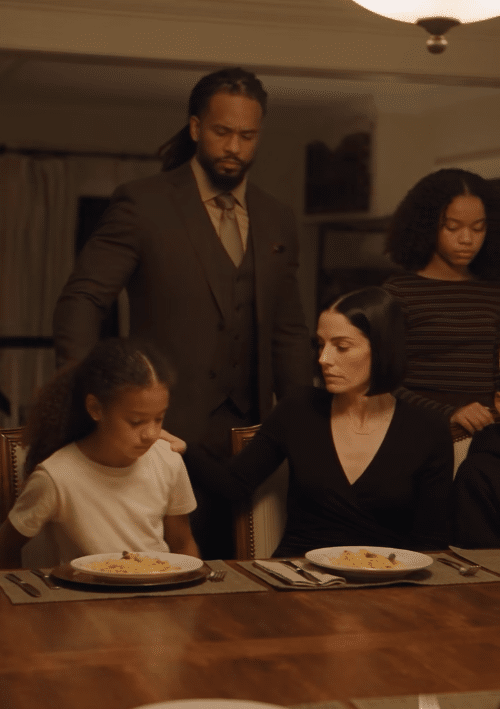
The dining room glowed beneath a warm chandelier, silverware resting neatly beside polished plates. Her brother and older sister were already eating, their conversation quiet and ordinary.
She walked toward the empty chair.
Then her stepmother stopped her.
“Not there. Eat in the kitchen.”
The girl froze.
She looked at the table, then at the woman standing between her and the chair.
“Why? We always eat together.”
The answer came without hesitation.
“This table is for my family tonight.”
The words were soft.
That almost made them worse.
The girl lowered her eyes and remained standing near the dining room, holding herself as still as she could.
Her older sister stopped eating.
Her brother glanced up.
Nobody said anything.
Then the front door opened.
And the man who had been away on another business trip walked into the room carrying a leather briefcase.
He had no idea what he had just walked into.
But the moment he saw his daughter standing alone, he knew something was wrong.
Act II
The father set his briefcase down slowly.
His eyes moved from the children at the table to his youngest daughter standing several feet away.
“Why isn’t she sitting with everyone?”
His wife turned toward him.
“She wanted to eat in the kitchen.”
For a second, the room became completely still.
The father didn’t argue.
He simply looked at his daughter.
“Is that true?”
She shook her head.
“No, Dad.”
Two words.
But they changed the atmosphere immediately.
The father pulled out the empty chair beside him.
“Then sit with me.”
The girl walked over quietly and sat down.
Only then did he notice her plate.
It was noticeably smaller than everyone else’s.
He stared at it.
Then at the other plates.
Then back at hers.
“Why is this all she has?”
His wife answered quickly.
“She said she wasn’t hungry.”
The girl looked down at her food.
She seemed to hesitate, as if she already knew that telling the truth might make everything worse.
But then she looked at her father.
“That’s what she gives me when you’re away.”
The father went still.
“She’s lying.”
The sentence wasn’t shouted.
It didn’t need to be.
His wife’s expression changed almost imperceptibly.
The older girl saw it.
She had been waiting for this moment.
Because unlike her father, she had not been away on those business trips.
She had been home.
She had seen the smaller plates.
She had seen her little sister sent away from the table.
And she had noticed something else.
Every time their father left town, the rules inside the house seemed to change.
The youngest girl was treated differently.
Her food changed.
Her place at the table changed.
Even the way she was spoken to changed.
At first, the older sister had thought it was temporary.
Then she started noticing a pattern.
And eventually, she decided that simply remembering wasn’t enough.
She needed proof.
She needed something her father couldn’t explain away.
She needed something that couldn’t be dismissed as a child’s misunderstanding.
She had been saving that proof quietly.
Until tonight.
And now, she finally stood up.
Act III
The older girl reached into her pocket and pulled out her phone.
Her father looked at her.
“What is it?”
She walked toward him.
“She’s not lying.”
Her voice was steady.
“Dad, I took pictures every time you went on a work trip—what Mom makes her eat.”
The words landed like a stone dropped into still water.
Her father stared at the phone.
His wife moved immediately.
“Give me that phone!”
The older girl stepped back.
“Don’t touch it!”
There was panic in the woman’s voice now.
Not anger.
Panic.
And that was the moment the father understood that this wasn’t a disagreement over dinner.
Something much larger had been hiding underneath the surface.
He took the phone from his daughter before his wife could reach it.
He didn’t say anything.
He didn’t need to.
He looked down at the screen.
The camera never showed what he saw.
But his face did.
At first, confusion.
Then disbelief.
Then a slow, painful realization.
The little girl sat beside him without moving.
She had spent so long accepting these meals that she had almost convinced herself they were normal.
She had stopped asking why her plate was smaller.
Stopped asking why she couldn’t sit with everyone.
Stopped asking why things changed whenever her father traveled.
Children often learn to survive unfairness by making it feel ordinary.
That was what frightened her father most.
Not the plate.
Not the kitchen.
The fact that his daughter had apparently learned not to expect better.
He looked at another picture.
Then another.
His jaw tightened.
Across the table, the boy had stopped eating completely.
The older girl watched her father carefully.
She had wondered for months whether he would believe them.
Now she had her answer.
He believed what he was seeing.
But there was something else in those pictures.
Something that explained why his wife had been so desperate to stop him from looking.
And when he finally looked up, the warmth had disappeared from his expression.
Act IV
His wife stood several feet away.
For the first time that evening, she looked uncertain.
The father slowly lowered the phone.
He looked at his youngest daughter.
She didn’t look afraid of him.
She looked tired.
That hurt more than anger ever could.
He turned back toward his wife.
“How long has this been happening?”
She opened her mouth.
Nothing came out.
The silence answered before she did.
His mind raced backward through the past year.
The work trips.
The phone calls where everything supposedly sounded normal.
The moments his daughter had seemed unusually quiet when he returned.
The times his wife had casually said she had already eaten.
The small explanations that had never seemed important enough to question.
Now they all connected.
He realized that the truth hadn’t been hidden in one dramatic secret.
It had been hidden inside dozens of ordinary moments.
A smaller plate.
An empty chair.
A child who stopped asking for things.
A sister who started taking pictures because nobody was listening.
The father looked at the older girl.
“You did this every time?”
She nodded.
“I didn’t know what else to do.”
There was no accusation in her voice.
Only relief.
Her father reached for her hand.
Then he looked at the youngest girl.
She was still sitting beside him.
He placed his hand gently over hers.
“You should have told me.”
Her eyes dropped.
“I thought you would be mad.”
“Not at you.”
The words came immediately.
And something in her face softened.
Across the room, the stepmother remained silent.
The father looked at her again.
This time, he wasn’t trying to understand a misunderstanding.
He was trying to understand how long someone had been making his daughter feel like she didn’t belong in her own home.
And the answer was written across the photographs in a way no explanation could erase.
But there was one final question.
Why?
Why had she been doing it?
Why only when he was away?
And why had she been so terrified of those pictures?
The answer would force the entire family to confront something much deeper than dinner.
Act V
The father didn’t raise his voice.
He didn’t need to.
He simply stood there with the phone in his hand, the evidence finally visible to him even if the audience could not see the screen.
For months, the youngest girl had been taught that love could be conditional.
That family could have boundaries she wasn’t allowed to cross.
That sitting at the same table was a privilege someone else could take away.
And every time her father left for work, she had learned to endure it quietly.
But that night, the pattern ended.
The older sister had broken the silence.
The youngest daughter had finally told the truth.
And the father had finally seen what everyone else had been too afraid to show him.
He looked at his daughter again.
“You’re never eating alone because someone says you don’t belong here.”
Her eyes filled with emotion, but she didn’t cry.
She simply nodded.
The father pulled her chair closer to his.
The gesture was small.
But to her, it meant everything.
For the first time in a long time, she didn’t have to wonder whether there was a place for her at the table.
There was.
It was beside her father.
The older girl sat back down.
Her brother quietly returned to his dinner.
Nobody touched the food for several seconds.
The room that had begun the night feeling divided now felt completely different.
Not healed.
Not yet.
There would be difficult conversations after this.
There would be questions about every trip, every photograph, every unexplained change in behavior.
There would be consequences.
But the most important thing had already happened.
The little girl had spoken.
Her sister had believed her.
And her father had listened.
He looked once more toward the woman standing across the room.
“How long has this been happening?”
This time, there was nowhere left for the truth to hide.
Because the little girl wasn’t standing outside the family anymore.
She was sitting right in the middle of it.
And everyone at that table finally understood what had been taken from her all along.