Act I
The Colonel rose so quickly that several officers barely had time to look up.
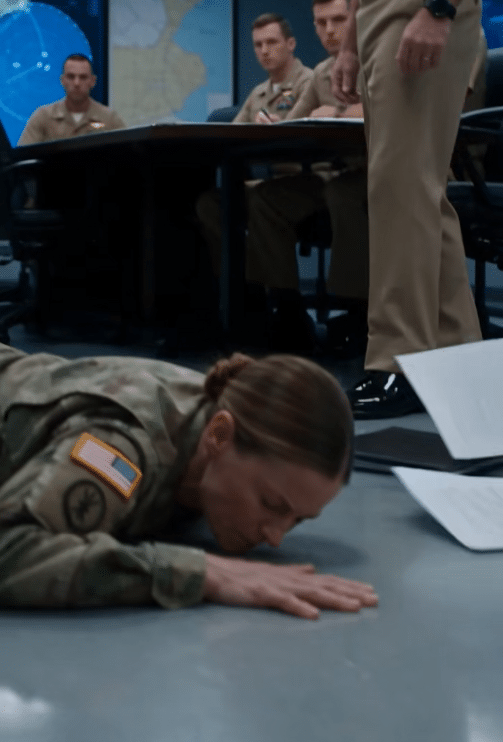
One second, the strategy room was quiet, filled with the low hum of the radar screen and the faint rustle of briefing papers. The next, his boot hooked hard behind the approaching officer’s leg.
She went down.
Her folder flew from her hand, striking the floor before sliding beneath the long black conference table. Papers scattered across polished tiles. Her palm caught the impact, reddening instantly, while the room seemed to hold its breath.
The woman did not curse.
She did not plead.
She simply lifted her head.
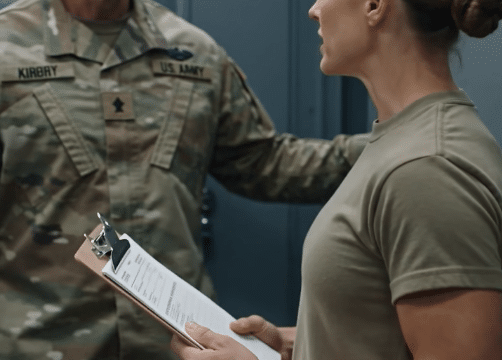
She was thirty-five, dressed in a clean olive uniform with none of the decorations or special insignia that usually commanded attention. Her brown hair was tied low at the back of her neck. There was nothing about her appearance that announced authority.
That was exactly what the Colonel had been counting on.
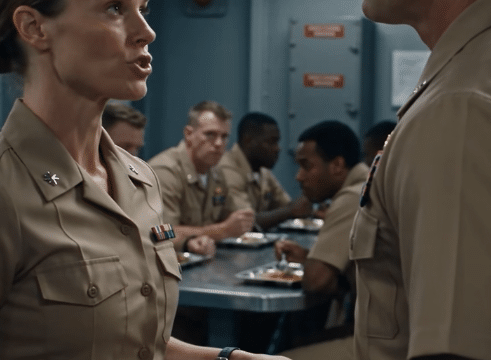
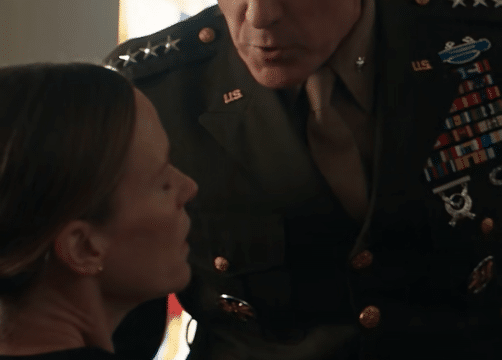
He stood over her in his formal uniform, silver Colonel insignia bright beneath the fluorescent lights.
“People like you don’t stand in strategy rooms. You clean them.”
A few officers looked down.
Nobody laughed.
Nobody helped her.
The wall map behind the Colonel displayed the theater of operations in colored lines and symbols. Red markers showed contested zones. Blue arrows showed projected movements. Every officer at the table had been studying that map for the last forty minutes.
Except the woman on the floor.
She had been watching them.
Slowly, she pushed herself upright.
Her eyes moved across the room—not with embarrassment, but with calculation.
Then she looked toward the folder.
The Colonel noticed.
With the toe of his boot, he shoved it farther beneath the table.
Something black slipped free.
It landed beneath the table lights with a soft, unmistakable thud.
A thin black file.
And in its lower corner was a small silver seal.
The junior officer seated nearest to it stopped writing.
His pen hovered above the page.
His face changed.
“Colonel… maybe you should see that.”
The Colonel didn’t even turn.
“Sit down. I decide what matters in this room.”
The woman finally stood.
She brushed dust from her sleeve.
Then she walked beneath the table, picked up the black file, and carefully wiped the silver seal with her thumb.
“You just made yourself part of this file.”
The room went colder.
Because the Colonel had finally looked at the seal.
And for the first time that morning, he wasn’t sure the room belonged to him.
Act II
The strategy room had always been Colonel Daniel Voss’s kingdom.
At fifty-two, Voss had spent more than three decades learning how to control rooms without raising his voice. He knew when to interrupt. He knew which junior officers were too intimidated to challenge him. He knew how to make a mistake sound like an order and an insult sound like discipline.
Most importantly, he understood hierarchy.
The room had been designed to reinforce it.
The Colonel sat at the head of the table beneath the largest tactical display. Senior officers occupied the seats closest to him. Junior officers sat farther down, where they could listen, take notes, and speak only when invited.
People knew their place.
Voss made sure of it.
So when the woman entered carrying a thin folder, he had immediately recognized her as an intruder.
Her name was Captain Mara Bennett.
At least, that was what her uniform suggested.
No combat patch.
No visible special assignment insignia.
No decorations.
No aide.
No security detail.
Nothing that explained why someone so apparently ordinary had been cleared to enter a restricted strategy meeting.
Voss had interpreted the absence of insignia as weakness.
He had made that mistake before.
He simply had never paid for it.
Mara had been watching the meeting from the doorway for several minutes before approaching the table. She had listened to Voss discuss troop movements, logistical vulnerabilities, and intelligence gaps.
She had also noticed three things.
The northern route on the map was outdated.
The radar data being used was incomplete.
And the Colonel was building an entire operational recommendation around information that had already been superseded.
She had come to deliver the correction.
Instead, Voss had decided to teach her a lesson.
What none of the officers knew was that Mara’s file had not come from the ordinary military chain of command.
It had come through a compartment so restricted that most of the people sitting around that table would never even learn its designation.
The black cover was deliberate.
The silver seal was older.
It belonged to a federal oversight authority with access to classified operational investigations, sealed command reviews, and internal misconduct cases involving senior personnel.
But the seal itself did not identify the agency.
That was the point.
Only people who had encountered it before were supposed to recognize it.
The young officer who had noticed it was one of those people.
Lieutenant Evan Cole was twenty-nine.
Six months earlier, he had been assigned to a temporary intelligence review involving sealed command records. He had spent two nights in a secure archive going through documents that were never supposed to leave a locked room.
He remembered that silver seal.
He remembered being told one thing about it.
If you see it on a file, do not touch the file.
And if your name appears inside it, do not assume your rank will protect you.
Cole stared at the black folder now resting in Mara’s hand.
He suddenly understood why she had walked into the room without visible insignia.
She didn’t need one.
Her authority wasn’t being displayed on her uniform.
It was sealed inside the folder.
Across the table, Voss still refused to acknowledge what was happening.
He leaned back in his chair.
“You’re disrupting my briefing.”
Mara looked at him.
She said nothing.
That silence bothered him more than an argument would have.
Because humiliation usually worked only when the victim accepted the role assigned to them.
Mara wasn’t accepting anything.
She was waiting.
And somewhere inside that black file was a record of why.
Act III
The first crack in the Colonel’s confidence came from the people who stopped looking at him.
One by one, officers around the table lowered their eyes toward the black folder.
Nobody spoke.
The radar screen continued pulsing behind them.
A red marker moved across the wall map.
The room should have felt like a command center.
Instead, it felt like a courtroom waiting for someone to open an envelope.
Mara placed the file on the table.
The silver seal caught the light.
Voss stared at it.
His expression tightened.
He had seen that symbol once before.
Years ago.
Not on a battlefield.
Not during an operation.
In a sealed investigation room.
The memory came back in fragments.
A dead communications officer.
A missing intelligence report.
A chain-of-command dispute that had disappeared from official records.
And a recommendation that had somehow been rewritten before reaching senior review.
Voss had never been officially accused of anything.
That was the important part.
Nothing had ever stuck.
No formal charge.
No public inquiry.
No career-ending scandal.
Just a handful of sealed documents that vanished into an administrative system powerful enough to bury almost anything.
Or so he had believed.
Mara opened the folder.
The pages inside were covered with blacked-out sections, dates, signatures, and classification markings.
She didn’t need to show the room everything.
She only needed to reveal the first page.
Voss saw his name.
His fingers tightened against the armrest.
Lieutenant Cole swallowed.
Now the other officers understood that the Colonel’s earlier cruelty had not been witnessed by accident.
Someone had been documenting him.
But Mara had not come into the room looking for revenge.
She had come because the same pattern was happening again.
The outdated intelligence on the wall was not a simple clerical mistake.
Someone had altered the operational data before the briefing.
Three units had been moved on paper but not in the field.
A supply corridor had been marked secure when it was not.
And the original intelligence report had been replaced.
The replacement carried an authorization code.
Voss’s authorization code.
For several seconds, nobody moved.
Then Voss stood.
“You don’t understand what you’re holding.”
Mara closed the file.
That was the moment he realized she understood far more than he did.
The black file wasn’t a threat.
It was evidence.
And the evidence didn’t concern only what he had done that morning.
It concerned what he had been doing for years.
The silver seal was not there to give Mara status.
It was there to tell everyone else that the normal chain of command had already been bypassed.
Voss stared at her.
For the first time, he looked less like a Colonel commanding a room and more like a man trying to remember how much of his past had been written down.
Mara’s eyes remained steady.
The room had changed.
But the worst part was that the Colonel still didn’t know who had sent her.
Act IV
The answer was buried beneath the documents.
Mara turned another page.
At the bottom was a signature from an authority Voss had not seen in years.
His face went pale.
The officers noticed.
That was when the balance of the room finally shifted.
The man who had controlled every conversation for the last hour suddenly seemed unable to find one.
Mara explained only what was necessary.
The classified review had been reopened after new evidence surfaced concerning the old intelligence discrepancy.
Someone had preserved copies of the original communications.
Someone else had preserved the authorization logs.
And someone had finally connected the missing pieces.
Voss had believed the past was gone because the official record had been cleaned.
But records were not the same thing as evidence.
Evidence could survive in places commanders never thought to look.
A private archive.
A duplicate transmission.
A handwritten notation.
A forgotten backup.
A signature.
The Colonel’s greatest mistake had been assuming that silence meant erasure.
Lieutenant Cole slowly placed his pen on the table.
He remembered the warning he had received months earlier.
Never assume a sealed file is dormant.
Mara looked around the room.
Every officer was listening now.
Not because she had raised her voice.
Because she didn’t need to.
The black folder had already done the speaking.
Voss tried to recover his authority.
“You walked into my briefing, disrupted my command, and accused me in front of my officers.”
Mara’s expression barely changed.
The distinction mattered.
She had not accused him.
The documents had.
She simply brought them into the room.
Voss looked toward the other officers.
No one met his eyes.
That frightened him more than anything Mara could have said.
For years, his power had depended on everyone believing that challenging him meant risking their own careers.
But now they understood something different.
The risk had changed sides.
A security notification appeared on the wall terminal.
Then another.
The room’s access system registered an incoming authorization request.
Every officer looked toward the screen.
Voss didn’t.
He already knew what it meant.
The review had moved beyond the room.
Mara closed the folder.
The silver seal disappeared beneath her palm.
“You thought this meeting was about strategy,” she said quietly.
Voss stared at her.
“It was never just about strategy.”
The door behind him unlocked.
No one had touched it.
And when the Colonel turned toward the sound, all the arrogance that had filled the room that morning was gone.
Because now he understood what the file actually represented.
Not a warning.
Not a threat.
A record.
And records have a way of waiting longer than people do.
Act V
The door opened.
Two senior investigators entered without ceremony.
They did not salute Voss.
They did not ask permission to enter.
They walked directly toward the table.
The Colonel remained standing.
For several seconds, he looked at Mara as though trying to understand when he had lost control of the room.
The answer was simple.
He had lost it the moment he decided humiliation was safer than curiosity.
Mara gathered the scattered papers from the floor herself.
She straightened them carefully.
The same papers he had kicked away minutes earlier were now being placed back inside the folder one by one.
There was no triumphant smile.
No dramatic celebration.
Just quiet precision.
That made the reversal sharper.
Because Mara had never needed to become cruel to defeat him.
She only needed to let the truth remain visible.
Lieutenant Cole watched her seal the folder.
He finally understood something else.
She had known what would happen when she walked into the room.
She had known Voss might challenge her.
She had known the file might fall.
Perhaps she had even known that he would react exactly as he did.
The humiliation had been his choice.
The consequences were not.
One of the investigators picked up the black file.
His eyes passed over the silver seal.
Then he looked at Voss.
The Colonel lowered his gaze.
The room remained silent.
On the wall, the tactical map still displayed the same red and blue markers.
But the officers no longer saw it the same way.
The meeting had begun as a discussion about military strategy.
It had ended as an exposure of something far more personal—the dangerous illusion that rank could make a person untouchable.
Mara turned toward the door.
Then she stopped.
For a moment, she looked back at the long conference table.
The chair at its head was still occupied.
But it no longer belonged to the most powerful person in the room.
It belonged to the truth everyone had been too afraid to examine.
Behind her, Voss finally spoke.
His voice was smaller now.
“This file…?”
Mara looked over her shoulder.
Her answer was calm.
It was the only answer he needed.
The file wasn’t about what he had done to her.
It was about what he had done to everyone who had been too afraid to stand up before her.
And that was why the silver seal had terrified him.
Because it meant the story had not started when he tripped her.
It had started years earlier.
He had simply been arrogant enough to believe nobody had been keeping the record.