Act I
The kick came before anyone could react.
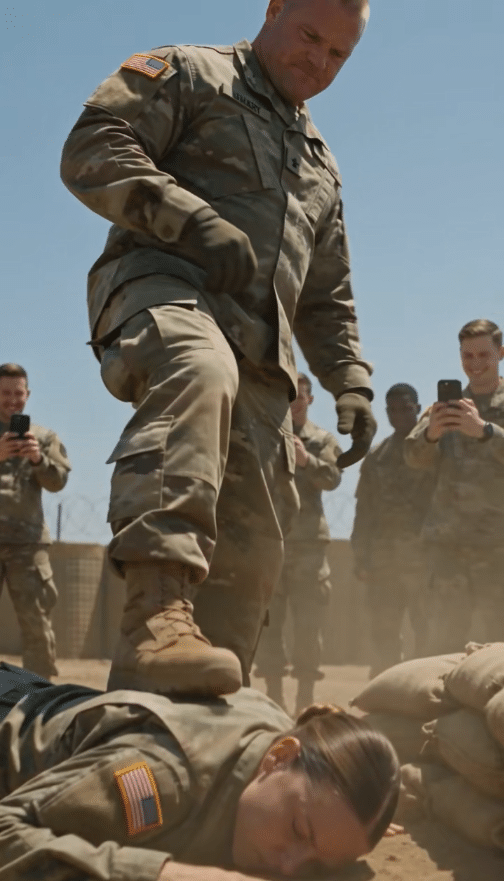
The drill sergeant drove his boot into the woman’s back, sending her face-first into the dry dirt beside the sandbags.
Dust exploded around her.
Her palms struck the ground. One scraped against a rough stone, but she barely seemed to notice. The man stepped forward and planted his boot against her upper back, holding her down in the middle of the training lane.
Around them, soldiers stood in a loose ring.
Some had phones raised.
A few were smiling.
Nobody stepped forward.
The woman turned her face slightly, breathing through the pain. Dirt clung to her cheek. Her eyes were red, but remarkably steady.
The drill sergeant looked down at her.
“You don’t belong on this field, trash. Crawl back where they hid you.”
The words carried across the lane.
He wanted everyone to hear them.
The barbed wire stretched behind them. Training tires and sandbags were scattered across the dirt. Wooden stakes marked the course.
It was supposed to be a test of endurance.
He had turned it into a public execution of dignity.
The woman didn’t plead.
She didn’t struggle wildly.
She simply waited.
That unsettled one of the soldiers holding a phone.
The twenty-four-year-old had been recording the whole thing with a smug expression. But as the drill sergeant grabbed the back of her collar and pulled her head upward, the collar shifted.
Something appeared beneath her hairline.
A small tattoo.
Dark.
Precise.
Almost hidden beside an old healed scar.
The young soldier’s smile disappeared.
He stared at the mark.
Then at the woman.
Then back at the mark.
“Sergeant… wait. Look.”
The drill sergeant didn’t even turn fully.
“Keep filming. She’s nothing.”
The young soldier lowered his phone slightly.
Nobody laughed anymore.
The woman slowly raised her eyes.
She looked directly at the man standing over her.
Her voice was quiet.
“You should have stopped when he told you to look.”
The drill sergeant finally glanced toward her neck.
At first, he saw nothing.
Then he saw the symbol.
His expression changed.
The phone in the young soldier’s hand dropped completely.
Another phone lowered.
Then another.
The men around the course began stepping backward.
The drill sergeant stared at the mark.
His boot remained on her back.
But suddenly, he seemed to have forgotten why.
Because the tattoo was not decoration—and the moment he recognized that, the training field stopped feeling like his territory.
Act II
The drill yard had always belonged to men like him.
At least, that was how he treated it.
He was forty-nine, broad, experienced, and physically imposing. His uniform was dark with dust, his gloves were black, and his boots were made for controlling terrain.
But more than his size, it was his reputation that gave him power.
He believed weakness needed to be exposed.
He believed embarrassment built discipline.
And he believed anyone who failed to keep up deserved to be reminded of their place.
The woman had become his target because she had not moved quickly enough through the barbed-wire lane.
That was all it took.
He had decided she didn’t belong.
The accusation had grown into humiliation.
The humiliation had become physical.
And the surrounding soldiers had become an audience.
That was how these things happened.
Not always with hatred.
Sometimes with a crowd.
Sometimes with people watching because they were afraid to look away.
Sometimes with a few phones raised by soldiers who convinced themselves they were only documenting what happened.
The woman understood crowds.
She understood power.
And she understood something the drill sergeant did not.
A person could reveal more about themselves by how they treated someone they believed had no power.
So she had watched him.
Even after the kick.
Even after the dirt.
Even after his boot pinned her down.
She had watched.
The old scar behind her neck was nearly invisible beneath her hair.
It had been there for years.
The tattoo beside it was smaller than a coin.
To an ordinary person, it might have looked meaningless.
To someone who knew what it represented, it was a different matter entirely.
The mark belonged to a classified military unit that officially no longer existed.
Its members had operated under conditions where identification could not be carried openly.
No ordinary patch.
No obvious insignia.
No public recognition.
Only a small symbol placed somewhere that could remain hidden beneath a uniform collar.
The woman had earned hers long before the soldiers surrounding her had even learned the unit’s name.
That history was why she didn’t panic.
She had already learned that surviving danger sometimes required patience.
Not every threat was defeated by fighting back.
Some were defeated by allowing the person making the mistake to continue until the truth became impossible to hide.
The young soldier with the phone had sensed that truth first.
He didn’t know the whole story.
He didn’t need to.
He recognized enough of the symbol to understand that something was seriously wrong.
His voice had carried the warning.
The drill sergeant had ignored it.
That was the moment the balance changed.
The woman remained on the ground.
The drill sergeant’s boot was still against her back.
But now, he was the only person on the field who didn’t understand what everyone else was beginning to see.
The soldiers stopped filming.
Not because anyone ordered them to.
Because they suddenly understood that whatever was happening might become evidence.
The young witness looked around.
Nobody wanted to be holding a phone when the truth came out.
The drill sergeant looked at them.
He noticed the silence.
He noticed the distance.
He noticed the fear.
But he still didn’t understand why.
Then he looked down again.
At the tattoo.
At the old scar.
And something buried deep in his memory began to surface.
He had seen that symbol before—but he had never imagined it would be on the neck of the woman he had just thrown into the dirt.
Act III
The symbol belonged to a story the military rarely told.
Years earlier, there had been a classified operation involving a small team assigned to a mission that officially became almost impossible to discuss.
The operation had never appeared in ordinary training material.
Its participants did not return to regular service in the usual way.
Some disappeared from active records.
Others came home carrying injuries that were never explained.
And one soldier returned with the symbol permanently marked beneath her collar.
The woman in the dirt.
She was that soldier.
Her name had never become famous.
There was no public monument bearing it.
No parade celebrated what she had done.
The operation had been buried beneath layers of classification and carefully worded reports.
But the people who knew about it remembered the symbol.
They remembered what it meant.
The drill sergeant had heard fragments.
Everyone in specialized training heard fragments.
Stories without names.
Missions without locations.
Warnings without explanations.
He had never connected any of them to her.
Because she didn’t look like a legend.
She looked tired.
Dusty.
Ordinary.
That was exactly why the mark mattered.
The drill sergeant stared at it again.
The woman slowly pushed one palm against the dirt.
Her shoulder tightened.
She was still hurting.
But she was no longer afraid.
She knew what he was doing.
He was trying to understand.
And the more he understood, the less powerful he became.
The young witness stood completely still.
He had stopped recording.
His phone hung uselessly at his side.
The other soldiers followed.
The ring around the woman had opened.
Men who had been laughing minutes earlier were now giving her space.
The drill sergeant noticed.
He looked at his boot.
Then at her.
For the first time, he seemed aware of how the scene looked from the outside.
A large man standing over a woman in the dirt.
A hidden military symbol exposed beneath her collar.
A crowd suddenly afraid.
A silence that had replaced laughter.
His own words came back to him.
She’s nothing.
The woman lifted her head slightly.
Her eyes met his.
There was no anger there.
That was what frightened him.
Anger would have meant confrontation.
Her expression was something else.
Certainty.
She had warned him.
Not by threatening him.
By allowing someone else to tell him to look.
He had refused.
Now there was no hiding from what he had done.
The young soldier took one slow step backward.
The others followed.
Nobody wanted to be close anymore.
The drill sergeant looked toward them.
He expected someone to support him.
Nobody did.
That was when he understood the worst part.
The crowd had not turned against him because they suddenly became brave.
They had turned because they had finally realized who was standing in front of them.
The woman slowly moved her hand toward the collar.
She did not cover the tattoo.
She let it remain visible.
The old scar beside it told another story.
A story of survival.
A story of an operation that had taken something from her and left something behind.
The drill sergeant stared.
His breathing changed.
He remembered a briefing from years ago.
A symbol on a slide.
A warning from an instructor.
A sentence nobody explained.
He had never imagined that symbol would appear here.
On this field.
On this woman.
And certainly not after he had placed his boot on her back.
The tattoo had finally become more frightening than his rank, and he was beginning to understand why.
Act IV
The drill sergeant slowly removed his boot.
The woman didn’t move immediately.
She stayed on the ground for another second, gathering herself.
Then she pushed up onto one knee.
Dust fell from her uniform.
Her palm was scraped.
Her face was dirty.
Her hair had loosened slightly from the impact.
But her eyes remained steady.
The drill sergeant stepped backward.
One step.
Then another.
The movement was small.
The soldiers noticed.
Nobody said anything.
The young witness looked at the tattoo one more time.
He had seen it before in a restricted training reference.
Not the woman.
Not her name.
Only the mark.
A symbol associated with an operation that instructors discussed with unusually careful language.
He suddenly understood why the drill sergeant’s face had changed.
The woman was not someone who had failed the training lane.
She was someone who had survived the kind of operation the training lane was designed to prepare people for.
The irony was almost unbearable.
He had mocked her for not being strong enough.
He had tried to prove her weakness by force.
And now the entire field was watching the opposite happen.
She was standing.
He was backing away.
The soldiers were silent.
The power had changed without a fight.
The woman brushed the dirt from her cheek.
Then she looked around the training lane.
She saw the barbed wire.
The sandbags.
The tires.
The ropes.
The young soldiers who had watched her fall.
Nothing about the course frightened her.
She had already crossed places much worse than this.
The drill sergeant had mistaken endurance for weakness because he had only seen the surface.
The woman understood something else.
Real strength did not always look loud.
Sometimes it looked like breathing through pain.
Sometimes it looked like refusing to beg.
Sometimes it looked like letting someone expose their own character while believing they were exposing yours.
The drill sergeant looked at the tattoo again.
The symbol seemed smaller now.
But its meaning seemed enormous.
He wanted to ask what it meant.
He didn’t.
Perhaps he already knew enough.
The young witness lowered his eyes.
He had been part of the audience.
That fact would stay with him.
The others would remember it too.
They had watched.
They had filmed.
They had laughed quietly.
And then they had discovered that the person they were watching had survived something that had become almost a forbidden memory inside the military.
The woman stood fully.
She adjusted the collar of her shirt.
The tattoo disappeared beneath the fabric again.
The moment it vanished, the field seemed to breathe.
But the fear remained.
Because everyone had already seen it.
The drill sergeant stared at the place where it had been.
His confidence was gone.
He no longer looked like the owner of the field.
He looked like a man trying to understand how badly he had miscalculated.
The woman walked past him.
She didn’t shove him.
She didn’t threaten him.
She didn’t need to.
The soldiers moved aside.
They gave her a path without being asked.
She passed through the ring.
And the drill sergeant remained behind.
Alone.
For the first time, he understood that the field had never belonged to him.
Then the woman stopped—and turned just enough for him to see the mark one last time.
Act V
The training lane had gone completely silent.
No phones were raised now.
No laughter remained.
The woman stood several feet away, her back toward the drill sergeant.
The tattoo was almost hidden again beneath her collar.
Almost.
He could still see a small edge of it.
That was enough.
The drill sergeant’s face had lost its color.
He had wanted everyone to believe she was nothing.
Now everyone understood that the exact opposite might be true.
The young witness looked down at his phone.
The recording was still there.
He could delete it.
He could keep it.
But neither choice could erase what he had seen.
The moment when amusement became fear.
The moment when a hidden symbol changed the meaning of an entire confrontation.
The moment a woman lying in the dirt became the person everyone instinctively stepped away to respect.
The drill sergeant looked at her again.
She did not turn around.
She didn’t need to.
The mark had already answered every question he was afraid to ask.
It told him that she had been somewhere before.
That she had survived.
That someone had decided she was worth protecting through anonymity.
And that the military had given her a symbol meant to be recognized only by those who understood what she had endured.
He had not recognized it.
He had seen weakness where there was discipline.
He had seen fear where there was control.
He had seen an ordinary soldier where there was a history he could not comprehend.
That was the humiliation he could not escape.
Not that she had defeated him.
She hadn’t.
She had barely fought him at all.
He had defeated himself the moment he decided her appearance told him everything he needed to know.
The woman finally turned her head.
Their eyes met.
Her expression remained calm.
Then she turned away.
The soldiers parted.
She walked beyond the training lane and disappeared behind the low concrete barrier.
Nobody followed.
Nobody called after her.
The drill sergeant remained in the dirt.
The same dirt where he had pinned her only minutes earlier.
But the field no longer felt the same.
The soldiers who had watched him were now watching him differently.
The witness lowered his phone.
The men around the course stayed silent.
And somewhere beneath the silence was a question nobody wanted to ask aloud.
What exactly had happened to that woman before she came here?
The drill sergeant knew there was an answer.
He also knew he probably didn’t want to hear it.
His eyes returned to the spot beneath her collar.
That tiny military tattoo.
That old scar.
That impossible piece of history.
He swallowed.
His voice came out almost as a whisper.
“That mark…?”
Nobody answered.
Because by then, the most important part of the story was already clear.
The woman had not survived because she was never afraid.
She had survived because fear had learned, long ago, that it could not control her.
And the drill sergeant had just made the mistake of treating a survivor like someone who needed to be broken.
The field stayed silent.
The phones stayed down.
And the man who had once called her nothing could only stare at the place where the hidden mark had disappeared, finally realizing that he had not uncovered her weakness.
He had uncovered the reason everyone else was afraid to touch her.