Act I
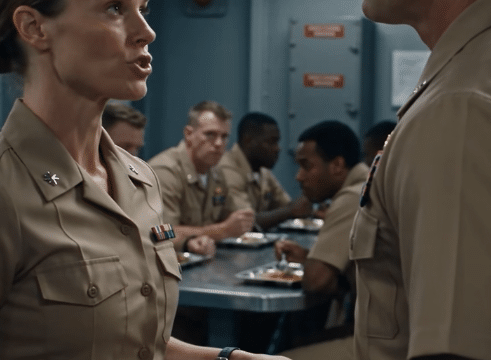
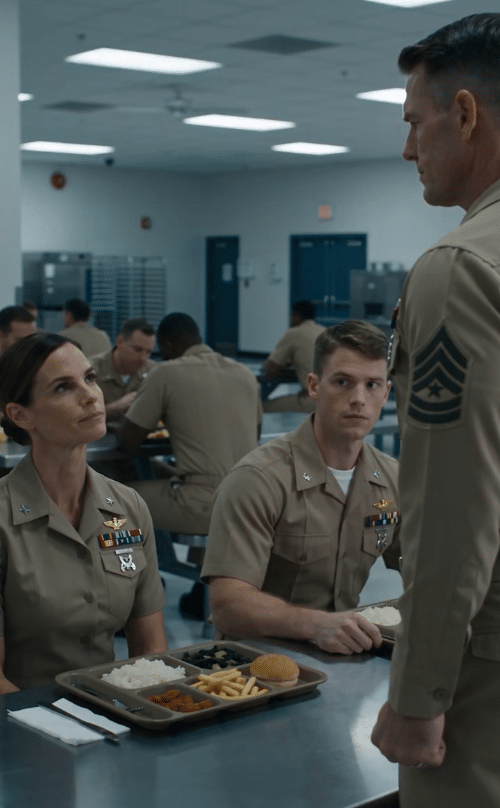
The Major was already standing over her when the cafeteria went quiet.
He pointed across the room toward a smaller table near the kitchen, the kind of table people used when every other seat was taken. His finger stayed there as if the destination had already been decided.
She remained seated.
Her untouched tray rested in front of her. A light jacket covered a dark-blue civilian-style blouse, and a visitor badge hung neatly from the front. Nothing about her appearance announced authority. Her dark-brown hair was tied low, her expression was calm, and she looked almost deliberately ordinary.
But the Major had noticed only one thing.
The badge.
She looked up at him.
“Why?”
The question was quiet enough that several nearby officers stopped eating.
The Major did not hesitate.
“This section is for officers. A visitor badge doesn’t make you an officer.”
His eyes dropped pointedly toward the badge, then returned to her face.
It was not simply an instruction. It was a public declaration of rank.
He had decided who she was before she ever opened her mouth.
Around them, forks slowed. Chairs stopped moving. Officers at neighboring tables began watching without appearing to watch.
The woman glanced down at the badge.
For the briefest instant, something darker could be seen behind it.
Then she looked back at him.
“Did I say it did?”
The Major’s expression tightened.
He had expected embarrassment. Perhaps an apology. Maybe even the quick, nervous movement of someone who realized she had entered the wrong room.
Instead, she had answered him with a question.
And somehow, that made the room feel smaller.
The Major pointed again.
“There’s a table near the kitchen.”
The humiliation was now unmistakable.
He wasn’t asking her to find another seat because the cafeteria was crowded. He was assigning her a place based entirely on what he believed she deserved.
The woman studied him for a moment.
“You want me to move there?”
“It would be better for everyone.”
A few officers lowered their eyes.
One man at a nearby table suddenly stopped chewing.
Because there was something the Major had not noticed.
Someone else had seen what was hidden behind that visitor badge.
And he was already getting to his feet.
The Major thought he had just ended the conversation. He had no idea someone in the room had already recognized the danger.
Act II
The cafeteria had its own hierarchy.
Everyone understood it.
The officers’ section was not marked by velvet ropes or signs. It did not need to be. People knew where senior officers sat, where junior personnel belonged, and which tables were considered neutral territory.
The Major had spent years enforcing invisible boundaries like those.
He was forty-four, sharply dressed, rigidly composed, and carried himself with the confidence of someone accustomed to being obeyed before he finished speaking.
His rank insignia was impossible to miss.
Neither was the assumption behind his behavior.
The woman across from him had none of the visible symbols he respected.
No obvious rank.
No formal military jacket.
No entourage.
Only a visitor badge.
To him, that was enough.
What he could not see was the darker credential tucked behind it.
It was not positioned for display. It was almost concealed, as though someone had deliberately decided that its authority did not need to announce itself.
That detail mattered.
Because the woman had not accidentally wandered into the officers’ section.
She had chosen that table.
And she had chosen not to explain herself.
There was a reason for that.
Earlier that morning, she had entered the base under controlled visitor access. The badge she wore was legitimate, but it was not the most important identification she carried.
The darker credential belonged to another level of authority.
One that was never displayed casually.
She had been told to observe.
Not to interfere.
Not to introduce herself.
Not to correct anyone who made assumptions.
Just watch.
So she watched.
She watched the Major walk through the cafeteria as if every table belonged to him.
She watched how junior officers straightened when he passed.
She watched how conversations became quieter around him.
And when he stopped beside her table, she watched something more important.
She watched what happened when nobody thought there would be consequences.
The woman did not look angry.
That was what made her difficult to read.
Her eyes remained steady. Her hands rested beside the tray. She did not rush to defend herself or reach for the credential hidden beneath the badge.
She simply allowed the Major to keep talking.
Because every additional word gave her a clearer picture.
Across the room, a young lieutenant had noticed the edge of the darker credential.
He was twenty-nine.
Young enough to understand that he should not interfere with a senior officer.
Experienced enough to recognize a credential that did not belong to an ordinary visitor.
His eyes moved from the badge to the woman.
Then to the Major.
His chair shifted backward.
The scrape of its legs against the floor was barely audible.
But the woman heard it.
So did the Major.
The lieutenant’s face had changed.
He looked nervous now.
Not because the Major was angry.
Because he had realized something the Major hadn’t.
He leaned forward.
“Major, maybe she can stay there.”
The cafeteria seemed to freeze.
The Major turned toward him.
For one second, there was almost disbelief in his expression.
Then came irritation.
“Sit down, Lieutenant.”
The lieutenant stopped.
His chair remained half-pulled from the table.
He looked at the woman again.
She gave him no signal.
No reassurance.
No warning.
Nothing.
And somehow, that was worse.
Because now the lieutenant understood that she was not asking anyone to rescue her.
She was letting the Major reveal himself.
The lieutenant had recognized the hidden credential. The Major had just ordered the only person who understood it to be silent.
Act III
The woman looked down at her tray.
The food had gone untouched.
That small detail suddenly seemed important.
She had never come to the cafeteria to eat.
Not really.
The meal was part of the cover.
The visitor badge was part of the cover too.
And the Major had walked directly into it.
For weeks, questions had been circulating quietly through the command structure about how authority was being exercised inside the unit.
Not dramatic questions.
Not the kind that appeared in headlines.
Smaller ones.
Why did junior personnel avoid certain officers?
Why were people afraid to question instructions?
Why did some commanders seem more interested in appearances than judgment?
And most importantly, what happened when someone believed the rules applied differently depending on who was standing in front of them?
That morning, the woman had been placed inside the answer.
Her mission was not to humiliate anyone.
It was to observe.
The test was simple.
Remove the obvious symbols of authority.
Leave only the person.
Then see what happened.
The Major had made the decision easier than anyone expected.
He saw a woman with a visitor badge sitting at an officers’ table.
Instead of asking who she was, he decided what she was.
Instead of checking the rules, he invoked rank.
Instead of correcting the situation privately, he made the correction public.
And when she questioned him, he had been given another opportunity to stop.
He refused.
“It would be better for everyone.”
Those words stayed in the room.
The lieutenant heard them.
The officers heard them.
And the woman heard something else.
Confirmation.
The Major had not simply made a mistake.
He believed what he was saying.
He believed certain people belonged at certain tables.
He believed visible status determined invisible worth.
And because he was accustomed to being obeyed, he had never considered the possibility that someone sitting quietly across from him might have more authority than the uniform on his shoulders suggested.
The woman slowly lifted one hand.
Her fingers touched the visitor badge.
The movement was so small that several people nearly missed it.
The Major did not.
Neither did the lieutenant.
She lifted the badge just enough.
A dark credential appeared behind it.
Only part of it.
No full title.
No explanation.
No dramatic announcement.
Just enough.
The lieutenant’s eyes widened.
The Major stared.
For the first time since he had approached the table, his posture changed.
Not much.
His shoulders remained square.
His face remained controlled.
But his eyes moved.
From the dark credential…
To her face.
Then back again.
Something had shifted.
The badge was real.
But it was not the whole truth.
The Major’s mind began racing through every possibility he had dismissed.
Why had she been sitting there?
Why had the lieutenant recognized the credential?
Why had she never defended herself?
Why had she asked him those questions instead?
The answer was becoming frighteningly simple.
She had not needed to argue.
She had been waiting for him to demonstrate exactly who he was.
And now he had.
The credential was only partly visible, but it was enough to make the Major understand that the person he had ordered away might never have been beneath him at all.
Act IV
Nobody moved.
The cafeteria had become painfully quiet.
The woman lowered the badge slightly but did not conceal the credential completely.
She did not tell him her rank.
She did not explain the assignment.
She did not rescue him from the consequences of his own assumptions.
That silence carried more weight than an argument could have.
The Major’s confidence was disappearing in pieces.
First came uncertainty.
Then calculation.
His eyes moved toward the lieutenant.
The lieutenant immediately looked down.
Not because he was afraid anymore.
Because he knew the warning had already been given.
The Major had been offered a chance to stop.
He had refused.
The room had witnessed it.
Every officer sitting nearby had heard the words.
Every person watching had seen the badge.
And now they had seen what was behind it.
The Major looked at the woman again.
She remained completely still.
There was no triumph on her face.
That was perhaps the most unsettling part.
She did not look pleased that he had been caught.
She did not look angry.
She looked patient.
As if the outcome had never depended on whether he believed her.
The Major’s mind returned to the first moment.
The visitor badge.
The officers’ table.
His finger pointing toward the kitchen.
He suddenly remembered how certain he had been.
How easy the decision had felt.
He had not asked whether she was authorized to sit there.
He had not checked her access.
He had not asked why she was alone.
He had simply looked at a badge and assigned a value to the person wearing it.
Now that same badge was being lifted just enough to reveal that he had been reading the wrong information.
The officers around them remained silent.
Nobody laughed.
Nobody celebrated.
This was not a spectacle.
It was something more serious.
A realization.
The Major had spent years teaching people to respect rank.
But in a few quiet minutes, he had demonstrated the difference between respecting rank and understanding authority.
One was visible.
The other was not.
The woman slowly let the badge fall back into place.
The dark credential disappeared again.
But it was too late.
The Major had seen it.
And he could no longer unsee it.
His mouth opened slightly.
Then closed.
For perhaps the first time in years, he had no immediate command to give.
The lieutenant remained frozen beside his table.
The officers watched without speaking.
And the woman simply sat there with her untouched tray.
She had never moved.
She had never needed to.
The Major had done all the moving for her.
He had moved from confidence to arrogance.
From arrogance to certainty.
From certainty to doubt.
And now, standing beside her table, he seemed suddenly aware of the distance between the person he had imagined and the person actually sitting in front of him.
Then his eyes landed on the credential one final time—and the confidence he had walked into the cafeteria with began to collapse completely.
Act V
The final moment came without shouting.
Without a confrontation.
Without anyone needing to announce what had just happened.
The woman looked at the Major.
Calmly.
Patiently.
Almost mercifully.
The visitor badge still hung from her jacket.
But now it looked different.
A few minutes earlier, it had been the symbol the Major used to justify his authority over her.
Now it was only the outer layer of a story he had failed to understand.
The Major’s eyes shifted again.
Badge.
Credential.
Face.
His expression remained controlled, but his eyes betrayed him.
The realization was no longer a possibility.
It was a fact.
He had judged the wrong person.
He had done it publicly.
He had been warned.
And he had ignored the warning.
Most importantly, the woman had never needed to claim power.
She had simply refused to surrender her dignity to someone else’s assumption.
The lieutenant finally lowered himself back into his chair.
Around him, the other officers slowly returned their attention to their meals, but nobody really went back to normal.
The cafeteria had changed.
Not because someone had been punished.
Not because a superior officer had arrived to deliver a dramatic speech.
Nothing so easy had happened.
Instead, everyone in that room had witnessed something much harder to forget.
A rank insignia could tell you what someone wore.
A visitor badge could tell you how someone entered.
Neither could tell you who was standing in front of you.
The woman picked up her fork.
Her meal was still untouched.
The Major remained beside the table for another moment.
He did not point toward the kitchen again.
He did not repeat the order.
He did not speak.
And perhaps that silence was the first honest thing that had happened since he walked over.
Because somewhere beyond the cafeteria walls, whatever formal review had brought the woman there would continue.
There would be records.
Questions.
Statements.
The lieutenant’s warning.
The Major’s words.
And the memory of an ordinary-looking visitor sitting quietly at an officers’ table while a superior officer revealed exactly how quickly he judged someone by the badge on her chest.
But none of that needed to happen in front of the cafeteria.
For now, the lesson was already complete.
The woman had never claimed she was an officer.
The Major had supplied that assumption himself.
And when he finally understood that the visitor badge had never been the whole story, there was nothing left for him to command.
Only one thing remained.
To stand there and realize that the person he had tried to send away had been watching him the entire time.
And that the real test had never been whether she belonged at the officers’ table.
It had been whether he belonged in command of the people sitting around it.