Act I
The Major was already angry when she asked the question.
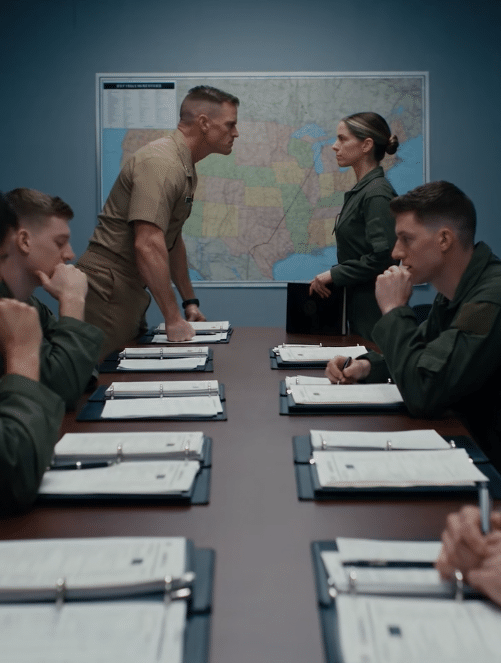
He leaned across the briefing table, one hand planted beside a stack of mission documents, his jaw tight beneath the harsh fluorescent lights.
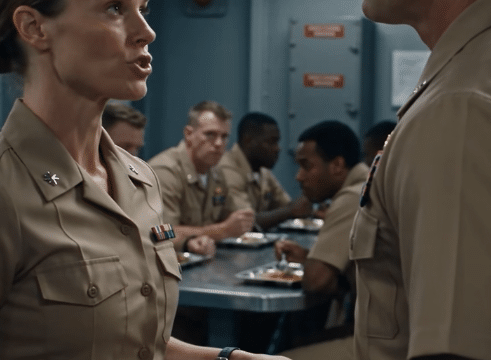
Around them, junior officers stood frozen.
The woman across the table didn’t raise her voice.
She didn’t challenge his authority.
She had simply questioned a procedure.
That was enough.
“Get out! You do not challenge me.”
The words slammed through the hallway.
Several soldiers looked away.
The woman didn’t.
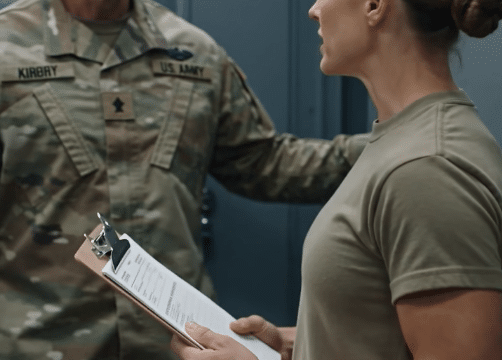
She stood in her olive uniform with a small black notebook resting beside her hand.
Her expression wasn’t defiant.
It was almost disappointed.
She held the Major’s gaze for several seconds before answering.
“There was no reason to take this further.”
The Major’s eyes narrowed.
He heard the warning.
He simply chose not to accept it.
For him, the issue had never been the procedure.
It was the fact that someone had questioned him in front of other people.
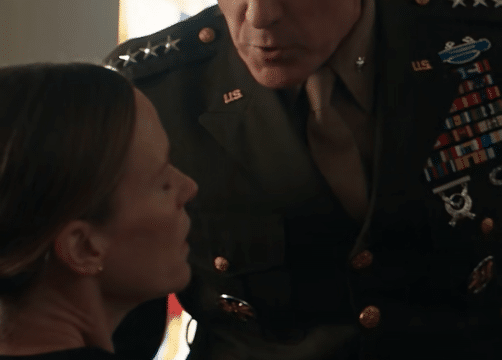
His rank was displayed clearly on his uniform.
His decorations caught the overhead light.
He had spent years making sure people understood what those symbols meant.
Now, a woman whose rank was barely noticeable had looked him directly in the eyes and calmly suggested he was going too far.
His pride couldn’t tolerate it.
His hand shot toward the black notebook.
He grabbed it from the table.
Then threw it onto the floor.
It landed beside his polished boots.
The hallway went silent.
The woman looked down at it.
Then slowly looked back at him.
The Major pointed toward the exit.
“I told you to leave.”
He thought that was the end.
He was wrong.
Because when she bent down to retrieve the notebook, one of the junior officers saw what was stamped on its cover.
An official inspection seal.
And the officer’s face went pale.
Act II
The briefing hallway had been built around hierarchy.
A long table divided the space.
Documents were arranged in neat stacks.
A tactical map covered the wall behind the officers, filled with routes and markings that represented missions far more serious than the argument happening in front of them.
But the Major wasn’t thinking about any of that.
He was thinking about being challenged.
He had interpreted the woman’s question as disrespect.
Maybe it had been harmless.
Maybe it had been necessary.
It no longer mattered.
His pride had already decided what the moment meant.
She had crossed him.
And people who crossed him were supposed to leave.
The woman knew exactly what was happening.
That was why she remained calm.
She had seen officers become defensive before.
She had watched people confuse questions with insubordination.
She knew that once anger replaced judgment, every additional word became another piece of evidence.
So she gave him one last chance.
“There was no reason to take this further.”
It wasn’t a threat.
It was a warning.
Stop now.
Walk away.
Let the moment disappear.
The Major refused.
Instead, he grabbed the black inspection notebook and threw it onto the floor.
The sound wasn’t loud.
But it carried.
A few soldiers shifted uneasily.
One junior officer lowered his eyes.
Another glanced at the notebook.
The Major pointed toward the corridor.
“I told you to leave.”
The woman still didn’t argue.
She simply walked toward the notebook.
That calmness began to bother him.
He had expected embarrassment.
Maybe anger.
Instead, she moved with the deliberate patience of someone who wasn’t worried about what happened next.
She crouched.
Picked up the notebook.
And brushed dust from its cover.
That was when the junior officer saw the seal.
His expression changed instantly.
He stepped backward.
Not dramatically.
Just one small movement.
But everyone nearby noticed.
The Major noticed too.
He looked at the notebook.
For the first time, he seemed genuinely curious about what he had just thrown.
And the woman saw that curiosity.
She said nothing.
She didn’t need to.
The seal was already beginning to answer him.
Act III
The notebook looked ordinary at first glance.
Small.
Black.
Practical.
The sort of thing an officer might carry to record notes during a briefing.
But the official seal on its cover was different.
It wasn’t decorative.
It wasn’t something added for appearance.
The junior officer knew enough to recognize that.
His face had gone pale because he understood what the Major had failed to understand.
The woman hadn’t been sitting at that table as a random observer.
She had been documenting.
The Major stared at the notebook.
Then at her.
His anger was still there.
But uncertainty had entered it.
She dusted the seal again.
Slowly.
Almost gently.
The gesture made the room even quieter.
No one stepped forward.
No one asked what the notebook contained.
No one needed to.
The Major had thrown it onto the floor in front of witnesses.
Now those witnesses were looking at him differently.
The woman stood upright.
Her posture remained controlled.
There was no triumph on her face.
No smile.
No dramatic display of superiority.
That was what made her presence so unsettling.
She didn’t need to prove anything.
The notebook was enough.
The Major’s eyes moved toward the official seal again.
He seemed to search his memory.
Had he seen that marking before?
Had someone warned him about an inspection?
Had his command been under review?
Was there already a report?
The questions arrived faster than he could suppress them.
His face tightened.
The woman watched him quietly.
He had spent the last several minutes demanding that she leave because she had asked one question about procedure.
Now he was beginning to wonder whether that question had never been the real purpose of her visit.
Maybe she had been checking something.
Maybe she had been documenting something.
Maybe his reaction was precisely what she had been sent to observe.
That possibility struck him harder than the notebook hitting the floor ever could.
The junior officer looked down.
The Major saw him.
And suddenly the entire room seemed to understand the same thing.
The Major had not silenced the woman.
He had given her something more valuable than an answer.
He had given her a record of how he behaved when questioned.
Still, she hadn’t explained the notebook.
She simply closed it.
Then looked directly at him.
The Major’s confidence was beginning to disappear.
But he still had one thing left.
His rank.
And she was about to tell him exactly what that rank might cost.
Act IV
The hallway seemed to shrink around them.
The Major stood beside the table.
The woman stood several feet away with the black notebook in her hand.
Between them was everything neither side was saying.
He had ordered her out.
She had warned him.
He had escalated.
Now the inspection seal was visible.
The junior officers watched in silence.
The Major’s eyes kept returning to it.
He finally understood why the junior officer had stepped back.
This wasn’t ordinary paperwork.
Whatever authority the notebook represented, it reached beyond the argument happening in that hallway.
The Major tried to recover his composure.
He straightened his shoulders.
Adjusted his stance.
Reminded himself who he was.
A Major.
A decorated officer.
A man accustomed to giving orders.
But the woman didn’t look impressed.
She looked at him as though she had already made her assessment.
Then she glanced toward the exit.
For a moment, it seemed she might actually obey.
The Major’s expression loosened.
He thought he had won.
Then she turned back.
Her voice remained calm.
Almost quiet.
“I’ll leave, Major. But your stars are leaving with me.”
The words changed everything.
The Major froze.
His eyes dropped to the notebook.
Then to the seal.
Then back to her face.
Suddenly, his rank didn’t feel like protection.
It felt like a target.
His mouth opened slightly.
No response came.
The junior officers remained silent.
The woman didn’t move.
She had never threatened him physically.
She hadn’t insulted him.
She hadn’t demanded that anyone punish him.
She had simply told him that his own stars might be part of what she was carrying out of the room.
And now the Major understood the consequence of his mistake.
He had thought he was removing an insignificant subordinate.
Instead, he had publicly interfered with someone carrying official inspection authority.
The very behavior he had displayed—anger, intimidation, refusal to answer a procedural question—could now become part of the record.
The notebook was no longer on the floor.
It was back in her hand.
And suddenly, that small black cover looked more dangerous to him than any weapon could have.
The woman turned toward the hallway.
She was ready to leave.
The Major remained frozen.
Because he finally understood that she had warned him.
And he had chosen not to listen.
Act V
The footsteps of the woman faded down the hallway.
She didn’t hurry.
She didn’t look back.
The black notebook remained tucked securely in her hand.
Behind her, the junior officers stood in uneasy silence.
Nobody followed.
Nobody spoke.
The Major remained beside the briefing table.
His decorations were still pinned perfectly to his uniform.
His Major insignia was still visible.
Everything about his appearance suggested authority.
But the expression on his face told a different story.
He kept staring at the doorway.
Then at the place where the notebook had landed.
His mind replayed the moment.
The question.
His anger.
His order.
The notebook hitting the floor.
Her warning.
His second order.
Then that final sentence.
Your stars are leaving with me.
He had believed the woman was challenging his authority.
Now he understood something much more frightening.
She may have been documenting it.
The official seal had transformed the notebook from an ordinary object into a question he could no longer dismiss.
What had she already recorded?
Who would read it?
How much authority did the inspection carry?
And how much of his command could be placed under scrutiny because of what had just happened?
He didn’t know.
That uncertainty was the punishment of the moment.
Not a formal hearing.
Not a suspension.
Not a public condemnation.
Just the realization that consequences could already be moving somewhere beyond his control.
The junior officer who had recognized the seal looked at him one last time.
Then looked away.
The Major noticed.
For years, people had lowered their eyes because they feared his rank.
Now, they were lowering their eyes because they understood what his rank might be about to lose.
The woman disappeared around the corner.
The Major remained alone with the briefing documents, the tactical map, and the silence he had created himself.
His gaze settled on the memory of that black notebook.
His confidence was gone.
And in the final moment, his eyes fixed on the official inspection seal as the realization finally reached him:
The woman hadn’t come to challenge his stars.
She had come carrying the authority to decide what happened to them.