Act I
The music was so loud that the windows across the street were trembling.
At the edge of the crowded front yard, a seventy-four-year-old woman stood beneath the string lights, clutching her thin coat in one hand. She had silver hair, a gray cardigan, a dark blue skirt, and the cautious posture of someone who had spent a lifetime trying not to make trouble.
She wasn’t there to ruin the party.
She wasn’t demanding that everyone leave.
She simply wanted the music lowered.
“Please… it’s very late…”
The party host turned toward her.
Thirty-nine years old, dressed in an open-collar white shirt and black dress pants, he looked completely at home among the luxury cars, expensive watches, overflowing drink tables, and laughing guests.
But her request changed his expression instantly.
In front of everyone, he saw her politeness as a challenge.
“Trash. Don’t tell me how to live.”
Then he crossed the yard.
There was no warning.
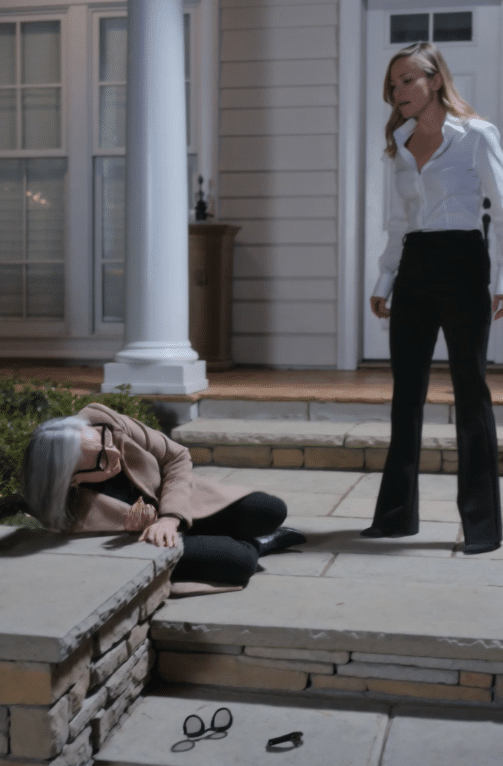
His kick struck her chest with tremendous force, throwing her backward onto the edge of the stone front step beside the planter.
Her coat fell from her hand.
Her glasses flew across the stones.
Her elbow struck the step, leaving a thin trace of blood.
For a moment, the party seemed to stop breathing.
The elderly woman curled instinctively against the pain, drawing a sharp breath as she tried to understand what had just happened. Her face showed shock and humiliation, but even then she did not beg.
She simply tried to speak.
“Please… it’s very late…”
The man stood over her.
Then came two more hard kicks into her back and side while she remained down.
Guests recoiled.
Several covered their mouths.
Neighbors stared from darkened windows.
People on the sidewalk froze where they stood.
Nobody stepped forward.
And the host, surrounded by people who had come to celebrate him, looked down at the seventy-four-year-old woman as though she were the problem.
“Go back to your old house.”
The words hung in the cold night air.
Then headlights appeared beyond the party.
Not one vehicle.
Several.
And the party was about to discover that the woman on the ground was not nearly as insignificant as he believed.
Act II
The neighborhood had always been the kind of place where people knew one another without necessarily knowing each other’s stories.
Large houses sat behind carefully maintained lawns.
Luxury vehicles lined the curbs during weekend gatherings.
Families watched from behind curtains when something unusual happened outside.
And at night, there was an unspoken understanding that everyone eventually turned down the noise and let the neighborhood sleep.
The seventy-four-year-old woman had lived with that understanding for decades.
She knew that parties happened.
She knew young people laughed late into the evening.
She knew that occasionally someone played music too loudly.
She had never considered any of that a personal offense.
What concerned her that night was simple.
The hour was late.
Families nearby had children sleeping.
Older residents were trying to rest.
The bass from the speakers had continued long after a reasonable evening had ended.
So she walked over.
She approached the edge of the property carefully, coat folded over one arm, and made the kind of request most neighbors would have understood immediately.
Turn it down.
That was all.
But the party host had spent the evening surrounded by attention.
Every laugh reinforced his confidence.
Every phone raised for a photograph reminded him that he was the center of the room.
When the elderly neighbor appeared, he didn’t hear a request.
He heard an accusation.
And because she had made that request in front of his guests, he reacted as though she had publicly challenged his authority.
That was why the violence happened so quickly.
It wasn’t an accident.
It wasn’t confusion.
He deliberately crossed the yard and attacked her.
Afterward, the people around him seemed unable to process what they had witnessed.
The same guests who had been laughing moments earlier now stood motionless.
A glass had fallen near the steps.
The string lights continued glowing overhead.
The speakers were still producing music, though it suddenly sounded distant beneath the silence of the crowd.
The woman remained on the ground.
Her glasses lay several feet away.
She was breathing sharply, trying to gather herself without surrendering what little dignity the attack had left her.
No one helped.
Not yet.
Perhaps they were frightened of the host.
Perhaps they didn’t know what to do.
Perhaps they were simply stunned by how quickly an ordinary neighborhood disagreement had become something so cruel.
But one thing was becoming clear.
The party host had mistaken silence for protection.
He had no idea how many people were watching.
And he certainly had no idea who was already on the way.
Because the approaching vehicles weren’t carrying another group of party guests.
They were carrying people who had come because something far more serious had happened.
And the first vehicle was already braking.
Act III
The sound of police brakes cut through the music.
Blue and red lights swept across the luxury cars.
The party guests turned toward the street.
A black SUV stopped behind the police vehicles, and doors opened almost immediately.
Two officers stepped out.
Then the police chief.
Beside him came a city representative in a black suit.
The mood changed before anyone said a word.
The host’s posture stiffened.
A few guests began moving away from him.
The elderly woman was still near the front steps.
The chief saw her first.
He didn’t walk toward the host.
He went straight toward the woman.
That decision was immediate and unmistakable.
The chief positioned himself between the elderly neighbor and the man who had attacked her.
The officers followed, creating a barrier.
The city representative remained a few steps behind them, watching the stunned gathering.
For the first time that night, the party host was no longer the largest presence in his own front yard.
The chief looked at the woman.
Then at the stone step.
Then at the scattered glasses and fallen coat.
His expression hardened.
Whatever had brought him there, he now had enough information to understand the seriousness of the scene.
The host looked from the officers to the chief.
His arrogance hadn’t disappeared completely.
It was still there.
But confusion had begun to push through it.
Why had police arrived so quickly?
Why was the chief personally standing between him and an elderly neighbor?
And why had the city representative come with him?
The chief turned toward the man.
“Stop right now. Do you know who she is?”
Silence.
The question landed harder than a threat.
The host stared at him.
The guests stared at one another.
The elderly woman remained behind the protective line formed by the officers.
The chief hadn’t explained her identity.
He hadn’t announced her importance.
He had simply asked one question.
And somehow, that question made the entire night feel different.
The host had thought he was humiliating an old woman who had no power.
Now the highest-ranking officer standing in front of him seemed to be telling him that he had chosen the wrong person to attack.
But why?
What could possibly make this woman important enough for the police chief and a city representative to arrive together?
The answer was still hidden.
And the host was about to ask for it himself.
Act IV
The party became completely silent.
No laughter.
No music anyone was paying attention to.
No casual conversations.
Just flashing lights moving across the walls and the cold night air pressing against the front yard.
The two officers stayed between the host and the woman.
The chief remained closest to her.
The city representative watched the guests carefully.
Nobody was confused about who was protected now.
The host looked toward the elderly neighbor.
For the first time, he seemed to see her differently.
Not as an inconvenience.
Not as the old woman who had interrupted his party.
But as someone surrounded by people with authority.
His expensive shoes were planted on the same stones where he had attacked her.
His watch caught the rotating police lights.
A few minutes earlier, those details had made him look powerful.
Now they looked almost meaningless.
The irony was impossible to miss.
He had believed wealth gave him the right to decide who belonged on his property.
He had believed being surrounded by guests made him untouchable.
He had believed an elderly neighbor could be dismissed simply because she had come asking for quiet.
But the arrival of the chief changed the balance instantly.
The woman hadn’t needed to shout.
She hadn’t needed to threaten him.
She hadn’t needed to prove herself.
She had simply asked for the music to be lowered.
The host had responded by turning a neighborhood disagreement into a violent act witnessed by multiple people.
And now there were official eyes on everything.
The guests who had once stood around him were no longer laughing.
The neighbors who had watched from dark windows were no longer invisible.
The city representative was there.
The police were there.
And the elderly woman was protected.
The host’s confidence cracked another degree.
He still wanted an explanation.
He still wanted to believe there had been some mistake.
But the chief’s question kept echoing in his mind.
Do you know who she is?
The host looked at the woman again.
She was still small beneath the oversized night around her.
Silver hair.
Gray cardigan.
Dark blue skirt.
A fallen coat nearby.
Nothing about her appearance explained the sudden arrival of police leadership.
Nothing about her quiet request had suggested she possessed any special status.
That was exactly why the question was so powerful.
The host didn’t know.
He had never bothered to know.
And now that ignorance was standing directly in front of him.
The chief didn’t explain.
He simply remained between the aggressor and the woman.
The silence stretched.
Then the host finally spoke.
Act V
The party had changed completely.
The speakers were still there.
The string lights still hung above the yard.
The luxury cars still lined the curb.
But the celebration was gone.
In its place was a tense stillness broken only by police radios and the occasional movement of a vehicle outside.
The elderly woman remained protected near the steps.
Her glasses had been recovered.
Her coat was still on the ground nearby.
The small stone planter beside her stood as a quiet reminder of how quickly everything had changed.
She had walked into the yard asking for one simple courtesy.
Lower the music.
Instead, she had been attacked.
The host had expected humiliation to make her disappear.
He had expected her age to make her powerless.
He had expected the crowd around him to reinforce his authority.
None of those assumptions survived the arrival of the police chief.
What mattered now was not the money in his driveway.
Not the expensive clothes.
Not the guests.
Not the party.
The only thing that mattered was what he had done.
And the chief’s first instinct had not been to confront him.
It had been to protect her.
That detail would stay with everyone who witnessed it.
The woman had never needed to prove she deserved respect.
Her age alone did not make her untouchable.
Her identity did not erase what had happened.
But the chief’s question made one thing painfully clear: the host had judged her by what he could see, and he had been catastrophically wrong about the person standing in front of him.
The guests waited.
The neighbors watched.
The officers remained in position.
And the host stood alone in the middle of a party that no longer felt like his.
His expression was caught between arrogance and fear.
He wanted an answer.
He needed an answer.
Who was this woman?
Why had the police chief come personally?
Why had a city representative followed him?
Why was everyone suddenly treating her with such unmistakable respect?
His confident expression finally cracked.
The man who had told her to go back to her old house was now looking at her as though he had never truly seen her before.
Then, in the final silence, he asked the question that revealed just how completely he had misunderstood the night.
“Who is she?”