Act I
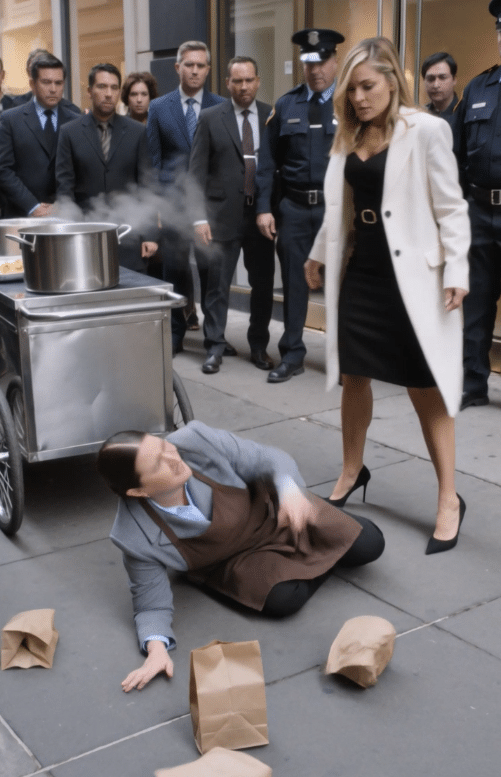
The soup pot rattled violently as the vendor crashed into her cart.
Steam burst upward.
Paper bags scattered across the sidewalk.
And the expensive handbag that had started the entire confrontation remained clutched tightly in the wealthy woman’s hand.
Forty-four-year-old Maria Bennett lay against the cart, struggling to catch her breath.
Her old gray coat was stained with spilled soup. One sleeve had caught against the metal edge, leaving a thin trace of blood on her forearm.
A moment earlier, she had been trying to maneuver her small food cart through the crowded sidewalk outside the luxury boutique.
Now she was on the ground.
The woman standing over her wore a spotless white coat, black dress, high heels, and the expression of someone who had already decided how the story would end.
It had supposedly started with a scratch.
A tiny mark on the side of her designer handbag.
She claimed Maria’s cart had caused it.
Maria had tried to explain.
“I’m sorry… I didn’t touch your bag…”
The woman looked at her as though she had just heard something ridiculous.
“Trash. You scratched a month of rent.”
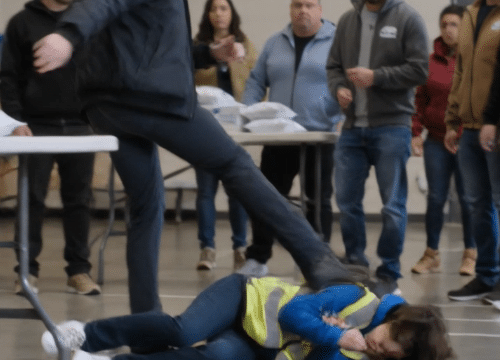
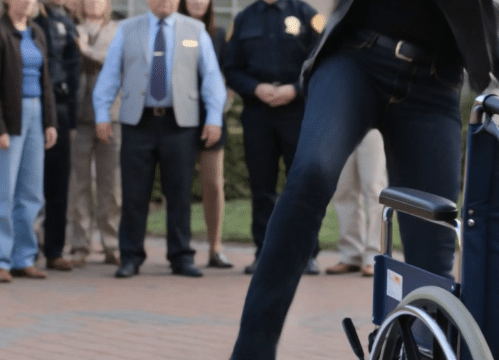
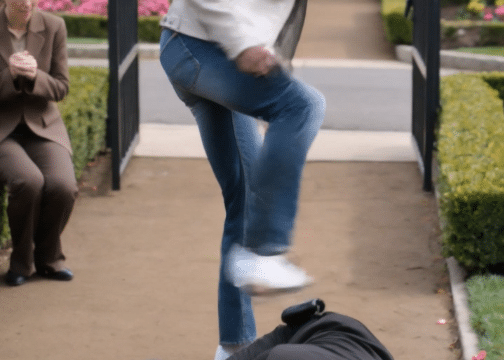
Then came the kick.
Maria was driven backward into the cart.
The soup pot shook.
Her hands grabbed desperately for the metal frame, but the cart rattled beneath her weight.
The woman stepped closer.
Two more kicks followed.
Maria curled instinctively against the cart, grimacing as she tried to protect herself.
The sidewalk had stopped moving.
People stared.
Some covered their mouths.
Others stepped backward.
Nobody intervened.
The woman looked down at Maria’s battered cart.
“Pay me from your cart.”
The words were almost casual.
As if Maria’s entire livelihood were nothing more than loose change.
Maria stared at the paper bags scattered across the pavement.
Inside those bags were the day’s meals.
Her rent money.
Her grocery money.
Her daughter’s school expenses.
Everything she had built had been reduced, in that moment, to a demand she could never afford.
Then the boutique door swung open.
Three people rushed onto the sidewalk.
A store manager.
A security guard.
And the woman who owned the boutique itself.
She didn’t look at the handbag first.
She looked at Maria.
Then she looked at the cart.
Then at the woman holding the supposedly damaged bag.
And when she finally spoke, the entire sidewalk went silent.
“That bag was already damaged.”
The wealthy customer froze.
Because the boutique owner hadn’t merely witnessed what happened—she had seen the bag before Maria’s cart ever came near it.
Act II
Maria had been selling soup on that corner for almost six years.
She wasn’t rich.
She wasn’t connected.
She didn’t own a restaurant with polished floors and expensive lighting.
She owned a cart.
Every morning, she arrived before sunrise.
She prepared the ingredients in a small licensed kitchen, loaded the containers, checked the wheels, and pushed everything into the shopping district before the sidewalks became crowded.
Her customers knew her.
Construction workers stopped for lunch.
Office employees came for soup when the weather turned cold.
Delivery drivers sometimes bought meals in pairs because they knew they wouldn’t have time to stop later.
Maria remembered names.
She remembered allergies.
She remembered which regular customer wanted extra bread.
She had built her business one paper bag at a time.
The luxury boutique beside her cart was almost the opposite world.
Its windows displayed handbags that cost more than Maria’s monthly income.
Its entrance was framed in polished stone.
People walked inside carrying champagne-colored shopping bags and emerged wearing the expression of people who had just spent money without needing to think about it.
Maria didn’t resent them.
She simply knew she lived in a different world.
And the boutique’s owner, Eleanor Whitmore, knew it too.
Eleanor had seen Maria every morning for years.
She had watched the vendor arrive in the same gray coat.
She had seen her work through rain.
She had seen her push the cart when one wheel began sticking.
And she had occasionally watched customers from her own store cross the sidewalk to buy soup.
There had never been a problem.
Until the woman with the white coat arrived.
Her name was Vanessa Cole.
She was thirty-nine and accustomed to getting immediate attention.
When she entered a store, employees recognized her.
When something went wrong, someone usually apologized.
And when she noticed the scratch on her handbag that morning, she immediately decided who was responsible.
Maria.
The accusation had been convenient.
The cart was close.
The sidewalk was crowded.
And Maria looked like someone who couldn’t afford to argue.
Vanessa had noticed the tiny mark on her handbag earlier that morning.
She knew it hadn’t come from Maria.
She knew because the scratch had already been there.
But the boutique district had taught her something dangerous.
People often believed the person who looked powerful.
Maria had tried to explain.
Vanessa hadn’t wanted an explanation.
She wanted submission.
She wanted Maria to admit responsibility.
She wanted money.
And when Maria refused, even politely, Vanessa escalated.
The first kick shocked everyone.
The second made people step backward.
The third left no ambiguity about what was happening.
But there was something Vanessa didn’t know.
Eleanor Whitmore had a security system that covered the entire entrance.
The boutique cameras didn’t just record people walking through the glass doors.
They recorded the sidewalk immediately outside.
And one of those cameras had been running all morning.
It had captured Vanessa before the confrontation.
It had captured the handbag.
It had captured the scratch.
And it had captured something else.
Something that could destroy the accusation completely.
Eleanor had seen it from inside the store.
That’s why she came through the door so quickly.
She hadn’t rushed outside because of a noise.
She had rushed outside because she knew the truth.
And when the store manager pulled up the footage, the tiny scratch on that expensive handbag suddenly became the least important part of the story.
Act III
The security guard positioned himself between Vanessa and Maria.
The store manager moved toward the injured vendor.
Eleanor remained standing near the boutique entrance.
Her eyes stayed on the handbag.
Vanessa tightened her grip around it.
For several seconds, nobody spoke.
The sidewalk seemed to hold its breath.
Eleanor had owned the boutique for fifteen years.
She had dealt with theft accusations.
Customer disputes.
Insurance claims.
Fake returns.
Arguments over damaged merchandise.
She had learned one lesson better than almost anyone.
Never accuse someone before checking the evidence.
Especially when the accusation could destroy their livelihood.
The manager had already reviewed the exterior camera.
There was no mystery.
Earlier that morning, Vanessa had entered the boutique.
The scratch was already visible.
She had noticed it while looking at the bag beneath the store’s bright display lighting.
She had complained quietly to an employee.
Then she left.
Only later did she return to the entrance and encounter Maria’s cart.
That was when the accusation began.
The camera showed the cart passing several feet away.
No collision.
No contact.
No sudden movement.
Nothing.
The bag had already been damaged.
Eleanor knew it.
The manager knew it.
The security guard knew it.
And now everyone on the sidewalk was beginning to understand.
The wealthy customer had not made an honest mistake.
She had chosen a target.
Maria had been standing behind a small cart wearing an old coat.
Vanessa had been carrying a handbag worth more than some people’s cars.
It was easy to assume which person would have more to lose.
But Vanessa had made one mistake.
She had chosen the wrong place to lie.
The boutique was filled with cameras.
The sidewalk was covered by them.
And Eleanor had no interest in allowing her store to become the setting for a false accusation.
The most painful part was what had happened before the truth emerged.
Maria had been terrified.
Not because she thought she had done something wrong.
Because she knew exactly what would happen if Vanessa convinced enough people.
A luxury handbag could mean a lawsuit.
A claim against her business.
A police report.
A demand for money.
One accusation could wipe out months of earnings.
Maria had seen small vendors lose everything over disputes they couldn’t afford to fight.
She had been trying to keep her cart upright when Vanessa attacked her.
Now she was sitting on the pavement beside it.
Her eyes were lowered.
Her breathing was still uneven.
She looked at the scattered paper bags and seemed more upset about the ruined meals than her own injury.
That detail struck Eleanor.
Maria was thinking about customers.
Even after being attacked, she was thinking about the food.
The boutique owner stepped closer.
She looked at the handbag again.
The scratch was small.
The consequences of the lie were not.
Vanessa’s expression began to change.
The confidence in her eyes weakened.
She glanced toward the boutique.
Then toward the security guard.
Then back at Eleanor.
The crowd had changed too.
People who had been staring at Maria moments earlier were now staring at Vanessa.
The social balance had shifted.
The person demanding money was suddenly the person expected to explain herself.
And there was still one piece of the evidence Eleanor hadn’t revealed.
The camera hadn’t merely shown that the bag was already damaged—it showed exactly when Vanessa first noticed the scratch.
Act IV
The boutique manager held the tablet at chest height.
The footage was unmistakable.
Vanessa entered the store earlier that morning with the same handbag.
The scratch was already there.
She noticed it.
She examined it.
She knew about it.
Then she left.
Hours later, she returned.
That’s when she saw Maria.
And that’s when the story changed.
The handbag hadn’t been damaged by a food cart.
The accusation had been constructed around an existing defect.
Eleanor looked toward Maria.
The vendor was still sitting beside the cart.
The security guard had remained between her and Vanessa.
Nobody was going to let the confrontation continue.
Vanessa’s posture changed.
She had entered the sidewalk believing she controlled the situation.
She had expected Maria to apologize.
Then she expected Maria to pay.
Then she expected everyone watching to accept her version of events.
But now there was evidence.
Not rumor.
Not opinion.
Evidence.
The crowd grew quieter.
One person lowered their phone.
Another stepped farther away.
A man who had watched the entire confrontation shook his head silently.
The boutique manager continued reviewing the footage.
There was no dramatic mystery left.
Only consequences.
And that was exactly what Vanessa had failed to consider.
She had assumed money could purchase certainty.
She had assumed expensive clothing created authority.
She had assumed Maria’s modest cart meant the vendor had no power.
But evidence didn’t care about wealth.
A camera didn’t care about social status.
And Eleanor didn’t care how much Vanessa had spent in her boutique.
She cared about what had happened outside her door.
The security guard moved closer to Maria.
The store manager gathered the scattered paper bags.
Eleanor looked down at the soup cart.
Its side panel had been bent slightly from the impact.
One of the wheels had shifted.
This wasn’t merely a handbag dispute anymore.
A working woman had been attacked because someone wanted money from her.
And the person who had started the confrontation had been caught lying about the reason.
Vanessa looked toward the boutique owner.
Her lips parted.
For the first time, there was no cruel smile.
No certainty.
No performance for the crowd.
Only disbelief.
The accusation she had built so confidently was collapsing in front of everyone.
Eleanor didn’t need to insult her.
She didn’t need to humiliate her.
The truth was doing that work by itself.
The sidewalk had become a completely different place.
Maria’s gray coat no longer looked like a symbol of poverty.
It looked like a uniform.
A working woman’s uniform.
Her cart wasn’t something pathetic.
It was the reason she had been standing there every morning, earning her living honestly.
And the handbag?
It was simply a handbag.
Expensive.
Beautiful.
Already damaged.
But never Maria’s responsibility.
The security guard remained beside the vendor.
The crowd parted.
Vanessa clutched the bag against her chest.
Her eyes darted toward Eleanor.
She was finally beginning to understand.
The person she had tried to overpower had never been alone.
There had been cameras.
There had been witnesses.
And there had been one person inside the boutique who knew exactly what the handbag looked like before the confrontation.
Vanessa had wanted Maria to pay for a scratch. Now she was facing the consequences of an accusation that had been recorded from beginning to end.
Act V
The story spread through the district before the afternoon was over.
Not because Maria wanted it to.
She didn’t.
She simply wanted to go home.
She wanted to clean the soup cart.
She wanted to replace the damaged wheel.
She wanted to check her arm.
And she wanted to forget the humiliation of lying on the pavement while strangers watched.
But the people who had witnessed what happened couldn’t forget it so easily.
The truth had been too clear.
The woman who had demanded money had been wrong.
The woman she had attacked had been telling the truth.
And the boutique owner had proved it.
Eleanor eventually made sure Maria’s damaged cart was repaired.
She didn’t treat her like a charity case.
That wasn’t what Maria needed.
She needed her livelihood restored.
She needed the sidewalk to become ordinary again.
Most of all, she needed to know that one person’s wealth couldn’t erase another person’s dignity.
Vanessa’s accusation didn’t survive the evidence.
The boutique’s records and security footage established that the handbag had already been damaged.
The confrontation was documented.
The assault was witnessed.
And the demand for payment suddenly looked very different once the original accusation had collapsed.
But the most powerful moment came several days later.
Maria returned to the same corner.
Same gray coat.
Same brown apron.
Same cart.
Same soup pot.
She checked the wheel.
It rolled smoothly.
Then she opened the lid.
Steam rose into the morning air.
People began lining up.
One office worker who had witnessed the confrontation stepped forward.
He bought two containers.
Another customer came over.
Then another.
Nobody made a speech.
Nobody needed to.
Maria simply served them.
For the first time since the incident, she smiled.
Across the sidewalk, the boutique’s glass doors reflected the morning sun.
Eleanor stood inside for a moment, watching.
She had learned something too.
Luxury didn’t protect a person from being wrong.
Money didn’t turn an accusation into truth.
And a person wearing an old coat wasn’t automatically powerless.
Sometimes dignity looked nothing like wealth.
Sometimes it looked like a woman standing behind a battered food cart at seven in the morning, serving soup to strangers because she refused to let one terrible afternoon decide who she was.
Maria never recovered the lunch bags scattered across that pavement.
She never erased the memory of the kicks.
She never forgot the silence of the crowd.
But she remembered something else.
The moment the boutique door opened.
The moment security stepped between her and the person attacking her.
The moment the truth came from someone who had absolutely nothing to gain by lying.
And the moment a tiny scratch on an expensive handbag stopped being a weapon.
Because the bag had never been damaged by Maria.
The accusation had.
And once the truth was visible, no amount of money could put that lie back together.
Vanessa had walked onto that sidewalk believing she could buy obedience.
She left knowing there was one thing money couldn’t purchase.
The right to rewrite the truth.