Act I
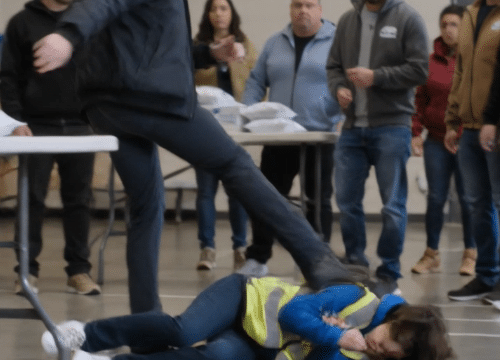
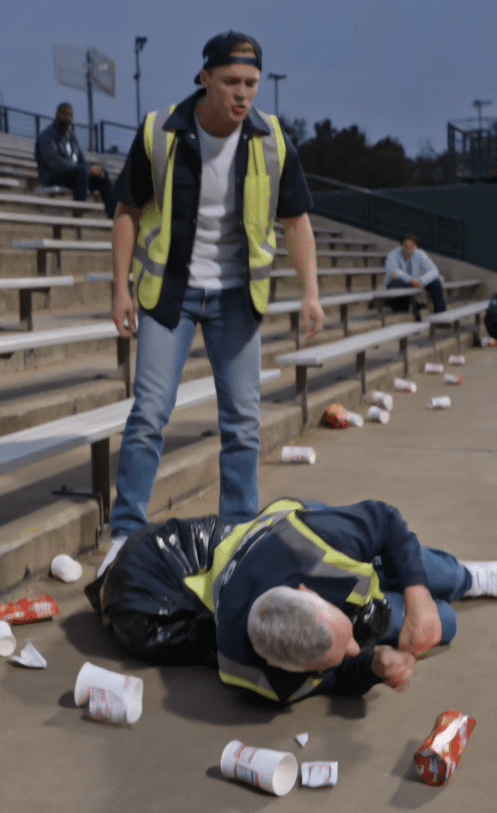
The kick sent the old cleaner crashing backward into the metal bleachers.
His large trash bag burst open on impact.
Paper cups bounced down the steps. Half-empty snack boxes scattered beneath the seats. His litter picker clattered onto the concrete as his elbow struck the sharp edge of a metal bench, leaving behind a thin trace of blood.
For one frozen second, the stadium seemed enormous and empty.
The scoreboard had gone dim.
The crowd was almost gone.
Only the echo of departing footsteps remained.
The sixty-one-year-old cleaner curled slightly on the bleacher step, breathing hard through the pain.
His dark blue uniform was covered in dust.
His yellow reflective vest had twisted sideways.
He looked up at the young man standing above him.
“I only asked you to use the bin…”
The young man didn’t look embarrassed.
He looked entertained.
He wore an expensive baseball jersey, a backward cap, jeans, and spotless white sneakers.
“Trash. Clean it like you’re paid to.”
The cleaner’s eyes dropped to the cups and snack boxes scattered around him.
He had spent the entire evening doing exactly that.
Cleaning.
Picking up what other people left behind.
Trying to finish his shift before the stadium lights shut down completely.
But the young man wasn’t finished.
He stepped down another bleacher.
Then delivered two more forceful kicks into the cleaner’s back and side.
The old man’s face tightened.
His breathing became ragged.
The witnesses nearby gasped and stepped backward.
Nobody helped.
Nobody moved toward him.
The young man looked down at the scattered trash.
“Pick it up from there.”
Then came a sound from the tunnel.
A heavy metal door slammed open.
And suddenly, the man who had been laughing wasn’t laughing anymore.
Act II
The cleaner’s name was Frank Miller.
Sixty-one years old.
He had worked at the stadium long enough to know which sections filled first, which bathrooms always needed another inspection, and which fans left their trash behind no matter how many bins were placed nearby.
He knew how to disappear into the background.
That was part of the job.
People noticed the players.
They noticed the scoreboard.
They noticed the food.
They noticed the final score.
They rarely noticed the man carrying the trash bag after everyone else went home.
Frank didn’t mind.
He had never needed applause.
He liked honest work.
Every night, when the stadium emptied, he walked through the rows with his litter picker, collecting cups, wrappers, snack boxes, and whatever else people decided wasn’t their responsibility.
That evening had been particularly busy.
The home team had won.
The stands had been loud.
Families had stayed late.
Teenagers had celebrated.
And one group of young men had apparently decided that the emptying stadium was their private playground.
They left paper cups under the seats.
Snack boxes on the steps.
Trash beside the railings.
Frank approached them politely.
He didn’t threaten them.
He didn’t lecture them.
He simply pointed toward the nearby bin.
The young man in the baseball jersey laughed.
His name was Tyler Brooks.
Twenty-four.
He had come to the game with several friends, and throughout the evening he had behaved as though being loud made him important.
He had money.
Nice clothes.
A confident smile.
Friends who laughed at nearly everything he said.
What he didn’t have was patience.
Frank’s request embarrassed him.
Not because it was unreasonable.
Because his friends were watching.
Tyler couldn’t tolerate being corrected by someone wearing a cleaning uniform.
So he turned the request into a confrontation.
Frank tried to walk away.
Tyler followed.
The old cleaner continued gathering trash.
Then Tyler stepped directly into his path.
Frank looked at him.
The young man’s smile widened.
The next moment, Tyler lunged down the bleacher step.
The kick came hard.
Frank went backward.
The trash bag tore.
Everything he had spent hours collecting exploded across the seats.
It was almost symbolic.
The man whose job was to clean up everyone else’s mess had suddenly become part of one.
Frank’s elbow hit metal.
His face tightened with pain.
His litter picker lay several feet away.
He could hear people gasping.
He could hear someone whispering.
But no one came.
Tyler stood over him.
Frank tried to explain that he had only asked them to use the bin.
Tyler’s answer was cruel.
Then came the second assault.
By the time Tyler told him to pick up the trash from the floor, Frank’s hands were shaking.
But something Tyler didn’t know was that Frank had been watching this stadium change for years.
He had seen players arrive as unknown rookies and leave as stars.
He had seen coaches fired.
Owners celebrated.
Owners criticized.
He had seen fans come and go.
And he had learned something about the building that Tyler had not.
The people who looked like they had the least power sometimes knew the most about what happened inside.
Frank knew who worked here.
Who owned the building.
Who walked through the private tunnel.
And which doors were never supposed to be opened without authorization.
That last detail was about to matter.
Because the metal door at the end of the tunnel had just opened.
And the person walking through it knew Frank far better than Tyler could imagine.
Act III
The door slammed against the wall.
Two security officers came through first.
Then came a man in a navy blazer over a white shirt.
Stadium credentials hung visibly from his neck.
He wasn’t dressed like a player.
He wasn’t dressed like a coach.
He wasn’t dressed like stadium staff.
He looked like someone who didn’t need to explain why he was there.
His name was Richard Bennett.
Fifty-seven years old.
Owner of the baseball team.
He had been inside one of the field offices when a security employee alerted him to what was happening in the bleachers.
At first, Richard thought it was another argument.
Then he heard the words “cleaner” and “kicked.”
He left immediately.
Now he stood at the top of the bleachers.
His eyes moved across the scene.
The scattered cups.
The snack boxes.
The torn trash bag.
The litter picker.
And finally, Frank.
Richard’s expression changed.
He moved toward him.
Not toward Tyler.
Toward Frank.
One security officer immediately positioned himself between the young man and the fallen cleaner.
The second moved toward the nearest exit.
The atmosphere shifted so quickly that several witnesses instinctively stepped aside.
Tyler looked around.
He had expected someone to yell at him.
Maybe security.
Maybe a supervisor.
But this wasn’t a supervisor.
This was the owner.
And Richard wasn’t looking at Tyler with the irritation of a businessman dealing with an inconvenience.
He looked at Frank with recognition.
The kind of recognition that made Tyler suddenly wonder whether the cleaner had a completely different place in this organization than he had assumed.
Richard bent down slightly.
“Frank.”
The cleaner looked up.
His eyes were tired.
Humiliated.
Pain still showed across his face.
But when he saw Richard, something in his expression softened.
Not relief exactly.
Something deeper.
Trust.
Richard had known Frank for years.
But the story Tyler didn’t know went back much further.
Frank had once been one of the stadium’s most important behind-the-scenes employees.
Not because of his title.
He had never had a glamorous title.
Years earlier, when the organization was struggling financially, Frank had quietly helped the team survive a difficult transition.
He knew the old stadium systems.
He knew which vendors could be trusted.
He knew how the building operated from top to bottom.
But even that wasn’t the reason Richard respected him.
Richard respected Frank because when Richard’s father had owned the team, Frank had been there through some of the organization’s darkest years.
He had stayed when other employees left.
He had worked double shifts when the stadium was understaffed.
He had helped families find lost children.
He had carried equipment during emergencies.
And when Richard eventually took over the organization, Frank never asked for a promotion.
He never asked for recognition.
He simply asked to keep working.
Richard gave him that choice.
Frank chose the cleaning crew.
He liked being close to the stadium without being at the center of it.
That was why Richard knew exactly who was lying on the bleachers.
Not “the cleaner.”
Frank.
A man who had given decades of his life to the organization.
A man Richard’s family trusted.
A man who had earned a level of respect Tyler couldn’t buy with the clothes on his back.
Richard stood.
He looked at the scattered trash.
Then at Tyler.
The security officers tightened their positions.
Richard spoke.
“Lock the gates. No one leaves yet.”
The stadium went silent.
The last few doors began closing.
The echo of the locks traveled through the empty concourse.
Tyler stared toward the exits.
His friends looked at one another.
Nobody laughed anymore.
Richard hadn’t explained why the gates were being locked.
He didn’t need to.
Not yet.
Because there was another piece of the story Tyler hadn’t discovered.
Frank wasn’t the only person Richard had come looking for that night.
Act IV
The stadium changed in seconds.
The gates locked.
Security moved into position.
The tunnel doors closed behind Richard.
The few remaining witnesses stood completely still.
Tyler looked toward the exit.
Then back toward Richard.
Then down at Frank.
For the first time, he seemed to understand that this wasn’t going to end with everyone simply walking away.
The man who had wanted to avoid a simple request about trash had turned a nearly empty stadium into a controlled scene.
And the irony wasn’t lost on anyone.
Tyler had wanted Frank to clean up his mess.
Now the stadium itself had stopped so that the mess could be dealt with properly.
Richard didn’t shout.
He didn’t threaten.
He didn’t even insult Tyler.
Instead, he walked toward Frank’s scattered belongings.
He picked up the litter picker.
Then he noticed something lying underneath one of the snack boxes.
A small laminated card.
Richard recognized it immediately.
It was Frank’s employee identification card.
But beneath his name was a designation Tyler had never bothered to notice.
Frank had been with the organization for twenty-seven years.
Twenty-seven.
Longer than Tyler had been alive.
Richard looked at the card.
Then at Frank.
And suddenly the owner’s anger became quieter.
More controlled.
That was worse.
Frank slowly tried to sit up.
His face tightened.
Richard didn’t touch him.
He knew Frank hated being treated as helpless.
Instead, he instructed security to keep the area clear while Frank gathered his breath.
The witnesses watched.
No one spoke.
The stadium that had been full of cheers less than an hour earlier now felt almost sacred.
The scoreboard glowed faintly in the distance.
The bleachers were empty.
The field lights were dimming.
And in the middle of it all sat an exhausted sixty-one-year-old man in a cleaning uniform.
Tyler finally noticed what the others had noticed.
Frank wasn’t embarrassed because he was ashamed of his job.
He was embarrassed because someone had tried to make him feel small for doing it.
That distinction mattered.
Richard turned toward Tyler.
His expression was calm.
But there was no friendliness left in it.
The security officers remained between them.
Tyler’s friends stood farther away.
One stared at the floor.
Another kept glancing toward the locked gate.
The young man’s confidence was cracking.
Yet Tyler still seemed unable to understand why Richard had ordered the entire stadium locked down.
Then Richard looked toward the tunnel.
One of the security officers gave him a brief nod.
A report was already being prepared.
The cameras had recorded what happened.
The stadium’s security system had captured the confrontation from multiple angles.
The truth wasn’t going to depend on competing stories.
There would be no argument about who started it.
No question about what happened.
No convenient version of events.
The cameras had seen everything.
And Richard knew it.
That was the moment Tyler realized something far worse than being embarrassed in front of his friends.
He had lost control of the story.
He couldn’t talk his way out.
He couldn’t simply leave.
He couldn’t pretend it had been an accident.
And he couldn’t make Frank look like the problem anymore.
Frank’s trash bag had burst open.
But the evidence was everywhere.
Cups.
Boxes.
The litter picker.
The security footage.
And the faces of everyone who had witnessed it.
Richard looked once more at Frank.
Then at Tyler.
The stadium remained silent.
Tyler’s smile was completely gone.
And when he finally heard the lock click behind him, he asked the only question he could think of.
Act V
“Lock the gates?”
Tyler’s voice was quieter now.
The words echoed through the empty stadium.
Nobody answered immediately.
That silence was the answer.
The gates weren’t locked to trap Tyler for dramatic effect.
They were locked because Richard refused to let the situation disappear into the night before the facts were documented.
Security had already begun preserving the footage.
The remaining witnesses were being separated from the confrontation.
And Frank was finally being given the time he needed to recover from the assault.
For years, Frank had worked beneath the attention of thousands.
He had cleaned seats after victories.
He had cleaned seats after losses.
He had picked up spilled drinks after celebrations.
He had collected forgotten gloves, hats, programs, and children’s baseballs.
Most fans never knew his name.
Richard did.
That was enough.
Frank eventually looked across the empty bleachers.
The trash was still everywhere.
Cups rested between the seats.
Snack boxes lay scattered across the concrete.
His torn bag sat nearby.
Under normal circumstances, Frank would already have started cleaning.
That was the kind of man he was.
But this time, he didn’t move.
He didn’t need to.
For once, someone else could handle the mess.
Richard approached him.
There was no grand speech.
No performance for the witnesses.
Just a quiet understanding between two men who had spent years inside the same organization.
Frank had done his job.
He had asked for one simple thing.
Use the bin.
Nothing more.
And for that, he had been attacked by someone who believed a cleaning uniform meant the person wearing it had less value.
Tyler had mistaken a job for a person’s worth.
He had mistaken patience for weakness.
He had mistaken quietness for permission.
And now the entire stadium had witnessed the difference.
The most powerful person in the building wasn’t the man wearing the expensive jersey.
It wasn’t the loudest person.
It wasn’t the person surrounded by friends.
It was the person willing to stop everything when someone crossed a line.
The stadium owner had locked the gates because the incident mattered.
Because Frank mattered.
Because a workplace shouldn’t become a place where someone could be attacked simply for asking people to respect it.
Eventually, the gates would open again.
The stadium would empty completely.
The scoreboard would go dark.
The players would leave.
The lights would shut off.
Tomorrow, another game would come.
Fans would return.
They would cheer.
They would eat.
They would leave their cups behind.
And Frank would probably be there again.
Walking the rows with his litter picker.
Carrying another trash bag.
Doing the same quiet work he had done for twenty-seven years.
But after that night, there was one thing that had changed.
People knew his name.
Not because he had demanded attention.
Not because he had asked for sympathy.
But because one young man had tried to make him feel worthless, and the owner of the entire organization had stopped everything to prove otherwise.
The trash could be picked up.
The damaged bag could be replaced.
The scattered cups could be thrown away.
Even the bloodstained edge of the bleacher could be cleaned.
But dignity was different.
Once someone tried to take it from you, you remembered who stood up when it happened.
Frank would remember.
Richard would remember.
And so would everyone who stood frozen in those bleachers that night.
Because the stadium had begun as a place of celebration.
It ended as something else.
A reminder that the people working behind the scenes were not part of the scenery.
They were people.
And sometimes, the quietest person in the stadium had already earned more respect than the loudest person in the room could ever understand.