Act I
The first thing people noticed was not the shouting.
It was the silence that came after.
On a freezing winter morning outside a suburban American train station, commuters rushed through the snow with their heads down, trying to escape the bitter wind. The small coffee cart near the entrance was usually just another part of the morning routine — a warm cup before work, a quick pastry before catching the train.
But that morning, everyone stopped.
A young group of men stood beside the cart, laughing as they walked away with several hot coffees and pastries in their hands.
They had ordered more than they needed.
They had taken everything.
And they had not paid.
Behind the cart, a 38-year-old mother named Emily watched the coins in her small payment box disappear with every second she waited. Her old brown winter coat was covered in snow. Her gloves were worn thin. Her face carried the exhaustion of someone who had spent years fighting battles nobody else could see.
But she still stepped forward.
“Please…” she called out.
The young men turned around.
Emily swallowed her pride.
“That money is for my son’s medicine…”
For a moment, the station seemed to slow down.
Her six-year-old son sat beside the cart, wrapped tightly in a thick blanket, coughing softly. The medicine bags underneath the counter were the reason she had opened her cart before sunrise. The reason she stood outside in freezing weather. The reason she kept going when life had already taken so much from her.
She was not asking for charity.
She was asking them to pay for what they took.
But the man leading the group did not see a struggling mother.
He saw someone who embarrassed him in front of his friends.
The young man in the expensive black jacket looked at her like she was nothing.
“Trash. Beg somewhere else.”
A few commuters slowed down.
Some looked uncomfortable.
Nobody moved.
Because the worst moments in life often happen in front of many people — and somehow, everyone still feels alone.
Emily reached toward the spilled edge of the conversation, still hoping there was a piece of humanity left.
There wasn’t.
The bully turned back.
And what happened next would make everyone at that station remember the morning forever.
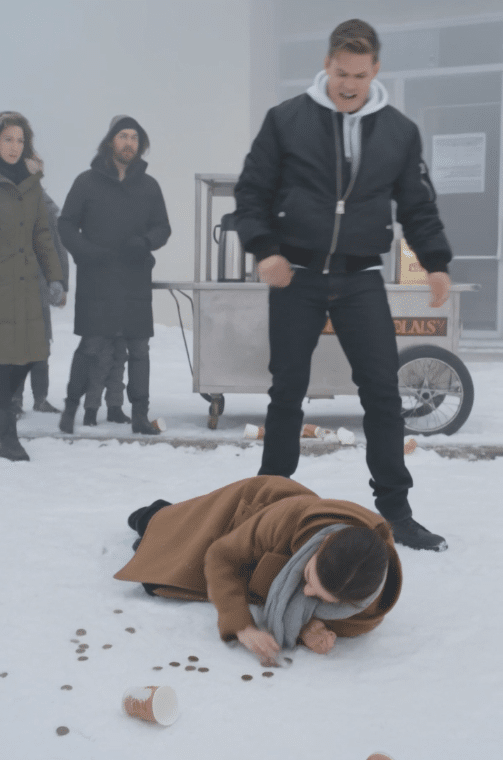
He attacked her without hesitation.
The impact sent her crashing beside the coffee cart onto the snowy pavement. Paper cups flew into the air. Lids scattered across the sidewalk. The coin box overturned, sending her hard-earned money rolling through the snow.
Her elbow struck the edge of the cart.
A small trace of blood appeared.
Nothing dramatic.
Nothing that matched the pain on her face.
She curled on the ground, struggling to breathe, but her eyes immediately searched for one person.
Her son.
That was the only thing she cared about.
And the bully still wasn’t finished.
Because he had mistaken kindness for weakness.
And he had no idea whose life he was about to change forever.
Act II
The snow continued falling as if the world itself was trying to cover what happened.
Emily had never imagined her life would end up like this.
Years earlier, she had been the kind of person who believed hard work could solve anything. She believed if she showed up every day, treated people fairly, and loved her family enough, somehow life would eventually reward her.
But life had a different lesson waiting.
After her husband left, Emily became the only person responsible for raising their son. Every bill became a calculation. Every grocery trip became a decision. Every winter became a test of survival.
The coffee cart was not a business dream.
It was a lifeline.
She knew every customer who stopped by. She remembered who liked extra sugar, who needed a stronger coffee, who was always late for the 8:10 train.
People saw a small cart.
Emily saw a future for her child.
Her son, Noah, had been sick for weeks. Nothing serious enough to attract attention from strangers. Nothing dramatic enough to make people stop.
Just a child fighting through cold nights, coughing under blankets while his mother searched for ways to afford the next prescription.
That was why she kept the medicine bags hidden under the counter.
Not because she was ashamed.
Because she knew how quickly the world judged people who struggled.
And that was exactly what the young men had done.
They saw an old coat.
They saw a small cart.
They saw someone they believed had no power.
The lead bully, Ryan, lived in a completely different world.
At twenty-five, he had never learned what it meant to worry about money. His expensive clothes, confident attitude, and group of friends gave him the illusion that he was untouchable.
People like Ryan rarely noticed the damage they caused.
Because they were used to consequences arriving for other people.
But there was one thing Ryan did not understand.
Power was not always loud.
Sometimes, it arrived quietly.
Sometimes, it came in a black sedan cutting through the snow.
And when that car stopped at the curb, the entire station was about to learn that Emily was not as invisible as they thought.
Act III
The sound of tires grinding against the snowy road changed everything.
A luxury black sedan stopped sharply near the station entrance.
The crowd looked over.
At first, nobody understood why.
The door opened.
A man stepped out wearing a long cashmere overcoat over a perfectly tailored black suit. His shoes were polished despite the snow. Behind him, a driver and an assistant followed immediately.
He did not rush.
He did not shout.
He simply walked forward.
And somehow, that was more frightening than anger.
Ryan’s friends stopped laughing.
The commuters who had looked away moments earlier now watched carefully.
The man walked past the scattered cups.
Past the spilled coins.
Past the frightened child.
And he stopped between Emily and the group.
The snow fell around him.
His expression did not change.
“Step away from her. Now.”
The words were quiet.
But they carried weight.
Ryan stared at him.
For the first time that morning, his confidence disappeared for a fraction of a second.
Because there was something different about this man.
He was not someone who needed to prove he had authority.
He already had it.
The driver stood behind him.
The assistant watched silently.
The crowd stepped aside.
Nobody knew who he was.
But everyone understood one thing.
This was not a stranger walking into a random argument.
This was someone who had arrived because Emily mattered.
Ryan looked around at his friends, expecting them to laugh it off.
But they didn’t.
The same people who had encouraged him moments earlier suddenly looked uncertain.
Because cruelty is easy when everyone around you is weak.
It becomes much harder when someone stronger walks into the room.
Ryan’s face hardened.
He tried to recover his pride.
“Who are you?”
But the question sounded different now.
Less like a challenge.
More like fear.
Because somewhere deep inside, Ryan realized something terrifying.
He might have just attacked the wrong person.
Act IV
The man did not answer immediately.
That silence was heavier than any explanation.
Emily remained on the ground, holding herself carefully while trying to comfort Noah. Her son’s crying had softened, but his eyes stayed fixed on the stranger standing between them and danger.
The man finally looked down at her.
Not with pity.
With recognition.
Like he had been searching for her longer than anyone knew.
Ryan noticed.
And that was when his confidence started collapsing.
Because this was no ordinary rescue.
There was history here.
A connection.
A reason.
The man glanced at the medicine bags under the cart.
Then at the fallen coins scattered across the snow.
Then at Emily.
Something changed in his expression.
Years of control remained on his face, but behind his eyes was something deeper.
Regret.
Anger.
And a memory.
Ryan’s group shifted nervously.
They had expected an argument.
Maybe a threat.
Maybe someone yelling.
They did not expect a man who looked like he had walked out of a boardroom to stand in defense of a woman everyone else had ignored.
The driver stepped forward slightly.
The assistant quietly made a phone call.
Suddenly, the young men understood they were no longer controlling the situation.
For the first time that morning, Ryan was the one being watched.
The people who had stayed silent now saw everything clearly.
The mother who begged for fairness.
The child who watched his mother get hurt.
The men who laughed.
And the stranger who arrived when nobody else did.
Ryan looked at the black sedan behind him.
He looked at the man standing calmly in front of him.
And the question he had asked seconds earlier suddenly felt much smaller.
Because he was no longer wondering who this man was.
He was wondering what this man knew.
Act V
Years later, people would remember that winter morning for one simple reason.
The powerful man did not arrive to show power.
He arrived to restore it.
The world had taken almost everything from Emily.
Her confidence.
Her security.
Her belief that people cared.
But one thing it had never taken was her dignity.
And that was the one thing Ryan had failed to understand.
He thought humiliation belonged to the person on the ground.
He thought money and status decided who mattered.
He thought a small coffee cart meant a small person.
He was wrong.
Because the woman he attacked was not invisible.
She was someone’s mother.
Someone’s friend.
Someone worth protecting.
The man in the black sedan looked at Ryan with the calm certainty of someone who had seen powerful people fall before.
He did not need to raise his voice.
He did not need to threaten him.
The truth itself was enough.
Ryan’s friends slowly stepped back.
The crowd remained silent.
The snow kept falling.
And in that moment, the balance of power completely reversed.
The same man who had stood over a helpless mother minutes earlier now stood frozen beneath the weight of a single unanswered question.
Who was the man who had come for her?
Ryan would find out soon.
And when he did, he would learn the most painful lesson of his life:
The people you choose to humiliate today may be the very people who hold the truth that destroys your tomorrow.