Act I
The transfer contract hit the old checkout counter so hard that the cash register rattled.
For a moment, the entire grocery store went silent.
The shelves filled with canned goods seemed to stand frozen around the woman who had spent more than twenty years behind that counter. The faded sign above the entrance still carried the same name her parents had painted decades ago: Family Grocery.
But now a stranger in an expensive black suit stood across from her, looking at the store like it was already another piece of property on his balance sheet.
The woman tightened her grip on the edge of the counter.
“This store is my family’s.”
Her voice was quiet, but it carried something the man clearly did not understand.
Pride.
The rival chain owner leaned forward, his silver watch catching the fluorescent lights above them. He placed one finger on the contract and pushed it closer.
“Trash. Small stores die.”
The words were not just cruel.
They were calculated.
He wanted her to feel powerless. He wanted her to believe that the years her family had spent building the store meant nothing compared to his money, his lawyers, and his influence.
Around them, customers stopped pretending not to watch.
A few people stood near the shelves, frozen between disbelief and fear.
Everyone knew what was happening.
A wealthy businessman was trying to erase a small family legacy in front of everyone.
And when she refused to sign, his patience disappeared.
What happened next made the entire store remember his name.
Act II
The grocery store had never been glamorous.
There were no polished marble floors. No luxury displays. No corporate logo shining above the entrance.
There were old wooden shelves, a worn checkout counter, and a front door that stuck slightly whenever the weather changed.
But to the owner, it was never just a business.
It was the place where her parents had worked until their hands became too tired. It was where she learned how to count change before she learned how to drive. It was where neighbors came during storms because they knew someone inside would always help.
The rival chain owner saw only numbers.
He saw a location.
A market opportunity.
A competitor that needed to disappear.
For months, his company had pressured small businesses across the neighborhood. Some owners gave in. Some accepted buyouts. Some simply closed because they could not fight someone with unlimited resources.
But this store was different.
She had already lost too much to surrender the last thing her family left behind.
The businessman stared at her refusal with growing anger.
“Sign before I close it for you.”
She looked at the contract.
Then she looked at the shelves behind him.
At the photographs hanging near the register.
At the faded sign her father had repaired himself years ago.
“No.”
That single word changed the atmosphere.
The man was not used to hearing it.
Not from employees.
Not from competitors.
And certainly not from someone he believed had no power.
He stepped around the counter.
The customers backed away.
The woman realized too late that the argument had become something far more dangerous.
The contract was still sitting there.
Waiting.
But the person who wanted it was no longer asking.
And the next few seconds would reveal exactly how far he was willing to go.
Act III
The sound that followed was not a crash.
It was a warning.
The old register shook.
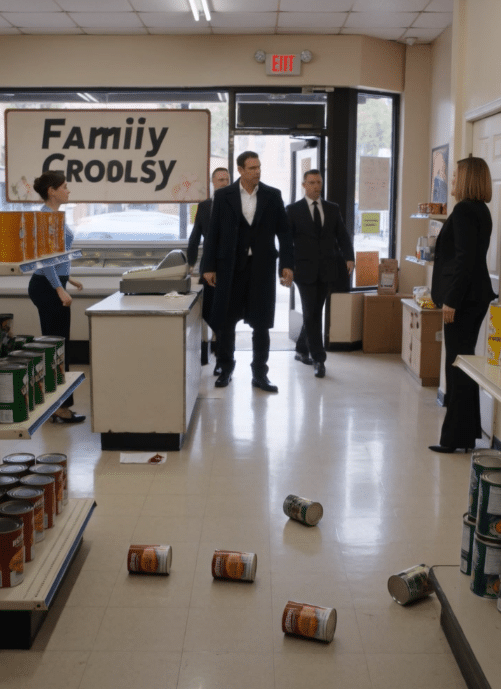
Cans fell from a nearby shelf.
The entire store seemed to react before anyone could.
The rival owner had crossed the counter.
In an instant, the person who had been demanding paperwork became the person everyone was afraid to challenge.
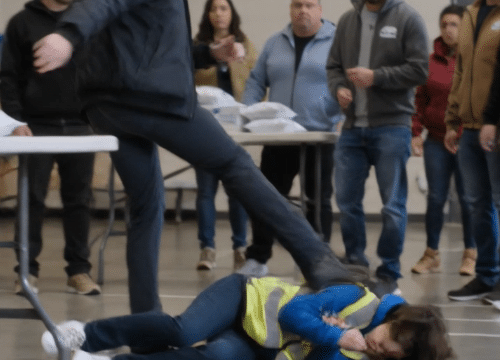
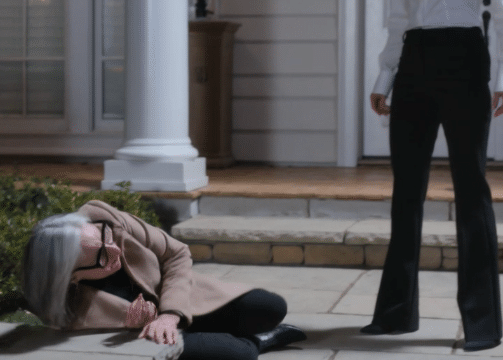
The family grocery owner hit the counter hard, the impact sending papers sliding across the floor. Her arm struck the edge of the counter, leaving a small mark as she struggled to push herself up.
The contract remained untouched.
That was the thing that seemed to anger him most.
Even after everything, she was still refusing to surrender.
She looked past him toward the old Family Grocery sign.
The same sign her parents had hung when the store first opened.
The same sign she had promised herself she would protect.
The man picked up the contract again.
“You still don’t understand,” he said.
He looked around the store as if he already owned it.
“This place is finished.”
But what he did not know was that someone else had already been watching.
Someone who understood exactly what was being taken.
Not just a building.
Not just a business.
A piece of someone’s life.
And that person was about to walk through the door.
Act IV
The front glass door suddenly burst open.
The sound cut through the store like thunder.
Everyone turned.
A man in a fitted black suit stepped inside, followed by two assistants.
He did not rush.
He did not need to.
The confidence in the room shifted the moment he entered.
The rival owner looked over his shoulder, expecting another customer.
Instead, he saw someone who made him stop moving.
The newcomer walked past the entrance and looked around.
At the fallen cans.
At the scattered papers.
At the frightened store owner behind the counter.
Then his eyes landed on the transfer contract.
The room became completely silent.
The rival owner tried to recover his confidence.
“You have no idea who you’re dealing with.”
The man in the black coat ignored him.
He simply looked at the contract again.
Then at the person who had tried to force it.
His voice was calm.
Almost too calm.
“Let her go.”
The words were not loud.
They did not need to be.
The two assistants moved forward, placing themselves between the businessman and the injured store owner.
For the first time all day, the rival owner looked uncertain.
Because this was no longer a small business owner standing alone.
This was someone who had backup.
Someone who knew exactly what was happening.
The bully’s expression changed.
The confidence started to crack.
And everyone watching realized the person who had controlled the room moments earlier was suddenly the one losing control.
Act V
The powerful man picked up the transfer contract from the counter.
He looked at the signature line.
Then he looked back at the rival owner.
The message was clear.
This was not about paperwork anymore.
It was about what someone was willing to do when they thought nobody could stop them.
The store owner sat quietly behind the counter, still holding onto the edge for support.
She had spent years believing she had to fight every battle alone.
But standing there in that moment, she finally understood something.
Sometimes protecting what matters does not mean having the most money.
Sometimes it means refusing to surrender long enough for the truth to arrive.
The rival owner stared at the man in front of him.
The same man who had walked into his victory and turned it into a defeat.
His voice, once filled with arrogance, was suddenly uncertain.
“Who are you?”
For the first time that day, he was not looking at a helpless store owner.
He was looking at someone who could challenge him.
Someone who knew the value of what he had tried to destroy.
And behind him, the old Family Grocery sign remained exactly where it had always been.
Still standing.
Still belonging to the family who built it.