Act I
The yacht’s engine was still idling beside the fueling dock when the coordinator pointed toward the bright warning sign.
“Sir, shut the engine off.”
Her voice was firm but controlled.
The white yacht rocked gently against its mooring lines as fuel hoses waited nearby. Dock workers paused in the middle of their routines, exchanging uneasy glances. Everyone at the marina understood the rule.
No engines during fueling.
It wasn’t paperwork.
It wasn’t bureaucracy.
It was the difference between a routine day on the water and a disaster.
The yacht owner leaned casually against the rail, barely acknowledging the warning.
Then he smiled.
“Trash. My yacht is different.”
The sentence floated across the dock with the ocean breeze.
The coordinator didn’t respond with anger.
She simply pointed once more to the large ENGINE OFF sign mounted beside the fueling station.
“Every vessel follows the same safety procedures.”
She never had the chance to finish.
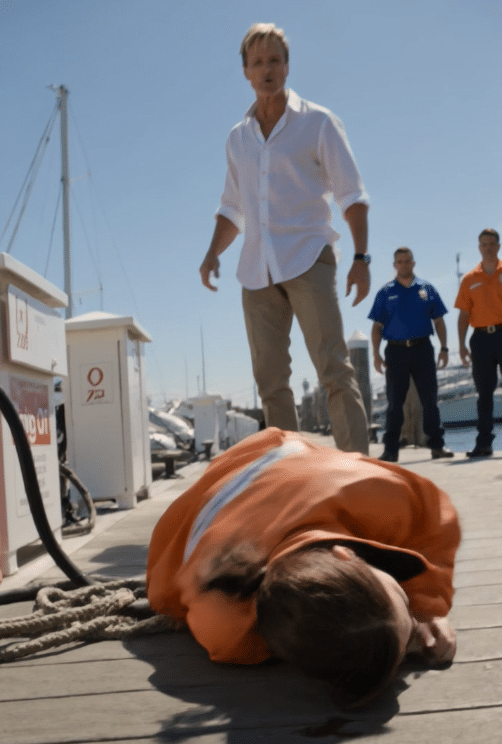
The owner stepped down onto the wooden dock and drove a brutal kick straight into her chest.
She crashed backward into a large bin filled with coiled mooring ropes.
Her handheld radio struck the weathered planks with a sharp crack.
Heavy ropes spilled across the dock as she fell, her palm scraping against the rough wood and leaving only a small trace of blood before she instinctively pulled her hand away.
The impact stole her breath.
She struggled to rise.
Before she could—
The owner stepped closer.
Two more hard kicks landed against her back and side as she curled on the dock beside the scattered ropes.
No one moved.
The fueling crew stood frozen.
Even the engine’s steady rumble suddenly sounded louder.
No one expected a routine safety reminder to end with violence.
But someone else had just arrived at the marina.
And the sound of screeching brakes changed everything.
Act II
The yacht owner believed wealth came with exceptions.
His vessel cost more than most houses.
His vacations stretched across private islands and exclusive harbors.
People usually hurried to satisfy his demands before he had to repeat them.
Rules, in his experience, were flexible.
Especially for people like him.
He stared down at the injured coordinator with complete indifference.
“Don’t touch my boat rules.”
Around him, the marina remained silent.
Dock workers wanted to intervene.
But fueling operations followed strict emergency procedures.
One careless movement near fuel lines could create an even greater danger.
The coordinator slowly forced herself upright.
Pain tightened across her chest, but her attention never drifted from the yacht’s still-running engine.
She wasn’t worried about herself.
She was watching the fueling zone.
Few visitors knew how many accidents she had quietly prevented over the years.
She wasn’t a harbor police officer.
She wasn’t a firefighter.
Yet every captain respected her judgment.
She had stopped fuel leaks before they spread.
She had prevented electrical hazards from becoming explosions.
She had guided inexperienced boaters through emergencies that could have ended in tragedy.
Most visitors remembered only her reminders.
Very few realized those reminders existed because others had once paid a terrible price for ignoring them.
Then the rumble of another vehicle echoed across the dock.
A harbor security cart raced toward the fueling area.
Every dock worker turned at once.
Someone important had arrived.
Act III
The harbor security cart stopped beside the dock with a sharp screech.
Port security officers stepped out first.
Then came the Harbor Master.
His weathered face revealed years spent commanding storms, emergencies, and countless difficult decisions.
He didn’t hurry.
He didn’t shout.
He simply walked toward the center of the confrontation.
Dock workers instinctively straightened.
Conversations stopped.
Even the yacht owner’s confident posture began to falter.
The Harbor Master’s eyes moved first to the injured coordinator.
Then to the yacht.
The engine was still running.
His expression hardened.
Only four words left his mouth.
“Cut his engine.”
The command carried across the marina like a ship’s horn.
Dock personnel reacted instantly.
One team secured the fueling area.
Port security positioned themselves between the owner and the injured coordinator.
Another worker safely shut down the yacht’s engine under established harbor procedures.
Within seconds, the entire marina was operating under one person’s authority.
For the first time that morning, the yacht owner’s confidence cracked.
He looked around.
No one stood with him anymore.
Every worker.
Every security officer.
Every captain nearby.
Their attention belonged to the Harbor Master.
What the yacht owner didn’t know was that the woman he had attacked had once saved lives without anyone ever hearing her name.
Act IV
Years earlier, the marina had faced one of the most dangerous fuel dock incidents in its history.
A visiting vessel ignored shutdown procedures while refueling.
Fuel vapors accumulated around the dock.
A single spark nearly turned the harbor into a catastrophe.
The young dock coordinator recognized the danger before anyone else.
She immediately halted fueling operations, evacuated nearby workers, and ordered emergency isolation of the area.
The investigation later confirmed that her quick judgment prevented a major explosion.
Afterward, she worked alongside harbor officials to redesign fueling procedures, improve emergency training, and strengthen safety enforcement throughout the marina.
Many captains complained about the stricter rules.
Most eventually came to appreciate them.
The Harbor Master never forgot who had insisted that convenience should never outweigh safety.
That was why his expression remained cold as he looked toward the yacht owner.
This wasn’t simply an assault.
It was an attack on someone who had dedicated her career to preventing disasters most people would never even know had almost happened.
The yacht owner swallowed hard.
“Who are you?”
The arrogance was gone.
Only uncertainty remained.
The Harbor Master offered no explanation.
He didn’t need to.
The dozens of workers standing silently behind him had already answered the question.
Authority at a harbor isn’t measured by the size of a yacht.
It’s measured by the responsibility to protect everyone on the water.
And the woman lying on that dock had carried that responsibility for years.
The balance of power had shifted completely.
Act V
Medical responders carefully examined the coordinator while the fueling operation resumed under strict supervision.
As she sat against the dock railing, one dockhand quietly handed her the radio that had skidded across the wooden planks.
She clipped it back onto her vest before asking only one question.
“Is the fueling zone secure?”
The Harbor Master glanced toward the now-silent yacht.
“It is.”
Only then did she allow herself to relax.
The dock slowly returned to its rhythm.
Fuel hoses were reconnected safely.
Boats departed one by one.
Seagulls circled overhead as waves gently struck the pilings beneath the marina.
The yacht owner stood alone, surrounded not by admiration, but by silence.
He had believed owning an expensive yacht placed him above ordinary rules.
Instead, he learned the lesson every experienced mariner already understood.
The ocean doesn’t care how wealthy you are.
Fuel doesn’t recognize privilege.
Safety rules exist because someone, somewhere, once paid the price for ignoring them.
People who witnessed that afternoon would later remember many things.
They remembered the Harbor Master’s calm authority.
They remembered the dock workers who moved as one the moment real leadership arrived.
But above all, they remembered the coordinator.
A woman who never confused enforcing safety with seeking power.
She wasn’t protecting regulations.
She was protecting lives.
Because true leadership isn’t measured by the vessel you own.
It’s measured by the people who return home safely because someone had the courage to insist that the rules applied to everyone.