Act I
The knitted scarf slipped from the elderly woman’s trembling hands and landed beside an expensive leather boot.
She gasped softly.
“I’m so sorry…”
At seventy-three, her fingers no longer moved as quickly as they once had. The icy wind sweeping across the tourist pier made them stiff despite the fingerless gloves she wore every day. She immediately bent down, clasping her hands in apology before reaching for the scarf.
She never touched the tourist.
She barely came close.
But that tiny accident was all the wealthy woman needed.
Dressed in a spotless white fur coat with oversized sunglasses and a designer handbag hanging from one shoulder, she stepped back as though something disgusting had crawled across the wooden deck.
Her lips curled in contempt.
“Trash. Your dirty scarf touched me.”
The words cut through the sound of crashing waves.
Nearby tourists slowed their steps.
Some turned to watch.
Others pretended not to notice.
The elderly woman lowered her head.
“I washed it this morning.”
Her voice was almost carried away by the wind.
She had knitted every scarf by hand, sitting beside the same folding chair through rain, summer heat, and freezing winters. Each one took nearly two full days to finish.
She wasn’t selling souvenirs.
She was selling time.
Selling survival.
Selling another chance to buy food before the next morning.
The wealthy tourist didn’t care.
She looked at the small wooden stand, the handwritten sign listing modest prices, and the old woman’s patched wool coat as if none of it belonged on the beautiful waterfront.
Then she took one slow step forward.
No one imagined she was about to turn a harmless mistake into something unforgettable.
Act II
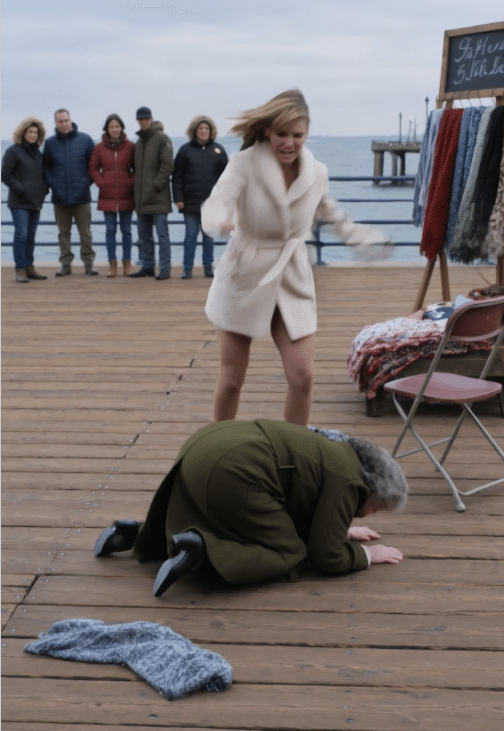
The kick struck without warning.
The elderly woman was thrown backward onto the weathered wooden pier beside her folding chair.
The chair toppled over.
Scarves scattered across the deck, colorful strands rolling through the freezing wind until one disappeared toward the edge of the pier.
Her palm scraped against the rough timber.
A faint streak of blood appeared.
Small.
Barely noticeable.
Yet it stunned the crowd into silence.
The old woman struggled to breathe.
She wasn’t crying because she had fallen.
She was staring helplessly at the scarves blowing farther away.
Each one represented hours of work.
Hours her aging hands could never get back.
Years earlier, after losing her husband to a fishing accident, she refused to leave the harbor town where they had spent their entire lives. Instead of asking strangers for help, she taught herself to knit, believing that as long as she could still create something with her own hands, she would never lose her dignity.
Every scarf she sold bought another day of independence.
The wealthy tourist stepped closer.
Without hesitation, she delivered two more brutal kicks into the old woman’s back and side.
The scarves continued tumbling across the pier.
No one moved.
No one spoke.
The woman adjusted her designer handbag as though nothing unusual had happened.
Then she looked down with cold satisfaction.
“Tourists shouldn’t see people like you.”
The sentence hung in the air heavier than the winter wind.
The elderly woman slowly reached toward one scarf sliding away across the deck.
Not because it was expensive.
Because she remembered exactly who she had knitted it for.
A young girl visiting from another state had admired it the previous afternoon and promised to return with her father.
She never got the chance.
Then…
A deep horn echoed across the harbor.
Every employee on the pier looked toward the glass office.
And everything changed.
Act III
The glass office door swung open.
A tall man stepped outside, his long dark coat billowing in the wind.
Behind him came several members of the pier security team.
No one had called them.
No one needed to.
The moment employees saw him, conversations stopped.
Even the gulls circling overhead seemed quieter.
The owner of the tourist pier walked forward with measured steps.
He didn’t hurry.
Authority never had to.
His eyes swept across the scene.
The scattered scarves.
The overturned chair.
The elderly woman struggling to sit upright.
Finally…
The wealthy tourist.
His expression turned colder with every step.
Security immediately moved between the old woman and her attacker, carefully shielding her without saying a word.
The owner stopped only a few feet away.
His voice remained calm.
“She has sold here for twenty years.”
That was all.
No accusations.
No shouting.
Just one sentence.
Yet every person standing on the pier instantly understood what it meant.
The wealthy tourist frowned.
“You know her?”
She expected the old man to be another employee.
Another manager.
Someone who could be ignored.
Instead, she noticed something unsettling.
Security wasn’t watching the elderly woman.
They were watching her.
And suddenly, the crowd no longer looked impressed by her designer clothes.
They looked embarrassed for her.
Because everyone on the pier knew a story she didn’t.
Act IV
Twenty years earlier, when the waterfront was little more than cracked timber and abandoned fishing docks, the elderly woman had been there every morning.
She greeted visitors before there were souvenir shops.
Before restaurants.
Before luxury cruises.
Before the pier became one of the town’s biggest attractions.
The owner remembered those days well.
He had inherited almost nothing except debt and collapsing docks.
Many locals left.
She stayed.
When construction workers rebuilt the waterfront, she brought them warm scarves during freezing mornings.
When storms damaged the boardwalk, she volunteered to cook meals for repair crews.
When tourists finally arrived years later, she welcomed every visitor with a smile that never depended on how much money they carried.
To many people, she was simply an old vendor.
To the owner…
She was part of the soul of the pier.
He knelt beside her carefully.
“Are you hurt?”
She tried to smile despite the pain.
“I’m worried about my scarves.”
The answer broke something inside the surrounding crowd.
Even after being humiliated, she thought first about the work she might lose.
The owner helped gather one scarf that had nearly blown into the water.
Then he stood and faced the tourist.
“You looked at this pier…”
He paused.
“…and thought wealth built it.”
His eyes moved toward the elderly woman.
“It was people like her.”
Silence settled over the waterfront.
Not one tourist lifted a phone anymore.
Not one employee looked away.
The truth itself had become impossible to ignore.
The wealthy tourist finally removed her sunglasses.
For the first time that afternoon, confidence abandoned her.
Act V
The wind gradually slowed as security helped the elderly woman back into her folding chair.
Employees quietly gathered every scattered scarf.
One young vendor repaired the handwritten sign.
Another brought her a warm cup of tea.
Visitors who had walked past her stand only minutes earlier now formed a small line.
Not out of pity.
Out of respect.
The owner announced that she would never again pay a rental fee for her small space on the pier.
“As long as I’m here,” he said softly, “this corner belongs to you.”
Tears filled the old woman’s eyes.
She had spent two decades wondering if anyone noticed the quiet life she had built one scarf at a time.
Now she finally knew.
The wealthy tourist stood alone on the wooden deck.
Her expensive coat offered no protection from the cold shame creeping across her face.
She stared at the owner, trying to understand why a frail old woman mattered so much.
Her voice trembled.
“You know her?”
The owner never answered directly.
He simply picked up one of the knitted scarves, folded it with gentle care, and placed it back on the small wooden stand.
Some people earn respect through money.
Others earn it through a lifetime of quiet kindness.
On that freezing afternoon, everyone on the pier finally understood which one would always matter more.