Act I
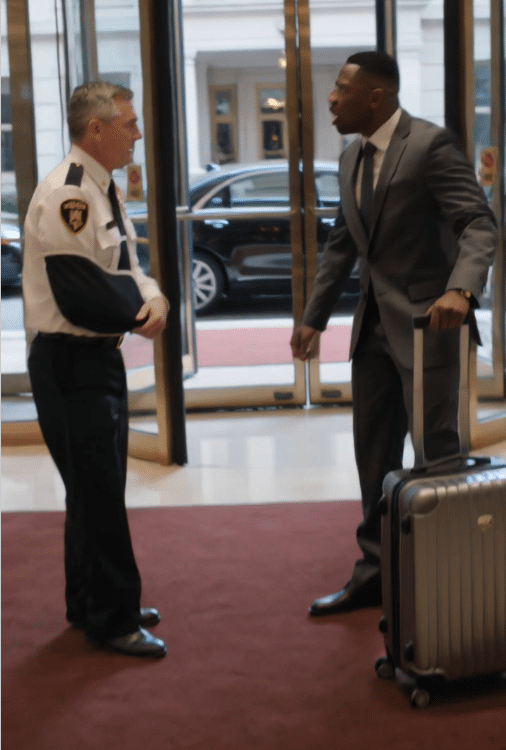
The glass door lingered open for only a second longer than usual.
Sixty-four-year-old Samuel Carter steadied it with his only arm, carefully shifting his weight so a guest could pass without the heavy door swinging shut. Every movement required patience, but after years on the job, he had learned how to make even the smallest gesture look effortless.
Almost.
The businessman waiting outside didn’t see effort.
He saw inconvenience.
“Trash. Open the door faster.”
Several reception staff glanced toward the entrance, but Samuel simply offered the same courteous smile he gave every guest.
“I’m sorry for the delay, sir.”
It was only a few seconds.
Nothing more.
The businessman tightened his grip on the handle of his expensive suitcase.
His face reddened with irritation.
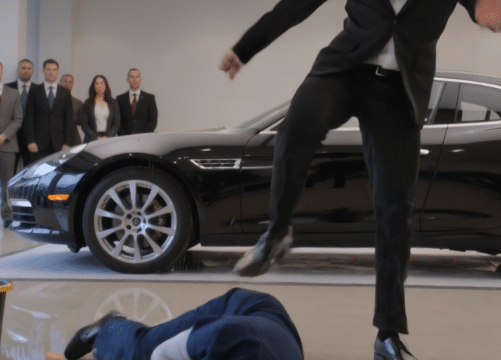
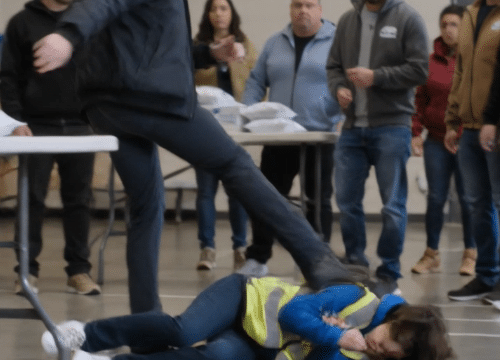
Without another word, he stepped forward and struck Samuel with a violent shove-like blow that sent the elderly doorman crashing backward onto the lobby carpet near the polished marble entrance.
His cap slid across the floor.
His shoulder struck the edge of the marble with a dull impact, leaving only a faint patch of redness.
Guests froze.
Suitcase wheels stopped rolling.
Samuel struggled to sit upright.
Before he could recover, the businessman stood over him.
“You’re too slow to work here.”
Silence swept through the lobby.
No one had expected a moment of impatience to become something so cruel.
Then the sound of several engines echoed outside.
A convoy of black luxury cars stopped at the hotel entrance.
The revolving doors reflected flashing headlights.
And every employee instinctively looked toward the driveway.
Act II
The lead vehicle stopped directly in front of the hotel.
Its rear door opened immediately.
An older man in an impeccably tailored suit stepped onto the red carpet, followed by assistants and security personnel.
The hotel manager, who had been hurrying toward the disturbance, abruptly changed direction and walked straight toward the new arrival with unmistakable respect.
The older man didn’t acknowledge the greeting.
His attention went directly to Samuel.
Ignoring everyone else, he crossed the lobby and knelt beside the fallen doorman.
“Take your time.”
His voice was calm.
He helped Samuel back into a seated position, retrieved the cap that had slid across the marble, and placed it gently beside him.
Only then did he rise.
He stepped between Samuel and the businessman.
His expression remained controlled, but his eyes carried unmistakable disappointment.
“You have no idea who you just touched.”
The lobby became so quiet that even the fountain near the reception desk seemed loud.
Behind the older man, his assistants stood silently.
The hotel manager remained respectfully a step behind them.
For the first time since entering the hotel, the businessman’s confidence wavered.
Everyone around him seemed to know something he didn’t.
Act III
Samuel adjusted his uniform jacket with his remaining hand.
“I’m alright,” he said softly.
“My shift isn’t over yet.”
The older man looked at him for a long moment.
“You’ve always said that.”
Years earlier, Samuel had served in the military before losing his arm during a rescue operation that saved several fellow service members.
After leaving the military, he refused to let his injury define the rest of his life.
He wanted work.
Not sympathy.
When the hotel first interviewed him, some questioned whether he could manage the demanding role of greeting guests and handling heavy entrance doors.
Samuel insisted on trying.
Within weeks, guests remembered him by name.
He welcomed every visitor with the same warmth.
He learned the names of regular travelers.
He quietly helped elderly couples with luggage and patiently held the doors for families juggling children, bags, and strollers.
Many never noticed that everything he did was accomplished with one arm.
The older man knew all of this.
Not because someone had told him.
Because he had watched Samuel work for years.
Whenever business brought him to the city, Samuel was the first face he saw.
And the last before he left.
Turning toward the businessman, the older gentleman spoke quietly.
“You saw someone moving slowly.”
He paused.
“I saw someone who has never stopped serving other people.”
The silence deepened.
Act IV
Hotel security reviewed footage from the entrance cameras.
The recording showed every detail.
Samuel had opened the heavy glass door as quickly as he could.
The delay lasted only moments.
He apologized immediately.
The violence had no justification.
The businessman folded his arms.
“He shouldn’t be working here.”
The older man answered without hesitation.
“People like him are exactly why places like this earn trust.”
Employees quietly straightened the entrance while giving Samuel space.
A bell attendant retrieved the scattered luggage tags.
Another employee carefully brushed dust from Samuel’s cap before handing it back.
No one treated him with pity.
Only respect.
The businessman slowly noticed that not one hotel employee stood beside him.
Even guests who had never met Samuel looked at the elderly doorman with quiet admiration.
The hotel manager stepped forward.
His voice remained professional.
“We’ve always considered Mr. Carter one of the finest members of our team.”
Those simple words carried more weight than any speech.
The businessman swallowed hard.
His confidence faded.
“Who is he?”
The older man answered without mentioning a title.
Act V
“He’s the kind of man this hotel was built to welcome.”
Nothing more.
Nothing less.
No introduction.
No explanation of influence.
Respect had already provided the answer.
Samuel slowly stood, adjusting his jacket before reaching for the heavy glass door once again.
The older man gently stopped him.
“Let someone else handle it for a moment.”
Samuel smiled.
“If I stop doing my job, people might think something’s wrong.”
A quiet laugh spread through the lobby.
The tension finally broke.
Guests who had witnessed the confrontation approached Samuel one by one.
Some shook his hand.
Others simply thanked him for the kindness they had experienced during previous visits.
One elderly couple recognized him immediately.
“You carried our bags after my surgery,” the husband recalled.
“You never let us feel like we were slowing anyone down.”
Samuel smiled modestly.
“I was only doing my job.”
The businessman quietly picked up his suitcase.
No one escorted him.
No one rushed to impress him.
He walked through the same glass doors he had been so impatient to enter—only now they seemed far heavier than before.
As the black convoy departed later that afternoon, the hotel returned to its usual rhythm.
Bell carts rolled across polished marble.
Guests checked in.
The revolving doors turned steadily.
Samuel resumed his post at the entrance, greeting every visitor with the same quiet professionalism that had defined him for years.
Because dignity had never depended on having two arms.
Or wealth.
Or status.
It came from showing respect to every person who walked through the door—especially when they had done nothing to earn anything less.