Act I
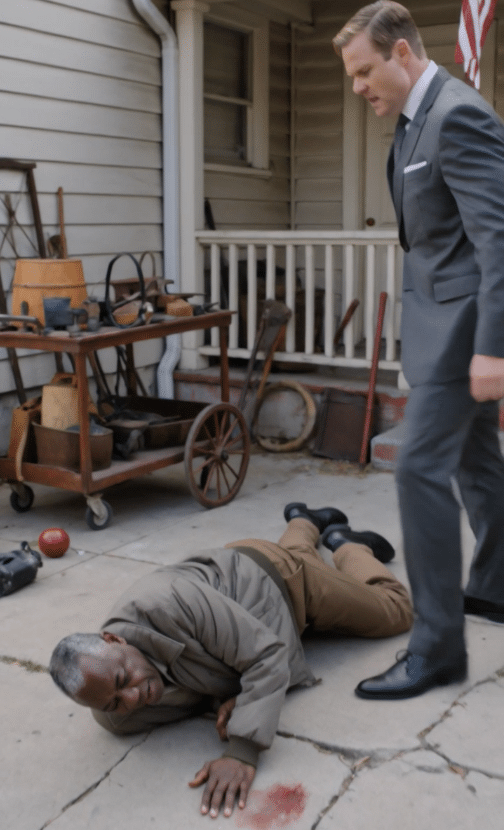
The old yard-sale cart stood only a few feet from the cracked sidewalk.
Rust clung to its wheels, and neatly arranged used tools, lamps, and kitchenware filled its shelves. It wasn’t much, but for sixty-nine-year-old Walter Hayes, it was the difference between paying the electric bill and going another month without heat.
A luxury sedan stopped in front of the little house.
Its driver stepped out wearing a tailored suit that looked more expensive than everything in Walter’s yard combined.
He stared at the cart with open disgust.
“Move this thing.”
Walter tightened his grip on the cart with his only hand.
“I can’t move it. This is how I live.”
The developer’s expression turned icy.
He glanced up and down the quiet neighborhood as though Walter himself were lowering the value of every home on the block.
“Trash. You make this street look cheap.”
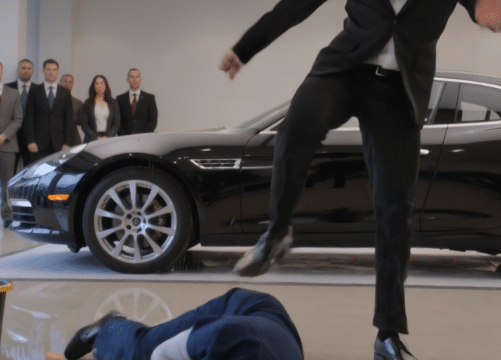
Before Walter could answer, the man shoved the cart aside.
Old tools, dishes, and family keepsakes crashed across the sidewalk.
Walter instinctively stepped forward to protect the few belongings he still had.
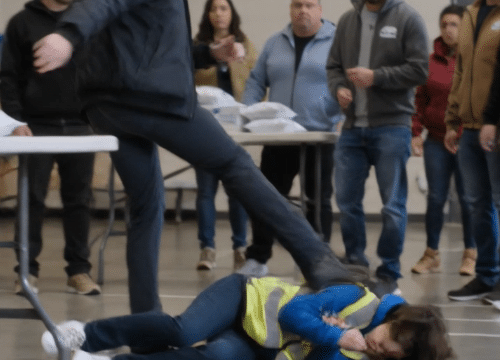
He never saw the kick coming.
The blow knocked him backward onto the concrete beside the overturned cart.
His elbow scraped against the pavement, leaving only a thin streak of red.
The developer stood over him.
“People like you should be gone already.”
Curtains shifted in nearby windows.
Neighbors froze.
No one had expected an argument over a yard sale to turn into something so cruel.
Then tires screeched to a stop outside the house.
A black SUV pulled to the curb.
A police cruiser stopped directly behind it.
And the silence became even heavier.
Act II
The SUV door opened first.
An older man stepped onto the sidewalk without saying a word.
Moments later, two local police officers climbed out of the cruiser behind him.
Neither officer rushed ahead.
Instead, both quietly fell in behind the older gentleman as though waiting for him to take the lead.
The developer frowned.
He clearly hadn’t expected company.
The older man ignored him completely.
His attention went straight to Walter.
He carefully helped the veteran sit upright before picking up the overturned cart and setting it back on its wheels.
Only then did he stand.
Positioning himself between Walter and the developer, he spoke calmly.
“You just made a serious mistake.”
The words weren’t loud.
They didn’t need to be.
Behind him, both officers remained silent.
Their posture alone spoke volumes.
The developer glanced from the officers to the older man.
For the first time since arriving, confidence slipped from his face.
Because everyone else on the street suddenly seemed to know something he didn’t.
Act III
Walter brushed dust from his worn jacket.
“I’m alright,” he said quietly.
His first concern wasn’t the scrape on his elbow.
It was the scattered belongings covering the sidewalk.
“My customers will think everything’s broken.”
The older man looked at the overturned cart.
“No,” he replied gently.
“They’ll see someone who refused to give up.”
Years earlier, Walter had lost his arm during military service.
After returning home, he never asked for special treatment.
He worked construction until his body could no longer handle it.
Then he repaired old tools, restored secondhand furniture, and sold household items from his front yard to make ends meet.
Everyone in the neighborhood knew him.
Children stopped by after school to hear his stories.
Retirees brought him broken lawnmowers just to give him extra work.
If someone couldn’t afford a tool, Walter often handed it over anyway.
“Pay me when you can.”
Sometimes they never did.
He never complained.
The older man had known Walter for years.
Not because of business.
Because he had quietly watched him help an entire neighborhood without expecting anything in return.
He turned toward the developer.
“You looked at poverty.”
He paused.
“I saw character.”
The words settled over the street.
No one argued.
Act IV
One of the officers quietly examined a nearby home security camera mounted above a garage.
The homeowner nodded and immediately offered the recording.
Minutes later, the footage confirmed everything.
Walter had remained calm.
He had explained why the cart mattered.
The developer had escalated the confrontation.
No one could deny it.
The developer folded his arms.
“This property is dragging the neighborhood down.”
The older man answered without hesitation.
“No.”
“Contempt does that.”
Neighbors slowly stepped out of their homes.
Without being asked, they began gathering Walter’s scattered belongings.
An elderly woman carefully wiped dust from old picture frames.
A teenager collected loose tools.
A young father repaired one bent shelf on the cart.
Piece by piece, Walter’s little business came back together.
The developer looked around.
No one stood beside him anymore.
Even the officers never took their eyes off him.
His voice grew noticeably quieter.
“Who are you?”
The older man smiled faintly.
Then he answered.
Act V
“I’m someone who knows what this neighborhood is built on.”
He didn’t offer a title.
He didn’t need one.
Respect had already introduced him.
Walter slowly stood with the older man’s help and looked at the rebuilt cart.
“I guess tomorrow’s sale is still on.”
A little girl from across the street smiled.
“I’ll tell my parents to come.”
Others nodded.
Within minutes, several neighbors began buying items they hadn’t planned to purchase at all.
One man quietly paid far more than an old toolbox was worth.
Another insisted on replacing the broken wheels on the cart free of charge.
Walter tried to refuse.
They refused to let him.
The developer climbed into his luxury car without another word.
The street that he had dismissed as “cheap” had revealed something money could never buy.
Community.
Before leaving, the older man rested one hand on the side of the weathered cart.
“A neighborhood isn’t measured by perfect lawns or expensive houses,” he said.
“It’s measured by how people treat the neighbor who has the least.”
Walter smiled as the afternoon breeze stirred the small American flag hanging from his porch.
Tomorrow he would unlock the cart again.
Arrange every tool by hand.
Welcome every customer with the same quiet kindness.
And everyone who had witnessed that afternoon carried home the same truth.
The value of a street is never determined by the wealth of the homes that line it.
It’s determined by the humanity of the people who live there.