Act I
The crowd surged without warning.
People pressed shoulder to shoulder through the Texas State Fair, laughter mixing with music from game booths and the smell of fried food drifting through the warm night air.
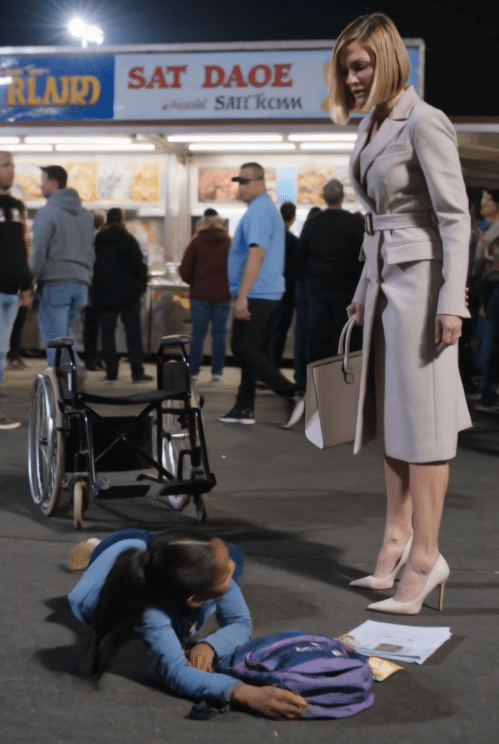
Caught in the crush, a fifteen-year-old girl carefully tried to guide her wheelchair through the narrow opening between families.
She didn’t realize her front tire had brushed the back hem of an elegant designer coat.
The mark was barely visible.
The reaction was impossible to ignore.
The wealthy woman spun around, outrage flashing across her face before the frightened teenager could even apologize.
The next moments unfolded so quickly that nearby conversations stopped mid-sentence.
The girl lost her balance and fell from her wheelchair as her backpack slid across the pavement, spilling notebooks, pencils, and school papers across the fairground.
Gasps rippled through the crowd.
The wheelchair rolled backward before coming to a stop several feet away.
The teenager tried to steady herself, more embarrassed than anything else, instinctively reaching toward the scattered schoolwork instead of looking at the people staring.
The woman stood over her with open contempt.
“Trash. Look what you did to my coat.”
The accusation echoed through the crowded midway.
A few people instinctively stepped forward, then hesitated.
Nobody wanted to become the next target.
The woman continued her cruel tirade.
“People like you should stay out of places like this.”
The words landed far harder than the tiny dusty mark ever could.
Then, somewhere beyond the crowd, engines rumbled.
Several black SUVs rolled toward the nearby VIP entrance.
Within seconds, everything changed.
Act II
The vehicles stopped in perfect sequence.
Bodyguards stepped out first, moving efficiently through the crowd without panic or shouting.
People instinctively made room.
Fair staff straightened their posture.
Security officers who moments earlier had been directing pedestrian traffic quietly shifted aside.
An older man in a black suit emerged from the center vehicle.
He didn’t hurry.
He didn’t need to.
Authority seemed to move with him.
Ignoring the whispers spreading through the crowd, he walked directly toward the fallen teenager.
The overturned wheelchair caught his attention first.
He calmly set it upright before turning toward the girl.
Only after ensuring her chair was no longer lying in the middle of the walkway did he step between her and the woman who had humiliated her.
His posture was calm.
Protective.
Unshakable.
The crowd fell silent.
The wealthy woman frowned, suddenly aware that no one around her was paying attention to her anymore.
They were watching him.
Act III
The teenager quietly gathered one notebook that had landed beside her.
Its pages were filled with careful handwriting, homework assignments, and dreams far bigger than the crowded fair around her.
She had come alone because she refused to let a wheelchair keep her from experiencing ordinary teenage moments.
She wanted to try the games.
Eat fair food.
Maybe win a stuffed animal.
Nothing more.
Nothing less.
The older gentleman noticed the school backpack before anything else.
He also noticed how the girl never raised her voice.
She didn’t accuse.
She didn’t demand sympathy.
She simply tried to collect the pieces of an evening that had gone terribly wrong.
Around them, spectators began exchanging uneasy glances.
A dusty mark on a coat could be brushed away in seconds.
Public humiliation lingered much longer.
The contrast became impossible to ignore.
One person had protected her dignity even after being knocked down.
The other had sacrificed her own dignity while standing.
Act IV
The older man finally turned toward the woman.
His expression remained composed.
“Enough.”
Only one word.
Yet it carried across the fairgrounds with unmistakable authority.
Behind him, bodyguards quietly formed a line.
VIP security stopped moving.
Even fair employees seemed to wait for his next decision.
The woman’s confidence faltered.
She looked from the older man to the security officers surrounding him.
None questioned his presence.
None challenged his authority.
Whispers spread through the crowd.
Some recognized him immediately.
He was one of the fair’s principal benefactors, a longtime supporter of community programs that made public events more accessible for children and families with disabilities.
His involvement had never been about publicity.
It had always been about ensuring every visitor felt welcome.
He looked back toward the teenager.
“No one should leave a place like this believing they don’t belong.”
The words weren’t loud.
They didn’t need to be.
The entire crowd had already heard them.
Act V
The lights from the Ferris wheel shimmered overhead as music resumed somewhere in the distance.
Life at the fair slowly continued.
But the people standing nearby remained exactly where they were.
They had witnessed something they wouldn’t soon forget.
The teenager sat quietly beside her wheelchair, still holding the notebook she had rescued from the pavement.
She looked exhausted.
Yet she refused to let humiliation define her.
The older gentleman remained between her and the woman, saying nothing more.
Sometimes silence carries greater weight than speeches.
The wealthy woman’s expensive coat no longer seemed important.
Neither did the dusty mark she had been so desperate to defend.
Surrounded by bodyguards and watched by dozens of witnesses, she suddenly realized every person around her had seen not a damaged coat—but damaged character.
Her confidence disappeared.
Her face lost its color.
She stared at the man before her, struggling to understand why an entire security team had instinctively followed his lead.
Barely above a whisper, she asked,
“Who are you…?”
He never answered.
He didn’t have to.
The respectful silence surrounding him spoke more clearly than any title ever could.
Long after the fair closed that night, few people remembered the tiny mark on the designer coat.
They remembered something far more important.
Real status isn’t revealed by the clothes someone wears or the price of a handbag.
It’s revealed by the instinct to protect the dignity of someone who has none of the power—but all of the courage.