Act I
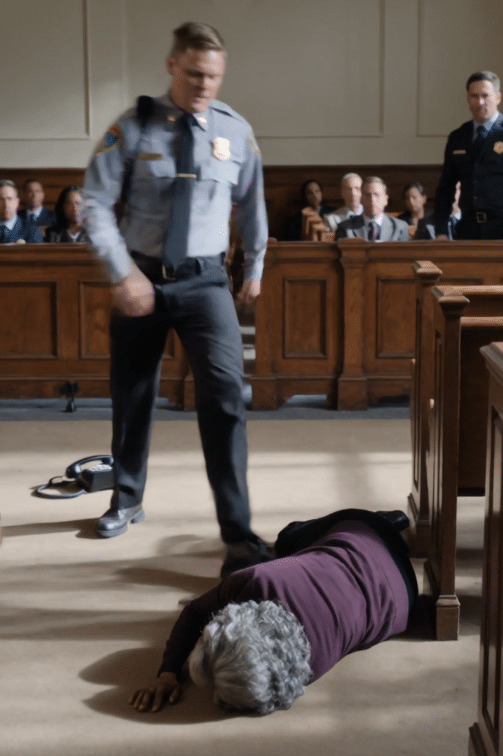
The courtroom had been wrapped in silence for nearly an hour when the shrill ringtone shattered everything.
Heads turned at once.
An elderly woman in a faded purple sweater fumbled with an old cell phone, her trembling hands refusing to obey her. Embarrassment spread across her face before she could even apologize.
Most people simply stared.
One man didn’t.
The bailiff stormed toward her with the certainty of someone who believed authority gave him permission to humiliate. His voice echoed through the courtroom before anyone else could react.
“Trash. Silence means silence.”
The words landed harder than the silence that followed.
The elderly woman tried to stand, clutching the phone as if she could somehow make the mistake disappear. Instead, she lost her balance and fell onto the polished marble floor. Her phone skidded several feet away, scattering papers from nearby spectators.
A faint scrape appeared on her chin.
She didn’t cry.
She simply looked around with quiet dignity, more ashamed of interrupting the hearing than of lying on the cold courthouse floor.
Then the bailiff leaned over her again.
“Stay down until court is over.”
No one moved.
Everyone assumed he knew exactly what he was doing.
They were about to discover how wrong that assumption was.
Then the rear courtroom door opened.
Act II
Few people in that courthouse knew the elderly woman’s name.
She wasn’t wealthy.
She wasn’t famous.
She had arrived alone carrying nothing but a worn handbag, reading glasses, and an aging phone that had probably belonged to another decade.
She had been called as a witness in a routine civil matter.
She had insisted on coming by herself despite her son’s repeated offers to arrange transportation.
“I’ve walked into courtrooms my whole life,” she had joked earlier that morning. “I can still manage one more.”
She never mentioned who her son was.
That wasn’t her style.
She had raised him to believe titles meant responsibility, not privilege.
Outside the courtroom, employees greeted judges with formal respect.
At home, she still reminded her son to eat enough vegetables.
To everyone else, she looked like another grandmother trying to navigate a confusing courthouse.
To one impatient bailiff, she looked like someone he could intimidate without consequence.
The spectators exchanged uneasy glances.
Some reached for their phones.
Others lowered their eyes.
No one expected the next sound to be hurried footsteps from behind the judge’s chambers.
Act III
The rear doors swung open.
The presiding judge didn’t walk.
He ran.
His black robe flowed behind him as he crossed the courtroom without acknowledging anyone else. Court staff instinctively stepped aside.
He didn’t look at the bailiff.
He didn’t ask what had happened.
He went straight to the elderly woman.
Kneeling beside her, he gently helped her sit upright before carefully brushing dust from her sleeve.
His expression wasn’t loud.
It was worse.
It was controlled.
His eyes moved briefly to the scrape on her chin, then to the phone lying across the marble floor.
Court officers immediately formed a quiet barrier around them.
Only then did the judge slowly rise.
His gaze settled on the stunned bailiff.
The entire courtroom held its breath.
“Who touched my mother in my courtroom?”
The sentence echoed through the chamber like a verdict.
Every conversation stopped.
Every chair became still.
Even the lawyers standing near counsel table seemed afraid to move.
The bailiff’s confidence disappeared in an instant.
Act IV
For the first time since the confrontation began, the security cameras mattered.
Witnesses mattered.
Every pair of eyes in the room mattered.
The court staff who had remained frozen moments earlier now stepped between the judge’s mother and the bailiff.
No one shouted.
No one celebrated.
Professionalism replaced panic.
The judge quietly instructed security to preserve the scene and identify everyone who had witnessed the encounter.
His attention returned to his mother.
“Are you hurt?”
She managed a faint smile.
“I’m more embarrassed than hurt.”
That answer somehow made the room even quieter.
The judge knew exactly who she was.
Not because she was his mother.
Because she was the woman who had spent decades teaching him that justice begins with how the weakest person in the room is treated.
The bailiff suddenly understood something far more terrifying than disciplinary action.
He hadn’t merely mistreated a visitor.
He had violated the very principles of the courtroom he had sworn to protect.
His badge suddenly felt much heavier than before.
Act V
By the time the hearing resumed, the atmosphere had changed completely.
The elderly woman was seated comfortably with medical staff checking the small scrape on her chin.
She insisted she would be fine.
The judge thanked every witness who had remained to give an honest account of what they had seen.
No favoritism.
No shortcuts.
Only accountability.
Exactly as his mother had taught him.
The bailiff stood alone, stripped of every illusion that authority could exist without restraint.
For the first time that day, he looked smaller than the woman he had tried to humiliate.
His lips trembled.
His eyes darted from the judge to the elderly woman before settling on the polished courthouse floor.
Only one question escaped in a broken whisper.
“Your mother…?”
The answer no longer needed to be spoken.
Everyone in the courtroom already knew.
Real authority is never proven by the power to intimidate.
It is revealed by the courage to protect those who cannot protect themselves.