Act I
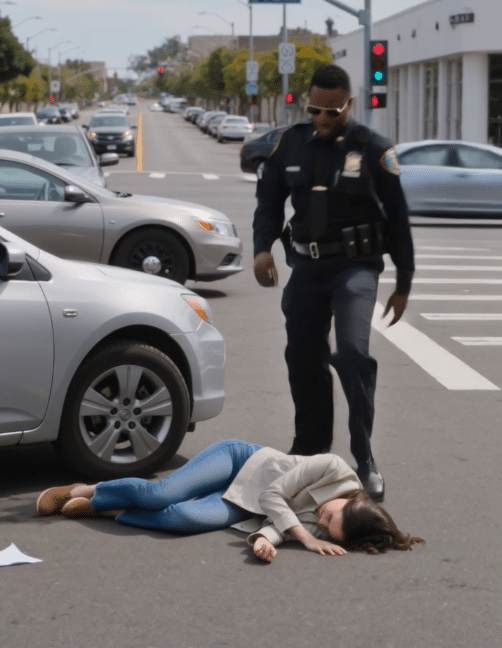
The traffic stopped long before the light turned red.
Drivers leaned out of their windows, pedestrians slowed their pace, and every eye on the busy intersection fixed on a silver sedan pulled over beside the curb.
A woman stood quietly outside her car, holding a folder of registration papers in trembling hands.
She wasn’t arguing.
She wasn’t resisting.
She simply looked confused.
“Officer, why did you stop me?”
The question should have been routine.
Instead, it ignited something ugly.
The patrol officer stepped forward with the swagger of someone who believed his badge placed him above accountability.
The papers slipped from her hands as she stumbled backward onto the asphalt. Loose documents scattered across the roadway, fluttering beneath passing gusts of wind while shocked bystanders froze in disbelief.
The officer glared down at her.
“Trash. You don’t question me.”
Silence spread across the intersection.
No one expected what they were witnessing.
Some instinctively reached for their phones.
Others simply stood frozen.
Above them all, mounted on the traffic-light pole, a security camera recorded every second.
The officer never bothered to look up.
That would become the mistake that changed everything.
Act II
To everyone watching, she looked like an ordinary commuter.
A beige jacket.
Blue jeans.
A modest sedan.
Nothing about her suggested wealth, influence, or power.
That was exactly how she preferred it.
She had spent years avoiding attention despite being married to one of the highest-ranking officers in the city’s police department.
Her husband often joked that people treated her more honestly because they had no idea who she was.
She agreed.
Titles could command respect.
Character revealed who deserved it.
That morning, she had left home planning nothing more dramatic than running errands before lunch.
She never imagined becoming the center of a public spectacle.
The patrol officer, however, saw only what he assumed was an easy target.
Someone unlikely to file a complaint.
Someone unlikely to be believed.
Someone he thought he could intimidate without consequence.
He had no idea that dozens of witnesses were watching.
Or that technology had become a far more reliable witness than fear.
Act III
The officer barked another order, demanding her documents while she remained on the pavement trying to gather the scattered papers.
People exchanged uneasy glances.
No one knew whether stepping in would make the situation worse.
Then another sound cut through the tension.
Sirens.
Not one.
Several.
A convoy of police vehicles rolled toward the intersection and stopped abruptly beside the traffic stop.
The atmosphere changed instantly.
Doors opened in rapid succession as senior officers stepped out.
Leading them was a police captain whose calm expression disappeared the moment he recognized the woman on the ground.
He didn’t look at the patrol officer.
He didn’t ask what had happened.
He ran straight to her.
Kneeling beside her, he helped her sit upright before checking the scrape on her elbow.
Only after making sure she was alright did he slowly rise.
His eyes lifted toward the traffic-light pole.
The security camera blinked silently above the intersection.
Then he turned toward the patrol officer.
Act IV
The captain’s voice carried across the street with quiet authority.
“Who kicked my wife on camera?”
The words landed like thunder.
Every officer in the convoy froze.
The patrolman’s expression emptied.
His gaze darted from the captain’s insignia…
…to the woman…
…then upward toward the traffic camera still pointing directly at the scene.
He suddenly realized he hadn’t merely humiliated a civilian.
He had done it in full public view.
On an official recording.
In front of fellow officers.
Several members of the captain’s team instinctively stepped between the woman and the patrolman, ensuring she was safe before anyone spoke another word.
No shouting followed.
No dramatic threats.
There didn’t need to be.
The evidence already existed.
The witnesses were still standing exactly where everything had happened.
The balance of power shifted in complete silence.
Act V
The woman slowly gathered the papers that had scattered across the road.
Several pedestrians quietly helped her.
No one had spoken during the confrontation.
Now complete strangers bent down to return every document to her hands.
The captain accepted the folder before offering it back with gentle care.
His concern wasn’t about rank.
It was about dignity.
Looking around the intersection, he thanked the witnesses for remaining.
Their willingness to stay mattered.
Truth often survives because ordinary people refuse to walk away.
As traffic remained stopped, the patrol officer stood alone.
The confidence that had fueled his arrogance only moments earlier had vanished.
His breathing grew shallow.
His lips trembled.
The authority he had relied upon now felt impossibly small beneath the weight of accountability.
Barely able to speak, he whispered the only words left to him.
“You are…?”
Sometimes the greatest reversal doesn’t happen because someone powerful arrives.
It happens because arrogance collides with truth—recorded, witnessed, and impossible to erase.
And on that ordinary street, one traffic stop became a reminder that real authority is measured not by the power to command others, but by the discipline to treat every person with respect.