Act I
The gas station fell silent a split second before chaos erupted.
A man in a faded blue jacket stood beside Pump Four, raising one hand toward the bright red NO SMOKING sign fixed to the fuel island. His voice remained calm, almost apologetic.
“Please don’t smoke near the pump. It’s dangerous.”
That should have been the end of it.
Instead, it became the beginning of a nightmare.
The smoker’s expression twisted with instant rage. Without another warning, he ripped the fuel nozzle from its holder and swung the heavy handle like a club.
The impact echoed across the concrete.
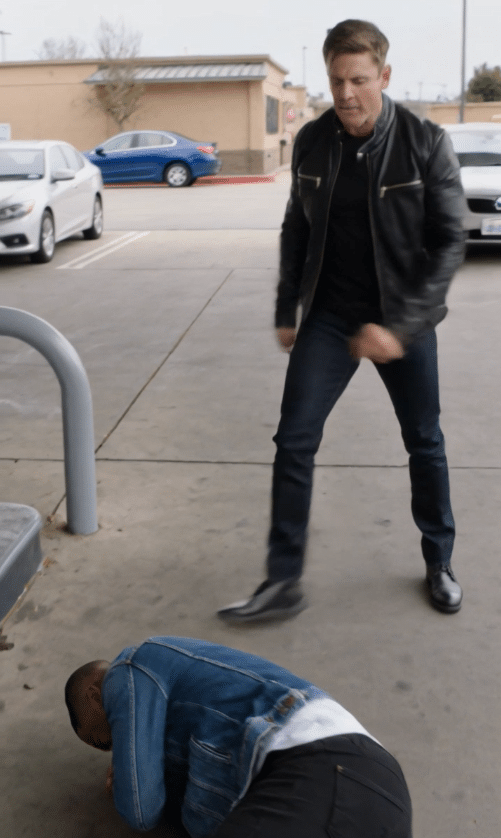
The victim staggered sideways as a thin line of blood trickled from his hairline. Before anyone could react, a brutal kick slammed into his chest, knocking him flat onto the unforgiving pavement between two vehicles.
A mother screamed.
Someone dropped their coffee.
But no one moved.
The attacker looked around, almost amused by the silence.
He had mistaken fear for permission.
What happened next would prove how dangerous that assumption was.
Act II
Witnesses would later tell investigators that the injured man never raised his voice.
His name was Daniel Brooks, a thirty-six-year-old electrician known throughout the neighborhood for helping strangers repair broken fences, jump dead batteries, and carry groceries for elderly neighbors.
That afternoon, he had stopped only to refill his pickup before heading to another emergency service call.
The smoker, meanwhile, arrived in a roaring sports car.
Designer leather jacket.
Expensive watch.
The kind of confidence that came from believing consequences were for other people.
When Daniel politely pointed toward the warning sign, the man interpreted safety as disrespect.
His anger exploded with terrifying speed.
After sending Daniel crashing onto the concrete, he leaned over him with icy contempt.
“Trash,” he sneered. “Don’t lecture me at my pump.”
Daniel struggled to breathe.
His chest burned from the kick.
Blood traced slowly down his forehead.
Still, he refused to beg.
That refusal seemed to make the attacker even angrier.
He kicked Daniel twice more in the back while he shielded his head with both arms.
Gas station customers froze.
Employees remained behind the glass doors, unsure whether rushing outside would make the situation even more dangerous.
Then came the sentence that everyone would remember.
“Stay down and smell the gas.”
For one unbearable moment, it looked as though cruelty had won.
Then every head turned toward the station entrance.
Act III
The first sound wasn’t a siren.
It was the sharp squeal of tires.
A compact fire response vehicle rolled into the station, followed immediately by a police cruiser. Both stopped abruptly near the convenience store, pushing lightweight warning signs aside as officers stepped out with urgent purpose.
Nobody understood why emergency responders had arrived so quickly.
Then a tall man wearing a fire marshal’s uniform climbed from the lead vehicle.
His eyes ignored everyone else.
They found Daniel instantly.
Everything about his expression changed.
He rushed forward, knelt beside the injured man, and carefully helped him sit upright.
The tiny streak of blood on Daniel’s forehead caught his attention.
For just a second, the fire marshal closed his eyes.
Not from fear.
From fury held under absolute control.
“Easy,” he whispered.
“I’m here.”
Several officers exchanged confused looks.
Then one quietly asked, “You know him?”
The marshal answered without taking his eyes off the injured man.
“He’s my brother.”
The words spread through the crowd like electricity.
The bully, who had been standing proudly only moments earlier, suddenly took an involuntary step backward.
His confidence began to crack.
But the worst moment for him was still coming.
Act IV
The fire marshal helped Daniel to his feet before gently checking the wound on his forehead.
Daniel tried to insist he was fine.
He even apologized for causing trouble.
That only deepened his brother’s anger.
He slowly turned toward the smoker.
The entire station seemed to stop breathing.
Police officers instinctively shifted position.
Customers quietly backed away.
The marshal’s voice remained low.
Controlled.
Deadly calm.
“Who attacked my brother?”
Nobody answered.
Nobody needed to.
Several witnesses looked directly at the man in the leather jacket.
Security cameras pointed from every angle.
The fuel island.
The convenience store entrance.
The overhead canopy.
Every second had been recorded.
The attacker finally realized there was nowhere left to hide.
His jaw tightened.
His hands began to shake.
Only minutes earlier he had believed a stranger’s life was worth less than his own pride.
Now he stood surrounded by officers, dozens of witnesses, and undeniable evidence.
Power had changed hands completely.
And everyone knew it.
There was only one thing left to hear.
Act V
The bully stared at the fire marshal as though trying to convince himself he had misunderstood.
His lips moved, but no sound came.
Finally, barely above a whisper, he managed to ask,
“Your brother…?”
No one answered.
They didn’t have to.
The fire marshal simply stood beside Daniel, one steady hand resting on his injured brother’s shoulder.
It said everything.
Respect wasn’t measured by expensive cars.
Authority wasn’t measured by designer clothes.
Character wasn’t measured by wealth.
The man lying on the concrete had tried to prevent a disaster that could have endangered everyone at the station.
The man who attacked him had mistaken kindness for weakness.
Within minutes, the illusion collapsed.
As police officers stepped forward, the crowd no longer looked at the injured electrician with pity.
They looked at him with admiration.
He had remained calm.
He had refused to answer violence with violence.
And in the end, dignity outlasted arrogance.
Long after the patrol cars departed and the fuel pumps returned to normal, witnesses remembered only one lesson from that afternoon.
The strongest people are often the quietest.
And the people you choose to humiliate in public may have far more strength—and far more people standing behind them—than you could ever imagine.