Act I
The first scream echoed through the church hall before anyone understood what had happened.
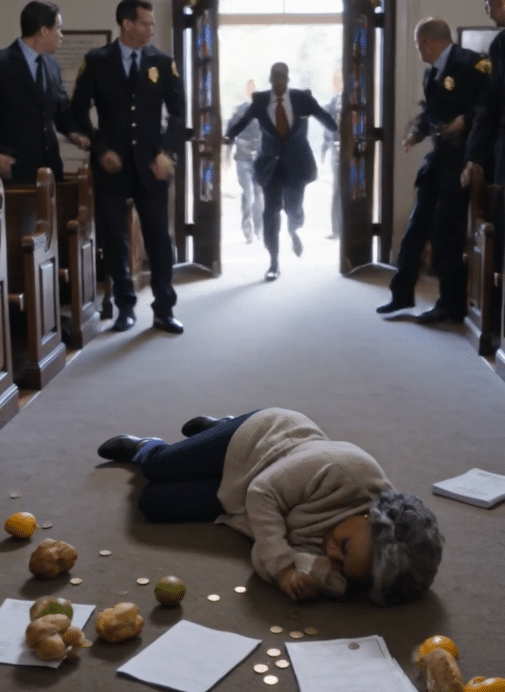
Freshly donated food scattered across the polished floor as a cardboard box burst open, sending bread, fruit, loose coins, and charity papers sliding in every direction. Standing over the mess was an elegantly dressed woman whose expensive jewelry glittered beneath the stained-glass windows. Rage had erased every trace of dignity from her face.
At her feet lay Mrs. Evelyn Carter.
Seventy years old. Frail. Dressed in an old gray sweater that had seen better days. She had spent the morning handing food boxes to struggling families after Sunday service, greeting every person with the same gentle smile.
Now that smile was gone.
The wealthy donor had already hurled a food box into Mrs. Carter’s chest, knocking the elderly volunteer backward against the donation table. Before anyone could react, another sharp strike landed across the old woman’s cheek, sending her glasses tumbling onto the wooden floor.
A painful silence swept across the room.
Instead of stopping, the woman stepped forward again.
“Trash,” she sneered loud enough for everyone to hear. “Don’t embarrass my family in church.”
Mrs. Carter struggled to breathe as she reached instinctively for the worn donation ledger that had fallen beside her. She didn’t cry. She didn’t argue.
She simply tried to protect the book.
That only seemed to make the bully angrier.
Nobody knew that within seconds, the entire church would witness a truth capable of changing everything.
Act II
Most people attending the church barely noticed Mrs. Carter anymore.
She arrived before sunrise every Sunday, unlocked storage closets, arranged donation boxes, folded chairs, and quietly disappeared before anyone thought to thank her.
Many assumed she was simply another elderly volunteer with nowhere else to be.
They couldn’t have been more wrong.
Years earlier, Mrs. Carter and her late husband had quietly donated millions to support local charities without asking for recognition. After losing their only son, they devoted their lives to serving others rather than building monuments to themselves.
She had personally requested that no plaque carry her family’s name.
“Good deeds don’t need applause,” she once told the former pastor.
Unfortunately, humility often looks like weakness to people searching for someone to dominate.
The wealthy donor saw only an old woman wearing inexpensive clothes.
She saw no history.
No sacrifice.
No quiet legacy.
Only someone she believed she could humiliate without consequence.
The room held its breath as the woman leaned down again.
“Pray from the floor.”
The words had barely left her mouth before another cruel kick forced Mrs. Carter onto her side.
Gasps erupted across the hall.
Still…
No one moved.
Until the massive stained-glass doors suddenly burst open.
Act III
Every conversation stopped instantly.
The echo of polished shoes crossing the stone floor replaced the frightened whispers.
The bishop had arrived.
Behind him walked the head priest and two church security officers, all wearing expressions that suggested they already understood something terrible had happened.
But instead of confronting the wealthy donor immediately, the bishop ignored everyone else.
He walked straight toward Mrs. Carter.
Then, to the astonishment of every witness, he gently helped the elderly woman back onto her feet before carefully picking up the worn donation ledger and placing it back into her trembling hands.
His voice softened.
“Are you hurt?”
Mrs. Carter gave the smallest nod.
The bishop’s expression hardened.
Not with anger alone.
With heartbreak.
Only then did he slowly turn toward the woman responsible.
His calm voice carried through the entire church.
“Mrs. Carter owns the land this church stands on.”
Silence.
Absolute silence.
The donor blinked once.
Twice.
The color drained from her face.
She stared at the elderly volunteer as though seeing her for the very first time.
Impossible.
This couldn’t be happening.
Or could it?
Act IV
The bishop took another measured step forward.
“For over forty years,” he continued, “she has refused public recognition while quietly ensuring this church could continue serving families in need.”
No one spoke.
Church members exchanged stunned looks.
Some began remembering stories they had once dismissed as exaggerations—anonymous repairs paid in full, scholarships funded without signatures, emergency shelters built during harsh winters.
Every act of generosity pointed back to one person.
Mrs. Carter.
The elegant donor suddenly realized the food boxes she had scattered across the floor existed because of the woman she had just humiliated.
Even the building surrounding them existed because of her generosity.
The bishop’s disappointment cut deeper than any raised voice could have.
“You judged wealth by clothing.”
“You measured dignity by appearance.”
“And inside a house built upon kindness… you chose cruelty.”
The donor’s confidence vanished.
Her shoulders dropped.
Her hands trembled uncontrollably.
For the first time that morning, she understood that every eye in the church was no longer watching Mrs. Carter.
They were watching her.
Act V
Volunteers quietly gathered the scattered food.
Children helped collect the coins.
Several elderly church members surrounded Mrs. Carter, making sure she was safe before anyone thought about the woman responsible for the attack.
Mrs. Carter accepted her glasses, brushed the dust from the donation book, and thanked the young volunteers with the same gentle smile she had worn before the violence began.
Not because she had forgotten.
But because compassion had always been stronger than pride.
The bishop addressed the congregation only once.
“A church is never measured by its walls,” he said. “It is measured by how it treats the weakest person standing inside.”
Those words lingered long after the room fell silent.
The wealthy donor stood alone near the stone wall, no longer surrounded by admiration or status.
Only regret.
Only shame.
Only the unbearable realization that she had publicly attacked the very woman whose generosity had given her family a place to worship.
Her lips trembled as the truth finally settled in.
“She… owns the land…?”
No one answered.
They didn’t have to.
For the first time in her life, wealth offered no protection, reputation carried no weight, and power meant absolutely nothing.
Standing quietly beside the donation table, Mrs. Carter never demanded revenge.
She simply reclaimed her dignity.
And somehow, that silence became the loudest judgment of all.