Act I
The lunch rush was at its peak when the restaurant fell into complete silence.
A middle-aged chef hurried out from the kitchen, still wearing a stained white apron, carrying nothing but an apology. A customer’s order had been mixed up, and before the exhausted chef could finish saying, “I’m terribly sorry,” the wealthy man exploded.
Without warning, he snatched the full plate off the table and dumped the food over the chef’s head.
Hot gravy ran down the chef’s face. Mashed potatoes slid across his shoulders. Vegetables clung to his chef coat while laughter from the bully’s friends echoed through the packed diner.
Then came something even worse.
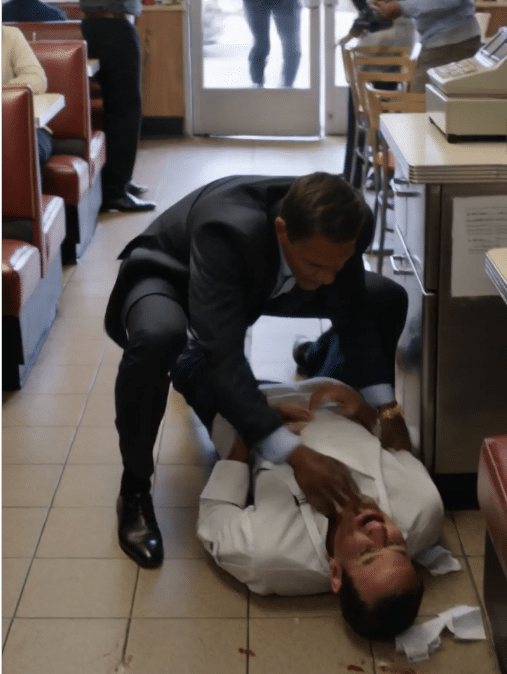
The customer stepped back, clenched his jaw, and drove a brutal kick straight into the chef’s stomach.
The impact knocked every ounce of air from the fifty-five-year-old man’s lungs. His body flew backward into the cashier counter, sending the register rattling as dozens of receipts fluttered to the floor around him. He collapsed onto the diner tiles, one hand clutching his stomach while the other trembled against the ground.
Not a single customer moved.
The wealthy man looked down with complete disgust.
“Trash. People like you can’t even serve food right.”
The chef never argued.
He simply fought to breathe.
No one realized the man lying on the floor had spent decades building something far greater than this small neighborhood diner.
Act II
Most customers believed he was just another overworked cook trying to survive another exhausting shift.
That assumption couldn’t have been further from the truth.
Years earlier, the chef had founded the very restaurant that everyone was eating in. Starting with one tiny family diner and an old secondhand stove, he had worked eighteen-hour days beside his wife until the business slowly grew into one of the region’s fastest-growing restaurant chains.
When success finally arrived, he quietly stepped away from the spotlight.
His son took over the company, expanding it across the state while his father returned to the original diner—the place where everything had begun.
He insisted on cooking several days each week.
Not because he needed the money.
Because he loved hearing families laugh over meals he had spent his life learning to prepare.
Almost no employees knew who he truly was.
He preferred it that way.
“If people only respect me because I own the company,” he once told his son, “then they don’t respect me at all.”
Unfortunately, one customer had just mistaken humility for weakness.
Standing over the injured chef, the wealthy man smirked.
Then, as if the first attack hadn’t been cruel enough, he slammed two more kicks into the chef’s stomach and side.
“Stay down where you belong.”
Even the waitresses looked away.
Then the diner door burst open.
Act III
The sound echoed through the restaurant louder than the argument itself.
A man in a tailored black suit entered with two regional managers close behind him. At first, customers assumed they were executives making a routine inspection.
Then they saw his face.
He wasn’t looking around the dining room.
He wasn’t greeting employees.
His eyes were locked on the chef lying helplessly beside the register.
Without saying a word, he pushed through the stunned crowd and dropped to one knee beside the injured man.
Ignoring the expensive suit he was wearing, he carefully wiped the sauce from the chef’s face with a clean napkin before supporting him beneath the shoulders.
“Dad…”
The chef gave him a tired smile.
“I’m alright.”
The son wasn’t convinced.
He glanced at the trembling hands, the bruised stomach, and the thin streak of blood at the corner of his father’s mouth.
Then he slowly stood.
The entire restaurant seemed to stop breathing.
Looking directly at the customer who had caused everything, he asked in a calm voice that somehow felt more terrifying than shouting,
“Who touched my father?”
Act IV
The wealthy customer’s confidence vanished immediately.
His friends, who had laughed only moments earlier, quietly pushed their chairs back and avoided looking at him.
Several employees recognized the man in the black suit at once.
He wasn’t just another executive.
He was the owner of every restaurant carrying the company’s name.
The regional managers surveyed the destroyed dining room—the spilled food, the scattered receipts, the frightened staff, and the chef still struggling to stand.
No explanation could erase what dozens of witnesses had just seen.
Security footage had captured everything.
Customers had already recorded the assault on their phones.
The owner never raised his voice.
He simply looked at the man who believed money entitled him to humiliate another human being.
“You attacked the man who built this company with his own hands,” he said quietly.
“You never even learned his name.”
The words landed harder than any punch.
Act V
The chef slowly rose to his feet with his son’s support.
His apron was ruined.
His body ached with every breath.
Yet there was still quiet dignity in the way he thanked the frightened waitress who handed him a clean towel before reassuring the employees that none of what had happened was their fault.
Around the restaurant, customers who had remained silent moments earlier now stood in complete embarrassment.
Some apologized.
Others simply lowered their eyes.
The wealthy customer found himself completely alone.
His expensive watch, designer clothes, and loud confidence meant nothing anymore.
His lips trembled as he stared at the man he had called “trash.”
“…Your father?”
No one answered.
They didn’t have to.
Because true character isn’t revealed by the way someone treats people with power.
It’s revealed by the way they treat the person they believe has none.
And that afternoon, inside a crowded little diner, everyone discovered who the richest man in the room really was.