Act I
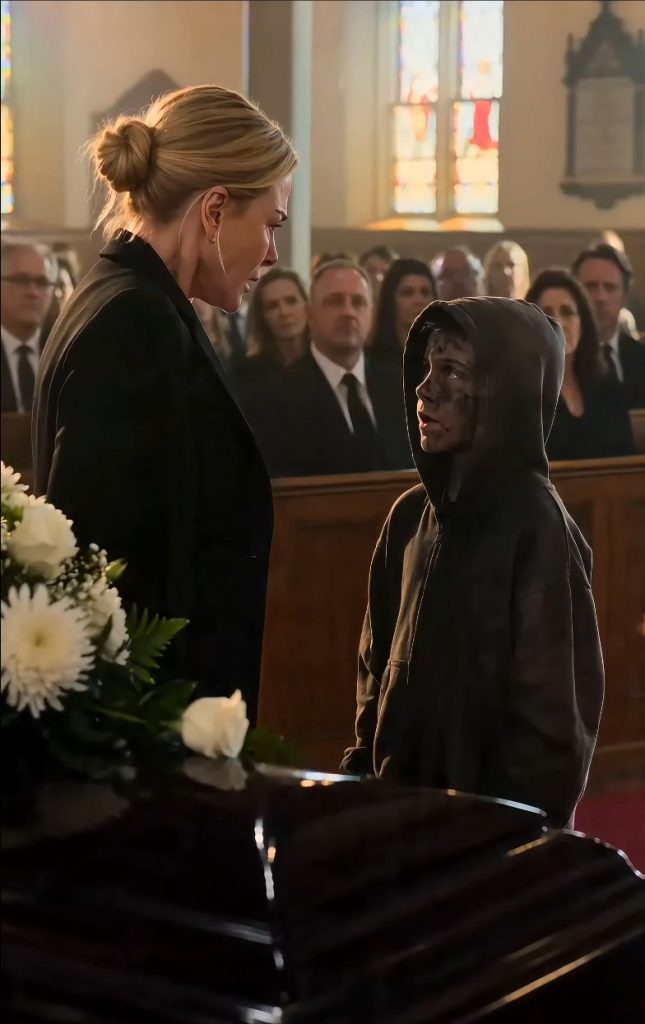
The boy did not belong among the mourners.
Everyone else wore black.
Black suits. Black dresses. Black veils. Black shoes lined neatly beneath the pews of St. Bartholomew’s, where the stained glass softened the morning light into pale gold and blue.
But the boy stood in the aisle wearing an oversized dark hoodie, the hood pulled up over his head, his small face smudged with dirt or ash. His sneakers were damp. His hands were tucked into his sleeves.
He looked cold.
He looked lost.
And he was staring directly at Grace Holloway.
Grace stood beside the casket with one hand resting on the polished wood. White chrysanthemums and roses covered the lid in a heavy, fragrant arrangement. Beneath them lay Thomas Holloway, her husband of twelve years, the man half the city had come to mourn and the man most of his own family had never truly forgiven her for loving.
Her eyes were swollen from crying.
She had prepared herself for whispers that morning. She had prepared herself for Richard’s cold stare from the front pew, for the trustees measuring her grief like it was a financial statement, for old friends pretending not to wonder what a woman in her forties had truly seen in a man nearly thirty years older.
She had not prepared herself for the boy.
He stopped in front of her.
The church seemed to hold its breath.
Then he said, very quietly, “He told me if anything ever happened to him you’d take care of me.”
Grace felt the words enter her before she understood them.
Take care of me.
A few mourners shifted in their seats. Somewhere behind her, someone inhaled sharply.
Grace turned fully toward him, her hand slipping from the casket.
“What?” she whispered.
The boy looked up at her with a seriousness no child should have had to learn.
“He said you would know.”
Grace’s throat tightened. “Know what?”
The boy did not answer.
He only reached into the front pocket of his hoodie and took out a folded white note, creased carefully down the center. His small fingers trembled, but his face remained calm, as if he had practiced this moment again and again on a bus, on a sidewalk, in the dark.
Grace could barely lift her hand.
“Take care of you?” she said, her voice breaking. “Who are you?”
The boy’s eyes flicked toward the casket.
Then back to her.
“My name is Oliver,” he said. “He said I was family.”
That was when Richard Holloway stood from the front pew.
And Grace realized the boy had not come to comfort her.
He had come to expose something Thomas had taken to his grave.
Act II
Thomas Holloway had been a man of locked drawers.
Grace had known that from the beginning.
He was kind, but not open. Generous, but careful. He could write checks large enough to keep entire shelters alive, then sit alone in his study for hours with one old photograph turned face down on his desk.
Grace never pushed him.
Not at first.
When they met, she was running the literacy program at a community center his foundation funded. Thomas arrived one evening in a navy suit, expecting a photo opportunity, and stayed three hours helping a nine-year-old boy sound out the word “elephant.”
Grace had watched him kneel beside that child, patient and gentle, and thought, There is more to this man than his name.
The city knew Thomas as a real estate heir, philanthropist, and widower.
His family knew him as complicated.
His eldest son, Richard, knew him as a throne to inherit.
Grace learned all of that slowly.
She learned that Thomas’s first wife had died years before. She learned Richard had taken over much of the company long before Thomas retired. She learned there had once been a daughter, Amelia, but whenever Grace asked about her, the room changed.
Richard said Amelia had stolen from the family trust and disappeared.
Thomas said nothing.
But once, late at night, Grace found him standing outside a locked bedroom at the end of the second-floor hall. His hand rested on the brass knob, but he did not open it.
“Was it hers?” Grace had asked.
Thomas closed his eyes.
“Yes.”
“Your daughter?”
He nodded.
“Did she really steal from you?”
He looked at Grace then, and she never forgot the grief in his face.
“No,” he said. “But by the time I understood that, I had already lost her.”
That was all he gave her.
Years passed.
Grace married him despite the gossip. She sat beside him through hospital visits, through sleepless nights, through the slow decline of a man who had spent his life in rooms where everyone wanted something.
But even with her, Thomas kept one drawer locked.
Three weeks before he died, he called Grace into his study.
He was thinner then. His hands shook when he reached for his tea. On the desk sat the same old photograph, still face down.
“I made mistakes,” he told her.
Grace took his hand. “We all do.”
“Not like mine.”
His voice had been so faint she had leaned close to hear him.
“If someone comes to you after I’m gone,” he said, “do not let Richard send them away.”
Grace frowned. “Who would come?”
Thomas’s eyes filled with a sorrow he had no strength left to explain.
“A child,” he whispered.
Before she could ask more, the nurse entered.
The next morning, Thomas was too weak to continue the conversation.
By the end of the week, he was gone.
Now, standing beside his casket, Grace stared at the boy in the hoodie and felt that unfinished sentence return like thunder.
A child.
Richard stepped into the aisle.
His face was calm, but his eyes were sharp.
“Grace,” he said, “don’t engage with this.”
Oliver moved half a step closer to her.
The folded note remained between them.
And for reasons Grace could not yet explain, she knew Richard was more afraid of that paper than of the boy.
Act III
Richard reached for the note.
Grace moved first.
She took it from Oliver’s hand and held it against her chest.
The church stirred.
Richard’s jaw tightened. “This is neither the time nor the place.”
Grace looked at him. “Then why are you so nervous?”
A flush rose under his collar.
“I am protecting my father’s funeral from a scam.”
Oliver flinched at the word, but did not cry.
That hurt Grace more than tears would have.
Children who expected kindness cried when they were denied it. Children who expected cruelty only went still.
Grace lowered herself slightly so her eyes were level with his.
“Did Thomas give this to you?”
Oliver nodded.
“When?”
“Three days before he went to the hospital the last time.”
A murmur passed through the pews.
Richard’s voice turned cold. “That’s impossible.”
Oliver looked at him.
“No, it isn’t.”
Grace unfolded the note.
Her hands trembled so badly the paper whispered between her fingers.
The handwriting hit her first.
Thomas’s.
Not the bold signature he used on documents. Not the elegant script on foundation letters. This was his private hand, slightly uneven, the one he used when leaving notes on her pillow or marking passages in books he thought she would love.
Grace,
If this reaches you, then I failed to speak the truth in time.
The boy’s name is Oliver. He is Amelia’s son.
Your stepson Richard did not protect this family. He destroyed part of it.
Grace stopped reading.
The church tilted.
She heard Richard say her name, but it sounded far away.
Oliver watched her with those solemn eyes, waiting for her to become another adult who chose disbelief because it was easier.
Grace forced herself to continue.
Amelia did not steal from me. Richard forged the transfer records and let her take the blame when she discovered his embezzlement. I believed him because I was proud, angry, and ashamed. By the time I found the truth, Amelia was gone.
I found Oliver six months ago.
He had been living under his mother’s last name. She died before I could ask her forgiveness. The boy knew me only as Mr. Thomas from the shelter library. I was afraid that if I brought him home before I had secured the evidence, Richard would make him disappear the way he made Amelia disappear.
Grace’s breath broke.
Behind her, someone sobbed.
Richard lunged forward. “Give me that.”
A man rose from the second pew before Richard reached her.
Father Michael, the priest who had known Thomas for thirty years, stepped into the aisle with a sealed blue envelope in his hand.
“Richard,” he said quietly, “sit down.”
The authority in his voice stopped the room.
Richard turned on him. “You have no right to interfere.”
Father Michael looked at Grace, then at the casket.
“Thomas gave me this envelope two days before he died,” he said. “He instructed me to release it only if Oliver came forward.”
Grace looked at the blue envelope.
Thomas had planned this.
Not perfectly. Not bravely enough while he was alive.
But he had tried, at the end, to put the truth where Richard could not bury it.
And inside that envelope was the part of the story Richard feared most.
Act IV
The funeral had become something else.
Not a service.
A reckoning.
Mourners who had come to say goodbye now sat frozen, trapped between grief and scandal. The white flowers on the casket seemed impossibly still. The stained glass cast soft light over faces that no longer knew where to look.
Father Michael handed the blue envelope to Grace.
Richard’s voice dropped into a warning. “Open that, and you’ll regret it.”
Grace looked at him.
For years, Richard had treated her like an intruder in her own home. He spoke over her at family dinners, removed her from email chains, corrected staff who called her Mrs. Holloway as if the title offended him.
She had endured it because Thomas was tired, because grief made people cruel, because she thought peace was a gift she could give her husband.
But this was not peace.
This was silence dressed up as respect.
Grace tore open the envelope.
Inside were copies of bank records, a handwritten confession from Thomas, a photograph, and a legal amendment stamped by his attorney.
The photograph slipped to the top.
Grace saw a young woman with Thomas’s eyes standing in front of a bus station, one hand on the shoulder of a little boy. Amelia. Older than the locked bedroom portrait, thinner, tired, but unmistakably his daughter.
Oliver leaned toward the picture.
“That’s my mom,” he said.
His voice was small now.
For the first time, he sounded eight.
Grace pressed the photo to her chest.
Richard’s face had turned ashen.
The attorney seated near the front, Mr. Dalloway, rose slowly.
“I can confirm,” he said, “that Mr. Holloway amended his trust before his passing. Oliver Bennett is recognized as Amelia Holloway’s lawful heir pending final court confirmation. Mrs. Grace Holloway was named his temporary guardian if she accepts.”
The room erupted into whispers.
Richard stared at the attorney. “You knew?”
“I knew what your father instructed me to know.”
“That child is not walking into my family and taking—”
“Our family,” Grace said.
Richard stopped.
Grace folded Thomas’s note carefully and placed it over her heart.
“You mean our family.”
The correction landed harder than a shout.
Richard looked at Oliver with such contempt that Grace instinctively stepped in front of the boy.
There it was.
The truth Thomas had been afraid of.
Not just financial fraud. Not just old lies. But the kind of coldness that could look at a child and see only a threat to money.
Grace turned toward Oliver.
“Did you come here alone?”
He nodded.
“Where have you been staying?”
He looked down. “The shelter. Mr. Thomas said if he didn’t come back, I should find the church. He said you would be sad, but you would listen.”
Grace nearly broke.
Thomas had trusted her with the one thing he had failed to protect.
Not the estate.
Not the name.
The child.
Richard stepped closer, voice rising. “Grace, think carefully. You have no idea who he is.”
Grace turned back to him.
“Yes,” she said. “I do.”
She held up the photograph of Amelia and Oliver.
“He is the boy your father died trying to bring home.”
Act V
Oliver did not cry until Grace asked if he was hungry.
The question was so ordinary, so gentle, that his face crumpled.
He tried to hide it at first. He pulled his sleeve over his hand and wiped at his eyes, embarrassed by the attention of all those adults in black.
Grace knelt in front of him.
The church watched.
Richard watched.
Thomas lay silent beneath the white flowers, while the secret he had hidden for too long finally breathed in the open.
“You don’t have to decide anything right now,” Grace told Oliver. “You don’t have to call me anything. You don’t have to trust me today.”
Oliver stared at her through tears.
“But you’re not leaving this church alone,” she said.
His lower lip trembled.
“Mr. Thomas said you were kind.”
Grace closed her eyes for a second.
Thomas had known her better than she knew herself in that moment. He had known that even wounded, even confused, even surrounded by people waiting for her to fail, she would recognize a child standing where no child should stand.
“I’m going to try to be,” she said.
Richard gave a bitter laugh. “This is insane.”
Mr. Dalloway adjusted his glasses. “No, Richard. What is insane is that your father’s independent auditors found enough irregularities to freeze your access to several family accounts. We will be discussing that with the court.”
The whispers stopped.
Richard’s mouth opened, but nothing came out.
For the first time that morning, his confidence had no place to stand.
Grace rose, keeping one hand on Oliver’s shoulder.
“You should leave,” she said.
Richard looked around the church as if expecting someone to defend him.
No one moved.
Not the trustees. Not the cousins. Not the men who had shaken his hand at every family event for twenty years.
The Holloway name had protected him for a long time.
But names lose power when the truth enters the room.
Richard walked out past the pews, face rigid, shoes striking the stone aisle too loudly. The heavy church door closed behind him with a final echo.
Only then did Grace turn toward the casket.
She guided Oliver with her, slow enough that he could pull away if he wanted.
He did not.
Together, they stood beside Thomas.
Oliver looked at the polished wood and the flowers.
“I didn’t know he was my grandpa,” he whispered.
Grace swallowed.
“I think he wanted to tell you himself.”
“Why didn’t he?”
There were a hundred answers.
Fear. Shame. Time. Pride. Regret.
None of them was good enough for a child.
So Grace chose the only answer that felt honest.
“Because grown-ups sometimes wait too long to be brave.”
Oliver thought about that.
Then he reached into his hoodie pocket and pulled out something small.
A wooden library card.
Mr. Thomas had written his name on the back in blue ink.
Grace covered her mouth.
Oliver placed the card gently beside the white roses.
“He said books help when people leave,” Oliver said.
Grace bent her head and wept.
Not the quiet, controlled grief she had worn all morning, but something deeper. Something that grieved Thomas and Amelia and the years stolen from a boy who should have been loved openly.
When the service resumed, Oliver sat beside Grace in the front pew.
Some mourners stared.
Others softened.
One older woman reached across the aisle and handed him a clean handkerchief. A man who had known Amelia as a little girl cried silently into his hands. Father Michael changed nothing in the prayers, but his voice grew warmer when he spoke of mercy, repair, and the duties of the living.
After the burial, Grace did not return to the Holloway mansion first.
She took Oliver to the diner across from the church.
He ate pancakes in silence, shoulders hunched, as if afraid the plate might be taken away.
Grace ordered him hot chocolate.
Then a second one.
When he finally looked at her, there was suspicion in his eyes, but also something else.
Exhausted hope.
“What happens now?” he asked.
Grace wrapped both hands around her coffee cup.
“I call your caseworker. I call the attorney. I make sure everything is done properly.”
His face fell slightly.
Adults had probably said things like that before. Properly was often a cold word.
Grace reached across the table and placed Thomas’s folded note between them.
“And tonight,” she added, “you sleep somewhere safe.”
Oliver looked at the note.
“With you?”
Grace’s answer came slowly, because she understood the size of it.
“Yes,” she said. “With me.”
Six months later, the locked bedroom at the end of the second-floor hall was opened.
Not as a shrine.
As a room.
The old curtains came down. The dust sheets were removed. Amelia’s childhood books were placed on one shelf, and Oliver’s new ones filled another. Grace kept Amelia’s photograph on the desk, not to trap the room in sadness, but to let a boy know his mother had belonged somewhere before lies drove her out.
The court cases took longer.
Richard fought, denied, blamed, and threatened. But Thomas had left enough evidence, and the auditors found more. In the end, money did what truth often cannot do alone.
It left a trail.
Oliver remained with Grace.
At first, he called her Mrs. Grace.
Then just Grace.
Then, one rainy morning nearly a year after the funeral, he came downstairs in pajamas, carrying a book under one arm, and asked, “Can you make pancakes, Mom?”
Grace froze at the stove.
Oliver froze too.
His face turned red. “I mean—”
She crossed the kitchen and held him before he could take it back.
The pancakes burned.
Neither of them cared.
That afternoon, Grace took him back to St. Bartholomew’s.
They brought white chrysanthemums and a small blue book for Thomas’s grave. Oliver stood quietly beside the stone, taller than he had been the day he arrived in the oversized hoodie.
Grace touched the engraved name.
“You were late,” she whispered to Thomas. “But you sent him to me.”
The wind moved softly through the churchyard.
Oliver slipped his hand into hers.
For the first time, Grace understood that Thomas’s final note had not only revealed a secret.
It had given her a way forward.
A boy had walked into a funeral asking to be taken care of.
And somehow, in the ruins of a family’s lies, he had saved the woman who thought she had only come there to say goodbye.