Act I
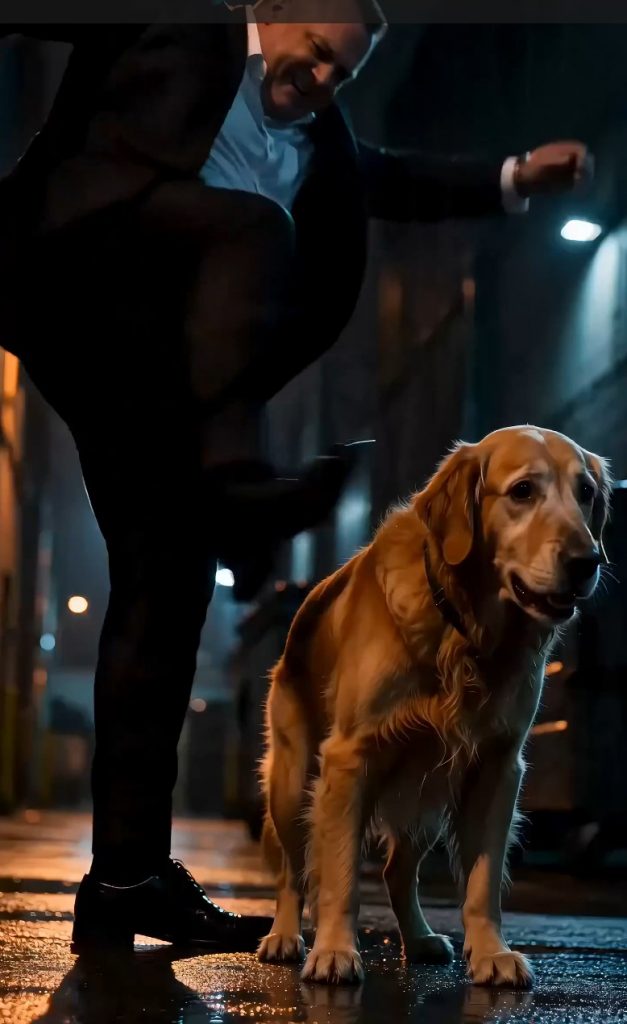
The old Golden Retriever yelped once, then folded against the wet pavement.
The sound vanished between the dumpsters and the orange streetlamp, swallowed by the damp night and the distant growl of city traffic. Rainwater dripped from a rusted fire escape. The asphalt shone black beneath the man’s polished shoes.
“Filthy mutt!” Victor Langford shouted.
He adjusted the cuff of his expensive black suit as if the dog had somehow offended the fabric.
The Golden Retriever tried to scramble away, but its paws slipped on the slick ground. Its golden fur was thin and damp, its body old, its eyes wide with the kind of fear that made it look smaller than it was.
Victor laughed.
Not loudly. Not like a man who had lost control.
Like a man who believed no one was watching.
He had stepped into the alley behind the Meridian Hotel to take a private phone call before the gala. Inside, two hundred donors were drinking champagne beneath crystal lights. His name was printed on the program in silver lettering.
Victor Langford, Chairman of Langford Urban Renewal.
Tonight, he was supposed to be honored for “revitalizing forgotten neighborhoods.”
Outside, beside the dumpsters, he was showing what he really thought of the forgotten.
The dog whimpered and lowered its head.
Victor stepped closer.
Then the animal’s ears twitched.
From the far end of the alley came the slow, heavy sound of boots on wet pavement.
One step.
Then another.
Victor turned, annoyed.
A tall figure entered the streetlamp’s edge. Only the lower half of him was visible at first: scuffed brown work boots, dark trousers, and a long weathered trench coat hanging motionless around his legs.
The dog saw him and moved.
Not quickly. It was too weak for that.
It crawled.
Across the rain-slick asphalt, past Victor’s polished shoes, toward the stranger’s boots.
Victor’s mouth twisted. “Don’t you dare.”
The dog pressed itself against the man’s foot and laid its head on the worn leather as if it had finally reached the one safe place left in the world.
Victor pointed at it.
“Kick that trash back here,” he snapped. “I’m not done.”
The man in the trench coat did not move.
He did not answer.
He simply stood there, silent as a wall.
Victor’s anger rose.
Then the stranger stepped fully into the streetlamp.
And Victor’s face went pale.
Because the man protecting the dog was not a stranger.
Act II
Victor Langford had built a career on making ugly things disappear.
Old buildings. Poor tenants. Bad headlines. People who asked too many questions.
He called it development.
The city called it progress.
By fifty-four, Victor had learned that cruelty could wear a good suit if the stitching was expensive enough. He smiled at charity dinners, posed beside mayors, and signed oversized checks for causes he never visited once the cameras left.
Tonight was meant to be another performance.
The Meridian Hotel ballroom was filled with investors, city officials, and reporters. Victor’s company had just been shortlisted for the largest redevelopment project in the district’s history. A contract that would turn five aging blocks into luxury apartments, boutiques, and private garages.
But one signature still mattered.
Elias Ward.
The old man in the trench coat.
Elias did not look like power. He never had. He wore work boots to board meetings and drove his own truck when he felt like it. His hands were rough, his voice was quiet, and he had the infuriating habit of listening more than speaking.
But his foundation owned half the land Victor wanted.
And Elias Ward was famous for one thing.
He could not be bought.
Victor had spent six months trying to impress him. He had donated to shelters, sponsored community dinners, and smiled through interviews about “humane development.” He had spoken with deep concern about vulnerable families and neighborhood dignity.
Elias had watched him the whole time with those cold, unreadable eyes.
Victor hated him for it.
What Victor did not know was that Elias had left the gala early for a reason.
Someone from the hotel kitchen had called him.
“There’s an old dog behind the building,” the dishwasher had whispered. “I think she has one of your shelter tags.”
Elias had not waited for an assistant. He had taken the service hallway, crossed the loading dock, and stepped into the alley himself.
He knew the dog before he saw her clearly.
Her name was Mercy.
She was thirteen years old, a retired therapy dog from Ward House, the shelter Elias built after his wife died. Mercy had spent years sitting beside frightened children, grieving veterans, and elderly residents who had nobody to visit them.
She was gentle with everyone.
Too gentle, some said.
Two days earlier, she had gone missing during a storm when a gate latch failed.
Elias had not slept much since.
Now she lay trembling against his boot.
Victor looked from the dog to Elias, and the streetlamp revealed every stage of his fear.
Recognition.
Calculation.
Panic.
Elias lowered his gaze to Mercy.
She lifted her head barely an inch, then rested it again on his boot.
That small movement did more than any accusation could.
It told Elias enough.
And Victor knew it.
Act III
“Mr. Ward,” Victor said, forcing a laugh that sounded thin in the alley. “This is not what it looks like.”
Elias did not answer.
Victor tugged at his suit jacket, as if straightening himself could rebuild the man he had been inside the ballroom.
“The dog startled me,” he said. “It came out of nowhere. I thought it might be dangerous.”
Mercy gave a small, exhausted breath.
Elias crouched slowly.
The movement was careful, controlled, almost tender. He placed one hand near the dog’s head but did not touch her until she leaned into him first.
Victor watched the old man’s fingers brush the damp fur behind Mercy’s ear.
“She’s dangerous?” Elias asked.
His voice was quiet.
That made it worse.
Victor swallowed. “I didn’t know she belonged to you.”
Elias looked up then.
For the first time, his eyes met Victor’s directly.
“That would have changed your behavior?”
The question landed in the alley like a verdict.
Victor had no good answer.
Behind them, the service door opened.
A young kitchen worker stepped out, then froze when he saw the scene. A hotel security guard appeared behind him. Then another staff member. The private cruelty Victor thought he had hidden was no longer private.
The security guard looked at Mercy, then at Victor.
“Mr. Ward,” he said carefully, “do you need help?”
“Yes,” Elias said. “Call the emergency vet. Then call the police.”
Victor’s face tightened. “Police? That’s unnecessary.”
Elias rose to his full height.
Mercy stayed pressed against his boot.
“You hurt an old animal behind a charity gala while asking me to trust you with an entire neighborhood,” Elias said.
Victor’s eyes darted toward the service door.
Inside that hotel were reporters. Donors. Board members. The mayor’s deputy. The people Victor had spent years convincing that he was not the man he had just revealed himself to be.
“Elias,” Victor said, lowering his voice. “Let’s be reasonable.”
The old man’s expression did not change.
“Reasonable,” he repeated.
Victor stepped closer, desperate now. “I can make a donation. To the shelter. A large one.”
The kitchen worker stared at him in disgust.
Elias looked down at Mercy again.
“She already gave more to this city than you ever have,” he said.
Victor opened his mouth.
But the alley security camera above the loading dock blinked red in the rain.
And Elias saw Victor notice it.
Act IV
Victor tried to leave before the police arrived.
He made it three steps.
The security guard blocked the service door.
Not roughly. Not dramatically. He simply stood there, broad-shouldered and silent, with the same look people get when they finally stop pretending money deserves obedience.
“Move,” Victor snapped.
The guard did not.
Inside the hotel, the gala music continued faintly, elegant and absurd against the scene unfolding in the alley.
Elias removed his trench coat and draped it gently over Mercy. The dog shivered beneath it, then settled as if she recognized his scent.
That was the moment Victor stopped looking angry and started looking afraid.
Not of being struck.
Not of being shouted at.
Of being known.
Because there are people who build their lives on the belief that the world will only see what they perform under bright lights. Victor had given speeches about compassion while stepping over the vulnerable. He had made millions from neighborhoods he described as “distressed assets.” He had learned to smile while removing people from homes their families had lived in for decades.
But the alley had stripped him down to one simple truth.
A man who could hurt the helpless when no one was supposed to see him could not be trusted with power over anyone.
The police arrived first.
Then the emergency vet.
Then, inevitably, the reporters.
Someone inside had heard whispers. Someone else had seen Victor being held near the service entrance. By the time Mercy was lifted carefully onto a clean blanket, three cameras were already pointed toward the alley.
Victor tried one last time.
“This is being exaggerated,” he said. “It was a misunderstanding.”
Elias stood beside Mercy, his shirt darkened by rain, his boots planted in the same place where she had crawled to him.
“No,” Elias said. “It was a revelation.”
A reporter called out, “Mr. Langford, is this your behavior outside all charity events?”
Victor turned sharply, but no answer came.
The question spread across his face like damage.
Another reporter asked Elias whether the foundation would still consider Langford Urban Renewal for the district project.
Elias looked at Victor.
For a moment, the alley held still.
Rain tapped on metal. Water dripped from the dumpster lids. Mercy breathed softly under the coat.
“No,” Elias said.
One word.
Victor’s shoulders dropped as if something invisible had been cut.
The contract was gone.
But Elias was not finished.
He reached into his pocket and removed a small silver tag from Mercy’s collar. It had been hidden beneath damp fur, scratched but readable.
Mercy.
Ward House Therapy Dog.
Be kind. She always is.
Elias held it up just long enough for the cameras to catch it.
And for Victor to understand exactly what the world would remember.
Act V
By morning, Victor Langford’s name was everywhere.
Not the way he had planned.
The gala photos disappeared beneath footage from the alley. Sponsors withdrew statements of support. Board members resigned from his redevelopment committee. City officials who had once praised him suddenly wanted investigations, audits, and distance.
Victor issued an apology written by lawyers.
No one believed it.
The video had already shown too much.
Not just what he did, but how quickly his face changed when he realized the dog belonged to someone powerful.
That was the detail people could not stop talking about.
He was not sorry when Mercy was helpless.
He was sorry when Mercy mattered.
But she had always mattered.
At Ward House, volunteers waited through the night while the emergency vet examined her. Mercy was old and shaken, but she was safe. When Elias brought her home the next afternoon, wrapped in a clean blue blanket, the shelter lobby filled with quiet tears.
A little boy who had once refused to speak to anyone but Mercy stood near the front desk with a drawing in his hands.
It showed a golden dog wearing a crown.
Elias knelt beside him.
“She’s okay?” the boy whispered.
Elias nodded. “She’s tired. But she’s home.”
The boy looked toward the recovery room. “Can she still help people?”
Elias’s throat tightened.
He thought of Mercy crawling across the alley, choosing his boots when she had no strength left to run. He thought of the way she had trusted him even after a human had taught her fear.
“Yes,” he said softly. “But now we help her first.”
Weeks passed.
Mercy healed slowly.
Her walks became shorter. Her bed was moved near the front window where sunlight touched the floor in the afternoon. Volunteers took turns sitting with her, reading aloud, brushing her fur, letting her rest her head on their shoes whenever she wanted.
Elias never washed the boot she had crawled to.
Not because of the dirt.
Because of the reminder.
Power, he told his staff later, is not what you do when a ballroom is watching. It is what you do in the alley, with no applause, when something weak is looking for mercy.
The redevelopment contract was reopened under new conditions. Tenant protections were strengthened. The shelter received enough donations to expand its emergency rescue program for senior animals.
The new program had a name.
Mercy’s Watch.
As for Victor, he was not dragged into some dramatic downfall in a single night. Real consequences rarely move that cleanly. They came through canceled deals, legal scrutiny, public disgrace, and the unbearable experience of being seen clearly by people who once admired him.
He lost the contract.
He lost the room.
He lost the mask.
Months later, Elias returned to the Meridian Hotel for a public hearing about the redevelopment plan. He wore the same brown boots.
Someone asked him why.
Elias looked down at them, then toward the crowd.
“Because one night,” he said, “an old dog reminded me that the people who can’t speak still tell the truth.”
Mercy did not attend that hearing.
She was back at Ward House, asleep by the window, her gray muzzle resting on a folded blanket while rain tapped softly against the glass.
But her name filled the room anyway.
It was in the new policies. In the shelter expansion. In the faces of people who had almost been pushed aside by men like Victor Langford.
And in the silence that followed whenever someone tried to call the vulnerable worthless.
Because everyone remembered the alley.
The polished shoes.
The scuffed boots.
The old dog crawling toward safety.
And the moment a cruel man realized that the life he treated like trash was protected by someone who would not look away.