Act I
The beer bottle clicked against the edge of the coffee table, light and careless, like the sound of a man who believed nothing in the room could touch him.
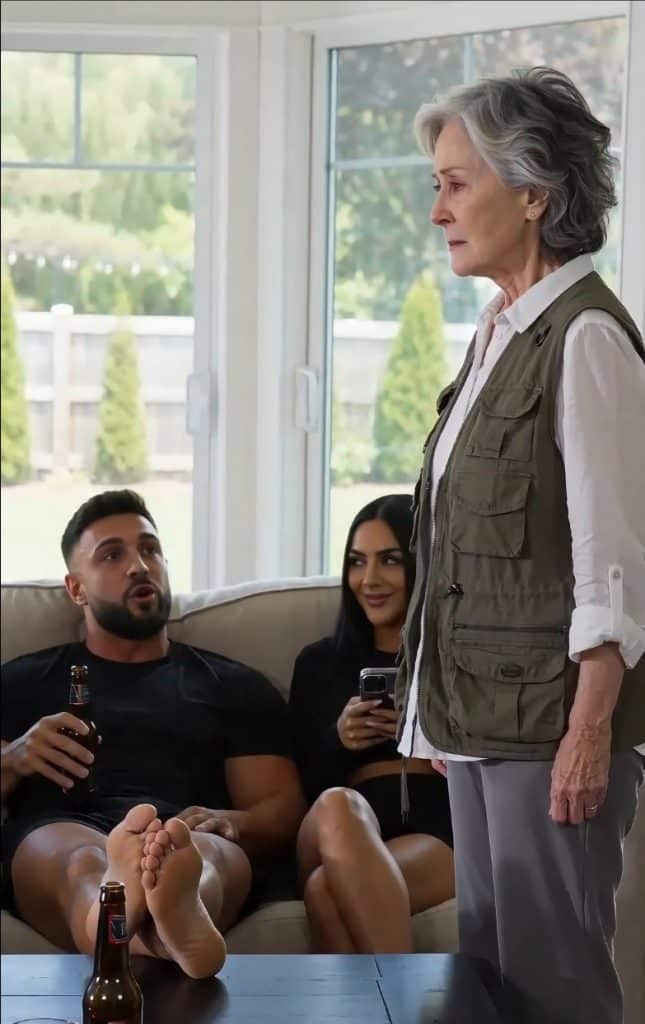
Ethan Miller leaned back on the beige sofa with his bare feet planted on the polished wood, his black T-shirt stretched across his chest, his smile sharp with contempt. Sunlight poured through the wide windows behind him, spilling across the bright suburban living room his mother had spent thirty years turning into a home.
“This is my house, you crazy old woman,” he said, loud enough for everyone to hear. “If you don’t like it, there’s the door.”
The room did not move.
Not the girlfriend sitting beside him with her legs crossed and a lazy smirk on her painted mouth. Not the two friends who had been drinking since noon, one slouched on the sofa, the other standing by the doorway with his arms folded like this was just another show. Not even the elderly woman standing across from him, her white shirt neatly tucked into gray trousers, her olive vest zipped halfway, her small brown leather bag resting against her hip.
Margaret Miller stood perfectly still.
Only her eyes betrayed her.
They were red at the edges, glossy with tears she refused to let fall. Her jaw tightened once, not from weakness, but from the effort it took to hold herself together while her only son spoke to her like a stranger on the street.
Ethan saw it and enjoyed it.
That was the cruelest part.
He lifted the beer bottle again, took a slow drink, then pointed it toward the front hallway. “I mean it. Go stay with one of your church friends. Go cry to Aunt Linda. I don’t care. I’m not letting you come in here and ruin my weekend.”
His girlfriend, Vanessa, gave a soft laugh.
It was not loud. It did not need to be.
Margaret’s eyes shifted toward her for a single second. Vanessa was already lowering her gaze back to her phone, thumb scrolling, jewelry flashing in the daylight as if the old woman’s humiliation was nothing more than background noise.
The backyard beyond the windows was impossibly green. The lawn had just been cut. The hydrangeas Margaret had planted after her husband’s funeral were blooming along the fence.
Inside, her son had turned the coffee table into a bar, the sofa into a throne, and her silence into entertainment.
“Look at her,” Ethan said, glancing at his friends. “She still thinks she can walk in here and tell me what to do.”
The man in the gray T-shirt looked down at his bottle. The one by the doorway shifted his weight but said nothing.
Margaret took a slow breath.
For a moment, Ethan thought she was going to beg. Maybe apologize. Maybe do what she had done so many times before: swallow the hurt, tidy the room, and pretend tomorrow might be different.
But this time, she did not look at the mess.
She did not look at the beer.
She did not look at the girlfriend.
She looked only at her son.
Then, without a word, she reached for the zipper of her small brown leather bag.
And that was the first moment Ethan stopped smiling.
Act II
Before Ethan became the kind of man who would humiliate his mother in her own living room, he had been the child who refused to sleep unless Margaret left the hallway light on.
He had been small once. Soft-cheeked, bright-eyed, always running through that same living room in dinosaur pajamas while his father, Thomas, pretended to chase him around the sofa.
Margaret remembered those days with a pain so sharp it sometimes felt physical.
She remembered Ethan pressing dandelions into her palm as if they were diamonds. She remembered his first fever, his first school play, the night Thomas lifted him onto his shoulders to hang the star on the Christmas tree.
And she remembered the promise she made beside her husband’s hospital bed.
“Keep the house,” Thomas had whispered, his voice thin from illness. “No matter what happens. It’s yours. It’s our life.”
Margaret had kept it.
Through medical bills. Through lonely winters. Through the long years of working double shifts at the clinic after Thomas died. She paid every tax bill, patched every leak, replaced every broken hinge. She kept the floors shining and the garden alive, because the house was more than walls.
It was proof that love had existed there.
Ethan grew up with that love wrapped around him so completely that he mistook it for something owed.
At first, people excused him.
He was grieving his father. He was angry. He needed time. Then he was a teenager with bad friends, then a young man with bad habits, then an adult who always had a reason he could not pay rent, could not hold a job, could not speak kindly to the woman who kept giving him chances.
Margaret gave him the spare room after his first eviction.
Then she gave him money to fix his truck.
Then she let him move back in “for a few months” after he swore he was starting over.
A few months became two years.
Then Vanessa appeared.
She arrived in perfume, heels, and glittering confidence, calling Margaret “Mrs. Miller” in a sweet voice that never reached her eyes. Within weeks, Vanessa’s clothes were in Ethan’s closet, her makeup was in the upstairs bathroom, and strangers were walking through Margaret’s kitchen at night, laughing too loudly under the roof Thomas had built.
Ethan changed after Vanessa.
Or maybe Vanessa only gave him permission to show what had already been growing inside him.
He stopped asking and started announcing. He moved Margaret’s framed family photos from the mantel because they looked “depressing.” He replaced her old curtains without permission. He put a lock on the office door.
Then came the lie.
“It’s basically my house anyway,” he told people.
Margaret heard him say it at a barbecue one Saturday, standing in the backyard with a beer in his hand while Vanessa leaned against him, smiling.
“She’s getting old,” Ethan said. “She doesn’t understand paperwork. Dad wanted me to have it.”
Margaret had been carrying a bowl of potato salad when she heard those words.
She did not drop it.
She did not confront him in front of his friends.
She simply turned around, walked back into the kitchen, and set the bowl down with shaking hands.
That night, she found the first missing envelope.
Then the second.
Tax notices. Insurance letters. A bank statement she had never opened because Ethan had taken it from the mailbox first.
By Monday, Margaret was sitting across from a lawyer named Helen Brooks, her brown leather bag on her lap and fear sitting cold in her chest.
Helen was careful with her words.
A line of credit had been requested against the house. Her signature had appeared on a document she did not remember signing. A transfer form had been prepared, though not finalized, naming Ethan as the intended owner.
Margaret stared at the copies until the letters blurred.
She recognized the date on one of them.
It was the day Ethan had brought her a stack of papers and said they were for updating the home insurance. He had stood beside her at the kitchen counter, impatient, tapping the pen against the marble.
“Just sign where I marked it, Mom. You make everything so difficult.”
She had trusted him.
That was the part that broke something inside her.
Helen wanted to move quickly. There were filings to make, records to challenge, a notary to contact, witnesses to track down. Margaret nodded through all of it, answering questions in a voice that sounded much calmer than she felt.
But when Helen asked if she wanted Ethan removed from the home, Margaret looked toward the window.
Outside the office, people hurried down the sidewalk with coffee cups and briefcases. The world had the nerve to continue.
“He’s my son,” Margaret said.
Helen’s face softened, but only a little. “That doesn’t mean he gets to destroy you.”
For three weeks, Margaret said nothing to Ethan.
She watched.
She listened.
She let him believe her silence was surrender.
And Ethan, mistaking mercy for weakness, made one final mistake.
Act III
The mistake was not the party.
It was not the beer bottles on the table, or Vanessa laughing in Margaret’s kitchen, or Ethan telling his friends that his mother was “losing it.”
The mistake was the camera.
Margaret had installed it after the missing mail began, a small security camera near the hallway shelf facing the front door and part of the living room. Ethan had mocked it when he first saw it.
“What, you think someone’s going to rob your porcelain angels?”
But he had forgotten it was there.
So when Margaret came home from the pharmacy that Friday and found three cars in her driveway, the music low but heavy, strangers in the living room, and Ethan lounging like a king, the camera was already recording.
It recorded his feet on her table.
It recorded Vanessa’s laugh.
It recorded the words he thought would make him powerful.
“This is my house, you crazy old woman. If you don’t like it, there’s the door.”
Margaret stood there as the sentence landed.
And somewhere deep inside her, grief finally stopped begging.
She did not shout. She did not plead. She did not remind him of childhood fevers, birthday cakes, school shoes, or every bill she had paid while he spent his twenties blaming the world.
She reached into her bag.
The zipper sounded louder than it should have.
Ethan’s eyes flicked down, annoyed.
“What now?” he muttered. “You got another church pamphlet?”
Margaret pulled out a folded white document.
Her hands were steady.
That made the room feel different.
Vanessa’s thumb paused over her phone. The friend in the doorway uncrossed his arms. Even Ethan sat forward a fraction, irritation turning into curiosity.
Margaret laid the paper on the coffee table between the beer bottles and the wooden tray.
She did not slide it toward him like an offering.
She placed it down like a verdict.
Ethan stared at it for a moment before giving a dry laugh. “What is this?”
Margaret’s voice came quietly.
“Read it.”
The two words were not loud.
They did not have to be.
Something in them made Ethan take his feet off the table.
The beer bottle touched the wood with a dull clink. He leaned forward, picked up the folded pages, and opened them with the careless confidence of a man expecting another bill, another warning, another harmless complaint from a mother he believed he could outtalk.
His eyes moved across the first line.
Then the second.
His brow tightened.
Vanessa looked up fully now.
“What is it?” she asked.
Ethan did not answer.
He turned the page.
The paper trembled slightly in his hand.
At the top was the name of the county court.
Below it was the case number.
Below that were the words that emptied the color from his face.
ORDER RESTORING FULL PROPERTY TITLE TO MARGARET ELLEN MILLER AND VOIDING FRAUDULENT TRANSFER DOCUMENTS.
The room seemed to shrink around him.
He read faster.
The line of credit had been frozen. The attempted transfer had been voided. The notary had admitted that Ethan was the person who brought in the paperwork. The bank had opened a fraud investigation. A temporary protective order prohibited him from intimidating, harassing, or removing Margaret from the property.
And at the bottom, in clean black type, was the sentence that took his breath.
Ethan Miller is ordered to vacate the residence within seventy-two hours pending further proceedings.
For the first time all afternoon, nobody laughed.
Act IV
Ethan looked up slowly.
The man who had called the house his own now held proof that he had never owned a single board of it.
His mouth opened, but no words came out.
Vanessa stood so quickly her bracelet struck the side of her phone. “Ethan?”
He swallowed. “Mom.”
That one word carried a different voice. Softer. Smaller. Almost like the child he had once been.
Margaret did not move.
“Don’t,” she said.
He blinked at her.
The friends on the sofa and by the doorway were staring now, caught between embarrassment and self-preservation. Neither of them looked brave anymore. Cruelty was easy when it had an audience. Consequences made the room feel colder.
Ethan tried again. “Mom, listen—”
“I listened,” Margaret said.
Her voice was quiet, but it cut through the living room more sharply than his shouting ever had.
“I listened when you said this was your house. I listened when you called me crazy. I listened when you told people your father wanted you to have what he left for me.” She looked at the document in his hand. “And then I listened to the lawyer, the bank, and the notary.”
Ethan’s eyes flashed with panic.
Vanessa turned toward him. “What does she mean, fraudulent?”
He did not look at her.
That was answer enough.
Margaret reached into her bag again and took out a second envelope. This one was smaller, older, yellowed at the edges. Ethan’s face changed the moment he saw it.
He recognized his father’s handwriting.
Margaret held it for a moment before placing it beside the court order.
“This is the letter your father wrote before he died,” she said. “The one I never showed you because I thought it would hurt too much.”
Ethan stared at it as if it might burn him.
Margaret unfolded it carefully.
Her eyes lowered to the page, and for the first time that day, her voice trembled.
“He wrote that this house was to remain mine for the rest of my life. He wrote that you were to inherit only after I was gone, and only if you had learned how to protect a home instead of take one.”
Ethan’s face twisted. “That’s not fair.”
The words came out too fast, too childish.
Margaret looked at him then, really looked at him, and whatever hope had survived in her eyes finally stepped back.
“Fair?” she asked. “I worked double shifts while you slept upstairs. I used my savings to cover your debts. I let you come back after you screamed at me in the driveway. I forgave you before you even apologized.”
Her voice grew stronger.
“You did not want fairness, Ethan. You wanted me afraid.”
Vanessa’s expression had changed completely now. The smug amusement was gone, replaced by a sharp calculation. She looked at the beer bottles, the court order, the old letter, then at Ethan.
“You told me the house was yours,” she said.
Ethan snapped his head toward her. “It was going to be.”
“That’s not the same thing.”
His friend in the gray shirt stood up slowly. “Man, I’m gonna go.”
Ethan turned on him. “Sit down.”
But the command had no weight left.
The friend by the doorway was already reaching for his keys.
One by one, the audience that had made Ethan feel powerful began abandoning the stage.
Vanessa grabbed her purse from the armchair. Ethan stared at her in disbelief.
“You’re leaving?” he asked.
She gave him a look so cold it almost matched the one she had given Margaret minutes earlier.
“I don’t date men being investigated for stealing from their mothers.”
The sentence landed with brutal simplicity.
Then she walked past Margaret without meeting her eyes.
The front door opened.
Closed.
The house exhaled.
Ethan stood in the wreckage of his own performance, holding a court order in one hand and his father’s final letter on the table before him.
Only Margaret remained.
And that was worse than any crowd.
Act V
For a long moment, mother and son stood in the bright living room without speaking.
The sunlight had not changed. The windows still looked out onto the green backyard. The hydrangeas still leaned gently along the fence. But the room itself felt older now, stripped of noise, stripped of lies.
Ethan’s shoulders sagged.
“Mom,” he said again, but this time the word sounded less like a strategy and more like fear. “I don’t have anywhere to go.”
Margaret closed her eyes.
That was the sentence she had dreaded.
Not because it surprised her, but because the old part of her still wanted to rescue him. The part that remembered dinosaur pajamas and hallway lights. The part that had once believed love could soften anything if given enough time.
But love without boundaries had nearly cost her the only home she had left.
When she opened her eyes, they were wet, but clear.
“There’s a list of shelters and legal aid offices in the envelope,” she said. “Helen included them.”
Ethan stared at her. “You’re really throwing me out?”
“No,” Margaret said. “You threw yourself out. I’m finally unlocking the door you kept slamming in my face.”
He flinched.
For once, she did not soften the blow.
She walked to the mantel, where one framed photo still remained. It showed Ethan at seven years old, missing two front teeth, sitting on Thomas’s shoulders in the backyard. Both of them were laughing. Margaret picked it up, dusted the edge with her thumb, and held it against her chest.
“I loved that boy,” she said.
Ethan’s eyes filled, but she did not look away.
“I still love him. But I will not let the man he became destroy me.”
The words were not screamed. They were not cruel.
That made them impossible to fight.
Ethan sank onto the sofa, the same sofa he had ruled from minutes earlier, but now he looked like a guest who had overstayed by years. The court order lay open beside the beer bottle. The contrast was almost unbearable.
Margaret picked up the bottle and carried it to the kitchen.
It was a small gesture. Ordinary. Domestic.
Yet it felt like reclaiming a kingdom.
When she returned, Ethan was staring at his father’s letter.
“Did Dad really write that?” he asked.
“Yes.”
“Did he know I’d end up like this?”
Margaret’s face softened, not with surrender, but with sorrow. “No. He hoped you wouldn’t.”
That hurt him more than anger would have.
By evening, the friends’ cars were gone. Vanessa’s makeup bag had vanished from the bathroom. Ethan packed in silence, moving through the house like every room had turned into a witness.
At the front door, he paused.
For one fragile second, Margaret saw the child again. The frightened boy waiting for someone to tell him the hallway light would stay on.
But she did not confuse pity with permission.
“You have seventy-two hours,” she said. “Use them wisely.”
Ethan nodded, unable to meet her eyes.
The door closed behind him.
Margaret stood alone in the living room.
The house was quiet now, but not empty. It held echoes of birthday candles, whispered prayers, slammed doors, and the sound of a folded legal document sliding across wood.
She walked to the coffee table and placed Thomas’s letter back into its envelope.
Then she opened the windows.
Fresh air moved through the room, lifting the stale smell of beer and arrogance, carrying it out toward the backyard where the hydrangeas bloomed in the late sun.
For the first time in years, Margaret sat on her own sofa without fear of footsteps on the stairs, without waiting for the next insult, without shrinking inside the home she had protected for everyone but herself.
A tear finally slipped down her cheek.
She let it fall.
Not because she had lost her son.
Because she had finally stopped losing herself.