Act I
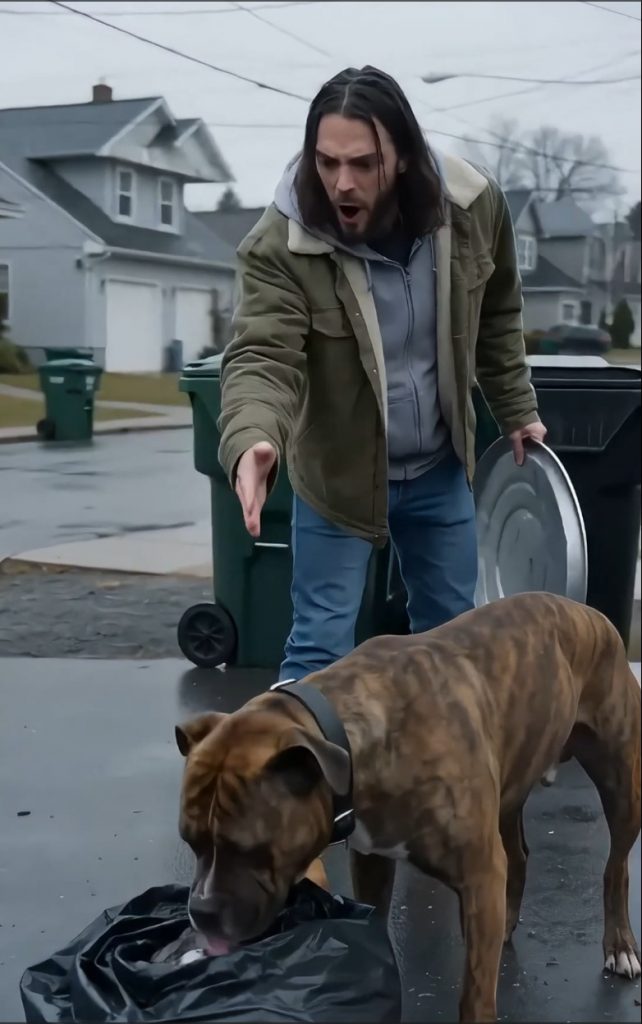
Leo was about to swing the lid when the dog looked up at him.
Not scared.
Not guilty.
Warning.
The morning was gray and wet, the kind of suburban morning where everything looked washed out and tired. Rainwater ran along the curb in thin streams. Trash bins stood in a crooked line beside the driveway, their green and black plastic sides shining with dampness.
A large brindle dog crouched over a black trash bag near the bins, nose pressed to a torn corner, paws scraping at the plastic.
“Hey!” Leo shouted. “Get away from it! Enough!”
He stepped closer, gripping a silver trash can lid in one hand.
The dog growled, but it did not run.
It hunched lower over the bag, muscles tight, black collar wet from the drizzle. Its eyes never left the torn opening.
Leo’s anger flared.
He had been awake all night. He had found garbage dragged across the curb before sunrise. He had assumed some stray had torn through the neighborhood trash again, and now here was this dog refusing to move like it owned the driveway.
“Move!” he barked.
From the porch, a woman’s voice cut through the damp air.
“No, Leo, stop! What’s wrong with you?”
Mara, his neighbor, rushed out in star-patterned pajamas and a checkered robe, slippers slapping against the porch steps. Her blonde hair was messy from sleep, her face pale with alarm.
Leo glanced back.
“It’s ripping through the trash!”
But the dog was not ripping wildly.
It was working carefully.
Paw. Sniff. Pause.
Paw. Sniff. Pause.
Leo noticed it only when Mara came closer.
The dog lowered its muzzle to the torn plastic and nudged something inside with impossible gentleness.
Leo’s grip loosened.
The metal lid slipped from his hand and crashed onto the wet asphalt.
The sound rang across the quiet street.
Leo crouched slowly beside the bag.
“Wait…”
The dog did not attack. It watched him, breathing hard, then stepped just far enough to reveal what it had uncovered.
Discarded newspapers.
A scrap of fabric.
And a tiny pale hand, curled against a purple ruffled sleeve.
Leo stopped breathing.
Mara reached them and froze.
For one terrible second, no one moved except the dog.
It lowered its head again and softly sniffed near the infant’s hand, as if checking whether the tiny life inside the torn black bag was still there.
Leo’s voice came out broken.
“Oh my God.”
Mara covered her mouth with both hands.
The dog stayed calm beside the bag, wet and watchful, the only one who had understood from the beginning.
This was not trash.
This was a baby.
Act II
Leo had not always been the kind of man who shouted before he looked.
That was what Mara would remember later.
There had been a time when he fixed loose porch railings for elderly neighbors without being asked. He shoveled driveways after storms. He carried groceries for Mrs. Patel from two houses down and pretended not to notice when she slipped homemade bread into his mailbox as payment.
Then his life collapsed in quiet pieces.
A job lost.
A marriage ended.
A brother he stopped speaking to.
Long nights, cheap coffee, and too much anger with nowhere useful to go.
By that gray morning, Leo had become the neighborhood man people avoided before breakfast. Not dangerous, exactly. Just loud. Bitter. Quick to assume the worst because expecting the worst made disappointment feel less personal.
Mara knew this, but she also knew there was still softness under him somewhere.
That was why she yelled when she saw him with the trash can lid.
She did not know the dog.
No one did.
It had appeared sometime before dawn, soaked and shaking near the curb, moving from one trash bag to another with frantic focus. Mara had first seen it from her kitchen window while making coffee. At first, she thought it was scavenging.
Then she saw how it kept returning to one bag.
The black one.
The one tied at the top but torn near the side.
The dog would sniff, step back, whine, then paw at the same place again. It did not grab food. It did not run when headlights passed. It stayed close as if afraid something inside might disappear if it looked away.
Mara had opened the front door just as Leo came outside.
He saw a mess.
She saw distress.
The dog saw a life.
That difference would haunt all of them.
Now Mara crouched beside Leo with shaking hands, afraid to touch the bag and more afraid not to.
“Is it…” Her voice failed.
Leo leaned closer, his anger completely gone.
“I don’t know.”
The baby’s tiny hand moved.
Barely.
But enough.
Mara let out a sound between a sob and a prayer.
Leo fumbled for his phone so violently he almost dropped it.
“Call 911,” Mara said.
“I am.”
His hands shook too badly to unlock the screen.
The dog gave one low whine and nudged the blanket inside the bag again.
Mara reached forward, then stopped.
“No, wait. We shouldn’t move too much.”
The baby was hidden under layers of damp cloth and crumpled paper, not fully visible. The black plastic had shielded the child from the rain, but it also trapped cold and fear inside its folds.
Mara pulled off her robe belt and used it to hold back the torn plastic without pressing on anything beneath.
Leo finally got through.
“There’s a baby,” he said into the phone, voice cracking. “There’s a baby in a trash bag. In my driveway. Please hurry.”
The dispatcher asked if the baby was breathing.
Leo looked at Mara.
Mara looked at the little hand.
The dog lowered its head and sniffed softly.
Then the smallest sound came from inside the bundle.
A weak cry.
Mara began to weep.
“Yes,” Leo said. “Yes, alive. She’s alive.”
Act III
The next four minutes stretched longer than any hour.
The dispatcher stayed on the line, telling Leo what to do and what not to do. Keep the baby warm. Do not shake. Do not pull too hard at anything stuck or wrapped. Watch for breathing. Wait for paramedics if the child is not in immediate danger.
Immediate danger.
Leo looked at the trash bins, the cold driveway, the torn bag, the drizzle turning to rain again.
Everything about this place was danger.
Mara ran inside and came back with clean towels from her linen closet. She moved like someone afraid that speed itself might hurt the baby. Leo held the plastic open while she gently layered a towel over the exposed part of the bundle, leaving space around the tiny face when they finally saw it.
A newborn.
So small that Leo’s whole idea of the world seemed to rearrange around her.
Her skin looked pale from the cold. Her eyes were squeezed shut. The purple sleeve belonged to a tiny outfit damp at the edges.
Mara whispered, “Oh, sweetheart.”
The dog pressed close, watching every movement.
Leo glanced at it.
“I almost hit you,” he said.
The dog only panted, rain dripping from its muzzle.
Sirens sounded in the distance.
Neighbors began appearing on porches. Doors opened. Curtains shifted. Someone called out, asking what happened, but Mara lifted one hand sharply.
“Stay back!”
Her voice had changed.
No longer panicked.
Protective.
The dog approved. It stood and turned toward the gathering people, placing itself between the baby and the street.
Leo stared at the animal.
It had been doing that all along.
Guarding.
Not growling over garbage.
Not causing trouble.
Guarding.
The ambulance arrived first, then a police cruiser.
Paramedics stepped out with urgency and care, kneeling beside the bag. One spoke to the baby in a soft voice while another checked her condition. A police officer asked Leo and Mara to step back, but the dog whined and tried to follow when the paramedics lifted the baby.
“She found her,” Mara said, pointing at the dog. “Or he did. I don’t know. The dog found her.”
The officer looked at the brindle dog, then at the infant being carried toward the ambulance.
“Looks like the dog saved her.”
Leo wiped rain and tears from his face with the back of one hand.
The words hit him harder than he expected.
Saved her.
He thought of the raised lid in his hand.
The anger in his voice.
The way the dog had stood its ground anyway.
A paramedic turned before climbing into the ambulance.
“She’s breathing. We’re taking her now.”
Mara nearly collapsed with relief.
Leo remained frozen, watching the ambulance doors close.
The dog barked once.
Short.
Desperate.
The paramedic paused.
Mara stepped toward the animal and put a trembling hand near its shoulder.
“It’s okay,” she whispered. “They’re helping her.”
The dog looked at the ambulance until it disappeared down the street.
Only then did it sit.
Mud-streaked.
Exhausted.
Victorious in a way no one yet knew how to honor.
Act IV
By noon, the neighborhood had become a crime scene.
Yellow tape marked off Leo’s driveway. Officers photographed the trash bins, the torn black bag, the wet newspapers, the curb, the street, the route from the sidewalk to the bins.
Detectives knocked on doors.
Who put out trash last night?
Did anyone see a car?
Any unusual sounds?
Any cameras facing the street?
Mara’s doorbell camera caught only fragments through rain. A shadow at 4:18 a.m. A figure near the curb. A vehicle idling with headlights off two houses away. The footage was blurry, but it was enough to prove the baby had not been there long.
Long enough to become dangerously cold.
Not long enough for hope to disappear.
The dog stayed on Mara’s porch while animal control scanned for a chip.
There was one.
His name was Bruno.
He belonged to an older man named Mr. Alvarez, who lived six blocks away and had reported him missing before sunrise. Bruno had bolted through a loose gate during the storm.
When Mr. Alvarez arrived, soaked from hurrying through the rain, Bruno stood and wagged his tail once before pressing himself against the old man’s legs.
“I’m sorry,” Mr. Alvarez told the officers. “He never runs. Never.”
Mara looked at Bruno, then at the driveway.
“Maybe today he had somewhere to go.”
Mr. Alvarez listened as they explained what happened.
The old man sank slowly onto the porch step.
“My Bruno found a baby?”
Leo nodded.
“He wouldn’t leave her.”
Mr. Alvarez covered his face.
“He was my wife’s dog,” he said. “She always said he had a heart bigger than sense.”
Leo looked away, ashamed.
“I thought he was just making a mess.”
Mara touched his arm.
“You didn’t know.”
“No,” Leo said quietly. “I didn’t look.”
That was the truth he could not escape.
He had seen a dog and assumed nuisance.
Bruno had seen a hidden child and refused to let the world throw her away.
At the hospital, the baby was listed as stable but under close observation. The police did not release her name because no one knew it. Nurses began calling her Lily, unofficially, because one of them said every child deserved to be called something soft.
The investigation moved quickly after that.
A neighbor’s dash camera caught a partial plate.
A gas station camera caught the same car twenty minutes earlier.
A young woman came forward the next day, frightened and overwhelmed, telling a story filled with panic, pressure, and a family that had told her the baby would “ruin everything.”
The legal truth would take time.
The emotional truth was already clear.
A child had been left where she should never have been.
And a dog had done what no human was there to do.
He stayed.
Act V
Leo visited Bruno three days later.
He brought a steak from the grocery store because apology did not come naturally to him, but feeding did.
Mr. Alvarez opened the door and raised an eyebrow.
“You here for me or the hero?”
Leo held up the bag.
“The hero.”
Bruno came trotting from the living room, clean now, brindle coat shining, black collar replaced with a bright blue one. He sniffed Leo’s boots, then looked up at him with the same steady eyes that had stared him down beside the trash bins.
Leo crouched.
“I owe you,” he said.
Bruno licked his hand.
Leo laughed once, then unexpectedly cried.
Mr. Alvarez pretended not to notice.
Mara came by later with a framed photo someone had taken after the rescue: Bruno standing near the ambulance, muddy and alert, ears forward, as if still waiting to be told the baby was safe.
Mr. Alvarez hung it near the front window.
“She would’ve liked this,” he said softly, meaning his wife.
In the weeks that followed, the story spread far beyond the neighborhood.
People left flowers near the curb until Mara asked them to donate blankets and baby supplies instead. The local shelter collected so many items that volunteers filled an entire room. The hospital received cards addressed simply to “Baby Lily.”
Leo became quieter after that morning.
Not healed.
Not transformed into a saint.
Just changed.
He fixed Mara’s porch step without being asked. He helped Mr. Alvarez repair the gate Bruno had escaped through. He stopped shouting at small problems as if they were personal enemies.
One morning, Mara found him standing by the curb, staring at the place where the bag had been.
“You okay?” she asked.
Leo nodded, then shook his head.
“I keep thinking about how close I came.”
“To what?”
“To making the worst mistake of my life.”
Mara stood beside him.
“But you didn’t.”
“Because he wouldn’t move.”
Across the street, Bruno barked from Mr. Alvarez’s yard, tail wagging as a mail truck passed.
Leo smiled faintly.
“No,” he said. “He wouldn’t.”
Months later, Lily was placed with a foster family approved to adopt her if reunification was not possible. The details remained private, as they should have. But the caseworker sent one update through the police department to the neighbors who had helped save her.
She was healthy.
She was growing.
She had a full laugh.
Mara read that part aloud on Mr. Alvarez’s porch while Leo stood nearby and Bruno lay at their feet.
A full laugh.
That was the line that broke them.
Mr. Alvarez took off his glasses and wiped them.
Mara covered her mouth, just as she had when she first saw the tiny hand, only this time the tears were different.
Leo crouched and scratched Bruno behind the ears.
“You hear that?” he whispered. “She laughs.”
Bruno sighed, resting his head on Leo’s boot.
A year after the rescue, the neighborhood held a small block gathering. Nothing grand. Folding tables, lemonade, children drawing with chalk on the damp-looking but dry pavement.
Someone made Bruno a bandana that read HERO.
He hated it.
Everyone loved it.
Near sunset, Mara watched a little girl from down the street toddle past the trash bins while her father walked close behind her. The bins were ordinary again. Plastic lids. Weekly pickup. Nothing more.
But Mara knew ordinary places could hold terrible things.
She also knew they could hold miracles.
A dog could find what everyone else missed.
An angry man could stop and change.
A neighbor could run out in pajamas and become part of a rescue.
A baby could survive the cold because something loyal and wordless refused to leave her side.
Leo came to stand beside Mara, arms folded.
“You ever think about that morning?”
Mara looked at Bruno, asleep under Mr. Alvarez’s chair while children played around him.
“Every time I hear a dog bark.”
Leo nodded.
“Me too.”
The sky softened into evening. Porch lights flickered on. Somewhere down the street, a baby laughed from an open window, bright and sudden.
Mara did not know if it was Lily.
It probably wasn’t.
But she smiled anyway.
Because somewhere, Lily was laughing too.
Because somewhere, a child who had once been hidden in a torn black bag was warm, fed, held, and known by name.
And because on one gray morning, beside a row of trash bins on a damp suburban driveway, a dog had looked at human anger and refused to surrender the life beneath his paws.