Act I
The dog would not move.
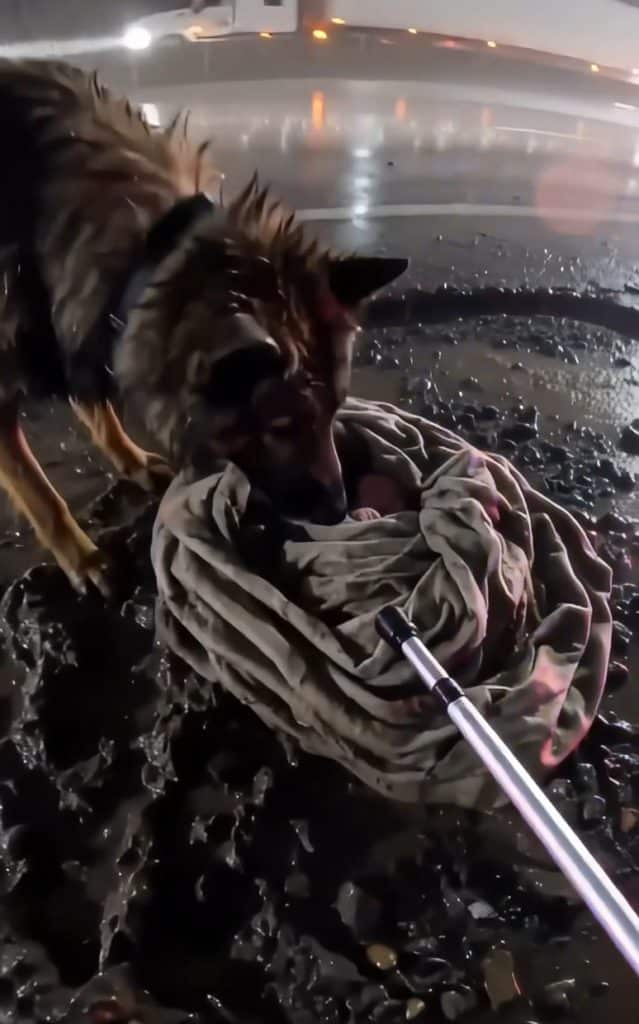
Rain hammered the highway shoulder so hard the world looked broken, all headlights and water and red taillights smeared across the night. Semi-trucks roared past close enough to shake the mud. Gravel slid beneath every step. The ditch beside the road had turned into a black ribbon of running water.
Officer Hannah Price stepped out of her patrol car with one hand gripping a silver control pole and the other raised toward the animal crouched ahead.
“Hey!” she shouted over the rain. “Back away!”
The dog answered with a bark so deep it cut through the storm.
It was large, dark-furred, drenched to the bone, and covered in mud from chest to paws. Its ears were pinned forward. Its teeth flashed white when lightning flickered above the highway.
At first glance, Hannah saw only danger.
A panicked dog on the shoulder of a busy road.
Aggressive.
Unpredictable.
Too close to traffic.
Dispatch had called it in as “a loose animal blocking the shoulder.” A truck driver had nearly swerved when the dog lunged toward his headlights.
Now Hannah understood why.
The dog was standing over something.
A dark shape in the mud.
At first, she thought it was trash. A torn blanket. A bundle of roadside debris dragged from the ditch by floodwater.
The dog snapped once near the pole when she stepped closer, not biting, not attacking, but warning.
“Easy,” Hannah said, lowering her voice. “I’m not here to hurt you.”
The dog growled, then glanced down.
That glance stopped her.
It was too deliberate.
Too human in its urgency.
Hannah lowered the pole a few inches and leaned forward, rain dripping from the brim of her cap into her eyes.
“Wait…” she whispered. “What is that?”
The dog shifted just enough for one corner of the muddy blanket to move.
Then Hannah saw it.
A tiny hand.
Pale.
Barely moving inside the soaked folds.
Her breath vanished.
The control pole slipped downward until it tapped against the gravel.
The dog stopped barking.
It lowered its head and gently nudged the blanket with its nose.
Hannah dropped to one knee in the mud.
“Oh God,” she whispered. “It’s alive.”
The dog gave a low, trembling whine and licked the newborn’s tiny hand as if asking the officer to finally understand.
It had not been blocking the road.
It had been guarding a life.
Act II
Hannah had been ten minutes from the end of her shift when the call came in.
Loose dog. Highway shoulder. Possible hazard.
Nothing unusual.
Storm nights always brought chaos. Fender benders. flooded gutters. stranded drivers. Animals running scared from thunder. People making bad decisions because rain made everything feel urgent and invisible.
She almost asked animal control to handle it.
Then dispatch added one detail.
“Caller says the dog keeps returning to the same spot. Won’t leave the mud.”
That was why Hannah went.
She had learned years ago that animals did not always make sense to people, but they usually made sense to themselves. A dog that refused to leave a spot in the rain had a reason.
Still, she had not expected this.
Not a newborn wrapped in a mud-stained receiving blanket on the edge of a highway.
Not a dog so soaked and exhausted it could barely stand, still bracing its body between the baby and the road.
Hannah pressed the radio button with shaking fingers.
“Dispatch, I need EMS now. Newborn found alive on the shoulder near mile marker 48. Repeat, newborn alive. Severe exposure risk. Send medical and backup.”
Her voice cracked on the last word.
The dog watched her closely.
It did not run.
It did not growl now.
It stayed low beside the bundle, panting hard, rain streaming from its muzzle. When Hannah eased one gloved hand toward the blanket, the dog’s body tensed again.
“I know,” she whispered. “I know. You did good. Let me help.”
The dog stared at her.
Thunder rolled over the highway.
Then, slowly, it moved its head aside.
Hannah peeled back the outer fold of the blanket just enough to see the baby’s face.
A newborn.
Tiny.
Cold.
Alive.
The baby made the smallest sound, almost swallowed by rain and traffic, and Hannah felt something inside her split open.
She had been trained for emergencies. She had handled wrecks, panic, fear, and grief. She knew how to work with steady hands when her heart was not steady.
But this was different.
This was a child left where headlights could miss her and tires could find her.
This was a dog understanding what people had failed to protect.
Hannah lifted the bundle carefully, keeping the blanket wrapped around the baby as best she could. The dog rose with her instantly, pressing close, whining as if afraid the child might disappear.
“I’ve got her,” Hannah said.
The dog followed every step through the mud to the patrol car.
When Hannah opened the rear door and climbed halfway inside with the baby, the dog placed both front paws on the threshold and tried to climb in after them.
“Okay,” Hannah breathed. “Okay, you’re coming too.”
She had broken smaller rules for worse reasons.
She spread an emergency thermal blanket across the seat, wrapped the newborn, and kept one hand near the baby’s chest while the dog crouched on the floorboard, eyes locked on the bundle.
Red and blue lights pulsed through rain-streaked windows.
The baby whimpered.
The dog whined back.
And Hannah, soaked to the skin, whispered into the radio again.
“Tell EMS to hurry.”
Act III
The ambulance arrived in six minutes.
It felt like an hour.
The paramedics moved fast, but even they slowed for half a second when they saw the dog in the patrol car, muddy and trembling beside the newborn.
“He won’t leave her,” Hannah said.
One paramedic looked at the animal, then at the baby.
“Then don’t make him.”
They transferred the newborn into a warmed medical wrap, checking her carefully while Hannah stood outside in the rain with the dog pressed against her leg. The dog tried to follow when they loaded the baby into the ambulance.
Hannah caught his wet fur gently.
“Not yet, buddy.”
The dog gave one sharp bark toward the ambulance doors.
Not angry.
Desperate.
The paramedic looked back.
“We’ll take good care of her.”
The doors closed.
The ambulance pulled away.
The dog stood in the wash of red light, staring after it until the darkness swallowed the taillights.
Only then did his legs buckle.
Hannah dropped beside him.
“Hey. Hey, stay with me.”
The dog was not injured badly, but he was spent. Cold, hungry, muddy, and shaking from whatever fight he had waged against the storm before anyone arrived.
Backup officers found Hannah kneeling in the mud with one hand on the dog’s shoulder.
“What happened?” one of them asked.
Hannah looked toward the empty patch where the bundle had been.
“The dog found her before we did.”
The investigation began right there in the rain.
Officers searched the shoulder, the ditch, the nearby trees, and the stretch of road leading back toward the last exit. They found no car seat. No stroller. No adult nearby calling for help.
Only tire marks softened by rain.
A scrap of blue ribbon caught in the gravel.
And the flattened patch in the mud where the dog had stood guard long enough for strangers to call him dangerous.
At the hospital, the newborn was taken into the neonatal unit and stabilized. Doctors later said minutes mattered. The rain, the cold, the highway, the mud—everything had been against her.
Everything except the dog.
Hannah arrived at the hospital two hours later, after giving her statement and changing into a dry uniform jacket someone brought from the station. The dog came too, wrapped in old towels in the back of an animal control van, not in a cage but under the supervision of a handler who had watched him refuse food until he saw Hannah again.
They let him stay in a secure service hallway near the pediatric wing.
He sat facing the door where the baby had disappeared.
Hannah sat on the floor beside him.
“You know,” she said quietly, “you scared half the county tonight.”
The dog leaned against her knee.
She looked at his muddy head, his tired eyes, the way he still listened for every sound from beyond the door.
“What should we call you?”
The dog blinked.
Hannah looked toward the rain-streaked hospital window.
“Storm,” she said.
The dog lowered his head onto his paws.
For the first time all night, he rested.
Act IV
By morning, the story had already spread.
Not all of it.
Not the details investigators were protecting.
But enough.
A newborn found alive by a highway.
A dog refusing to leave her.
An officer who thought the dog was a threat until she saw the tiny hand in the blanket.
News vans gathered outside the hospital. People called the station asking about the baby. Others asked about the dog. Some wanted to adopt him before anyone even knew whether he belonged to someone.
No microchip was found.
No collar.
No tag.
Just mud, rain, and loyalty.
The hospital staff began calling the baby Grace before anyone made it official.
Because what else could they call a child found alive in a storm?
Hannah visited the neonatal unit that afternoon. A nurse led her to the viewing window, where the newborn slept beneath soft light, wrapped now in clean blankets instead of rain-soaked fabric.
“She’s doing better,” the nurse said. “Still being monitored, but she’s a fighter.”
Hannah touched the glass.
Behind her, in the hallway, Storm whined softly.
The nurse smiled.
“He knows she’s in there.”
“He knew before all of us,” Hannah said.
Detectives worked the case hard.
Traffic cameras gave them fragments. A dark sedan stopping briefly on the shoulder. Headlights cutting through rain. A door opening. A shape placed low near the mud. Then the car leaving.
But there was another shape in the footage too.
Storm.
He appeared from the ditch minutes later, running toward the bundle. He circled it, nudged it, then stood over it as cars passed dangerously close. When headlights came too near, he barked and lunged toward the road, forcing drivers away from the shoulder.
For nearly forty minutes, he kept the baby from being unseen.
From being run over.
From being washed into the ditch.
From being alone.
Hannah watched the footage in the detective room with both hands clenched.
No one spoke for a while.
Finally, Detective Morales said, “That dog saved her life.”
Hannah nodded.
But she could not stop watching the earlier part.
The car stopping.
The door opening.
Someone choosing to leave a newborn in the rain.
Anger rose in her chest, hot and useless.
Morales paused the video.
“We’ll find who did it.”
Hannah looked at the frozen image.
“I know.”
But the picture she carried home that night was not the car.
It was Storm in the rain, standing over a bundle no bigger than a loaf of bread, daring the whole highway to come closer.
That image would not leave her.
Two days later, a woman came forward.
Young. Frightened. Barely older than a teenager. She arrived at a community clinic in another county, sick with fear and asking whether a baby had been found near the highway.
The full truth was complicated. Painful. Still under investigation. There had been pressure from someone older. Panic. A storm. A decision made in terror that nearly became tragedy.
Hannah was not told everything.
She did not need everything to understand that Grace’s life had passed through too many unsafe hands before landing beneath the body of a dog who refused to abandon her.
The legal system would decide the rest.
For Hannah, the question became simpler.
What happens now to the child?
And what happens to the dog who saved her?
Act V
Storm was supposed to go to a shelter after his medical check.
He did not.
At least, not for long.
The shelter staff reported that he refused to settle unless he had a blanket near him. Any blanket. He would gather it beneath his chest, curl protectively around it, and stare at the door.
When Hannah visited, he walked straight to her and pressed his muddy-turned-clean head against her stomach like they had known each other for years.
“You can’t do this to me,” she said.
Storm wagged his tail once.
Her husband, Mark, laughed when she sent him a photo.
Their apartment was too small, he said.
Their schedule was too unpredictable.
They already had enough chaos.
Then he came to meet Storm.
The dog sat beside Hannah, calm and massive, watching Mark with solemn brown eyes.
Mark lasted twelve minutes.
“He can sleep by the door,” he said.
Hannah smiled.
“That’s a yes?”
“That’s me pretending I ever had a choice.”
Grace remained in protective medical care while the courts sorted through family options, guardianship questions, and the investigation surrounding her abandonment. Hannah was not family. She knew that. She respected that.
But the hospital allowed her to visit sometimes.
Storm was not allowed inside the neonatal unit, of course, but once Grace was stronger, a nurse arranged a brief meeting in a quiet courtyard under supervision.
Grace was bundled in a soft yellow blanket.
Storm approached slowly, almost crawling, as if even his footsteps might be too loud for someone so small. He sniffed the air near her, then lay down at the nurse’s feet and rested his head on the ground.
Not touching.
Just guarding.
The nurse wiped her eyes.
“He remembers.”
Hannah looked down at the dog.
“No,” she said softly. “He never forgot.”
Months passed.
Grace was placed with a foster family who later began the adoption process. They were kind people, older, steady, and patient. They sent Hannah one photo through the caseworker: Grace asleep in a crib beneath a mobile of clouds and stars.
In the corner of the photo was a stuffed German Shepherd.
Hannah showed it to Storm.
He sniffed the screen, then looked at her as if unimpressed by technology but satisfied by the baby’s survival.
The case concluded slowly, painfully, with accountability for the adults involved. There were no clean villains in some parts of it, only fear and failure and choices that nearly cost a child her life.
But there was one clean truth.
Storm had stayed.
A year later, on the anniversary of the rescue, Hannah drove past mile marker 48 in daylight.
No rain.
No flashing lights.
No roaring storm.
Just a strip of shoulder, a guardrail, and grass growing where mud had swallowed her boots that night.
Storm sat in the back seat, head lifted, ears alert.
Hannah pulled over safely and stepped out.
For a moment, she stood looking at the place where she had first mistaken loyalty for aggression.
She remembered raising the pole.
Storm barking.
The tiny hand.
Her own horrified whisper.
Oh God, it’s alive.
Storm came to stand beside her, calm now, his coat shining in the afternoon sun.
“You scared me half to death,” she told him.
He leaned against her leg.
She crouched and scratched behind his ears.
“But you were right.”
Cars rushed past in steady lines. None of the drivers knew what had happened there. None knew that a newborn’s life had balanced in that mud, beneath rain and headlights, guarded by a dog everyone had misunderstood.
Hannah looked down the highway.
Sometimes rescue arrived with sirens.
Sometimes it wore a badge.
Sometimes it came soaked in rain, covered in mud, barking at the world to stay back until one person finally listened.
Storm lifted his head toward the road, watching the passing cars with the same quiet seriousness he had carried since the night they met.
Hannah rested a hand on his back.
The storm was gone.
The baby was safe.
The dog had a home.
And the place that had once held fear now held a story she would never stop telling:
A story about a newborn in the rain.
An officer who almost saw danger instead of devotion.
And a dog who stood over the smallest life on the side of a highway and refused to let the darkness win.