Act I
The chair scraped so loudly that everyone in the waiting room looked up.
The woman forced the boy down into it with one hard hand on his shoulder, then smiled at the receptionist as if nothing had happened.
“Kids,” she said lightly. “Always restless.”
The boy did not look restless.
He looked terrified.
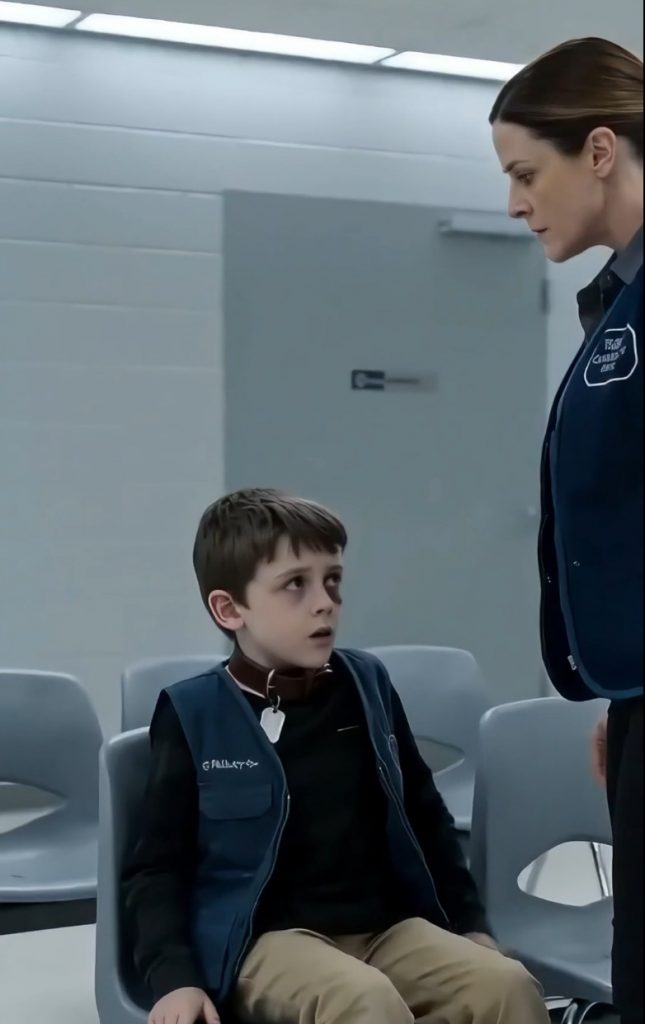
He was small for his age, maybe nine, with short brown hair and a bruise shadowing one eye. His navy vest was zipped too high over a black shirt, and his khaki pants were wrinkled at the knees. Around his neck was a thick brown leather collar with a small metal tag that clicked every time he trembled.
The woman leaned close to him.
“Sit still,” she hissed. “You’re making a scene.”
The boy stared at the floor.
“I didn’t do anything,” he mumbled.
Her face stayed pleasant for the room, but her fingers dug into his wrist when he moved one hand toward his pocket.
“Don’t you dare show anyone,” she whispered.
Across the waiting area, an older man with a long gray beard watched without blinking.
He wore a black leather vest over a dark shirt, metal chains, and dog tags that rested against his chest. One patch on his vest read CAVALRY. Another was faded almost white from years of sun and rain.
His name was Silas Boone.
Most people saw the beard, the vest, the boots, and looked away.
The boy did not.
For half a second, his eyes lifted toward Silas.
Not enough to ask for help.
Just enough to hope.
Silas heard the metal tag on the collar clink again.
He looked at the woman’s hand around the boy’s wrist.
Then he stood.
The woman noticed immediately. Her grip loosened. Her smile returned too quickly.
“Can I help you?” she asked.
Silas walked toward them slowly, each bootstep heavy on the linoleum floor.
He did not answer.
He stopped in front of the boy and looked down at the collar.
The tag was turned backward.
The boy’s lips trembled.
The woman stepped between them.
“He’s with me,” she said sharply.
Silas lifted his eyes to hers.
For a moment, the whole sterile hallway seemed to lose its air.
Then he spoke, low and steady.
“No child belongs on a leash.”
Act II
The woman’s name was Marla Voss, and she had built her life around looking official.
The navy utility vest helped. The white lettering on the back helped. The clipboard she carried helped most of all. People trusted clipboards. They trusted busy women with tight ponytails and tired expressions who sounded like they had somewhere important to be.
Marla worked for a private transport contractor that moved children between temporary placements, evaluations, and court appointments. She knew exactly how to speak to nurses, receptionists, security guards, and caseworkers.
Firm, but friendly.
Overworked, but competent.
Strict, but necessary.
She called cruelty “structure.”
She called fear “behavior management.”
And she called the boy “difficult.”
His real name was Noah Price.
He had not been difficult before his mother died.
Before then, he had been a boy who collected bottle caps, drew spaceships in the margins of homework, and carried a photo of his grandfather in his backpack. His grandfather, Robert Price, had raised horses in Montana and used to send Noah postcards with mountains on them.
After Noah’s mother’s accident, everything became paperwork.
Temporary custody. Emergency placement. Agency calls. Missing signatures. Delayed background checks. Adults saying words over his head while moving him from one room to another.
Marla entered his life during the third placement.
She told him she knew how to handle boys like him.
The collar appeared one week later.
At first, she said it was a “safety device” because Noah had tried to run from her van during a transfer.
He had run because she told him his grandfather had stopped trying to get him.
That was a lie.
Robert Price had been calling every office, every court line, every agency number he could find. But grief, bureaucracy, and bad people can form a maze around a child.
Noah did not know any of that.
He only knew Marla got angry when he asked questions.
He only knew the collar made adults stare, and Marla always had an explanation ready.
“He has severe behavioral issues.”
“He hurts himself when anxious.”
“Doctor recommended identification.”
No one wanted to challenge the explanation because challenging meant getting involved.
So people looked away.
Until Silas Boone did not.
Silas was at the county medical building that afternoon for a veterans’ support appointment he almost skipped. He hated fluorescent lights. Hated plastic chairs. Hated forms asking him to rate his pain from one to ten, as if pain were ever that polite.
He had served in cavalry reconnaissance decades earlier, in places where silence could save lives and small details mattered. A hand signal. A footprint. A child too still in a place where children should move.
That was what made him notice Noah.
Not the bruise first.
Not even the collar.
The stillness.
The boy sat like someone who had learned that moving made things worse.
Silas had seen that before.
In war zones.
In shelters.
In his own mirror after coming home.
When Noah tried to reach into his pocket and Marla grabbed him, Silas knew the boy had been trying to show something.
A note.
A number.
A secret.
Something.
And Silas had spent too many years regretting the moments when he stayed seated.
So he stood.
Act III
Marla’s smile cracked around the edges.
“Sir,” she said, lowering her voice, “you need to step back. He’s under supervision.”
Silas did not move.
“By who?”
“By me.”
“That’s not an answer.”
The receptionist looked up from behind the silver counter. A man near the vending machine stopped scrolling on his phone. The room was watching now, and Marla knew it.
Her hand returned to Noah’s shoulder.
The boy flinched.
Silas saw it.
So did everyone else.
Marla gave a brittle laugh.
“He’s dramatic. He bruised himself during an episode.”
Noah whispered, “No, I didn’t.”
The room went quiet.
Marla’s head snapped toward him.
Silas stepped closer.
“Let him talk.”
“He is a minor,” Marla said. “You have no authority here.”
Silas reached slowly to the dog tags at his chest, not as a threat, but as if reminding himself who he had been before the world taught him to mind his own business.
“No,” he said. “But I’ve got eyes.”
Noah’s hand moved again toward his pocket.
This time, Silas blocked Marla’s reach with his body.
“Go ahead, son.”
Marla hissed, “Noah.”
The boy froze at the sound of his name in her voice.
Silas softened his tone.
“You’re safe enough to try.”
Noah’s fingers shook as he pulled a folded square of paper from his pocket. It was wrinkled, worn soft at the edges, and covered in tiny handwriting.
Marla lunged for it.
Silas caught her wrist before she reached the boy.
He did not squeeze hard.
He did not have to.
“Don’t.”
The receptionist stood.
“Security,” she called.
Marla yanked her hand back.
“This is harassment. I’m a certified transport supervisor.”
Silas took the paper from Noah carefully and opened it.
At the top was one sentence written in a child’s uneven letters.
Please call my grandpa. They lied.
Under it was a phone number.
And a name.
Robert Price.
Silas stared at the name.
The room blurred for half a second.
He knew that name.
Not well. Not from family.
From a veterans’ outreach board in the next county. A retired farrier who had called the Cavalry Riders charity three times asking if any veteran volunteers knew lawyers who helped with custody cases.
A grandfather looking for a boy named Noah.
Silas slowly lifted his eyes to Marla.
Her face had gone pale.
“You know him,” she said.
Silas folded the paper once and held it out toward the receptionist.
“Call this number,” he said. “Now.”
Marla turned toward the exit.
The security guard arrived before she reached it.
Act IV
Marla tried every version of the truth except the real one.
She claimed Noah was unstable. Then confused. Then manipulative. Then traumatized and prone to inventing stories.
But the waiting room had changed.
People who had been strangers five minutes earlier were now witnesses.
The receptionist had seen the wrist grab.
The man by the vending machine had recorded Marla trying to snatch the paper.
The security guard had noticed the collar and called building police.
And Silas stood between Noah and the woman who had controlled him for too long.
Noah did not cry at first.
That worried Silas more than tears would have.
The boy sat with both hands flat on his knees, breathing in tiny controlled pulls. The leather collar still circled his neck. Every few seconds, his fingers twitched toward it, then stopped.
A nurse came out with scissors.
Noah saw them and recoiled.
Silas crouched slowly in front of him, knees popping.
“No one’s doing anything without asking you first,” he said.
Noah looked at him.
“Will it hurt?”
“No.”
“Will she get mad?”
Silas looked over his shoulder at Marla, who was now speaking sharply to an officer near the counter.
“She can be mad from over there.”
For the first time, something like disbelief crossed Noah’s face.
The nurse asked permission.
Noah nodded.
The collar was removed gently.
When it came away from his neck, the metal tag gave one last little clink and fell into the nurse’s palm.
Noah touched the place where it had been.
His hand stayed there.
As if he had to confirm the air was real.
The receptionist returned, phone pressed to her shoulder, eyes wet.
“His grandfather is on the line.”
Noah stared.
Silas held out the phone.
The boy took it with both hands.
A man’s voice came through, broken and breathless.
“Noah?”
The boy’s face collapsed.
“Grandpa?”
The waiting room heard only one side of the conversation after that, but it was enough.
“I thought you stopped looking.”
A pause.
“She said you didn’t want me.”
A longer pause.
Then Noah began to cry like a child who had finally found the door out of a nightmare.
Silas turned away to give him privacy and found himself facing Marla.
Her expression had changed again.
The fake confidence was gone.
Now there was only anger.
“You don’t know what he’s like,” she said. “You don’t know what I had to deal with.”
Silas looked at the collar in the nurse’s hand.
Then at Noah, hunched over the phone, whispering to the grandfather who had never abandoned him.
“I know enough,” Silas said.
The officer asked Marla to come with him.
She protested once.
Then stopped when the security guard moved closer.
As she was led away, Noah did not look at her.
That was its own kind of victory.
Act V
Robert Price arrived three hours later in muddy work boots and a denim jacket soaked from rain.
He came through the glass doors so fast the receptionist barely had time to point.
Noah stood from the chair.
For one second, neither of them moved.
The grandfather looked older than Silas expected. Smaller too, as if the search had carved pieces from him. His eyes went immediately to Noah’s face, then to the place on his neck where the collar had been.
His mouth tightened with pain.
Noah whispered, “Grandpa.”
Robert crossed the waiting room and dropped to his knees.
Noah ran into him.
The old man wrapped both arms around the boy and held on as if the building might try to take him back.
“I never stopped,” Robert said into his hair. “I never stopped looking. Not one day.”
Noah clutched his jacket.
“She said you did.”
“She lied.”
“I wanted to call.”
“I know.”
“She took the postcards.”
Robert closed his eyes.
“I’ll write you a thousand more.”
Silas stood near the wall, arms folded, watching the reunion with the heavy quiet of a man trying not to intrude on something sacred.
Robert looked up after a while.
“You Boone?”
Silas nodded.
Robert’s voice broke.
“They told me a man with cavalry patches helped him.”
“Boy helped himself,” Silas said. “I just stood up.”
Robert held out one hand.
Silas took it.
Noah stayed pressed against his grandfather’s side, but his eyes lifted to Silas.
“Thank you,” he said.
Silas swallowed.
“You keep that note-writing habit,” he said. “It worked.”
The investigation that followed reached further than one waiting room.
Marla’s records were reviewed. Other children were interviewed. Complaints that had been dismissed as “behavioral resistance” were reopened. The private contractor lost its county contract within weeks, and several officials who had signed off on Marla’s reports suddenly found themselves answering questions they should have asked long before.
The collar became evidence.
Noah did not ask to see it again.
Robert took Noah home to Montana after emergency custody was granted. The process was not instant, but for once the system moved like it understood a child was not a file.
Silas visited two months later.
He drove up a long gravel road bordered by open fields and found Noah outside the barn brushing a brown pony with a white blaze.
The boy looked different.
Not healed all the way. Healing is not a door that swings open once.
But his shoulders were looser. His face had color. His neck was bare except for a thin cord necklace with a tiny carved wooden horse his grandfather had made.
Robert came out of the barn carrying two mugs of coffee.
“He talks about you,” he told Silas.
Noah rolled his eyes.
“Grandpa.”
Silas took the mug.
“Good things, I hope.”
Noah looked down, then back up.
“He says you scared her.”
Silas’s beard twitched.
“Did I?”
Noah nodded.
“Good.”
They all laughed softly.
Later, as the sun lowered over the fields, Noah showed Silas a new notebook. Inside were drawings of horses, mountains, and one careful sketch of a man in a leather vest standing in front of a row of gray plastic chairs.
Under the drawing, Noah had written:
He didn’t look away.
Silas stared at it for a long time.
Then he closed the notebook gently.
“You know,” he said, voice rough, “sometimes people don’t know what to do when they see something wrong.”
Noah brushed the pony’s mane.
“You did.”
Silas looked out over the pasture.
“I almost didn’t.”
The boy turned to him.
“Why did you?”
Silas touched the dog tags at his chest.
“Because someone should have stood up for me once, and didn’t.”
Noah was quiet for a moment.
Then he said, “I’m glad you remembered.”
Years later, Noah would forget parts of that waiting room.
The exact shade of the walls.
The receptionist’s name.
The sound of the fluorescent lights.
But he would remember the collar coming off.
He would remember his grandfather’s voice on the phone.
He would remember the old biker with cavalry patches stepping forward when everyone else was still deciding whether the situation was any of their business.
That was the moment Noah learned something no cruel adult had wanted him to know.
Control can look official.
Fear can be trained into silence.
But silence is not consent, and a child’s small glance across a waiting room can be a shout if the right person is listening.
And sometimes the difference between captivity and rescue is one stranger who stands up, looks cruelty in the eye, and says without fear:
No more.