Act I
The father broke free from the firefighters with a scream that made the whole street turn.
“Let me go! My baby’s still in there!”
Flames roared from the windows of the white two-story house, twisting bright orange against the black night. Smoke poured from the roofline. Fire truck lights flashed red across the wet grass, the neighbors’ frightened faces, and the bare chest of the young man fighting to get back inside.
His name was Caleb Miller.
Soot covered his arms and shoulders. His gray sweatpants were soaked from the grass. His face was not just afraid.
It was shattered.
Two firefighters grabbed him before he reached the front steps. He fought them like a man who no longer cared whether he lived.
“My daughter!” he screamed. “She’s upstairs!”
Across the lawn, his wife, Hannah, collapsed to her knees in a pink sweater and pajama pants, one hand pressed to her chest as if something inside her had physically torn.
“No,” she sobbed. “No, no, no…”
The nursery window glowed from within.
That was where their three-month-old daughter, Lily, had been sleeping.
Caleb had carried Hannah out first after smoke filled the hallway. He thought he had time to go back. He thought the firefighters would let him try. He thought a father could make a deal with fire if the thing waiting inside was his child.
But the flames had swallowed the stairwell.
The firefighters held him back because running in would not save Lily.
It would only kill him too.
Then someone in the crowd screamed.
From the burning doorway, something black moved through the smoke.
At first, it looked like a shadow breaking loose from the house.
Then the shadow leapt down from the porch.
It was Duke.
The family’s enormous black dog.
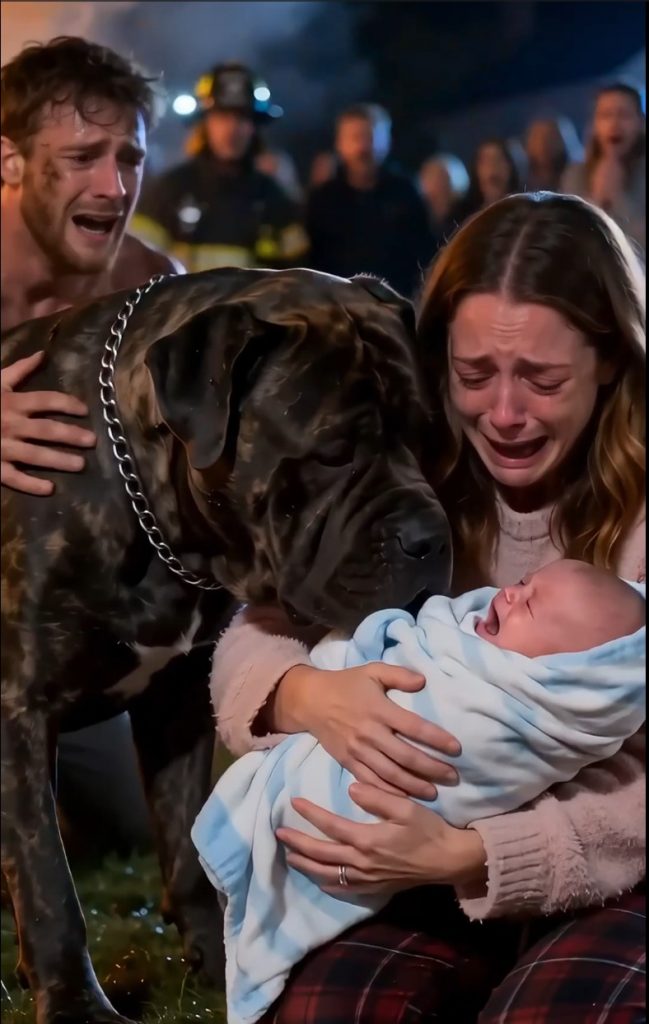
His silver chain collar flashed in the firelight. His fur was wet, smoky, and dusted with ash. His chest heaved with every breath, but his jaws were locked carefully around the edge of a white-and-blue baby blanket.
A sound rose from inside the bundle.
Thin.
Sharp.
Alive.
A baby’s cry.
Hannah lifted her head.
The whole street froze.
Duke ran straight toward her through the wet grass, carrying the blanket as gently as if it were made of glass.
Caleb stopped fighting.
The firefighters loosened their grip.
And Hannah reached out with shaking hands just as Duke lowered the bundle into her arms.
“Oh my baby,” she cried. “Oh my baby!”
Lily wailed against her mother’s chest, frightened but alive.
Duke stood there long enough to see the baby safely held.
Then his legs folded beneath him, and he sank into the grass beside them, panting hard, his eyes still fixed on the child he had pulled from the fire.
Only then did the street understand.
The dog had gone where no one else could.
Act II
Three years earlier, nobody wanted Duke.
He was too big, too black, too quiet.
At the county shelter, people walked past his kennel and slowed only long enough to read the warning card. Strong dog. Needs experienced owner. Not recommended for small children without assessment.
Duke never barked when visitors came.
He only watched.
That made people nervous.
Caleb noticed him on a rainy Saturday when he and Hannah had gone to the shelter “just to look.” They were newly married then, living in a small rental house, still arguing playfully about furniture, paint colors, and whether they were ready for a dog.
Hannah wanted something small.
Caleb stopped in front of Duke’s kennel.
The dog lifted his head.
His eyes were dark, tired, and strangely gentle.
“He looks sad,” Caleb said.
“He looks huge,” Hannah replied.
The shelter volunteer told them Duke had been found near an abandoned property after a storm. No tags. No chip. No one came for him. He was patient with staff, protective of his food at first, and terrified of shouting.
“People see the size and assume danger,” the volunteer said. “But he’s mostly just waiting to trust someone.”
Caleb understood that more than he admitted.
He had grown up in houses where men shouted first and apologized never. He knew what it was to become quiet so people would stop expecting softness from you.
Duke came home that afternoon.
Hannah loved him slowly.
At first, she set rules. No furniture. No kitchen. No sleeping by the bedroom door.
Duke broke none of them.
He simply followed her with solemn devotion until one night she came home crying after a brutal nursing shift, sat on the floor beside the laundry basket, and found Duke resting his giant head in her lap.
After that, the rules softened.
When Hannah became pregnant, Duke changed.
He stopped sleeping near the front door and began sleeping outside the nursery. Before Lily was born, he would sit beside the crib Caleb had assembled crookedly and stare at it as if waiting for a command only he understood.
After Lily came home, Duke became her shadow.
If she cried, he reached the bassinet before either parent. If Hannah rocked the baby, Duke lay at her feet. If Caleb carried Lily across the room, Duke followed one step behind, watchful and serious.
Not everyone found it sweet.
Hannah’s mother worried.
“A dog that size near a newborn?” she said. “I don’t care how gentle he seems.”
A neighbor complained that Duke looked intimidating behind the fence.
Even Caleb, once or twice, wondered whether love had made him careless. A baby was fragile. A dog was still a dog.
But then came the night Lily stopped breathing right after a feeding.
It was Duke who woke them.
He barked once outside their bedroom door.
Then again.
Not loud enough to frighten the baby. Loud enough to demand attention.
Hannah found Lily red-faced and struggling, and her training took over. Minutes later, the danger had passed. The doctor said they had acted quickly.
Hannah sat on the nursery floor afterward, Lily sleeping against her chest, and looked at Duke.
“You knew,” she whispered.
Duke only rested his head beside her knee.
After that, no one in the house doubted him.
Until the fire.
It started in the laundry room just after midnight, where old wiring behind the dryer finally failed after weeks of flickering lights Caleb had been meaning to fix. By the time the smoke alarm screamed, the hallway downstairs was already filling.
Caleb woke coughing.
Hannah was disoriented, choking on smoke, one hand reaching toward the nursery monitor on the bedside table.
“Lily,” she gasped.
Caleb grabbed her first because she was closest and the smoke was thick enough to blind him. He dragged her down the back stairs, thinking he could turn and go back.
Duke disappeared into the smoke before Caleb could call him.
At first, Caleb thought the dog had panicked.
Then he heard barking from upstairs.
Not fear.
Warning.
Duke had gone to the nursery.
And the house was beginning to collapse between him and the baby.
Act III
The firefighters arrived six minutes after the call.
To Caleb, it felt like six years.
He kept trying to run back inside. Every time, someone stopped him. He screamed until his voice cracked. He begged. He cursed. He offered his own life like it was a bargaining chip.
No one judged him.
Every person on that lawn understood what he was trying to do.
They also understood he would not survive it.
Hannah knelt in the grass, rocking back and forth without Lily in her arms. A neighbor wrapped a blanket around her shoulders, but she did not seem to feel it.
“My baby’s in the blue blanket,” she kept saying. “She sleeps in the blue blanket.”
A firefighter shouted toward the front team.
“Second floor compromised!”
Another voice answered from inside the smoke.
“Stairwell blocked!”
Caleb heard the words and broke again.
The nursery window cracked from the heat.
Hannah screamed.
Then, through the roar, came a sound no one expected.
A dog bark.
Not from outside.
From inside the house.
One firefighter turned his helmet toward the porch.
“Did you hear that?”
Caleb lifted his head.
“Duke,” he whispered.
Inside the house, Duke had reached the nursery through the upstairs hall, moving low beneath smoke that stung his eyes and burned his lungs. The door was partly closed. He pushed through with his shoulder.
Lily was crying in the crib.
The room was hot, lit by orange flickers from beyond the hall, but the fire had not yet reached the crib.
Duke had no hands.
No way to lift a baby the way humans do.
But he knew the blanket.
He knew the scent.
He knew what mattered.
The blue-and-white blanket was tucked around Lily’s small body. Duke gripped the outer edge, careful not to bite too close, and tugged. Lily rolled slightly, crying harder, but the blanket held around her.
Duke pulled again.
The bundle shifted.
Behind him, smoke poured through the doorway.
The hall was no longer safe.
So Duke did not go back the way he came.
He followed air.
Dogs understand doors, but they understand air better. A broken draft moved toward the front staircase, where part of the railing had fallen. The route was narrow, dangerous, half-blocked by smoke and heat.
Duke dragged the blanket inch by inch.
Not fast.
Not clean.
But forward.
Outside, Caleb saw movement behind the smoke at the entrance.
A firefighter raised his arm.
“Hold!”
The porch doorway glowed like the mouth of a furnace.
Then Duke burst through it.
The crowd gasped as one body.
He landed hard on the porch step, stumbled, recovered, and kept going.
In his mouth was the blanket.
Inside the blanket, Lily cried.
That cry cut through the night harder than any siren.
Hannah rose from the grass before anyone touched her.
Duke ran to her because he had always known where Lily belonged.
Act IV
The handoff lasted only seconds, but everyone who saw it would remember it for the rest of their lives.
Duke stopped in front of Hannah, lowered his massive head, and waited until her arms were beneath the blanket. Only then did he release his grip.
Hannah pulled Lily into her lap and screamed her name.
The baby cried loudly, face flushed and alive, tiny fists moving beneath the blanket.
Caleb dropped beside them, shaking so badly he could barely touch his daughter. He reached one hand toward Lily’s face, then stopped, afraid somehow that she might vanish if he moved too quickly.
“She’s alive,” Hannah sobbed. “Caleb, she’s alive.”
He folded over both of them.
The firefighters moved in immediately, checking the baby, checking Hannah, shouting for oxygen, blankets, space. A paramedic knelt beside them and gently examined Lily while Hannah refused to let go.
Duke lay beside her, panting in harsh bursts.
His eyes stayed open.
On Lily.
Always Lily.
Caleb noticed first.
“Duke?”
The dog’s head lowered toward the grass.
A firefighter crouched beside him.
“He needs help too.”
Caleb turned, still crying, one arm around Hannah and Lily.
“Save him,” he pleaded. “Please. He saved her.”
The firefighter did not hesitate.
A second team brought an oxygen mask fitted for pets from the rescue kit. Someone wrapped Duke in a blanket. A young firefighter, face streaked with soot, held the mask carefully near the dog’s muzzle.
“Come on, big guy,” he whispered. “Stay with us.”
Duke’s chest rose and fell.
Slow.
Heavy.
But steady.
The house behind them continued to burn.
A window collapsed inward. Sparks rose into the night. The place where Caleb and Hannah had painted the nursery yellow, where they had brought Lily home, where Duke had learned to sleep outside the crib, was being swallowed piece by piece.
But the family was on the lawn.
All of them.
A neighbor began to cry openly.
The father of two teenage boys, who had once crossed the street to avoid Duke because the dog looked “too intense,” stood with both hands on his head, whispering, “That dog. That dog.”
Hannah looked down at Duke through tears.
Her voice broke.
“You brought her back.”
Duke’s tail moved once against the grass.
Just once.
But everyone saw it.
And for the first time that night, the sound rising from the crowd was not panic.
It was hope.
Act V
The Millers lost the house.
By dawn, only the frame remained standing in places, blackened and broken beneath a gray morning sky. Firefighters walked through the ruins after the flames were out, speaking quietly, marking hazards, salvaging what little they could.
A photo album survived in a half-melted storage bin.
Lily’s crib did not.
The blue nursery walls did not.
The little mobile with clouds and stars did not.
But Lily slept in the hospital bassinet that morning with her mother’s hand resting gently near her feet.
Her lungs were clear.
Her cries were strong.
The doctor said she had been very lucky.
Caleb looked at Duke through the glass door of the veterinary treatment room and knew luck had a name.
Duke spent two days at the emergency animal clinic. Smoke had exhausted him. Heat had singed parts of his fur. His paws were sore from crossing debris, but he would recover.
The vet told Caleb that in a calm, professional voice.
Caleb sat down in the clinic hallway and cried anyway.
When Duke finally came home, it was not to the house on Maple Ridge.
There was no home there anymore.
The family stayed with Caleb’s sister in a guest room crowded with borrowed clothes, donated diapers, insurance papers, and the strange silence that follows disaster. Hannah moved like a person whose body was present before her mind had caught up. Caleb checked the baby monitor even when Lily slept three feet away.
Duke slept on the floor beside the crib.
No one told him not to.
News of the rescue spread faster than the family could process. A neighbor’s video showed only the final seconds: Duke emerging from smoke, the blanket in his mouth, Hannah reaching for the baby. It played on local news. Then national news. Then everywhere.
People called Duke a hero.
Caleb did too.
But Hannah said something different when a reporter asked what Duke meant to their family.
She looked down at the dog, who was wearing a soft bandage on one paw and seemed more interested in the reporter’s microphone than the question.
“He’s not our hero because he did one brave thing,” she said. “He’s family because he knew our daughter mattered before anyone had to tell him.”
After that, donations came.
Clothes. Baby supplies. Dog food. Gift cards. Handwritten letters from strangers. A retired firefighter sent a pet oxygen mask kit to the local department in Duke’s honor. A classroom of children mailed drawings of a giant black dog carrying a baby through flames.
One picture showed Duke with wings.
Caleb taped it above Lily’s temporary crib.
Months later, when the new house was being built on the same lot, Caleb walked through the unfinished frame with Duke beside him. The rooms were only beams and plywood then. No paint. No furniture. No memories yet.
Caleb stopped at the doorway of what would become Lily’s new room.
Duke stepped inside first.
He sniffed the corners, circled once, and lay down near the spot where the crib would go.
Caleb laughed softly.
“Already on duty?”
Duke looked at him as if the question was ridiculous.
When the fire department held its annual community ceremony that spring, they gave Duke a medal on a blue ribbon. He sat patiently beside Hannah’s chair while Lily, now chubby-cheeked and wide-eyed, grabbed at the ribbon with both hands.
The crowd applauded.
Duke yawned.
Caleb stood to speak, though he had not planned to. He looked out at the firefighters who had held him back, the neighbors who had watched his worst night, the paramedics, the vet, the people who had helped rebuild what fire had taken.
Then he looked at Duke.
“I was angry at the men who stopped me from running inside,” Caleb said. “I thought they were keeping me from saving my daughter.”
His voice trembled.
“They were saving my wife from losing us both.”
The firefighters lowered their eyes.
Caleb continued.
“But Duke… Duke heard her. He went where instinct, love, and loyalty told him to go. I don’t know how to thank a dog for giving me my child back.”
He swallowed hard.
“So I’ll spend the rest of his life trying.”
Hannah cried quietly, holding Lily close.
That night, back in the temporary room, Caleb woke to a soft sound.
Lily fussing.
Before he could sit up, Duke lifted his head.
The dog stood slowly, walked to the crib, and looked in.
Lily settled at the sight of him.
Caleb watched from the bed, his throat tight.
The fire had taken their house.
It had taken furniture, photographs, baby clothes, walls marked with first plans and future dreams.
But it had not taken Lily.
It had not taken Hannah.
It had not taken Duke.
And sometimes, survival is not the absence of loss.
Sometimes survival is a crying baby in her mother’s arms, a father on his knees in wet grass, and a smoke-covered dog lying beside them with the quiet certainty that love means going back into the dark when someone small is waiting there.
A year later, on Lily’s first birthday, the rebuilt house was full of light.
Not too many guests. Not too much noise.
Just family, firefighters, neighbors, and one enormous black dog lying beside the high chair, watching cake fall to the floor with professional interest.
Hannah lit one candle.
Caleb held Lily’s tiny hand away from the flame.
Everyone sang.
Duke lifted his head at the noise, then rested it back down.
After the song, Lily clapped frosting-covered hands and squealed.
The room laughed.
Warmly.
Safely.
Caleb looked around the new dining room, at the people who had carried them through the ashes, at his wife smiling through tears, at his daughter alive and bright, and finally at Duke.
The dog’s medal hung framed on the wall near the door.
But Duke did not look at it.
He only watched Lily.
Still guarding.
Still loving.
Still the shadow that had walked into fire and brought their whole world back in a blanket.