Act I
The traffic had not moved in forty minutes.
Cars stretched across the highway in both directions, their brake lights glowing red through the rain. Engines idled. Wipers dragged tired arcs across windshields. Drivers stood beside open doors, wrapped in coats and impatience, staring toward the accident far ahead that no one could see.
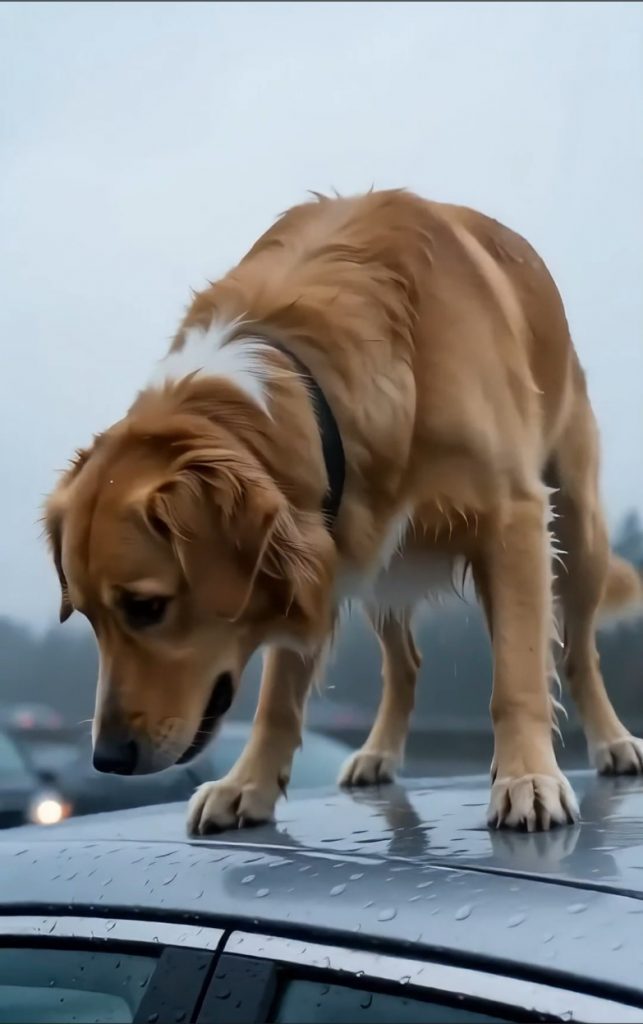
Then the dog climbed onto the roof of the silver sedan.
At first, people laughed.
A golden-tan retriever mix stood on top of the car with rain darkening the fur around his ears and paws. His white chest patch rose and fell with fast, panicked breaths. He barked toward the traffic, then lowered his head toward the roof beneath him, claws scraping against wet metal.
“Why is that dog up there?” someone called.
No one answered.
The dog barked again.
Not playful. Not confused.
Desperate.
Ryan Keller watched from inside his own car, his hand still wrapped around a paper coffee cup gone cold. He was supposed to be on his way to a client meeting. He had spent the last half hour complaining silently about the jam, the rain, the missed call from his sister, and the fact that his phone battery was dying.
Then he saw the dog’s eyes.
They were not fixed on the road.
They kept dropping toward the sedan.
Ryan opened his door.
Rain hit his face as he stepped onto the damp asphalt.
“Easy, buddy,” he said, raising one hand as he approached.
The dog stopped barking for half a second and stared at him.
Then he whined.
The sound cut through Ryan harder than the barking had.
A blonde woman standing near a black SUV turned toward him, her face tight with worry.
“Something is wrong,” she whispered.
Ryan nodded without looking away from the dog.
The sedan’s windows were dark with rain and reflection. No one stood beside it. No driver yelled for the dog to get down. No passenger leaned out.
The car sat locked and silent in the middle lane, as if abandoned in a traffic jam that had no room for abandonment.
The dog barked once, sharp and commanding, then looked down again.
Ryan followed his gaze.
He stepped closer to the rear passenger window and bent carefully, cupping one hand against the wet glass to see inside.
For one second, he did not move.
Then his face went pale.
He jerked back from the window and shouted so loudly the nearest drivers flinched.
“Everyone back up now!”
The dog barked wildly above him.
The crowd began to retreat in confusion.
And inside the silver sedan, hidden behind fogged glass and rain, something no one had noticed was running out of time.
Act II
Ryan had never liked dogs.
That was what he would tell people later, though it was not completely true.
He liked them from a distance. In parks. In commercials. In other people’s homes after they had been told to sit. What he did not like was their need. The way they looked at you as if they expected honesty.
Ryan was not good with need.
Not anymore.
Three years earlier, his wife, Natalie, died in a collision on a rainy road outside Portland. The official report used polite terms. Low visibility. Loss of control. Delayed emergency response.
Ryan remembered only one thing clearly.
Her voicemail.
She had called him before the accident, crying because the weather was getting worse and she was scared to keep driving. He had been in a meeting. He saw her name on the screen and declined the call.
He listened to the voicemail later.
Too late.
After that, Ryan became the kind of man who answered work emails faster than family calls, because work rarely asked questions that could break him. He sold the house. Stopped going to Sunday dinners. Let his sister leave messages he sometimes did not return.
That morning, she had called twice.
He did not answer.
He told himself he would call later.
Then the highway stopped.
At first, the traffic jam felt like punishment. Rain streaked the windshield. Cars boxed him in. His phone battery sat at twelve percent. Somewhere ahead, sirens flashed weakly through the gray.
He was trapped with nothing to do except think.
Then came the barking.
The dog had appeared from nowhere, scrambling onto the silver sedan with frantic determination. People assumed the owner was inside, maybe embarrassed, maybe filming. But minutes passed, and no one came out.
Ryan saw the dog paw at the roof.
Saw him look through the sunroof.
Saw him bark toward the rear passenger side.
That was when Ryan got out.
And when he looked through the window, the whole world narrowed.
A little girl was strapped in a car seat in the back.
She looked about four. Her head had fallen to the side. Her lips were pale. One mittened hand hung loose near a stuffed rabbit on her lap.
Beside her, a woman lay slumped across the front seat, unmoving.
The dashboard lights flickered.
A warning symbol glowed red.
And through the cracked reflection of rain, Ryan saw a thin haze inside the car that did not look like breath on glass.
He had no medical training.
No rescue experience.
No authority.
But he knew danger when a dog had been screaming it at the sky.
“Back up!” he yelled again. “There’s a child inside!”
The highway changed instantly.
A murmur became panic. Doors opened. People stepped away. Someone screamed for a medic. Someone else shouted for emergency services.
The blonde woman from the SUV ran toward Ryan.
“I’m a nurse,” she said. “What did you see?”
“Child in the back. Woman in front. They’re not responding.”
Her expression hardened with focus.
“Call 911.”
“Already happening!” a man shouted from behind them.
The dog barked from the roof again, then scratched toward the rear door.
Ryan tried the handle.
Locked.
The front driver’s door.
Locked.
The blonde nurse looked through the glass and swore under her breath.
“We need them out now.”
Ryan’s eyes moved to the dog.
The retriever mix was trembling, rain dripping from his muzzle, eyes fixed on the child inside.
“He’s hers,” Ryan said.
The nurse nodded.
“And he knew.”
That was the moment Ryan stopped seeing an animal making noise.
He saw a witness.
A witness no one had listened to until it nearly became too late.
Act III
The little girl’s name was Sophie.
Ryan learned it because the dog’s collar tag said:
BUDDY
SOPHIE’S BEST FRIEND
His throat tightened when he read it.
Buddy barked again, then whined down toward the glass, as if begging the adults to hurry in a language too obvious to misunderstand now.
The nurse’s name was Hannah. She had already taken control of the crowd.
“You,” she pointed to a man in a construction jacket, “do you have a window tool?”
He shook his head.
“Anything heavy?”
The man ran to his truck.
Ryan stayed at the rear window, tapping hard.
“Sophie?” he called. “Hey, sweetheart, can you hear me?”
No movement.
The woman in the front seat shifted slightly.
A weak sign.
Alive.
Hannah looked through the front window.
“She might have passed out before she could open the doors.”
“From what?”
“I don’t know yet. But we are not waiting to find out.”
A trucker pushed through the crowd carrying a heavy emergency hammer from his cab.
Ryan took it with both hands.
For one second, he froze.
The rain. The glass. The child. The unmoving woman.
A memory flashed so violently he almost dropped the tool.
Natalie’s voicemail.
I’m scared, Ryan. Can you just talk to me for a minute?
Hannah saw his face.
“Hey,” she said sharply. “Stay with us.”
Ryan blinked.
The past released him just enough.
He nodded.
Hannah wrapped her coat around her arm and pointed to the rear side window, away from Sophie’s face.
“Here.”
Ryan struck.
The first hit cracked the glass.
The second shattered it.
Buddy barked once, then scrambled low on the roof, ears pinned, as the crowd gasped.
Ryan cleared enough glass for Hannah to reach inside and unlock the door. The moment it opened, the smell hit them: stale air, something chemical, something wrong.
Hannah pulled back.
“Do not crowd the car!” she shouted. “Give us air!”
Ryan reached for Sophie’s seat belt with shaking fingers. Hannah stopped him just long enough to check the child’s neck and breathing.
“She’s breathing,” Hannah said. “Weak, but breathing.”
Ryan nearly collapsed from relief.
Together, they lifted Sophie out carefully, keeping her head steady. Hannah carried her toward the shoulder while another bystander spread a coat on the ground.
Buddy jumped down from the roof so fast Ryan thought he would slip. The dog landed hard, scrambled, then ran to Sophie’s side and pressed his wet nose near her hand.
Sophie’s fingers twitched.
Buddy whimpered.
Ryan turned back to the car.
The woman in the driver’s seat was still inside.
Her face was turned toward the center console, one hand limp near a phone that had fallen between the seats. On the screen, a message draft glowed faintly.
Ryan could see only part of it.
Traffic stopped. Sophie sleepy. Something wrong with car. Need—
The message had never been sent.
Ryan opened the front door from inside and leaned in.
“Ma’am? Can you hear me?”
Her eyelids fluttered.
Hannah shouted from behind him, “Ryan, don’t stay in there!”
He grabbed the woman carefully under the arms with help from the construction worker and pulled her out into the rain.
Emergency sirens were growing louder now, threading through the trapped traffic.
Buddy lay beside Sophie, licking her mitten.
The little girl coughed.
Then she opened her eyes.
“Buddy?” she whispered.
The dog let out a broken sound that was almost a cry.
Every adult nearby went silent.
Because a dog had stood on a car roof in the rain and screamed until strangers saved his family.
But the question still remained.
Why had no one in the sedan been able to get out?
Act IV
The answer came in pieces.
The woman was Sophie’s aunt, Rachel, not her mother. She had picked Sophie up from preschool because Sophie’s mother, Elena, was stuck at work across town. Buddy rode with them because Sophie had refused to go anywhere without him after a week of nightmares.
The highway jam began after a multi-car accident miles ahead.
Rachel called Elena once to say they were stuck but fine.
Then the car began acting strangely.
The heater pushed out an odd smell. The dashboard flashed warnings. Rachel cracked the window, but rain blew in and Sophie complained she was cold. She tried to turn the car off, but the electronic locks glitched. Her phone signal dropped. Her message would not send.
Then Sophie got sleepy.
Too sleepy.
Rachel turned to check on her niece and realized something was wrong.
She tried to open the door.
Failed.
Tried the window.
Nothing.
The last thing she remembered was Buddy whining from the back seat, then squeezing through the partially open sunroof after Rachel had pushed it back in desperation for air.
Buddy had climbed out.
Then onto the roof.
Then he barked until the highway listened.
Paramedics treated Sophie and Rachel on the shoulder while firefighters checked the sedan. The crowd stayed back now, subdued and shaken. Drivers who had been angry about being delayed stood in rain-soaked silence as the truth moved from person to person.
They had been feet away from a child in danger.
They had complained about noise.
The dog had not.
Elena arrived twenty minutes later in a patrol vehicle, brought through the emergency lane by a state trooper after she called 911 in hysterics when Rachel stopped responding.
She jumped out before the car fully stopped.
“Sophie!”
The little girl, wrapped in a thermal blanket, lifted her head.
“Mommy.”
Elena fell to her knees beside the stretcher and gathered Sophie as carefully as the paramedics allowed. She kissed her forehead, her cheeks, her hair, repeating thank you in a broken whisper to no one and everyone.
Buddy pushed his head into her shoulder.
Elena wrapped one arm around him too.
“My good boy,” she sobbed. “My good, good boy.”
Ryan stood a few steps away, rain dripping from his hair, hands shaking now that the action had ended.
Hannah looked at him.
“You okay?”
He laughed once, breathless.
“No.”
“Good. That means you understand what happened.”
Ryan watched Elena cling to her daughter.
His phone buzzed in his pocket.
The screen lit up.
His sister again.
For once, he answered immediately.
“Ryan?” she said, surprised. “Are you okay?”
He looked at the shattered sedan window. At Buddy pressed against Sophie’s blanket. At a mother crying over the child who almost vanished in plain sight.
His voice broke.
“No,” he said. “But I’m here.”
There was a pause on the other end.
Then his sister’s voice softened.
“Okay. Stay there. Talk to me.”
So he did.
In the rain, beside a highway full of strangers, Ryan told his sister he was sorry for all the calls he had ignored.
He did not tell her everything.
Not yet.
But it was the first door opened.
And Buddy, exhausted but still watchful, lay with one paw touching Sophie’s blanket as if he had no intention of trusting humans to notice fast enough ever again.
Act V
The traffic started moving two hours later.
By then, the silver sedan had been towed, Sophie and Rachel had been taken to the hospital, and Buddy had been allowed into the ambulance after Sophie cried until the paramedic finally said, “Fine, but he sits where I tell him.”
Buddy obeyed with the solemn dignity of a dog who had already outranked everyone present.
Ryan did not go to his meeting.
He sat in his parked car after the lanes cleared, staring at his rain-streaked windshield while the world resumed its impatience around him.
Cars honked.
Engines shifted.
People hurried back into their lives.
Ryan could not.
He kept seeing Buddy’s eyes through the rain.
Desperate.
Focused.
Refusing to be dismissed.
That evening, Ryan drove to the hospital.
He told himself he only wanted to check that the child was alive. That was all. A quick visit. A polite question at the front desk. Then home.
But when he reached the pediatric floor, he found Hannah already there, holding two coffees.
She handed him one.
“I figured you’d come.”
He took it.
“How is she?”
“Stable. Doing well. Her aunt too.”
Ryan exhaled.
“And Buddy?”
Hannah smiled. “Currently being treated like hospital royalty.”
They found Sophie sitting up in bed, pale but awake, with Buddy lying on a blanket beside her. Elena sat in the chair with one hand on her daughter and the other on the dog.
When she saw Ryan, she stood.
“You’re the man who looked in the window.”
Ryan shifted uncomfortably.
“I just listened to your dog.”
Elena’s eyes filled again.
“That’s more than enough.”
Sophie looked at him.
“Buddy was loud.”
Ryan smiled faintly.
“He was very loud.”
“He gets loud when people don’t understand.”
The sentence landed deeper than Sophie could have known.
Ryan crouched near the bed.
“He was right to keep barking.”
Sophie nodded seriously.
“He’s my best friend.”
Buddy thumped his tail once.
Over the next few days, the story spread.
A dog on a highway roof. A stranger who looked inside. A nurse who acted fast. A child saved because an animal refused to stop warning people.
News crews called Buddy a hero.
Elena corrected them.
“He’s family,” she said. “Hero is just what he did that day.”
Ryan avoided reporters at first.
Then Hannah convinced him to give one short statement, mostly to remind people that strange behavior can be a warning, not an inconvenience. He stood awkwardly in front of a camera and said, “The dog knew something was wrong before any of us did. I’m just grateful I finally paid attention.”
Finally.
That word followed him home.
That night, he listened to Natalie’s voicemail for the first time in almost a year.
Not to punish himself.
To hear her.
Then he called his sister again.
And the next week, he joined her for dinner.
It was uncomfortable. Tender. Imperfect. She cried when he walked in. He apologized badly, then better. She did not pretend everything was fixed.
But she set an extra plate.
That mattered.
Months later, Sophie and Buddy visited the fire station for a small ceremony. Buddy received a blue ribbon, a bag of treats, and a certificate he immediately tried to chew.
Sophie wore a yellow raincoat even though the sky was clear.
Ryan attended too.
So did Hannah.
Elena hugged them both with the fierce gratitude of someone who knew thank you could never be large enough.
During the ceremony, Sophie asked if she could say something.
The firefighters lowered the microphone.
She stood on a small step stool, Buddy beside her, and looked at the gathered adults with solemn brown eyes.
“When Buddy barks like that,” she said, “you should listen.”
The crowd laughed softly.
Then stopped, because the child was not joking.
Sophie continued.
“Even if you don’t know why yet.”
Ryan looked down.
Hannah touched his arm lightly.
Years later, people would still tell the story of the dog on the roof. They would talk about the rain, the traffic jam, the shattered window, the little girl with the unicorn shirt, and the retriever mix who would not let a highway full of strangers ignore him.
But Ryan remembered something else most clearly.
The moment before he stepped out of his car.
The choice.
Stay warm. Stay annoyed. Stay separate.
Or open the door.
He had spent years thinking the worst moments in life came with no warning.
Sometimes they did.
But sometimes warning came loudly, inconveniently, soaked in rain, standing on top of a silver sedan and barking until someone finally cared enough to look closer.
That was the lesson Buddy left on the highway.
Danger does not always announce itself in words.
Help does not always arrive wearing a uniform.
And sometimes, the first voice telling the truth is the one everyone mistakes for noise.