Act I
The house was gone, but the dog would not believe it.
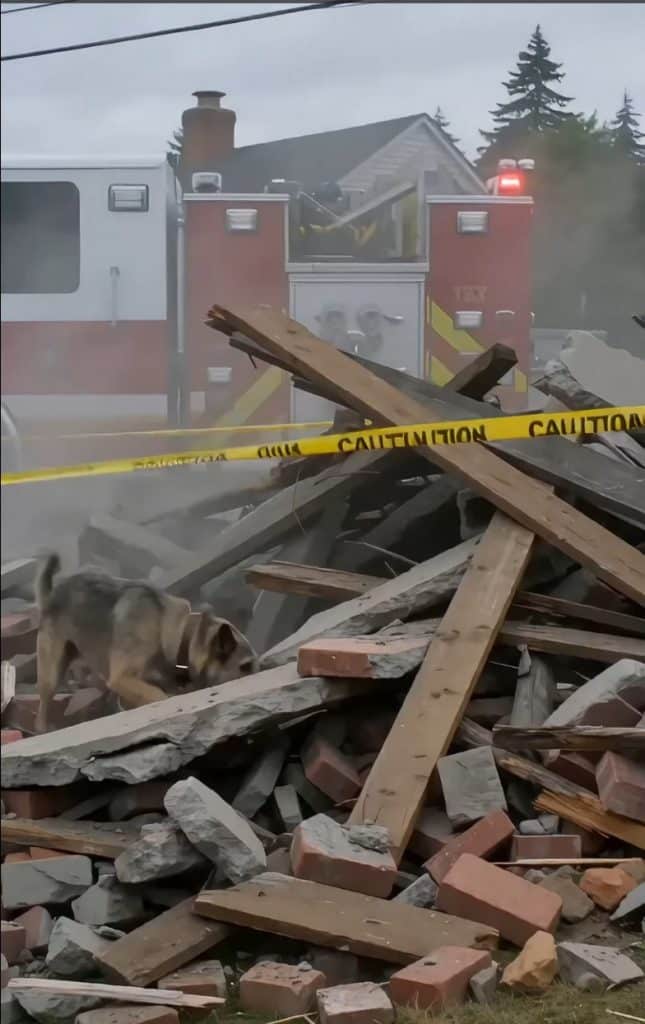
Where a blue two-story home had stood that morning, there was only a mountain of broken beams, cracked brick, dust, torn insulation, and splintered furniture crushed into shapes no one could recognize. Red fire truck lights flashed across the debris. Yellow POLICE LINE tape snapped in the cold wind. Neighbors stood behind it with their hands over their mouths, staring at the place where a family’s life had collapsed in seconds.
And at the center of it all, a scruffy terrier mix was digging like the world depended on his paws.
“Rusty!” Megan Carter screamed. “No! No! Easy! Come here!”
The dog ignored her.
His gray-and-tan fur was matted with dust. His brown leather collar hung crooked around his neck, the gold tag flashing every time the fire truck lights swept over him. He scrambled over a beam, slid down a pile of bricks, shoved his nose into a gap, and barked so sharply that even the firefighters turned.
Megan tried to run toward him.
A firefighter caught her around the waist before she reached the unstable pile.
“Ma’am, stop!”
“My son is in there!” she cried. “My son is in there!”
Her white T-shirt was streaked with dust. Her plaid pajama pants were soaked at the knees from where she had collapsed on the sidewalk after the explosion. Her face was wet with tears, gray with ash, and twisted with a fear no one knew how to comfort.
The firefighter held her back, but his eyes were on the dog.
Rusty barked again.
Not at the crowd.
Not at the firefighters.
At one exact place beneath a collapsed section of the living room wall.
A pile of brick shifted under his paws.
“Get that dog back,” someone shouted.
“The structure’s unstable!”
But Rusty dug harder.
His claws scraped against stone. Dust puffed around his muzzle. He pushed his snout into the darkness between two broken beams and whined.
Megan screamed again.
“Let him go!”
She did not know whether she meant let him go in or let him come back. She only knew that the dog was the last thing moving where her son had disappeared.
The firefighter in the orange-striped jacket stepped carefully closer.
“Hang on,” he called to his team. “He knows exactly where his owner is.”
The crowd behind the police tape fell silent.
A woman in a pink sweater whispered, “Oh my God.”
Rusty pulled his head from the hole and barked straight at the firefighter, frantic and hoarse.
The firefighter turned over his shoulder.
“Bring the hydraulic lift!” he shouted. “Now!”
Then, from the darkness where Rusty had been digging, something moved.
Small.
Dusty.
Alive.
A child’s hand pushed weakly through the gap.
And Megan stopped screaming.
Act II
Rusty had been Ethan’s dog before he was anyone else’s.
That was how Megan always thought of it.
Not the family dog. Not the rescue dog. Ethan’s dog.
Two years earlier, Rusty had appeared under their back porch during a thunderstorm, all ribs and mud and suspicion. He looked like a bundle of wet rags with eyes. Megan had wanted to call animal control. She already had a job, a mortgage, a cracked kitchen ceiling, and a seven-year-old son who asked questions from sunrise until bedtime. She did not need a stray dog.
Ethan disagreed.
“He picked our house,” he said.
“That is not how ownership works.”
“It is for dogs.”
Rusty would not come out for Megan. He would not come out for the neighbor. He would not come out for hot dogs, blankets, or gentle voices.
Then Ethan sat on the porch steps with a peanut butter sandwich and began reading aloud from his dinosaur book.
Rusty crawled out by page six.
By page twelve, his head was in Ethan’s lap.
Megan lost the argument that night.
Rusty became Ethan’s shadow. He followed him to the mailbox. Slept outside his bedroom door. Waited by the window when the school bus was late. If Ethan cried, Rusty appeared with a sock, a toy, or once, inexplicably, a dish towel from the kitchen drawer.
Megan’s husband, Ryan, used to laugh and say, “That dog thinks he’s security.”
Ryan had been gone eleven months now.
A construction accident on a rainy Thursday. A phone call Megan could still hear in her sleep. A funeral where Ethan wore a tie too big for him and held Rusty’s collar the entire time.
After Ryan died, the house changed.
Ethan got quieter.
Megan got busier.
Rusty got watchful.
He started sleeping at the foot of Ethan’s bed instead of outside the door. He barked at strange cars. He stood between Ethan and the basement stairs after a pipe burst and flooded half the lower level. He whined whenever the old furnace made a popping sound.
Megan had meant to replace that furnace.
She had meant to fix the sagging porch step, the cracked brickwork near the side wall, the leak by the laundry room window. But grief turned every task into a mountain. Bills came first. Then work. Then school forms. Then the car. Then groceries. Then another thing broke.
The house kept waiting.
So did the furnace.
That morning, Ethan had stayed home from school with a cough. Nothing serious, Megan thought. A warm blanket, cartoons, soup by lunchtime. She had left him in the living room with Rusty curled beside him while she went upstairs to call the insurance company about yet another repair estimate.
Then the house groaned.
Not a sound any house should make.
Rusty barked.
Once.
Then again.
Megan heard Ethan call, “Mom?”
Then came the blast.
A dull, terrible boom from below. The floor jumped beneath Megan’s feet. The hallway split with dust. Something slammed into her shoulder and threw her against the wall. The world became noise, smoke, splintering wood, and darkness.
When she crawled out through the broken upstairs landing, neighbors were already running.
“Ethan!” she screamed. “Ethan!”
But the living room was gone.
The front half of the house had collapsed inward, dropping beams, brick, and furniture into a jagged pile. Firefighters arrived within minutes. They pulled Megan back. They asked where Ethan had been. She pointed and could not breathe.
Then Rusty appeared.
At first, she thought he had escaped through the back.
He came limping around the side of the debris, covered in dust, one ear nicked, eyes wild. Megan reached for him, sobbing with relief, but the dog did not come to her.
He ran straight back onto the rubble.
“Rusty!” she shouted.
He did not listen.
He climbed over the broken beams and found one spot.
One impossible spot.
And began to dig.
Act III
The firefighters did not trust the dog at first.
They trusted instruments. Plans. structural assessments. Commands shouted through radios. They trusted experience because experience was what kept rescuers alive when buildings wanted to collapse twice.
But Rusty had no respect for procedure.
Every time they pulled him away, he fought back toward the same place. Not randomly. Not everywhere. One narrow pocket between the crushed living room wall and the remains of the staircase.
He shoved his nose into the gap, barked, backed up, dug, barked again.
Captain Luis Ramirez saw it first.
He was the firefighter in the orange-striped jacket, a man with twenty years of disaster calls behind his eyes. He had seen dogs panic in emergencies. He had seen pets run in circles, bite at rescuers, hide under cars, refuse to move from familiar smells.
This was different.
Rusty was not looking for comfort.
He was indicating.
Ramirez crouched near the dog, careful where he placed his weight.
“What do you hear, buddy?” he murmured.
Rusty whined and scratched at the bricks.
Ramirez leaned closer.
For a moment, all he heard was the fire truck engine, the crowd behind the tape, Megan sobbing somewhere behind him, and the tiny shift of unstable debris settling.
Then he heard it.
Not a voice.
Not yet.
A faint tapping.
Three tiny knocks from somewhere beneath the pile.
Ramirez’s head snapped up.
“Quiet!” he shouted.
The whole scene changed.
Firefighters stilled. The crowd froze. Even Megan stopped mid-sob, her hands locked against her mouth.
Ramirez lowered himself again.
“Ethan!” he called. “Can you hear me?”
Silence.
Then two faint taps.
Megan made a sound like her heart had been pulled from her chest.
“He’s alive,” she whispered.
Rusty barked once, as if furious everyone had taken this long to understand.
Ramirez pointed to the debris.
“We’ve got a possible void. I need lift bags, cribbing, camera scope, and medical standby. Nobody steps on that section unless I say so.”
The team moved instantly.
The danger was cruelly simple. Ethan might be alive inside a pocket created by collapsed furniture and beams, but one wrong movement could crush the space that had saved him. They could not just pull. Could not just dig. They had to open the house without making it fall again.
Megan fought the firefighter holding her back.
“I need to talk to him.”
“Ma’am, please.”
“That’s my baby!”
Ramirez looked over.
For a second, professional caution and human mercy battled on his face.
Then he nodded.
“From behind the line. Keep your voice calm.”
Megan stumbled forward as far as they allowed.
She dropped to her knees in the street.
“Ethan!” she called, forcing her voice not to break. “Baby, it’s Mom. I’m here.”
At first, nothing.
Then, from beneath the rubble, a tiny voice answered.
“Mom?”
The crowd gasped.
Megan covered her mouth and bent forward like the sound had struck her.
“I’m here, sweetheart. I’m here.”
“It’s dark.”
“I know. I know, baby. The firefighters are coming.”
“Rusty found me?”
Megan looked at the dog.
Rusty stood at the gap, dust on his muzzle, ears raised, body shaking with effort and fear.
“Yes,” she said through tears. “Rusty found you.”
There was a faint sound from the rubble.
Maybe a sob.
Maybe relief.
Then Ethan whispered, “Don’t let him leave.”
And Rusty lay down in the dust beside the opening as if he had understood every word.
Act IV
The rescue took forty-six minutes.
No one in the street experienced those minutes normally.
Time stretched and broke. Every small movement became unbearable. Every tool sounded too loud. Every shift of wood made Megan flinch so violently that the older woman beside her wrapped both arms around her and held on.
“Breathe,” the woman whispered.
“I can’t.”
“Yes, you can. He needs to hear you breathing.”
So Megan breathed.
Badly.
But she did.
Ramirez’s team worked with terrifying care. They slid supports under beams. Lifted brick by inches. Fed a small camera scope through a gap Rusty had widened with his paws. The screen showed darkness first. Then insulation. Then the broken leg of the coffee table.
Then Ethan’s face.
Dusty. pale. tear-streaked.
Alive.
Megan saw it from behind the tape and collapsed into the arms around her.
The child was wedged under a section of the couch, protected by a fallen beam that had created a narrow pocket above his head. He could move one arm. Not much else.
Rusty had been digging less than two feet from him.
“He’s conscious,” Ramirez said. “Scared, but conscious.”
Rusty whined at the captain’s voice.
Ramirez looked at him and shook his head once.
“You did your part, buddy. Let us do ours.”
Rusty did not move.
A firefighter reached for his collar.
The dog growled.
Not viciously.
Warning.
Megan lifted her head.
“Please don’t take him away,” she said. “Ethan asked for him.”
Ramirez hesitated, then looked at the debris. Rusty was clear of the main lift area now, lying near the gap without putting weight on the unstable section.
“He stays,” Ramirez said. “But nobody lets him forward.”
The dog seemed to accept the compromise.
As the team opened the void wider, Megan kept talking.
She told Ethan about the first day Rusty came home. About the peanut butter sandwich. About the time Rusty stole half a birthday cake and pretended he had no idea why his nose was covered in frosting.
Ethan answered sometimes.
Other times he was quiet too long, and everyone in the street stopped breathing until he spoke again.
“Mom?”
“I’m here.”
“Is the house gone?”
Megan’s eyes moved over the wreckage.
The broken porch. The crushed window frame. The roof folded into the living room. The framed family photos somewhere inside all of it. Ryan’s jacket still hanging by the back door, maybe buried now. Ethan’s dinosaur books. The couch where they had watched cartoons that morning.
Then she looked at the gap where her son was breathing.
“No,” she said. “A house is walls. We’re still here.”
Behind her, people began to cry quietly.
Even Ramirez looked down for a second.
Then the lift bags rose.
The beam shifted.
A firefighter slid his arm carefully into the opening.
“Ethan,” Ramirez said, voice steady, “I’m going to help you move one hand first. Can you reach toward my voice?”
A dusty hand appeared.
Small fingers moved faintly through the gap.
Rusty jumped to his feet and barked.
The crowd erupted in sobs, prayers, and gasps.
Megan reached toward the rubble with both hands, though she was still too far away to touch him.
“That’s it, baby,” she cried. “That’s it. Keep reaching.”
The firefighter caught Ethan’s hand.
And the street, which had been holding its breath since the house fell, finally exhaled.
Act V
Ethan came out covered in dust and wrapped in a firefighter’s arms.
He looked smaller than Megan remembered.
That was the first thing she thought when they placed him on the stretcher. Smaller, paler, shaking under the emergency blanket, but looking for her with eyes that still knew the world had not ended.
“Mom,” he whispered.
Megan broke through the line the moment Ramirez nodded.
She fell beside the stretcher and touched his face with trembling hands.
“I’m here. I’m right here.”
“Rusty?”
The dog pushed between two firefighters before anyone could stop him.
This time, no one tried.
Rusty put his front paws gently on the edge of the stretcher and pressed his dusty nose against Ethan’s hand. Ethan’s fingers curled weakly into the fur between his ears.
“Good boy,” he whispered.
Rusty closed his eyes.
Megan bent over both of them and wept.
The ambulance took Ethan to the hospital. Megan rode with him. Rusty was supposed to stay behind, but he planted himself at the ambulance doors and refused to move until Ramirez made a call, muttered something about “emotional support,” and helped lift the dog inside.
“He earned it,” Ramirez said.
At the hospital, Ethan was treated for injuries from the collapse and exhaustion from being trapped, but the doctors told Megan the words she had been terrified to ask for.
He would recover.
Not quickly. Not without nightmares. Not without follow-up appointments and healing that would take time in ways no X-ray could measure.
But he would recover.
Rusty slept beneath his hospital bed with his collar tag resting against the floor.
Every time a nurse came in, Ethan reached down until his fingers touched fur.
Megan stayed awake all night watching them.
By morning, the story had spread through the town.
The little terrier who found the boy.
The dog who refused to leave.
The paw prints in the rubble that led firefighters to the only survivable pocket in the collapsed house.
Reporters came. Megan refused cameras near Ethan. But she did let Ramirez speak.
He stood outside the hospital in his soot-streaked gear and told them the truth.
“That dog saved time we did not have,” he said. “We had a large collapse, unstable debris, and limited sound from the victim. The dog indicated the exact location. Without that, this rescue could have gone very differently.”
People left flowers near the police tape.
Then dog treats.
Then a small sign.
GOOD BOY, RUSTY.
The investigation later found what Megan had feared and hated herself for fearing.
The old furnace had failed. A gas leak had spread beneath the floor. The collapse had been made worse by structural repairs delayed too long and a support wall weakened by years of water damage.
Megan carried guilt like a second body.
She told herself she should have fixed it sooner. Should have borrowed money. Should have noticed the smell. Should have taken Ethan to school despite the cough. Should have done a hundred impossible things that only looked obvious after disaster made them permanent.
One evening, Ramirez visited Ethan at the hospital.
He brought a small plastic firefighter helmet and a certificate for Rusty.
Ethan loved the helmet.
Rusty tried to eat the certificate.
Megan apologized, embarrassed, but Ramirez laughed.
Then he found her in the hallway later, staring through the glass at her son.
“You’re doing it,” he said.
She looked at him.
“Doing what?”
“Blaming yourself for the whole house.”
Her eyes filled.
“It was my job to keep him safe.”
“It was your job to love him,” Ramirez said. “You did. That dog is proof.”
Megan looked back at Rusty under the bed.
“Because he found him?”
“No,” Ramirez said. “Because your son had a dog who loved him that much. Dogs learn that kind of loyalty in homes where love lives.”
Megan cried then.
Not because the guilt disappeared.
Because someone had finally placed something beside it.
Grace.
Three months later, Ethan came home.
Not to the blue house. That was gone. But to a small rented place with a squeaky porch, two bedrooms, and a fenced yard Rusty inspected like a building contractor with serious concerns.
The first night, Ethan could not sleep.
Megan found him sitting on the floor beside Rusty, holding the dog’s collar tag.
“I keep hearing it,” he said.
“The house?”
He nodded.
Megan sat beside him.
“I do too.”
“Do houses remember people?”
She thought about the old blue house. Ryan’s laugh in the kitchen. Ethan’s crayons under the couch. Rusty’s muddy paw prints by the back door. All of it gone, and somehow not gone.
“I think people remember houses,” she said. “And that’s enough.”
Ethan leaned against her.
“Rusty remembered where I was.”
Megan smiled through tears.
“Yes,” she said. “He did.”
The next spring, the town rebuilt the Carter home through donations, insurance, volunteer labor, and more kindness than Megan knew how to accept without crying. They made it safer. Stronger. Smaller, because Megan asked for that. She did not need a big house anymore.
She needed one where her son could laugh without fear.
On the day they moved in, Ethan hung Rusty’s rescue certificate by the back door.
Above it, Megan placed a framed photo taken outside the hospital: Ethan in a wheelchair, Megan kneeling beside him, Ramirez standing behind them, and Rusty with one paw on Ethan’s blanket like he owned the whole scene.
Under the picture, Ethan wrote in careful marker:
HE FOUND ME.
Years later, people would still tell the story when fire trucks passed through the neighborhood.
They would talk about the collapse. The dog. The child’s hand appearing from the bricks. The moment everyone realized there was still life beneath the wreckage.
But Megan remembered something quieter.
Before the hand appeared.
Before the rescue team shouted.
Before the crowd gasped.
There was a dog digging in the dust while everyone else saw only ruins.
Rusty did not understand structural collapse. He did not know about gas lines or lift bags or survivable voids. He only knew the boy he loved was somewhere under the broken world.
So he stayed.
He barked.
He dug until people listened.
And because he refused to leave the rubble, Ethan came home.