Act I
The little girl asked for help so quietly that most people in the waiting room almost missed it.
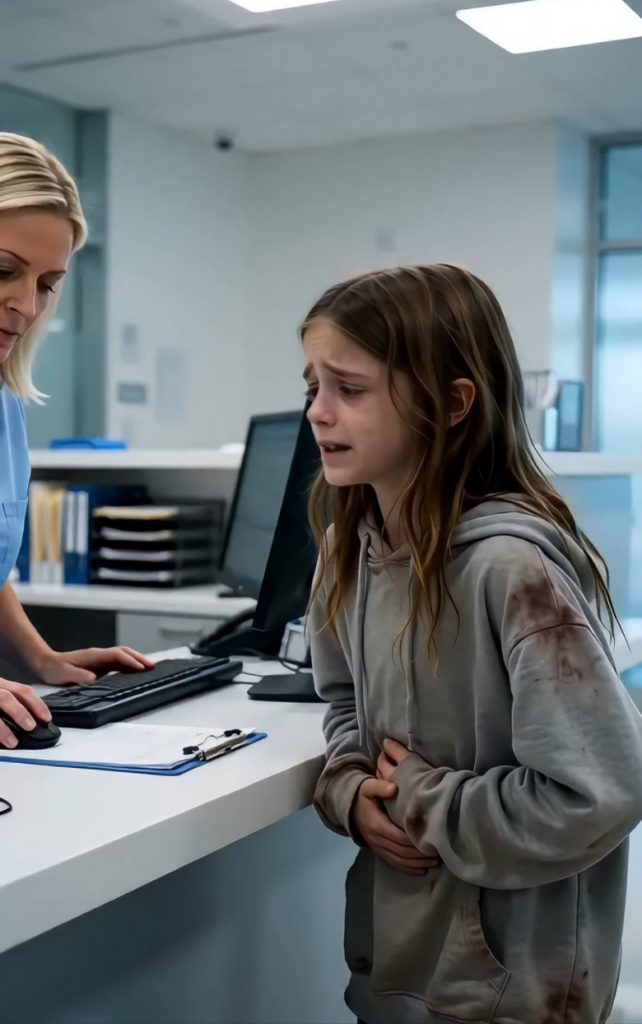
She stood at the reception desk in an oversized gray hoodie, both hands pressed to her stomach. Her long brown hair hung in messy strands around her pale face, and her knees looked like they were trying not to buckle.
“Ma’am,” she whispered, “my stomach hurts really bad.”
Behind the glass partition, the receptionist stopped typing.
Her name tag did not show a name. Just one cold word.
RECEPTIONIST.
She looked the child up and down, from the dirty hoodie to the worn sneakers to the faint stains on one shoulder, and her mouth tightened.
“Where are your parents?”
The girl swallowed. “I don’t know.”
“You don’t know?”
Her voice sharpened enough that two patients looked up from their chairs.
The child shook her head. “Please. I just need a doctor.”
The receptionist leaned forward.
“We don’t help beggars here,” she snapped. “Get out, right now.”
The words struck harder than a slap.
The girl flinched and folded inward, her small hands tightening over her stomach. For a moment, she looked at the woman as if maybe she had misunderstood. As if no adult in a hospital would really say that.
But the receptionist pointed toward the glass doors.
“Out.”
The green EXIT sign glowed above the entrance like an order.
The girl turned slowly.
Her lower lip trembled, but she tried not to cry. Each step toward the door was short and unsteady, like walking itself hurt.
No one moved.
The waiting room held its breath.
Then a newspaper folded sharply.
A man in a black suit lowered it from his face.
He had short brown hair, glasses, and the controlled expression of someone who had spent years learning not to show anger until it was useful. He looked first at the child, then at the receptionist.
The newspaper slid onto the chair beside him.
He stood.
His shoes struck the tile with calm, deliberate steps as he crossed the waiting area.
The receptionist looked up only when he stopped in front of her desk.
Her arrogance faded a little.
“Can I help you?” she asked.
The man did not answer at first.
He turned toward the girl near the exit.
“Sweetheart,” he said gently, “don’t leave.”
The child stopped.
Then he faced the receptionist again.
His voice was quiet.
That made it worse.
“You just ordered a sick child out of a medical facility.”
The receptionist opened her mouth.
The man reached into his jacket and placed an ID badge on the counter.
Her face went white.
Because the man she had dismissed as another waiting patient was Dr. Daniel Reeves.
And he owned the hospital.
Act II
Regina Medical Center had his mother’s name on the founding documents.
Not on the building anymore. That had changed after investors arrived, after mergers and expansions and consultants with expensive watches began using words like “efficiency” and “patient filtering.”
But Daniel Reeves remembered what the hospital had been.
His mother, Dr. Evelyn Reeves, opened the first clinic in a converted brick house forty-two years earlier. Back then, she treated construction workers with bad backs, children with fevers, elderly neighbors who paid in cash, and people who arrived with nothing but fear and hope.
Daniel grew up sleeping in the break room while his mother worked overnight.
He remembered her voice.
“You do not get to decide who deserves pain relief by looking at their shoes.”
He remembered her hands.
Always warm. Always steady.
When she died, Daniel was twenty-eight and still in surgical residency. He let the board manage the hospital because he believed institutions could preserve values without the people who created them.
That was his first mistake.
By the time he returned a decade later, Regina Medical looked better than ever from the outside.
Glass doors. Polished floors. New equipment. Updated signage.
But the complaints had started reaching him quietly.
A pregnant woman told to try another hospital because she “looked uninsured.”
An elderly man ignored for hours until his daughter threatened legal action.
A teenager with a high fever asked to leave because he could not produce ID.
Every official report softened the language.
Miscommunication.
Scheduling pressure.
Front desk discretion.
Daniel hated that phrase most.
Discretion had become a curtain.
So he came in anonymously.
No announcement. No assistant. No tour.
Just a black suit, a newspaper, and a seat in the waiting room.
He wanted to see what happened when no one knew power was watching.
For forty minutes, nothing did.
Patients checked in. Phones rang. Nurses passed through. The receptionist typed, sighed, and performed politeness only for people she considered important.
Then the little girl entered.
Daniel watched her from behind the paper.
She did not come through the doors like someone seeking attention. She slipped in like she expected to be told she did not belong. Her hands were already wrapped around her stomach. Her face had that washed-out look Daniel had seen too many times in emergency rooms.
Pain.
Fear.
Delay.
He lowered the paper slightly.
The receptionist barely looked at her before judging her.
That was when Daniel felt something old and cold settle inside him.
His mother’s hospital had not lost its mission all at once.
It had lost it one turned-away person at a time.
And now a child was standing under the EXIT sign because an employee decided poverty looked contagious.
Before Act III, one sound changed everything.
The child collapsed.
Act III
The girl made it three more steps before her body gave up.
Her hand reached toward the glass door handle, missed, and slid down the wall. Her knees bent. A soft gasp left her mouth.
Daniel moved before anyone else understood what was happening.
He reached her just as she sank toward the tile and caught her under the shoulders.
“Easy,” he said. “I’ve got you.”
The girl’s skin was cold and damp. Her breathing came in shallow bursts. Up close, Daniel saw how young she really was.
Ten, maybe eleven.
Her eyes opened halfway.
“I’m sorry,” she whispered.
His chest tightened.
“For what?”
“For making trouble.”
The waiting room went silent in a different way now.
Not passive.
Ashamed.
Daniel looked over his shoulder.
“You,” he said to the receptionist, voice controlled but sharp. “Call pediatrics. Now.”
She stood frozen.
“Now.”
She grabbed the phone with shaking hands.
Daniel turned to the patients. “Can someone bring that chair closer?”
Three people stood at once.
A woman hurried forward with tissues. An older man pushed aside the glass coffee table. Another patient opened the inner door and called for a nurse.
The little girl clutched Daniel’s sleeve.
“They’ll send me away,” she whispered.
“No,” he said. “They won’t.”
“What if I can’t pay?”
Daniel’s voice softened.
“Then we treat you anyway.”
Her eyes filled.
A nurse arrived, then another, and the room shifted from cruel stillness into urgent care. They helped the girl onto a stretcher. Someone asked her name.
“Lucy,” she whispered. “Lucy Miller.”
Daniel froze.
Miller.
He looked again at her face.
Brown eyes. Small nose. A faint dimple in one cheek even through pain.
He knew that dimple.
Years earlier, a nurse named Hannah Miller had worked the night shift at Regina Medical. She was the kind of nurse who stayed after clocking out because a frightened child wanted the same person in the room. She had once challenged a senior administrator for refusing a man with no insurance card.
Daniel remembered the argument.
He remembered Hannah’s words.
“This hospital was built for people who run out of options.”
Then, two years later, Hannah was gone.
Car crash. Rainy road. A daughter left behind with relatives Daniel had never met.
The girl on the stretcher looked up at him.
“My mom used to work here,” she said, as if reading the recognition on his face.
Daniel’s throat tightened.
“What was her name?”
“Hannah.”
The receptionist covered her mouth.
Because everyone behind that desk knew Hannah Miller’s name.
They knew the memorial plaque in the east hallway.
They knew the scholarship fund.
They knew the photograph of Hannah smiling in blue scrubs beside a handwritten quote:
No child should leave this place without being seen.
And moments earlier, they had tried to push Hannah’s daughter out into the night.
Before Act IV, Daniel found the real reason Lucy had come alone.
She had been hiding from the person who was supposed to bring her.
Act IV
Lucy needed urgent evaluation.
That was all Daniel allowed himself to think at first.
No guesses out loud. No dramatic declarations in front of a frightened child. No turning her pain into a courtroom before she had a doctor at her side.
He walked with the stretcher until the pediatric team took over.
Lucy turned her head toward him as they rolled her through the doors.
“You’ll stay?” she asked.
“I’ll be right outside.”
She believed him.
That nearly broke him.
When the doors closed, Daniel turned back toward the reception area.
The receptionist stood behind the desk, pale and rigid.
Her name, he learned from the system screen, was Carol Vance.
She began speaking before he asked.
“Dr. Reeves, I didn’t know who she was.”
The waiting room heard it.
Daniel stared at her.
“That is not the defense you think it is.”
Carol swallowed. “She looked—”
“Careful.”
The word cut through the air.
Carol stopped.
Daniel stepped closer to the desk.
“She looked sick. She looked scared. She looked like a child. That should have been enough.”
Carol’s face flushed.
“I was following intake policy.”
“No,” Daniel said. “You were hiding behind it.”
He turned to the glass partition and saw several staff members watching from the hallway. Nurses. A medical assistant. One junior doctor. All silent.
Daniel raised his voice just enough for all of them.
“From this moment forward, no patient in visible distress is to be turned away from reception without medical assessment. No child is to be sent out alone. No staff member is to use appearance, presumed ability to pay, or lack of documentation as a reason to deny immediate screening.”
Carol’s lips parted.
“But administration—”
“I am administration.”
A murmur moved through the room.
Daniel pointed to the chair behind her.
“Step away from the desk.”
Her eyes widened. “You’re suspending me?”
“I’m removing you from patient contact pending investigation.”
Carol looked around as if someone might defend her.
No one did.
Then the glass doors opened again.
A man rushed inside, soaked with rain though the night had only just begun to drizzle. He wore a wrinkled jacket and had a hard, impatient face.
“Where is she?” he demanded.
Daniel turned.
The man spotted the empty space near the exit, then the staff gathered by the hall.
“Lucy!” he shouted.
Daniel stepped between him and the clinical doors.
“Who are you?”
The man’s eyes narrowed. “Her uncle.”
Lucy’s uncle.
The person who should have brought her.
The man pushed forward. “She’s dramatic. She does this. I told her she didn’t need a hospital.”
Daniel did not move.
“She arrived alone, in pain, frightened, and asking for help.”
The uncle scoffed. “Kids lie.”
A nurse behind Daniel spoke quietly.
“She has marks on her shoulder.”
The uncle’s face changed for half a second.
Enough.
Daniel saw it.
So did the security guard now approaching from the hallway.
The uncle lifted his hands. “Look, I don’t want trouble. I just came to take her home.”
Daniel’s voice dropped.
“She is not leaving with you tonight.”
“You can’t stop me.”
Daniel looked toward security.
“Yes,” he said. “I can.”
The uncle lunged toward the doors.
Security caught him before he reached them.
The waiting room erupted in gasps. Carol backed into the file cabinet. The man shouted Lucy’s name, then cursed Daniel, then demanded a lawyer, a doctor, anyone who would listen to him instead.
Daniel watched without blinking.
Because the truth had become clear.
Lucy had not wandered into the hospital because she was dramatic.
She had escaped to it because it was the one place her mother had taught her should always open the door.
Act V
Lucy had emergency surgery before midnight.
The doctors spoke carefully afterward, the way good doctors do when the truth is serious but not hopeless. She was stable. She would recover. She had arrived late, but not too late.
Daniel stood in the hallway outside her room and let those words settle into him.
Not too late.
So much of his life had been too late.
Too late to stop the board from changing his mother’s clinic into a cold machine.
Too late to thank Hannah Miller properly for defending patients when leadership failed her.
Too late to protect her daughter before she had to walk into the hospital alone, clutching her stomach while adults looked away.
But this time, not too late.
Lucy woke the next morning with sunlight crossing the white blanket.
Daniel sat in the chair beside her bed, still in the black suit from the night before, his tie loosened, his newspaper folded on the windowsill.
She blinked at him.
“You stayed.”
“I said I would.”
Her eyes moved around the room.
“Where’s Uncle Mark?”
Daniel kept his voice gentle.
“He won’t be allowed to come in. A social worker is here to help. The police are asking him questions.”
Lucy absorbed that quietly.
Then she turned her face toward the window.
“My mom said this hospital was safe.”
Daniel looked down.
“It should have been.”
Lucy’s eyes filled.
“She said if I ever needed help, I should find the blue sign and tell them I was Hannah Miller’s daughter.”
Daniel closed his eyes for a moment.
Of course Hannah had told her that.
Of course she believed the place would remember.
“I’m sorry,” he said.
Lucy looked back at him.
“You didn’t yell at me.”
“No.”
“You didn’t make me leave.”
“No.”
She studied him with the solemn seriousness of children who have learned too early how to measure adults.
“Are you the boss?”
He almost smiled.
“Something like that.”
“Then make it safe again.”
The words were not loud.
They became the order he needed.
Carol Vance never returned to the reception desk.
The investigation found more than one cruel moment. Complaints buried. Intake rules twisted. Staff pressured to keep “difficult cases” out of the waiting room. Daniel removed two administrators within the week and ordered outside review of every turn-away complaint from the previous three years.
The hospital changed slowly at first.
Then visibly.
A new sign appeared at reception:
If you are in pain or afraid, tell us. You will be seen.
Under it, Daniel placed Hannah Miller’s photograph.
Not hidden in a hallway.
At the front.
Where everyone entering would see the nurse whose daughter had nearly been dismissed by the very system she had once defended.
Lucy recovered in foster care with a temporary guardian who had known her mother from the hospital. She visited Regina Medical months later wearing a clean yellow sweater and carrying a drawing for the pediatric nurses.
In the picture, the hospital had enormous glass doors.
They were open.
Daniel kept that drawing in his office.
Not because it made him feel proud.
Because it reminded him how close they had come to failing her.
On the one-year anniversary of that night, Regina Medical held a small ceremony.
No cameras.
No donors.
Just staff, patients, and a few families whose complaints had finally been heard.
Daniel stood near the reception desk, looking at the place where Lucy had once been told to leave.
Then Lucy walked in holding her guardian’s hand.
She was taller now. Healthier. Still quiet, but not folded into herself.
She looked at the new sign.
Then at Hannah’s photograph.
Then at Daniel.
“My mom would like this,” she said.
His throat tightened.
“I hope so.”
Lucy stepped closer to the desk, where a new receptionist smiled warmly and asked how she could help.
The girl glanced back at Daniel once.
Not scared.
Not asking permission.
Then she said, “I’m here to see the place my mom saved.”
Daniel looked at Hannah’s photograph.
For years, he had thought saving a hospital meant balancing budgets, hiring surgeons, and keeping the doors open.
He understood now that doors could be open and still reject people.
A hospital was not saved by glass, lights, or polished floors.
It was saved every time someone weak walked in and was not made to prove they deserved mercy.
That night, long after the lobby emptied, Daniel stood beneath the green EXIT sign.
He remembered Lucy’s small figure walking toward it.
He remembered the newspaper folding in his hands.
He remembered his mother’s voice.
You do not get to decide who deserves pain relief by looking at their shoes.
The automatic doors opened and closed softly as a new patient entered.
This time, the receptionist stood.
Not with judgment.
With attention.
“How can we help you?”
Daniel watched from a distance.
Then, finally, he walked away.