Act I
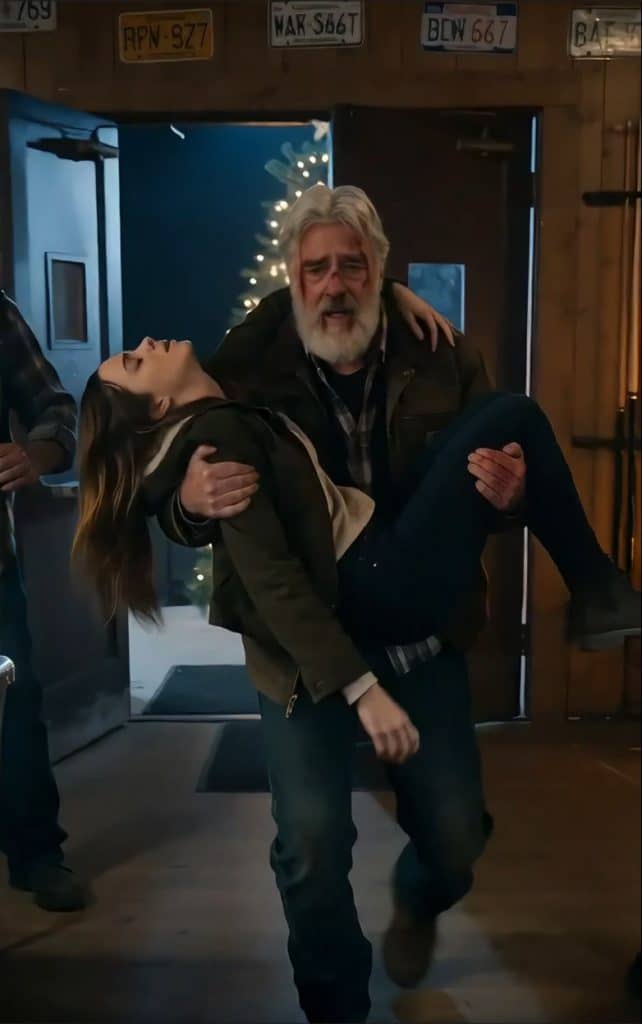
The double doors slammed open so hard the Christmas lights trembled.
Every man in the clubhouse turned.
One second earlier, the room had been full of laughter, pool cues cracking against balls, boots scraping over old wood, and the warm glow of a Christmas tree tucked beside the bar. The bikers of the Iron Hollow club had been drinking coffee, arguing over a card game, and pretending none of them cared about the holiday decorations someone’s wife had forced them to hang.
Then the old man staggered in.
He had white hair, a gray beard, and blood streaked across his face from his nose to his chin. His dark jacket hung crooked from one shoulder. His breath came in broken gasps.
In his arms, he carried a woman.
Her head rested against his shoulder. One arm hung loose. Her hair covered half her face, and she did not move.
For a moment, nobody spoke.
The old man took two steps forward, then nearly fell.
A pool cue hit the floor.
“What the hell happened?” the biker leader demanded.
His name was Mason Pike, though most men called him Pike because he looked like something that had learned to survive underwater and in war. Salt-and-pepper beard. Leather vest. Heavy silver chain. Eyes sharp enough to cut through lies before they finished forming.
The old man lifted his face.
His lips trembled.
“I don’t even know where to start.”
Then his knees gave out.
He crashed down onto the wooden floor, still holding the woman against his chest with both arms locked around her like letting go would be a second death.
The clubhouse exploded into motion.
Bikers rushed from every corner. Chairs scraped back. Someone knocked over a glass. Another man shouted for blankets. The bartender grabbed the landline.
Mason dropped to one knee beside the old man.
“Call an ambulance,” he roared. “Now!”
The old man tried to speak again, but all that came out was a ragged sob.
Mason reached carefully for the woman’s wrist, checking for a pulse. It was there. Weak, but there.
“Who is she?” he asked.
The old man looked down at her face.
“My daughter,” he whispered.
Mason froze.
At first, he thought he had misheard.
Then the woman’s hair shifted, revealing a small silver pendant at her throat.
A crescent moon wrapped around a tiny iron wing.
Mason knew that necklace.
He had given it to his little sister twenty-six years ago, the night she disappeared.
And now she was lying unconscious on his clubhouse floor.
Act II
Mason Pike had spent half his life pretending he was not waiting for a ghost.
Her name was Lily Pike.
She had been sixteen when she vanished.
Back then, Mason was twenty-two, loud, reckless, and convinced the world could be handled with fists, engines, and stubbornness. Lily had been the soft one in the family. The reader. The singer. The girl who fed stray cats behind the diner and wrote letters to people she was angry with because she hated shouting.
Their father drank. Their mother prayed. Mason fought.
Lily watched.
Then one winter night, after a storm knocked power out across the county, Lily disappeared from the road between the high school gym and home.
No body.
No goodbye.
No proof.
Just a scarf found near the bridge and rumors that changed depending on who wanted attention.
The police said she ran away.
Mason never believed it.
He searched until his knuckles split. He questioned men twice his size and once nearly burned down a mechanic’s garage after hearing Lily had been seen near it. Eventually, the town stopped calling him a grieving brother and started calling him a problem.
The Iron Hollow bikers found him during that time.
They were not saints, no matter what their charity posters later claimed. They were rough men with rough pasts. But they understood loyalty. They understood what it meant to keep searching after decent people went home.
For years, Mason chased every rumor.
A girl in Nevada.
A woman in a shelter in Ohio.
A nameless patient in a county hospital.
Nothing.
Life kept moving around the hole Lily left.
Mason became club president. He got older. His beard turned gray. The Iron Hollow club stopped running from trouble and started standing between trouble and whoever needed help.
They escorted women to court.
Fixed cars for single mothers.
Delivered toys at Christmas.
Broke up fights before cops arrived.
But Mason never took Lily’s picture down from the clubhouse office.
Every Christmas, he hung the crescent-and-wing charm she left behind on the tree. Not the real necklace. A copy he had made when hope still felt practical.
The real one had been around Lily’s neck the night she vanished.
Now it was around the neck of the woman on his floor.
The old man holding her was named Harold Mercer.
He lived thirty miles north in a dying farm town called Red Ash. Mason had never met him, but Harold knew the club. Everyone in the county did.
That was why he came.
Not to a hospital.
Not to a sheriff’s station.
To them.
Because the men who hurt him had uniforms in their pockets and money behind their names.
Harold had been driving home from the pharmacy when he saw a woman stumble out of a locked side door behind the old Hawthorne Mill. She was barefoot, dazed, and holding a folded envelope against her chest.
“She knew my name,” Harold told them later, his hands shaking around a mug of coffee he could not drink. “I don’t know how. She grabbed my coat and said, ‘Mr. Mercer, please. You knew my father.’”
Mason sat across from him, unmoving.
Harold’s voice broke.
“I did. I knew your father. Years ago. He fixed my truck for free when my wife was sick. She said if I ever saw the Iron Hollow patch, I could trust it.”
Mason looked toward the hallway where the ambulance crew worked over Lily.
The woman he had buried in his mind and refused to bury in his heart.
Harold continued.
“I got her into my truck. Then a car blocked the road. Two men came after us. I drove through a ditch, hit a fence, kept going. They followed me until the highway split.”
He touched the blood on his face like he had forgotten it was there.
“They said she belonged to them.”
Mason’s fist tightened on the table.
“No,” he said. “She belongs to nobody.”
And in the back room, Lily Pike opened her eyes for the first time and whispered a name no one expected.
“Caleb.”
Act III
Caleb was Mason’s son.
He was also the reason Mason had locked the door to his office every night for twelve years.
Caleb Pike had been twenty when he left Iron Hollow. Not because he hated the club. Because he hated what grief had done to his father.
“You don’t want a son,” Caleb had said on their last night together. “You want another search party.”
The words were cruel.
They were also true enough to bleed.
Caleb joined the army, then a private security firm overseas. He sent three letters in the first year. Then one postcard. Then nothing.
Mason told people his son was busy.
Privately, he feared he had lost him the same way he lost Lily: into a world that swallowed people and sent back rumors.
Now Lily had woken after twenty-six years and whispered Caleb’s name.
Mason pushed past the paramedic before anyone could stop him.
“Lily?”
Her eyes moved toward him.
She was older, of course. There were lines at the corners of her mouth, silver threads in her hair, and exhaustion carved into her face. But beneath all of it, Mason saw the girl who used to steal his leather jacket and say she looked tougher in it than he did.
Her lips trembled.
“Mason?”
He made a sound that no man in the room would ever speak of later.
Then he took her hand carefully, as if even joy might hurt her.
“I’m here,” he said. “I’m right here.”
Her fingers tightened weakly around his.
“They took Caleb.”
The room went cold.
Mason stared at her.
“What do you mean?”
Lily’s breathing became shallow. The paramedic warned her to stay calm, but she shook her head, panic rising through the medicine and shock.
“They found him asking about me. He came looking. He found the mill. They caught him.”
Mason felt every eye in the room turn toward him.
His men knew the name Caleb. They knew the silence around it. They knew better than to ask.
Lily’s gaze shifted toward Harold.
“The envelope,” she whispered.
Harold jolted, then reached inside his torn jacket. With shaking hands, he pulled out the folded packet the woman had clutched when he found her.
Mason opened it.
Inside were photographs, dates, names, and pages of handwritten notes. Some old. Some recent. At the top of the first page was Lily’s handwriting.
She had been taken years ago by a man named Victor Rane, who used the old mill and a network of corrupt officials to hide people who had no one powerful looking for them. Runaways. Debtors. Women fleeing bad homes. Men with addiction records nobody believed.
Lily had survived by becoming useful.
Keeping records.
Cleaning offices.
Remembering names.
Waiting.
Then Caleb found her.
Not by accident.
He had come home quietly six months earlier after finding one of Mason’s old missing-person flyers online. He followed a lead to Red Ash, found the mill, and discovered Lily alive.
But before he could get help, Rane’s men caught him.
Lily escaped only because Caleb created a distraction.
“He told me to find you,” she whispered. “He said you’d bring the whole club if you had to.”
Mason’s eyes burned.
He looked at the bikers gathered around him.
No one needed orders.
But he gave them anyway.
“Lock this place down,” he said. “Get Lily to the hospital. Keep Harold guarded. And somebody get me every map of Red Ash County.”
His vice president, Knox, stepped forward.
“And you?”
Mason looked toward the door Harold had burst through minutes earlier.
“I’m going to get my son.”
Act IV
The Hawthorne Mill had been abandoned for thirty years, at least officially.
In truth, it had never been empty.
It sat beyond Red Ash behind a chain-link fence and a row of dead pines, its brick walls blackened by weather, its windows boarded from inside. During the day, it looked like ruins. At night, trucks came and went through a rear gate no one was supposed to notice.
Mason did not ride in loud.
That was what people expected from bikers.
Engines roaring. Headlights blazing. Leather and fury announcing themselves half a mile early.
But Mason had learned something after losing Lily.
Anger was loud.
Rescue had to be smart.
The Iron Hollow men moved in three groups. One called the state police contact they trusted. One blocked the service road with disabled trucks. One cut power to the outer floodlights.
Mason went in through the old loading dock with Knox and two others.
The mill smelled like rust, damp wood, and secrets.
They found Caleb in a storage room beneath the east stairwell.
Alive.
Barely standing, but alive.
His face was bruised. His hands were tied. When the light hit him, he squinted like he had already prepared himself for death and did not know what to do with rescue.
Then he saw Mason.
For one second, neither man moved.
Caleb looked older than Mason remembered. Leaner. Harder. But his eyes were still his mother’s, still full of all the things he felt and refused to say first.
Mason cut the rope from his wrists.
Caleb’s voice cracked. “Lily?”
“Alive.”
Caleb shut his eyes.
The relief nearly folded him in half.
Mason caught his shoulder.
The years between them stood there too, stubborn and wounded.
There was no time to fix them.
Not yet.
A shot cracked somewhere above.
Not close enough to hit them, but close enough to end the reunion.
Knox swore. “We’ve got company.”
Victor Rane appeared on the upper catwalk with two men behind him.
He was in his sixties, silver-haired, clean-shaven, wearing a long black coat that made him look more like a judge than a monster. Men like him often learned early that the world feared ugliness but trusted polish.
“Mason Pike,” Rane called down. “Still chasing family ghosts?”
Mason stepped into the open.
“Where are the rest of them?”
Rane smiled. “You always did think you were a hero.”
“No,” Mason said. “I just know what cowards sound like when they’re losing.”
Sirens wailed in the distance.
Rane’s smile faded.
Caleb stood beside his father, unsteady but upright.
Rane looked at him. “You should have stayed gone.”
Caleb’s voice was hoarse. “So should you.”
The state police hit the front entrance moments later.
The mill erupted in shouting, boots, commands, and men trying to run through exits Iron Hollow had already blocked.
Rane tried to slip down the rear stairs.
Harold Mercer stopped him.
The old man had no business being there. He should have been in a hospital bed. Instead, he stood at the bottom of the stairwell with a tire iron in one shaking hand and dried blood still on his face.
Rane froze.
Harold’s voice trembled, but it carried.
“You said she belonged to you.”
Behind him, two state troopers moved into position.
Harold lifted the tire iron just enough to make his meaning clear.
“You were wrong.”
Rane was arrested on the spot.
Not by the bikers.
Not by revenge.
By the law he had spent decades buying and bending until better men forced it to stand upright again.
Mason watched the troopers take him away.
Then he turned and saw Caleb leaning against the wall, pale and exhausted.
This time, Mason did not wait for the right words.
He pulled his son into his arms.
Caleb stiffened for half a second.
Then broke.
“I found her,” Caleb whispered.
Mason held him tighter.
“You found us both.”
Act V
Lily spent Christmas in the hospital.
So did Harold.
So did Caleb, though he complained loudly enough that the nurses threatened to sedate him with holiday pudding.
The Iron Hollow clubhouse emptied into the hospital waiting room in shifts. Big men in leather vests sat under fluorescent lights holding paper cups of coffee, wrapped gifts, and flowers they clearly did not know how to arrange.
Harold became a legend before New Year’s.
The old man who drove through a fence with a rescued woman in his truck.
The old man who walked into a biker clubhouse instead of dying quietly on a back road.
The old man who later claimed he was not brave, only “too scared to stop.”
Lily recovered slowly.
There were things time could not immediately repair. Years stolen. Names remembered. People she had tried to save and could not. Nights when she woke and did not know where she was. Mornings when she stared at Mason as if needing proof he was still there.
He gave it.
Every day.
No speeches.
No pressure.
Just presence.
He brought her books. Coffee she said was terrible but drank anyway. The crescent-and-wing ornament from the clubhouse Christmas tree. When he placed it in her hand, she cried for the girl she had been when he gave her the first one.
Caleb stayed too.
Father and son learned to sit in silence without using it as a weapon.
Some apologies came awkwardly.
Some came at three in the morning.
Some came through actions because Pike men were better at fixing broken locks than speaking directly about broken hearts.
Mason apologized for making grief bigger than fatherhood.
Caleb apologized for leaving without looking back.
Lily listened to both and finally said, “You’re both idiots.”
That was the first time she laughed.
The sound was small.
It changed the room.
The investigation after Rane’s arrest spread across three counties. Documents from Lily’s envelope helped identify people who had disappeared into systems designed to forget them. Corrupt deputies resigned before charges came. Judges reopened cases. Families received calls they had stopped praying for because hope had become too painful.
Not every ending was happy.
Mason learned that quickly.
But some doors opened.
Some names returned.
Some graves were found.
Some living people came home.
Three months later, Lily walked into the Iron Hollow clubhouse on her own feet.
The room had been cleaned after the night Harold burst through the doors, but Mason still saw it as it had been: blood on wood, men frozen in shock, his sister limp in a stranger’s arms.
Now she stood under the warm industrial lights wearing a denim jacket over her hospital sweater, the silver necklace resting at her throat.
Every biker in the room stood.
Even the ones who had never met her before.
Harold sat at the bar with a bandage still visible near his hairline, grumbling that everybody fussed too much. Caleb stood beside the Christmas tree, though it was March and Mason had refused to take it down until Lily saw it lit.
She looked at the tree.
At the ornament.
At the men.
At the brother who had never stopped searching.
Then she walked to Harold first.
The old man tried to stand.
She stopped him with a hand on his shoulder.
“You carried me,” she said.
He looked embarrassed. “Not very far.”
“Far enough.”
Harold’s eyes filled.
Then Lily turned to the bikers.
Her voice shook, but did not fail.
“I thought nobody was coming.”
Mason stepped toward her.
Lily looked at him.
“But someone did.”
She reached for his hand.
“And then all of you did.”
The clubhouse was silent.
Not the tense silence of shock.
The sacred kind.
The kind that happens when rough men remember why they became a family in the first place.
Mason squeezed her hand.
“You’re home,” he said.
Lily looked around the room again, at the wood-paneled walls, the old license plates, the bar lights, the patched vests, the ridiculous Christmas tree still glowing months late.
Then she smiled through tears.
“No,” she said softly. “I’m safe.”
Years later, people would still talk about the night an injured old man burst into the Iron Hollow clubhouse carrying a woman everyone thought was lost forever.
They would talk about the ambulance.
The blood.
The bikers storming the mill.
The arrests that followed.
But Mason remembered something quieter.
A pair of double doors slamming open.
A stranger refusing to let his sister fall.
A necklace catching the Christmas lights.
And the terrible, beautiful moment when the past came back breathing, broken, and asking for help.
That was the night Iron Hollow stopped being only a clubhouse.
It became what Lily had been trying to reach all along.
A door that opened when every other door had failed.