Act I
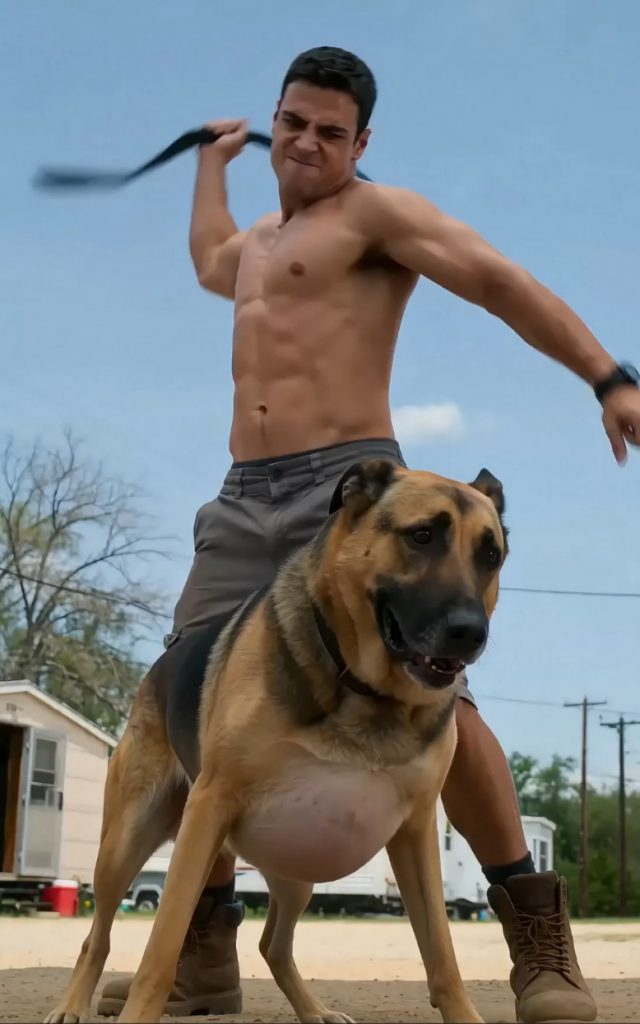
The belt cracked through the trailer park like a gunshot.
The pregnant dog hit the dirt with a broken yelp, curling her body around her swollen belly as dust jumped beneath her paws. She was tan and black, ribs trembling, ears pinned flat while the shirtless man above her drew the belt back again.
Mike didn’t stop.
He liked the way everyone watched and did nothing.
The white trailers sat under the brutal noon sun, their windows half-blinded by cheap curtains. A few doors had opened. A few faces hovered in shadows. But no one stepped forward.
Not until the little girl came running.
She was barefoot, hair flying behind her, teal shirt dusty at the hem. She threw herself over the dog just as Mike lifted the belt for another strike.
“Please!” she sobbed, wrapping both arms around the animal. “Don’t hit my momma too!”
Mike froze.
The belt hung in the air.
“What the hell did you just call her?”
The girl buried her face in the dog’s fur. “I’ve already lost one,” she cried. “I can’t lose another!”
The dog whimpered beneath her, pressing close as if the child’s small body were the only safe place left in the world.
Mike’s face hardened again.
Whatever confusion had stopped him faded into rage. He tightened his grip on the leather and stepped closer, his boots grinding into the dirt.
“Move,” he growled.
The girl shook her head.
Mike lifted the belt.
That was when the engines came.
One at first.
Then three.
Then a whole line of motorcycles roaring into the park, their chrome flashing in the sun, their tires kicking dust into the air. Choppers rolled between the trailers and spread across the yard in a wide semicircle.
The sound swallowed everything.
Mike turned, belt still raised.
The little girl looked up through tears.
A middle-aged man near the trailer stepped forward with a beer bottle low in his hand, his voice cautious but shaking.
“Mike, come on, man,” he said. “It’s just a kid. Respect.”
Mike snapped his head toward him.
“Stay away,” he shouted. “Don’t interfere in my business.”
The motorcycles stopped.
The engines idled like thunder.
Then the largest biker at the front slowly removed his sunglasses.
He looked at the girl.
Then at the dog.
Then at Mike’s belt.
And whatever he saw there made every man behind him go silent.
Act II
Her name was Lily Harper, and she had learned too early that adults could disappear while still standing in front of you.
Her mother, Grace, had once made the trailer feel like a home. She hung yellow curtains over the tiny kitchen window. She planted basil in coffee cans by the steps. She sang old country songs while brushing Lily’s hair and always changed the words to make Lily laugh.
And she loved strays.
Dogs, cats, injured birds, even a possum once that lived beneath the back steps and terrified the mailman.
Grace used to say the world was mean enough without good people looking away.
That was how Daisy came to them.
She had been a skinny tan-and-black dog wandering near the highway, muddy, hungry, and so scared that even food couldn’t tempt her close. Grace spent three nights sitting on the ground with a bowl beside her, talking softly until Daisy finally crawled into her lap.
From then on, Daisy belonged to them.
Or maybe they belonged to Daisy.
She slept at the foot of Lily’s bed. She followed Grace to the laundry line. She barked whenever Mike came too close, long before anyone else understood why.
Mike moved into the trailer six months after Grace started getting sick.
At first, he brought groceries. Fixed the porch step. Told Lily she could call him “Uncle Mike” if she wanted.
She didn’t want.
Grace didn’t marry him. She never even said she loved him. But when the bills piled up and the medication got expensive, Mike started acting like the trailer was his because he was the only man strong enough to stand in the doorway.
After Grace died, he stopped pretending.
He sold her tools. Pawned her sewing machine. Threw away the basil cans because he said they made the steps look trashy. He drank too much, shouted too easily, and told Lily that no one was coming for her.
Daisy was the only thing he couldn’t take from her.
The dog had slept beside Grace’s bed during the final weeks, her muzzle resting on the thin blanket, refusing to leave even when Grace no longer had the strength to lift her hand.
On the last morning, Grace had whispered to Lily, “Take care of Momma Daisy.”
Lily had nodded, crying too hard to speak.
That was what she called the dog after that.
Momma Daisy.
Not because she thought Daisy was her mother.
Because Daisy was the last living thing Grace had asked her to protect.
Then Daisy got pregnant.
To Lily, the puppies felt like a miracle Grace had left behind. Little heartbeats under Daisy’s ribs. A future in a place that had been shrinking around her since the funeral.
To Mike, they were a problem.
“More mouths,” he said. “More noise. More mess.”
Lily heard him on the phone two nights before the belt.
“She’s worth something if I sell her before she drops the litter,” he told someone. “Kid won’t shut up about it, but she’ll get over it.”
Lily slept on the floor with Daisy that night, one arm over the dog’s belly.
She did not know how to stop Mike.
So the next morning, when he dragged Daisy into the yard by her collar and called her useless, Lily ran to the only person who had ever told her not to be afraid of loud engines.
Her mother’s older brother.
Ray Mercer.
Most people in the county knew him as Reaper Ray.
Lily knew him as the man who smelled like leather and peppermint gum, who knelt when he talked to her, who cried behind his sunglasses at Grace’s funeral when he thought no one could see.
Grace had kept her distance from Ray for years because Mike hated him.
That should have told everyone enough.
But Lily still had the number Ray wrote on the back of an old photograph before he left the funeral.
Anytime, kiddo. I mean it.
That morning, while Mike was outside shouting at Daisy, Lily hid behind the washing machine and called.
She only had time to whisper three words.
“He’s hurting Daisy.”
Then Mike kicked the trailer door open.
Lily dropped the phone.
And Ray Mercer started riding.
Act III
Mike had always counted on fear.
Fear kept doors closed.
Fear kept witnesses quiet.
Fear made people tell themselves it wasn’t their business when a man shouted too loud or a little girl stopped playing outside.
But motorcycle engines changed the shape of fear.
The bikers did not rush him.
That made it worse.
They sat in a loose half circle, boots planted in the dust, leather vests shifting as engines grumbled beneath them. Some were old. Some were broad. Some wore gray in their beards and scars on their hands. None of them smiled.
Ray Mercer swung one leg off his bike.
He was not the tallest man in the yard, and Mike was built like someone who spent more time admiring mirrors than listening to warnings.
But Ray had the kind of stillness Mike did not know how to read.
It was not weakness.
It was control.
Ray took one step forward.
“Lily,” he said.
The girl lifted her head.
“Uncle Ray?”
Mike’s face changed.
Just a flicker.
Enough.
Ray’s eyes moved from Lily’s dusty face to Daisy trembling beneath her arms.
Then to the belt.
“You hit that dog?” Ray asked.
Mike gave a sharp laugh. “This ain’t your yard.”
“No,” Ray said. “It was my sister’s.”
The trailers seemed to hold their breath.
A woman watching from behind a screen door covered her mouth. The bystander with the beer bottle lowered his hand. Two boys near an old pickup stopped whispering.
Mike rolled his shoulders, trying to reclaim the space.
“Grace is gone,” he said. “Trailer’s mine now.”
Ray’s jaw tightened.
“Funny thing about that.”
He reached into the inside pocket of his leather vest and pulled out a folded envelope.
Mike’s eyes dropped to it.
Ray noticed.
“So you do know,” he said.
Mike’s anger sharpened. “Know what?”
“That Grace never signed the title over.”
Lily stared at him.
Mike’s mouth twitched.
Ray unfolded the paper slowly, letting the silence stretch.
“My sister knew she was sick. She also knew what kind of man you were. Three weeks before she died, she gave me copies of everything. Trailer title. Insurance papers. Custody letter. Veterinary records for Daisy. And a notarized statement saying you were not to be left alone with Lily.”
Mike’s grip tightened around the belt.
Ray’s voice lowered.
“You’ve been living in a dead woman’s home, scaring her child, and pretending nobody knew better.”
Mike looked around.
Too many eyes now.
Too many witnesses.
“I fed that kid,” he snapped. “I kept a roof over her head.”
Lily flinched.
Ray saw it.
Everyone saw it.
The bystander finally spoke again, quieter this time.
“Mike,” he said, “man, just put the belt down.”
Mike spun on him.
“You shut your mouth.”
Ray took another step forward.
“No,” he said. “He’s done shutting up.”
The biker nearest the back of the formation pulled out his phone and held it up.
A video was already recording.
So were three others.
Mike saw the phones.
Then he saw Lily still wrapped around Daisy, her small shoulders shaking, dirt streaked across her wet cheeks.
For the first time, he seemed to understand that the yard was no longer his stage.
It was evidence.
Act IV
The first police cruiser arrived fifteen minutes later.
Then animal control.
Then a county child welfare officer in a white sedan who looked like she had been called away from lunch and had arrived ready to ruin someone’s entire day.
Mike tried to perform for them.
Men like him often do.
He lowered the belt, spread his hands, and laughed like everyone else was overreacting.
“It’s my dog,” he said. “Kid got dramatic. You know how kids are.”
Lily clutched Daisy tighter.
“She’s not yours,” she whispered.
The child welfare officer, Ms. Alvarez, crouched several feet away so she wouldn’t frighten her.
“What’s her name, sweetheart?”
“Daisy,” Lily said. Then, after a shaky breath, “Momma Daisy.”
Mike scoffed.
Ray’s head turned.
The sound died in Mike’s throat.
Animal control moved carefully toward the dog. Daisy trembled but did not snap. She only pressed her face into Lily’s side, trusting the one small person who had trusted her first.
“She’s pregnant,” the officer said, his voice tight. “She needs a vet immediately.”
Mike rolled his eyes. “It’s a dog.”
Ray stepped closer, but Ms. Alvarez lifted one hand.
She didn’t need the bikers to handle this.
The law had finally entered the yard.
The deputy took the belt and bagged it. Another officer interviewed the bystander. A neighbor from Trailer 12 came out crying and said she had heard shouting for weeks. A teenager admitted he had filmed Mike dragging Daisy outside before Lily ran in.
Then Ray handed over Grace’s envelope.
Ms. Alvarez read the custody letter twice.
Her expression changed with each line.
Grace had not left Lily to Mike.
She had left Lily to Ray.
The paperwork had been filed with an attorney but never processed after Grace’s death because Mike had hidden the notice, intercepted the mail, and told everyone Lily had no family willing to take her.
Ray’s hands curled at his sides.
“I called,” he said, voice low. “He told me Lily didn’t want to see me.”
Lily looked up.
“No,” she whispered. “He said you forgot us.”
Ray turned toward her.
The hurt in his face was immediate and deep.
“Never,” he said. “Not one day.”
Mike backed toward the trailer.
The deputy blocked him.
“Where do you think you’re going?”
Mike’s charm was gone now. His confidence cracked into something uglier.
“This is insane,” he said. “You’re listening to bikers and a kid over me?”
Ms. Alvarez stood.
“No,” she said. “I’m listening to documents, witnesses, video, and a little girl who should have been protected long before today.”
The yard went quiet.
Daisy gave a soft whimper.
Lily lowered her face to the dog’s head.
“I tried,” she whispered. “I tried, Momma.”
Ray knelt beside her, slow enough not to startle either of them.
“You did more than try,” he said. “You saved her.”
Lily shook her head. “He was going to hit her again.”
“But he didn’t.”
Ray looked over his shoulder.
The bikers sat silent on their motorcycles, their hard faces turned toward the child in the dirt.
“He didn’t,” Ray repeated, “because you were brave enough to stand in front of someone bigger.”
Lily’s chin trembled.
“I was scared.”
Ray’s voice softened.
“Brave people usually are.”
When animal control lifted Daisy gently onto a stretcher, Lily panicked and grabbed for her.
“No! Don’t take her!”
The officer paused.
Ms. Alvarez looked at Ray.
Ray looked at Lily.
Then he said the only thing that mattered.
“We’re going with her.”
Act V
Daisy had six puppies before sunrise.
The vet clinic stayed open through the night, even after the last appointment ended and the lobby lights dimmed. Lily slept for maybe twenty minutes at a time in a chair beside Ray, waking every time Daisy shifted.
Ray never left.
Neither did three bikers posted outside the clinic doors like leather-clad guardian angels with coffee cups and red eyes.
Daisy was sore and exhausted, but alive.
When the first puppy squeaked against her belly, Lily covered her mouth and cried so hard Ray thought her heart might be too full for her small body.
The vet placed a hand on her shoulder.
“She did great,” he said. “So did you.”
Lily looked through the glass at Daisy licking the tiny pup.
“Mom would’ve loved them,” she whispered.
Ray swallowed.
“She would’ve named every single one something ridiculous.”
Lily gave a tiny laugh.
It was the first laugh anyone had heard from her in months.
By noon, Mike was gone from the trailer park.
Not just from the yard.
Gone in the way men like him hate most: not chased out by fists, but removed by paperwork, statements, video, and consequences he could not intimidate into silence.
He was charged for what he had done to Daisy. The investigation into Lily’s care continued. The trailer title was confirmed in Grace’s name, with instructions that Lily’s guardian would control it until she was old enough.
Ray was granted emergency custody.
When he brought Lily back to the trailer two days later, she stood at the doorway and would not go in.
Ray did not push.
“We don’t have to stay here,” he said.
Lily looked at the yellow curtains in the kitchen window.
“My mom picked those.”
“I know.”
“And the basil cans?”
“I saved them,” Ray said.
She turned to him.
“You did?”
He nodded toward the back of his truck.
There they were, dented and dry, but not gone.
Lily walked to them slowly. She touched one rusted rim with her fingertip.
“Mike said they were trash.”
Ray crouched beside her.
“Mike was wrong about a lot.”
The trailer did not become safe all at once.
Places remember.
The yard still held the shape of what had happened there. Lily avoided the patch of dirt where she had covered Daisy with her body. At night, she woke crying for her mother, then for the dog, then for reasons she could not explain.
Ray learned fast.
He learned not to close doors too hard. Not to stand over her when talking. Not to say “calm down” when she was already trying with everything she had.
He learned that healing a child was not about being tough.
It was about being steady.
Daisy and the puppies came home after a week.
That changed the trailer more than paint ever could.
The puppies turned the little living room into chaos. They stumbled over each other, chewed blankets, yawned with their whole bodies, and fell asleep in piles that made Lily whisper their names like prayers.
She named the first one Grace.
Ray cried in the bathroom for five minutes after that.
The biker club came every Saturday.
Not all at once. Never too loud. Ray made rules.
No revving engines near the trailer.
No crowding Lily.
No talking about Mike unless she brought him up first.
The men obeyed like soldiers.
They fixed the porch steps. Repaired the air conditioner. Repainted the trailer trim. Built Daisy a shaded run beside the house and a small fenced patch where the puppies could tumble in the sun.
The bystander came too.
His name was Earl, and he arrived one afternoon with no beer bottle in his hand, only a bag of dog food and shame written all over his face.
“I should’ve stepped in sooner,” he told Ray.
Ray looked at him for a long moment.
“Yes,” he said.
Earl nodded, accepting it.
Then Lily came out holding a puppy against her chest.
Earl crouched.
“I’m sorry,” he said to her.
Lily studied him with the solemn eyes of a child deciding whether an adult meant what he said.
Then she handed him the puppy.
“Hold her carefully,” she said.
Earl did.
Months later, the dusty yard bloomed again.
Ray lined the steps with coffee cans full of basil, marigolds, and one stubborn tomato plant Lily insisted would grow if they encouraged it enough. Yellow curtains moved in the window. Daisy slept on the porch in the shade, six healthy puppies sprawled around her like dropped socks.
Lily still missed her mother.
That never went away.
But grief became less like a hand around her throat and more like a picture she could hold without breaking every time.
On the anniversary of Grace’s passing, Ray took Lily and Daisy to the little cemetery beyond the highway. The biker club waited by the gate, quiet and respectful, engines off.
Lily placed a marigold on her mother’s grave.
Then she placed a small framed photo beside it.
Daisy with her puppies.
“She did it, Momma,” Lily whispered. “I kept her safe.”
Ray stood behind her, sunglasses on though the sky was cloudy.
Lily reached back for his hand.
He took it.
For a while, neither of them spoke.
Then Lily looked up at him.
“Do you think Mom saw?”
Ray’s throat tightened.
“Yeah, kiddo,” he said. “I think she saw everything.”
Lily nodded, satisfied.
Back at the trailer park, the place no longer felt quite so desolate.
It was still dusty. Still poor. Still lined with old trailers that rattled in high wind and baked under summer sun.
But it was no longer Mike’s yard.
It was Lily’s home.
It was Daisy’s porch.
It was the place where a little girl had thrown herself between cruelty and something helpless, believing she was alone.
And then the ground had started shaking with engines.
Not because violence had come to answer violence.
Because love, when it finally arrived, came loud enough that even the cowards opened their doors and looked.