Act I
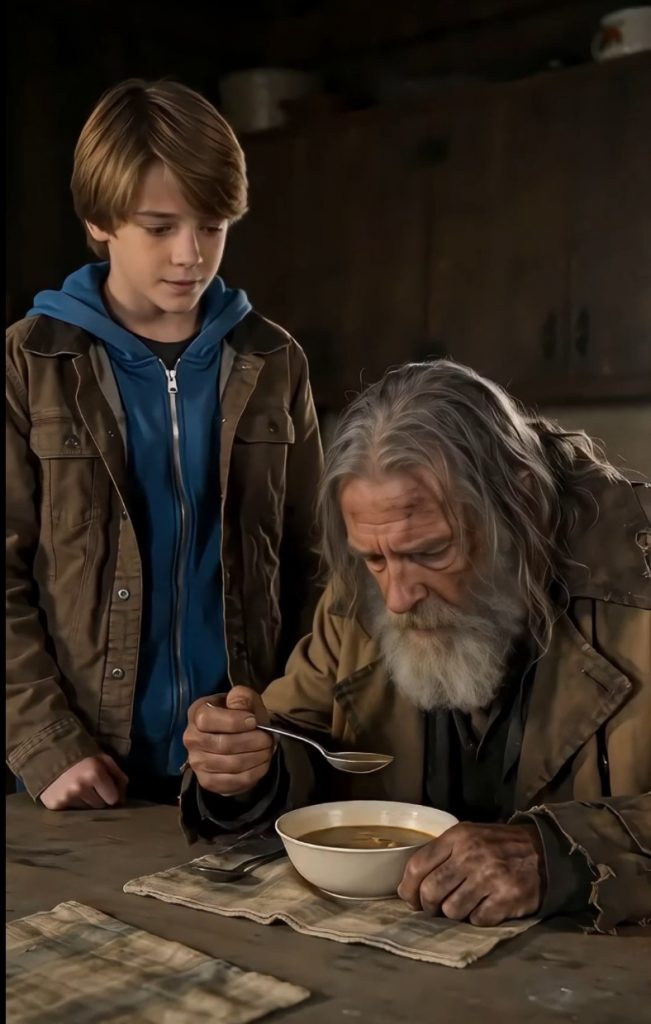
The old man ate like someone who had forgotten food could be warm.
He sat hunched over the weathered kitchen table, both hands trembling around the spoon, his torn brown coat hanging from his shoulders like it had been dragged through years of rain. Gray hair fell in tangled ropes around his face. His white beard hid most of his mouth, but not the way his lips shook each time he lifted the soup.
Across from him, Noah Carter stood with his hands tucked nervously into the pockets of his brown denim jacket.
He was fourteen, old enough to understand danger, but still young enough to believe hunger mattered more than suspicion.
Outside, the fields behind the house were disappearing into dusk. Inside, the small kitchen glowed with dim yellow light. The wood-paneled walls made everything feel close. The stove clicked softly as it cooled. White curtains stirred faintly over the sink.
Noah watched the stranger swallow another spoonful.
“Is it okay?” he asked quietly.
The old man nodded.
His eyes stayed on the bowl.
“Thank you,” he rasped.
The voice sounded cracked, as if it had not been used kindly in a long time.
Noah glanced toward the back door.
His mother would be home any minute.
He knew she would not like this. Mara Carter did not like surprises, especially not strangers in the house. She locked the doors before sunset. She kept a flashlight and an old baseball bat near the mudroom. She checked the windows twice every night, even though they lived miles from the nearest town.
Noah used to think she was just cautious.
Then, over the years, he began to understand that caution was not the same as fear.
His mother was afraid of something.
She just never said what.
The back door creaked open.
Noah turned fast.
Mara stepped inside carrying a glass of water in one hand, her olive-green jacket damp from the mist outside. Her dark hair was tied back, a few loose strands stuck to her cheek. She looked tired, the way she always did after working late at the feed store.
Then she saw the man at the table.
She stopped.
The glass stayed lifted near her chest.
Noah spoke quickly.
“Mom, I found this man outside. He was cold and hungry, so I brought him in. He’ll warm up, eat something, and then he’ll leave.”
Mara did not answer.
Her eyes were fixed on the old man.
Not with ordinary fear.
Not even anger.
Recognition.
The man slowly lowered his spoon.
His tired gaze lifted from the bowl to the doorway.
For a moment, the room became so quiet that Noah could hear the water trembling inside the glass.
Then Mara’s fingers went slack.
The glass slipped from her hand and shattered against the floor.
Water spread across the boards. Broken pieces skittered beneath the table. Noah flinched at the crash, but his mother did not move.
Her face had gone pale.
The old man pushed himself halfway up from the chair, one hand gripping the table to steady himself.
“Mara,” he whispered.
Noah felt the air leave his lungs.
The stranger knew her name.
His mother’s lips trembled. Tears filled her eyes before a single word came out.
“That can’t be.”
The old man looked at her like he had been waiting twenty years to hear her voice.
And suddenly Noah understood the truth.
He had not brought a stranger into their kitchen.
He had brought home a ghost.
Act II
Mara Carter had spent half her life refusing to say her father’s name.
Not because she hated him.
Because saying it made the walls feel too thin.
Thomas Vale had disappeared when Mara was sixteen years old, on a night the whole county still remembered in careful whispers.
There had been a storm. A flooded road. A sheriff’s cruiser parked outside this same house. Her mother crying at the kitchen table. Men with flashlights moving through the barn and the fields, calling a name that never answered back.
By morning, everyone in Mill Creek knew the story.
Thomas Vale had stolen money from the family sawmill and run.
That was what the sheriff said.
That was what the bank records seemed to show.
That was what Mara’s uncle Raymond repeated to anyone who asked, his voice thick with sorrow and disgust.
“My brother broke this family,” Raymond had said at the funeral that was not really a funeral, because there was no body to bury.
For years, Mara believed it.
She believed her father had abandoned them.
She believed he had left her mother with debt, shame, and a house full of silence. She believed he had chosen money over family.
Then her mother died three years later, taking whatever doubts she had with her.
Raymond took over the property.
Raymond handled the accounts.
Raymond told Mara she was too young to understand grown-up betrayal.
And when she became pregnant with Noah at twenty, alone and terrified, Raymond told her she was just like her father.
“Running from consequences,” he said.
That was the last time Mara let him into the house.
She raised Noah in the old kitchen where her mother once canned peaches and her father once played cards by the stove. She worked every job she could find. She patched the roof herself. She learned how to fix pipes, stack wood, stretch money, and sleep lightly.
But she never removed the framed photograph from the hallway drawer.
Thomas Vale standing beside a sixteen-year-old Mara at the county fair, one hand resting proudly on her shoulder.
She had tried to throw it away once.
She could not do it.
Because somewhere under all the anger was a memory that refused to die.
Her father teaching her to drive the tractor.
Her father carrying her inside when she fell asleep on the porch.
Her father saying, “No matter what they tell you, Mara-girl, truth has a way of coming home.”
She had hated him for that sentence most of all.
Because truth had not come home.
Not in twenty-three years.
Until her son found a starving old man by the roadside and brought him to her table.
Now Thomas Vale stood in her kitchen, thinner than any living man should be, with years carved into his face and grief trembling in his hands.
Noah stared between them.
“Mom,” he whispered, “who is he?”
Mara opened her mouth.
No sound came.
Thomas looked at the boy.
His eyes moved over Noah’s face with a strange, aching wonder, as if he were reading a letter he had never been allowed to open.
“You’re hers,” he said softly.
Noah took a half step back.
Mara wiped at her tears, but more came.
“You died,” she said.
Thomas shook his head.
“No.”
“You left.”
His face crumpled.
“No.”
The word was quiet, but it hit the room hard.
Mara’s grief sharpened into anger because anger was easier to hold.
“Then where were you?” she demanded. “Where were you when Mom lost the mill? Where were you when she got sick? Where were you when I buried her?”
Thomas gripped the back of the chair.
His knees looked ready to give out.
“Raymond,” he whispered.
Mara froze.
The name moved through the kitchen like cold air under a door.
Thomas swallowed.
“Your uncle didn’t just take the mill,” he said. “He took me.”
And beneath the old kitchen, under floorboards Mara had crossed every day of her life, the first buried secret began to stir.
Act III
Thomas could not tell the story all at once.
His voice broke too often.
Mara made him sit again, though her hands shook so badly she spilled half the water she poured into a second glass. Noah swept up the shattered pieces from the floor without speaking. He was too frightened to ask questions and too old not to understand that every answer was about to change his life.
Thomas drank slowly.
Then he reached inside his torn coat.
Mara stiffened.
Noah did too.
But the old man only pulled out a small oilskin packet, tied with dirty twine.
“I kept this hidden,” he said. “All these years.”
Mara stared at it.
Thomas placed it on the table beside the soup bowl.
“I didn’t steal from the mill,” he said. “Raymond did. He was moving money through false invoices. Your mother found out first. She told me we had to go to the sheriff.”
Mara’s face tightened.
“She never said that.”
“She didn’t get the chance.”
The room seemed to darken around them.
Thomas looked at the window, not the people in front of him.
“That night, Raymond came here before the storm. He begged me to meet him at the lower barn. Said he wanted to confess before anyone else found out. I believed him.”
His mouth twisted with shame.
“I still thought he was my brother.”
Noah leaned closer to the table despite himself.
“What happened?”
Thomas’s eyes flicked to him, gentle and haunted.
“He had two men waiting.”
Mara’s hand went to her throat.
Thomas spoke carefully, sparing them the worst of it.
“They beat me badly enough that I couldn’t fight. When I woke up, I was in the back of a truck. Raymond told me if I ever came home, he would make sure your mother and Mara paid for what I knew.”
Mara shook her head slowly.
“No.”
Thomas pushed the oilskin packet toward her.
“He had me put away under a false name. A private facility two counties over. He paid men to say I was confused, violent, a danger to myself. By the time I got clear enough to fight it, the papers already said Thomas Vale had vanished.”
Mara was crying again, but silently now.
“I wrote,” he said. “Every month at first. Then every birthday. I gave the letters to anyone who promised to mail them.”
He laughed once, bitter and small.
“Not one reached you.”
Mara untied the packet.
Inside were folded letters, old and softened from being handled too many times. On the top envelope, in faded ink, was her name.
Mara-girl.
She pressed one hand over her mouth.
Noah watched his mother unfold the first page.
The handwriting was shaky but familiar from old recipe cards and signed school forms she had once kept hidden in a drawer.
My dearest Mara,
If you are reading this, then some mercy has finally found us.
Mara sat down hard.
For years, she had thought her father had left her with nothing.
But he had been writing into darkness, trusting paper to do what no person had done.
Find its way home.
Thomas nodded toward the packet.
“There’s more.”
Mara looked up.
“The proof,” he said. “Not all of it. But enough. Raymond’s ledger copies. A note from your mother. Names of the men who took me. The deed transfer he forged after she died.”
Noah looked toward the hallway.
“Uncle Raymond still lives over the ridge,” he said.
Mara’s face changed.
Fear returned first.
Then something stronger.
Because Raymond Vale was not just a name from the past.
He was still powerful in Mill Creek. He owned the feed store where Mara worked. He chaired the church board. He shook hands with judges, sponsored school fundraisers, and smiled in newspaper photos with men who owed him favors.
For twenty-three years, he had lived as the grieving brother.
The responsible one.
The man who stayed.
Thomas looked down at his hands.
“I came back because I heard he was selling the land.”
Mara frowned. “What land?”
Thomas’s eyes lifted.
“This house. The lower fields. The timber ridge.”
“He can’t. This is mine.”
“No,” Thomas said softly. “It was supposed to be yours. But if he filed what I think he filed, he’s been waiting for one thing.”
“What?”
Thomas looked at Noah.
“For your son to turn eighteen.”
The kitchen fell silent.
Noah went pale.
Thomas’s voice dropped.
“Raymond didn’t just bury the past, Mara. He built a future on it. And Noah is standing in the way.”
That was when headlights swept across the kitchen curtains.
Act IV
Mara stood so quickly the chair scraped backward.
Noah turned toward the window.
Outside, a truck rolled into the yard and stopped near the back porch. Its engine idled low. The headlights burned through the white curtains, turning the small kitchen into a box of shadows.
Thomas’s face went gray.
“He followed me.”
Mara moved to the drawer beside the stove and pulled out the flashlight she kept there. Her hand hovered near the old baseball bat by the mudroom.
Noah looked from her to Thomas.
“Mom?”
“Stay behind me.”
The back door opened without a knock.
Raymond Vale stepped inside as if he owned the house.
He was older now, broad through the shoulders, silver-haired, clean-shaven, wearing a wool coat that looked too fine for a muddy farmyard. His eyes went first to Mara.
Then to Thomas.
For one second, the mask slipped.
Not much.
But enough.
The kind, respectable face Mill Creek knew vanished, and something hard and furious looked out from behind it.
“Well,” Raymond said quietly. “That’s unfortunate.”
Mara’s stomach turned.
Not because he was surprised.
Because he was not surprised enough.
“You knew he was alive,” she whispered.
Raymond glanced at Thomas with disgust.
“I knew he was persistent.”
Noah stepped closer to his mother. “You did this?”
Raymond looked at him as if noticing him for the first time.
“You’re too young to understand what families do to survive.”
Thomas gripped the table.
“You mean what you did to steal.”
Raymond smiled faintly.
“Still dramatic after all these years.”
Mara’s voice shook. “You told me he abandoned us.”
“You needed a story you could live with.”
“No. You needed a story that protected you.”
Raymond’s eyes hardened.
The air in the kitchen changed. The warmth drained from it. The soup sat untouched. The letters lay spread across the table like witnesses.
Raymond noticed them.
His face tightened.
Mara picked up the top letter and held it against her chest.
“You’re done,” she said.
Raymond gave a short laugh. “With what? A few old papers? A half-mad vagrant? You think anyone in this town will believe him over me?”
Thomas flinched at the word vagrant, but Noah did not.
The boy moved before anyone could stop him.
He grabbed his phone from the counter and held it up.
“They don’t have to believe him,” Noah said. “They can hear you.”
Raymond’s expression froze.
Noah’s thumb hovered over the screen.
“I started recording when you walked in.”
Mara stared at her son.
The boy who had brought a stranger in from the cold had also understood danger faster than any of them.
Raymond took one step toward him.
Mara lifted the bat.
“Don’t.”
For the first time, Raymond looked at her not as a frightened niece, not as a woman he had controlled through history, but as someone who might actually strike back.
A knock sounded at the front door.
Everyone froze.
Then a woman’s voice called from the porch.
“Mara? It’s Sheriff Donnelly. We got Noah’s text.”
Noah let out a shaky breath.
Mara looked at him.
He swallowed.
“I sent it when the truck pulled in.”
Raymond’s face collapsed into disbelief.
Thomas began to cry.
Not loudly.
Just one broken sound from an old man who had been waiting decades for someone in that house to choose him.
Sheriff Donnelly entered with two deputies. She had known Mara since high school. Her eyes moved from the letters to Thomas, then to Raymond standing too still near the back door.
“What’s going on here?” she asked.
Mara looked at her uncle.
Then she looked at her father.
For twenty-three years, the truth had belonged to the man who lied loudest.
Not anymore.
“This man,” Mara said, pointing at Thomas, “is my father.”
Raymond closed his eyes.
“And my uncle made him disappear.”
Act V
The town did not believe it at first.
Towns like Mill Creek prefer old stories. Old stories are comfortable. They explain who gets pity and who gets shame. They tell people where to stand at funerals and who to invite to church suppers.
Thomas Vale had been the man who ran.
Raymond Vale had been the brother who stayed.
It took less than two weeks for that story to break apart.
The letters were authenticated. The old facility records showed a man admitted under a false name the same week Thomas vanished. A retired attendant remembered payments delivered in cash. The forged deed transfer carried a signature that did not match Mara’s mother’s hand.
Then Noah’s recording reached the county investigator.
Raymond’s voice, calm and unmistakable, saying just enough to open every locked door.
You needed a story you could live with.
That sentence became the beginning of his downfall.
Investigators searched Raymond’s office. They found ledgers hidden behind old tax boxes. Shell companies. False invoices. Land sale contracts waiting for Noah’s eighteenth birthday, when Raymond planned to challenge the trust and claim Mara had no legal right to keep the property.
The truth did not arrive gently.
It tore through the family like weather.
Mara spent days moving between rage and grief. Some mornings she could barely look at Thomas because his face carried both proof and pain. Some nights she sat at the kitchen table reading every letter he had written, sobbing over birthdays he had not missed in his heart, only in her life.
Thomas did not ask her to forgive him.
That helped.
He never once said he should have fought harder. He never once demanded she call him Dad. He only stayed in the spare room, ate what she put in front of him, and answered every question Noah asked.
And Noah asked many.
What was Mara like as a kid?
Did she really put frogs in Raymond’s boots?
Did she really win the county pie contest at twelve?
Did she always look angry when she was trying not to cry?
Thomas answered each one with the tenderness of a man rebuilding his daughter from memory.
Slowly, the house changed.
Not all at once.
The doors still locked at night. Mara still startled when trucks pulled into the drive. Thomas still woke from dreams he would not describe. Noah still watched both adults carefully, as if afraid one of them might disappear if he looked away too long.
But the kitchen became warmer.
The white curtains were washed.
The old stove was repaired.
A second chair stayed pulled out at the table, no longer for a stranger, but for someone expected.
One evening, just before winter settled in fully, Mara found Thomas standing by the back door, looking toward the lower fields.
“You don’t have to stay,” she said quietly.
He turned.
The words hurt him. She saw that.
So she added, “I mean, you’re not trapped here.”
Thomas looked at the floor.
“I know.”
Mara stepped beside him.
For a long moment, they watched the dark fields together.
Then she said, “I used to hate you every Christmas.”
His eyes closed.
“I know.”
“I thought you chose to miss them.”
“I tried to come home in every way I could.”
Mara nodded, tears already rising.
“I found the letter from my seventeenth birthday.”
Thomas looked at her.
“You told me not to let grief make me cruel.”
His mouth trembled.
“I was afraid it would.”
“It almost did.”
He lowered his head.
Mara reached for his hand.
It took everything in him not to break at that small touch.
“I don’t know how to be your daughter again,” she whispered.
Thomas covered her hand gently with both of his.
“I don’t know how to be your father again.”
They stood there in the quiet kitchen, honest at last.
“Maybe we start with soup,” Noah said from behind them.
Mara turned.
Her son stood at the stove with a crooked smile, stirring a pot far too confidently for someone who had once burned toast.
Thomas laughed.
It was rough and surprised and full of tears.
Mara laughed too.
Not because everything was healed.
Because for the first time, healing felt possible.
Months later, Raymond Vale sat in a county courtroom with his expensive lawyer and his ruined reputation. Mara testified. Thomas testified. Noah’s recording played through the speakers.
Raymond stared straight ahead the entire time.
But when Mara stepped down from the witness stand, she did not look at him.
She looked at her father.
Thomas sat in the front row, clean-shaven now, his gray hair trimmed, his hands folded around the worn packet of letters that had survived when almost nothing else did.
Noah sat beside him.
Three generations on the same bench.
Bent, bruised, but unburied.
The house stayed with Mara.
The land stayed with Noah’s future.
And the kitchen, once the place where a glass shattered under the weight of an impossible recognition, became the place where the truth finally learned how to sit down.
Years later, Noah would still tell people he found his grandfather by the road.
Cold.
Hungry.
Almost gone.
But Mara knew that was only half the story.
Noah had not simply found a man.
He had found the missing piece of a family everyone else had stopped looking for.
And Thomas, who had spent twenty-three years trying to come home, finally understood what his own words had once meant.
Truth did have a way of coming home.
Sometimes it arrived in a torn brown coat.
Sometimes it sat at your kitchen table with shaking hands.
And sometimes, before anyone could believe it, it whispered your name.