Act I
The dog hit the boy before anyone could scream.
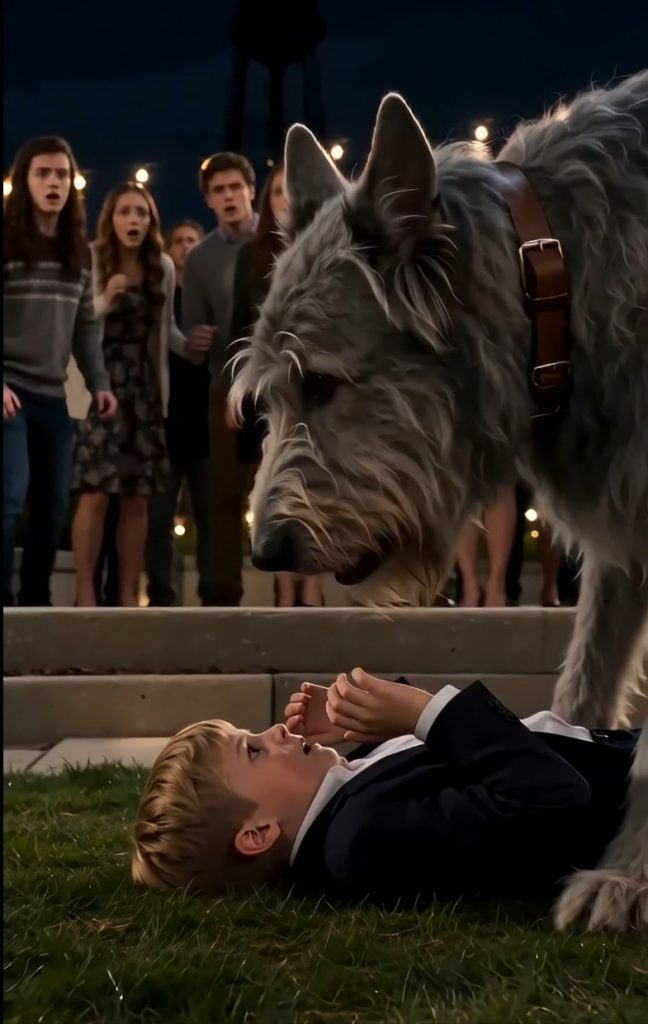
One moment, Lucas Wren was standing on the manicured grass in his little black suit, smiling awkwardly beneath the warm string lights of the courtyard gala. The next, a massive shaggy gray dog exploded from the shadows and knocked him flat onto the lawn.
The crowd gasped as one body.
Glasses clinked. Someone screamed. A woman dropped her champagne flute onto the stone walkway, where it shattered against the concrete edge of the planter.
Lucas landed on his back, arms flying up, eyes wide with terror.
The dog stood over him.
It was enormous, with a thick brown leather collar buried in its shaggy fur and a muzzle lowered close to the boy’s face. Its growl rolled through the courtyard, deep enough to make every adult step back instead of forward.
“Get it off him!” someone shouted.
But no one moved.
The dog barked once, sharp and violent, and Lucas squeezed his eyes shut. His small hands pushed weakly at the animal’s chest, but the dog did not retreat. It pinned him there, not biting, not tearing, just holding him down with terrifying force.
The party had been beautiful ten seconds earlier.
Warm lights. White tablecloths. Caterers moving through the crowd. Donors in velvet dresses and dark suits gathered in the courtyard of Ashford Preparatory, celebrating the new children’s arts wing named for Lucas’s dead father.
Now all anyone saw was a boy on the grass and a dog over him.
Then a man’s voice cut across the panic.
“Don’t move!”
It came from somewhere beyond the walkway, deep and commanding. The dog stopped barking immediately.
Not slowly.
Immediately.
Its body went rigid.
Lucas opened one eye, trembling.
The dog lifted its head.
Not toward the crowd.
Toward the sky.
The screams faded into stunned silence as everyone followed the animal’s gaze.
Above the courtyard, near the dark outline of the old water tower beyond the school fence, a small green light pulsed in the night.
Once.
Twice.
Three times.
And the dog, still standing over the boy, began to whine.
That was when Lucas’s mother realized the dog had not attacked her son.
It had saved him.
Act II
Before that night, everyone knew the dog as a mistake.
His name was Morrow, and he had belonged to Lucas’s father, Adrian Wren.
Adrian was a gentle man with a difficult job. He designed security systems for museums, schools, and private estates, the kind of invisible protection wealthy people paid for and then pretended not to need. He noticed patterns. Weak doors. Wrong shadows. People standing where they should not stand.
He also noticed fear in animals.
Morrow had been found as a half-starved stray near an abandoned warehouse three years earlier. Too large for most homes, too wary for easy adoption, too intense for people who wanted a pretty dog to sleep by a fireplace.
Adrian brought him home anyway.
“He watches what people miss,” he told his wife, Elise.
Elise had laughed then.
Lucas, only six at the time, fell in love instantly.
Morrow followed the boy everywhere. He slept outside his bedroom. He stood between Lucas and unfamiliar adults. When Lucas cried during thunderstorms, Morrow pressed his huge body against the bed until the fear passed.
Then Adrian died.
A car accident, they said.
Wet road. Late night. Loss of control.
That was the official report.
Elise never believed it completely.
Adrian had been too careful. He had called her that evening from his office and said he was coming home early because he found something “buried inside the Ashford project.”
He never made it.
After his death, the world around Elise shifted with terrifying speed. Lawyers appeared. Board members offered sympathy with contracts attached. Adrian’s half-brother, Grant, stepped in to “help manage the estate” until Lucas’s trust was settled.
Grant was elegant, polished, and patient in the way predators are patient.
He never raised his voice. He never said anything cruel in front of witnesses. But he found ways to make Elise feel unstable.
She was grieving too loudly.
She was questioning too much.
She was overprotective of Lucas.
And the dog, Grant said, was dangerous.
Morrow had growled at him twice.
Grant used that as proof.
Within months, he convinced the family attorney to remove Morrow from the house after claiming the dog was a risk to Lucas. Elise fought, but grief had weakened her credibility. A wealthy widow with red eyes and a child who had nightmares was easy to dismiss.
Morrow was taken to a private kennel outside town.
Lucas cried for three nights.
Then stopped asking.
That scared Elise more than the crying.
The gala was Grant’s idea.
A public tribute to Adrian Wren. A donor event at Ashford Preparatory. A plaque. A speech. A video montage. A night designed to show that the Wren family had healed and that Grant was the responsible man guiding them forward.
Elise hated every minute of it.
But her attorney told her to attend.
“Appear cooperative,” he said. “Do not give Grant a reason to claim you are isolating Lucas.”
So she came.
Lucas wore the black suit he hated. Elise wore a cream dress and smiled when people touched her arm and said Adrian would be proud.
Grant stood near the stage all evening, accepting praise that did not belong to him.
And somewhere beyond the lights, someone opened a kennel gate.
Morrow came through the courtyard like a storm.
But he was not running at random.
He was running exactly where Adrian had trained him to run.
Toward the signal.
Act III
The man who shouted “Don’t move” was Jonah Vale.
Most guests did not know him.
They saw an older groundskeeper in a brown jacket, someone hired to keep the courtyard tidy and check the lights before donor events. They did not see what Adrian had seen in him years earlier: a former military dog handler with a limp, a quiet voice, and the kind of loyalty that survives being underestimated.
Jonah had trained Morrow.
Not as an attack dog.
As a protection dog.
The difference mattered.
An attack dog obeys aggression.
A protection dog reads threat.
Adrian had been working on a private system before he died, one meant for schools and public events. It used tiny reflected light signals to test sight lines from rooftops, towers, windows, and high structures. Green pulse meant exposed target. Red pulse meant exit. White pulse meant false alarm.
It was supposed to be a safety tool.
But in the wrong hands, it could become something else.
Adrian discovered that someone had copied the prototype files.
That was what he meant when he told Elise he had found something buried inside the Ashford project.
He had not been talking about money.
He had been talking about access.
After Adrian’s death, Jonah kept quiet because he had no proof, only suspicion and a dog who reacted badly whenever Grant came near. Then Morrow was taken away, and Jonah understood someone else knew the dog was dangerous to their plan.
Not because Morrow would hurt Lucas.
Because Morrow would remember the signal.
That night, Jonah had been checking the courtyard lighting when he saw the green pulse flicker near the water tower.
At first, he thought grief had made him imagine it.
Then he saw Lucas step onto the grass.
Directly under the open sight line.
And then Morrow appeared.
The dog did exactly what he had been trained to do.
He removed the child from exposure.
Fast.
Hard.
Without waiting for human permission.
That was why he knocked Lucas down. That was why he stood over him. That was why he barked toward the crowd and then froze when Jonah gave the command.
Morrow was not attacking.
He was shielding.
Elise reached her son first after Jonah signaled the dog back. She dropped to her knees in the grass, pulling Lucas into her arms. He was shaking so hard his teeth clicked together.
“Morrow,” he sobbed.
The dog lowered its head, whining softly.
Lucas reached out with one trembling hand and buried his fingers in the shaggy fur.
The crowd stared, confused, ashamed, still frightened.
Grant pushed through them with a face full of outrage.
“Get that animal away from him!”
Morrow growled.
Not at Lucas.
At Grant.
Jonah stepped between them.
“Funny,” Jonah said, voice low. “He only does that around men who lie.”
Grant’s expression hardened.
Then the green light pulsed again above the water tower.
This time, everyone saw Grant look up before anyone else did.
Act IV
That look ruined him.
It was not enough for a conviction.
Not alone.
But it was enough to change the room.
Or rather, the courtyard.
The guests who had been whispering about the dog were now whispering about the light. Phones came out. Security moved toward the fence. The warm party atmosphere drained away, leaving behind a cold public fear no string lights could soften.
Jonah kept his eyes on Grant.
Elise kept Lucas behind her.
Morrow stayed low beside the boy, no longer barking, but alert in a way that made the air feel wired.
Grant tried to laugh.
“This is absurd. A light in the sky and suddenly I’m accused of something?”
“No one accused you,” Elise said.
Her voice was calm.
Too calm.
Grant looked at her and realized his mistake.
She had not accused him.
He had defended himself too early.
Campus security reached the base of the old water tower ten minutes later. The police arrived six minutes after that. What they found was not a person holding a weapon, as the crowd had feared.
It was a mounted device.
Small. Remote-operated. Modified from one of Adrian’s own prototypes.
A green targeting pulse.
A camera.
A directional audio unit.
Not designed to harm by itself.
Designed to guide someone else.
Designed to create panic, movement, and opportunity.
The police searched the perimeter. They found no attacker, but they found something better.
A signal relay hidden inside a catering van.
The van was registered to a shell company.
The same shell company that had recently billed Grant Wren’s office for “event logistics.”
Grant said he knew nothing.
Then Jonah gave the police Adrian’s old drive.
The one he had kept hidden after the funeral because Adrian, cautious to the end, had left it with him the week before he died.
On it were design files.
Warnings.
And one unfinished report naming Grant as the person who had pressured Adrian to sell the school safety system to a private security contractor with foreign investors and no child-protection safeguards.
Adrian had refused.
Then he died.
The courtyard fell into a silence deeper than shock.
Grant’s face changed slowly as he watched officers compare the device to Adrian’s files. The handsome composure remained, but only on the surface. Beneath it, panic moved like something trapped behind glass.
Elise stood with Lucas in her arms, looking at the man who had spent a year calling her unstable.
“You took his dog,” she said.
Grant’s jaw tightened. “That dog nearly crushed your son.”
“No,” Jonah said. “That dog knew the system better than you did.”
Morrow lifted his head at the sound of Jonah’s voice, then looked back at Lucas.
The boy’s small hand stayed tangled in his fur.
The police did not arrest Grant in front of the donors that night.
Men like Grant rarely fall in one clean moment.
But they took his phone.
Then his laptop.
Then the catering van’s records.
By morning, his office was sealed.
By noon, the story was everywhere.
Not the story Grant had planned. Not the grieving family, the generous uncle, the noble tribute to a dead brother.
A different story.
A dog knocking a boy down under a green light.
A prototype stolen.
A death reopened.
A powerful man finally standing in the sight line of his own lie.
Act V
Lucas refused to sleep unless Morrow was outside his door.
Elise did not argue.
For the first week after the gala, the dog barely left him. He followed Lucas from room to room, a huge gray shadow padding across the hardwood floors as if making up for every day they had been separated.
Sometimes Lucas woke crying.
Sometimes he asked if the green light was coming back.
Sometimes he whispered, “Did Uncle Grant make Dad go away?”
Elise never lied to him.
But she also never handed him more truth than his small heart could carry.
“We are finding out,” she would say, holding him close. “And you are safe tonight.”
That was enough for one night.
Then another.
Then another.
The investigation widened.
The official accident report on Adrian’s death was reopened. A mechanic found evidence that his car had been tampered with. The contractor connected to Grant began cooperating. Financial records showed payments routed through multiple companies. Emails proved Grant had expected to gain control of Lucas’s trust if Elise were declared unstable or negligent.
The gala had not been meant to hurt Lucas directly.
That was the horror of it.
It was meant to create a public incident.
A “dangerous dog” attacking the heir.
A mother who failed to protect him.
A traumatized child pulled deeper into Grant’s custody argument.
But the device on the tower had done more than signal a staged panic.
It exposed the stolen system.
It awakened the one witness Grant had removed from the house.
Morrow.
Grant was arrested three months later.
Elise watched it on the news with the sound muted. Lucas was asleep upstairs. Morrow lay at her feet, ears twitching with every noise outside.
The headline called Grant’s downfall a corporate conspiracy.
Elise turned off the television.
To her, it was simpler.
Her husband had been killed because he said no.
Her son had almost been stolen by a man who dressed greed as concern.
And the dog everyone feared had been the only one who remembered the pattern clearly enough to stop it.
The school removed Grant’s name from every donor list.
Then, quietly, they renamed the new safety wing.
Not after Grant.
Not even after Adrian, at Elise’s request.
They named it the Wren Center for Student Protection, with a small bronze plaque near the entrance.
It showed a child’s hand resting on the head of a large dog.
Beneath it were the words:
For those who watch when others look away.
At the dedication, Lucas wore a navy sweater instead of a suit.
He insisted.
“No more party suits,” he told Elise.
She smiled through tears. “No more party suits.”
Morrow sat beside him on the grass, calm and dignified, accepting every respectful glance as if he had always known the humans would eventually catch up.
Jonah attended too, standing near the back with his hands folded over his cane. When Lucas saw him, he ran over and hugged him around the waist.
“Thank you for yelling,” Lucas said.
Jonah cleared his throat. “Thank Morrow. I just translated.”
Lucas looked at the dog.
Morrow wagged his tail once.
A year later, the courtyard looked different to Elise, though the lights were the same.
Warm strings overhead.
Manicured grass.
The old water tower dark against the night sky.
But the fear had left the place.
Not completely. Fear never leaves cleanly after it has touched a child. But it no longer owned the grass where Lucas had fallen.
He played there now with other children during school events, Morrow watching from the edge like a shaggy old guardian who had retired from drama but not from duty.
Sometimes people still whispered about that night.
They said the dog attacked.
They said the dog saved.
They said there had been a green light, a hidden device, a conspiracy, a dead father’s secret system.
All of it was true.
But Lucas understood it in a simpler way.
One evening, as Elise stood near the walkway, Lucas knelt beside Morrow and wrapped both arms around his neck.
“You pushed me down because you loved me,” he said.
The dog leaned into him.
Elise looked up at the water tower.
No light pulsed there now.
Only darkness.
Only sky.
Only the memory of a signal that had meant danger until one loyal animal turned it into proof.
Grant had expected people to see a monster on the grass.
Instead, they saw a guardian.
And in the space between one bark and one command, the lie that killed Adrian Wren finally lost its cover beneath the lights.