Act I
The box should not have been there.
That was the first thing Owen Hart thought as he stumbled through the flooded channel beneath the concrete bridge, water slapping cold against his boots. Rain had turned the drainage bed into a shallow, rushing river. Broken branches spun around rocks. Mud pulled at his feet. The air under the bridge smelled like wet stone, moss, and winter.
But the wooden box stayed still.
Dark brown. Rectangular. Half-soaked. Wedged near the waterline as if someone had placed it there carefully and then walked away.
Owen’s breath came hard.
He had been following a sound.
Not a cry exactly.
Not something loud enough to be certain.
Just a weak, thin noise carried strangely under the bridge while he was walking home from the late bus stop. At first, he thought it was a cat. Then maybe a bird trapped somewhere in the debris.
Then the rain shifted, and he saw the box.
He splashed toward it.
His hands were already shaking before he touched the lid. The wood was cold and slick beneath his fingers. One corner was swollen from water. A dirty strip of cloth had been tied around the latch, not to secure it, but to keep it from floating open.
Owen tore it loose.
The lid creaked.
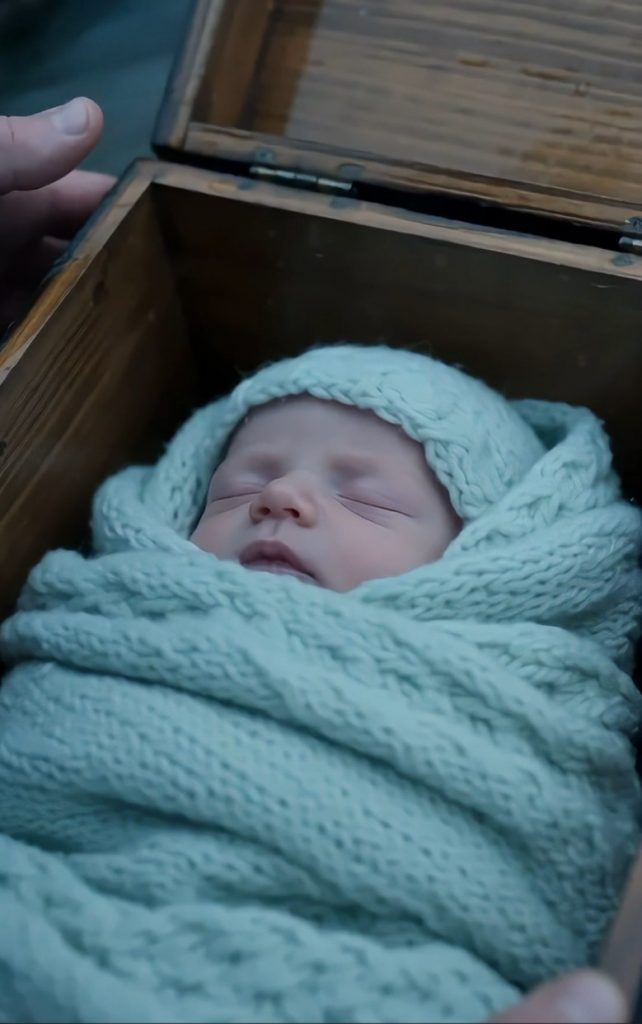
Inside was a pale knitted blanket.
For half a second, his mind refused to move beyond that detail. A blanket in a box. A soft thing in a hard place. Something warm-looking in a world of grey water and stone.
Then the blanket shifted.
Owen gasped so sharply it hurt.
A baby lay inside.
Tiny. Quiet. Wrapped in mint-green wool, with only a small pale face visible beneath the fold. The infant’s eyes were closed. The skin around the cheeks had the fragile pinkness of something far too new for the cold world around it.
“No,” Owen breathed.
The water rushed louder around him.
He slid both hands beneath the baby with a care that slowed time. His fingers spread to support the head, the body, the blanket, everything at once. The baby weighed almost nothing.
That frightened him most.
He pulled the infant against his chest and stood, slipping once on the stones before catching himself.
“Come on,” he whispered, already turning toward the embankment. “Come on, stay with me.”
Then his thumb brushed something inside the blanket.
A folded paper.
Tucked deep against the baby’s side.
Owen did not read it there. He could not. The child was too cold, the water too close, the slope too steep.
He ran.
And behind him, the wooden box spun free at last, hit a rock, and drifted into the flood like it had never meant to be found at all.
Act II
Owen Hart was not supposed to be under the bridge that evening.
He was supposed to be at the hospital.
That was where he had spent most nights for the last three months, sitting in a plastic chair beside his younger sister’s bed, watching machines blink in the dark while doctors used careful words that never quite meant hope.
Mia was twenty-four.
Or had been.
That was still how Owen’s mind phrased it, refusing the final shape of grief even though the funeral had been two weeks ago.
She had died after childbirth complications, though the official paperwork made everything sound clean and unavoidable. Owen knew life was rarely that simple. He had known it since the night Mia called him, crying so hard he could barely understand her.
“They won’t let me leave,” she had whispered.
“Who won’t?”
There was a pause.
Then the line cut out.
That was the last real conversation he ever had with his sister.
By the time Owen reached the private clinic where she had been admitted, Mia was unconscious. Her husband, Conrad Vale, stood outside the room in a tailored coat, speaking to a doctor as if he owned the hallway.
Conrad did own many things.
A logistics company.
Two apartment blocks.
A country house.
A reputation so polished people apologized before questioning him.
He also owned the story after Mia died.
The baby had not survived, he said.
A terrible loss, he said.
Mia had been fragile, he said.
Owen had asked to see the child.
Conrad’s face had changed then.
Only for a second.
But Owen saw it.
“There was no child to see,” Conrad said.
The clinic supported his statement. The records were vague. The nurse Owen tried to find had resigned. Mia’s belongings were returned in a sealed bag with her phone missing.
Everyone told Owen he was grieving.
Conrad told him it directly.
“You need to let my wife rest.”
My wife.
Not your sister.
Not Mia.
My wife.
After the funeral, Owen began walking at night because sleeping had become a room he could not enter. The bridge was part of an old route from the bus depot to his apartment, a bleak shortcut beneath the city’s quieter edge. No shops. No houses. Just runoff channels, winter trees, and concrete pillars holding up traffic that never looked down.
That evening, he had walked there because rain made the streets empty.
Because empty felt honest.
Then he heard the sound.
Now he was climbing the gravel embankment with a baby inside his jacket, his boots sliding, his chest burning, rain running into his eyes.
“Stay with me, buddy,” he pleaded. “Please.”
At the top of the slope, he collapsed to one knee beneath the shelter of an overpass support. He pulled his phone from his pocket with numb fingers and called emergency services.
“I found a baby,” he said, voice cracking. “Under the bridge. In a box. The baby’s cold. Please, hurry.”
The dispatcher asked questions.
Owen answered what he could.
Location. Condition. Breathing. Blanket. Water.
Then he remembered the note.
Still holding the baby with one arm, he eased the folded paper from the blanket and opened it with trembling fingers.
The writing was shaky.
Rushed.
But he recognized the hand instantly.
Mia’s.
Owen, if you find him, his name is Noah. Conrad lied.
Act III
The ambulance arrived eight minutes later.
Owen counted every second.
He rubbed the blanket carefully between his palms, trying to warm the baby without hurting him. He spoke nonsense because silence felt dangerous.
“You’re okay. You’re okay. I’ve got you. I’ve got you, Noah.”
The name broke him every time he said it.
Noah.
Mia had chosen that name when she was sixteen, long before Conrad, long before private clinics and locked doors and expensive lies.
“If I ever have a son,” she told Owen once while they ate cheap noodles on the kitchen floor of their first apartment, “I’m naming him Noah. It sounds like someone who survives the flood.”
Owen had laughed then.
He was not laughing now.
Paramedics took Noah gently, wrapping him in heated blankets and checking him with focused urgency. One of them asked if Owen was the father.
“No,” he said, staring at the baby. “I’m his uncle.”
The word landed inside him like a vow.
At the hospital, the doctors moved Noah into a neonatal emergency room. Owen stood behind the glass, soaked, shaking, still holding Mia’s note in a plastic evidence sleeve an officer had given him.
A police detective arrived just before midnight.
Her name was Elena Cruz. She had tired eyes, a navy coat, and the rare quality of seeming more interested in the truth than in controlling the room.
Owen told her everything.
Mia’s call.
Conrad.
The missing phone.
The clinic.
The claim that the baby died.
The box.
The note.
Detective Cruz listened without interrupting. When he finished, she asked only one question.
“Do you still have your sister’s old messages?”
Owen nodded.
Every one.
By dawn, the case began to tear open.
The first crack came from the clinic records. The child had been listed as stillborn in one file, transferred in another, and absent entirely from a third. The attending doctor had signed all three versions.
The second crack came from a traffic camera near the bridge.
At 5:12 p.m., a black SUV registered to Conrad Vale’s company stopped near the old service road above the drainage channel. Someone got out carrying a dark shape. The camera was too far away to show a face.
But the timing was enough.
The third crack came from Noah himself.
The hospital placed a temporary identification band on his ankle. When a nurse removed the soaked outer blanket, she found another band beneath it, hidden under the fold.
Not from the city hospital.
From the private clinic.
Baby Boy Vale.
Born three weeks earlier.
Alive.
Owen sat down hard in the waiting room.
Three weeks.
Noah had been alive for three weeks while Owen mourned him beside his mother’s grave.
Detective Cruz stood beside the window, phone pressed to her ear. Her expression did not change much, but Owen saw the anger in the tightness around her mouth.
“Get a warrant,” she said. “For the clinic, the Vale residence, and the company vehicle logs.”
Then she looked at Owen.
“Your sister didn’t just leave a note. She left us a map.”
Act IV
Conrad Vale came to the hospital at 9:30 a.m.
He arrived in a black coat, hair perfect despite the rain, face arranged into wounded confusion. Owen saw him through the waiting room glass and felt something inside him go very still.
Conrad did not look like a man rushing toward a miracle.
He looked like a man arriving to inspect damage.
“Owen,” he said softly. “What have you done?”
Owen stood.
Detective Cruz stepped between them before Conrad got close.
“Mr. Vale,” she said. “We need to ask you some questions.”
Conrad looked at her badge, then smiled with the weary patience of someone used to being inconvenienced by public servants.
“Of course. But first, I’d like to see the child.”
The child.
Not my son.
Not Noah.
The child.
Owen’s hands curled at his sides.
Detective Cruz did not move. “You reported that your son died at birth.”
Conrad closed his eyes briefly, as if this pained him. “My wife was unstable in her final weeks. I now believe she may have arranged something without my knowledge.”
Owen almost lunged.
Cruz lifted one hand slightly, stopping him without looking.
Conrad continued, “If there is a baby, and if he is mine, then clearly he belongs with his father.”
That was when Owen understood.
Conrad had not wanted Noah dead.
Not originally.
He had wanted control.
Mia must have tried to hide the baby. Maybe with a nurse. Maybe with someone she trusted. Maybe she had found a way to keep him out of Conrad’s hands before her body failed.
But Conrad found him.
And when the search, the records, or the money trail became too risky, he chose the place where unwanted things disappeared.
A flood channel under a bridge.
Detective Cruz’s phone buzzed.
She read the message, then looked at Conrad.
“Your vehicle was recorded near the bridge yesterday evening.”
Conrad’s smile faded by a fraction.
“I own many vehicles.”
“This one was driven by your head of security.”
“Then speak to him.”
“We are.”
A door opened down the hallway. Two officers entered with a man in a wet grey jacket between them. He looked like he had not slept.
Conrad turned.
The man could not meet his eyes.
Detective Cruz’s voice was calm. “Your employee says you ordered him to dispose of a box. He says he did not know what was inside until he heard a sound. He panicked and left it near the water instead of farther downstream.”
Conrad’s face hardened.
The performance was gone now.
“He’s lying.”
Owen stepped forward.
“Mia wrote the note.”
For the first time, Conrad looked afraid.
Not guilty.
Afraid.
Owen pulled the evidence sleeve from his coat pocket and held it up.
Conrad stared at the paper, and in that second, the truth passed across his face. He recognized her handwriting. He recognized the threat of her voice returning from the dead.
Detective Cruz saw it too.
By evening, the clinic director had been taken in for questioning. A nurse named Clara Wynn came forward after seeing the news break online. She admitted Mia had begged her to contact Owen before the delivery, but Conrad’s people had confiscated Mia’s phone and controlled access to her room.
Clara had hidden the baby for two weeks in an offsite apartment, planning to get him to Owen.
But Conrad found out.
Mia’s note had been tucked into the baby’s blanket the night she died, Clara said. Mia had gripped her wrist with the last strength she had and whispered, “If they take him, make sure my brother knows his name.”
Clara wept through the statement.
Owen did not.
He had moved beyond tears for the moment.
He stood outside the neonatal room, watching Noah breathe, and understood that grief was no longer the only thing Mia had left him.
She had left him a life to protect.
Act V
Noah survived.
That was the sentence Owen repeated to himself every morning for the first month.
Noah survived.
Not because the world was merciful.
Because Mia fought from a hospital bed. Because Clara risked herself. Because a security guard hesitated at the edge of becoming a monster. Because Owen heard a sound under a bridge and did not keep walking.
The baby gained weight slowly. His color improved. His fingers began curling around Owen’s thumb with surprising strength.
The doctors said he was lucky.
Owen hated that word.
Luck was too small for what had happened.
The legal battle came fast and ugly. Conrad’s attorneys moved to claim custody. Then the evidence moved faster. The clinic records. The video. The employee testimony. Clara’s statement. Mia’s note. Financial transfers to the doctor. Texts showing Conrad’s panic after learning Mia had named Owen as the baby’s preferred guardian in a document hidden with her attorney.
That document became the final blow.
Mia had known.
Maybe not everything.
But enough.
In court, Conrad tried to look like a grieving widower. He spoke of confusion, trauma, betrayal by staff. He said Owen was unstable, obsessed, unfit to care for a child.
Then the judge read Mia’s handwritten note aloud.
Owen, if you find him, his name is Noah. Conrad lied.
The courtroom went still.
Conrad stopped looking like a man in control.
Noah was placed in Owen’s temporary care, then permanent guardianship after Conrad was indicted. The adoption came later, quietly, on a spring morning with rain tapping softly against the courthouse windows.
Owen held Noah through the entire hearing.
The baby slept through most of it.
When the judge signed the final order, Detective Cruz sat in the back row and wiped her eyes with the heel of her hand, pretending she had not.
Clara came too.
She brought a small knitted hat that matched the blanket from the box. Owen accepted it with both hands.
“I should have done more,” she whispered.
Owen looked at Noah, then back at her.
“You did enough for him to be here.”
That was true.
And sometimes enough is the difference between a grave and a future.
Months later, Owen returned to the bridge.
Not with Noah.
Never with Noah.
He went alone on a clear cold afternoon, when the channel had lowered and the water moved gently over the stones. The wooden box was gone. The flood had taken it, or the police had collected what remained. Either way, the place looked smaller than it did in his memory.
Less monstrous.
More ordinary.
That made him angrier than he expected.
Terrible things often happened in ordinary places. Under bridges. Behind clinic doors. Inside expensive houses. In rooms where men with clean hands signed papers and called it necessary.
Owen stood at the waterline and unfolded a copy of Mia’s note.
The original was evidence.
This one was his.
He had read it so many times the words lived inside him now.
His name is Noah.
Owen looked at the water.
“You named him right,” he whispered.
The wind moved under the bridge, softer than before.
One year later, Noah’s first birthday was held in Owen’s small apartment above the bakery. There were too many balloons, too much cake, and a crooked banner Clara insisted on hanging even though Noah could not read.
Detective Cruz brought a stuffed bear.
The bakery owner downstairs brought cupcakes.
Owen placed a framed photograph of Mia on the shelf beside the cake. In it, she was laughing at some joke he could no longer remember, hair loose around her shoulders, eyes bright and alive.
Noah stared at the candle with grave suspicion.
Then he smashed his hand into the frosting.
Everyone laughed.
Owen did too.
The sound surprised him.
Later, after the guests left and the apartment grew quiet, Owen sat in the rocking chair with Noah asleep against his chest. The mint-green blanket lay over them both, washed clean, softened by use, no longer smelling of floodwater or fear.
He thought about the box.
The rushing channel.
The cold.
His own voice breaking under the bridge.
Come on. Stay with me, buddy.
Noah stirred, then settled again, warm and heavy against him.
Owen lowered his cheek to the baby’s fine hair.
For a long time, he had believed the worst night of his life was the night he lost Mia.
But now he understood something more complicated.
The night under the bridge had been both an ending and a beginning.
It was the night Conrad’s lie began to drown.
It was the night Mia’s final truth surfaced.
It was the night a baby named for survival was pulled from a wooden box in the flood and brought back into the world that had almost failed him.
Owen held his nephew closer.
Outside, rain began softly against the window.
This time, it did not sound like danger.
It sounded like a promise being kept.