Act I
The cane hit the asphalt before anyone understood what the officer had done.
It clattered across the white parking line, bounced once, then rolled beneath the nose of a silver sedan in the middle of the sunlit shopping center lot.
For a second, the old man was left standing without it.
His body tilted.
His right hand shot toward the car’s hood, fingers scraping against the warm metal as he fought to stay upright. The bright midday sun showed everything too clearly: the fear in his pale blue eyes, the tremor in his knees, the shame of a man whose balance had been stolen in public.
The police officer stood a few feet away in a black uniform, boots planted wide, face hard.
He had crossed the parking lot like a storm.
Heavy steps.
Rigid jaw.
One hand resting near his duty belt.
The elderly man had been standing beside his own car, leaning on a wooden cane, when the officer came at him.
No warning anyone could hear.
No patience.
No dignity.
Just a boot swinging out and knocking the cane away as if it were trash.
The old man’s breathing turned sharp.
He steadied himself against the silver sedan, then slowly turned his head toward the officer.
His face changed.
The panic did not disappear completely, but something older rose beneath it. Something colder. Something trained into him long before this parking lot, long before this young officer had ever worn a badge.
The officer stepped closer.
“You deaf, old man? I told you to move away from the vehicle.”
The elderly man looked at him for a long second.
Then he spoke in a low, gravelly voice.
“Looks like you picked the wrong man.”
The officer’s expression twitched.
Not fear yet.
Annoyance.
Then the old man’s hand slapped against the car’s surface, firm and deliberate.
The camera of a nearby shopper caught it perfectly.
His fingers spread across the silver paint.
On one finger sat a gold ring.
Three dark stars were carved into the band.
The officer saw them.
His face drained of color.
The old man straightened as much as his body allowed.
And for the first time, the badge on the officer’s chest did not feel like the most powerful thing in the parking lot.
Act II
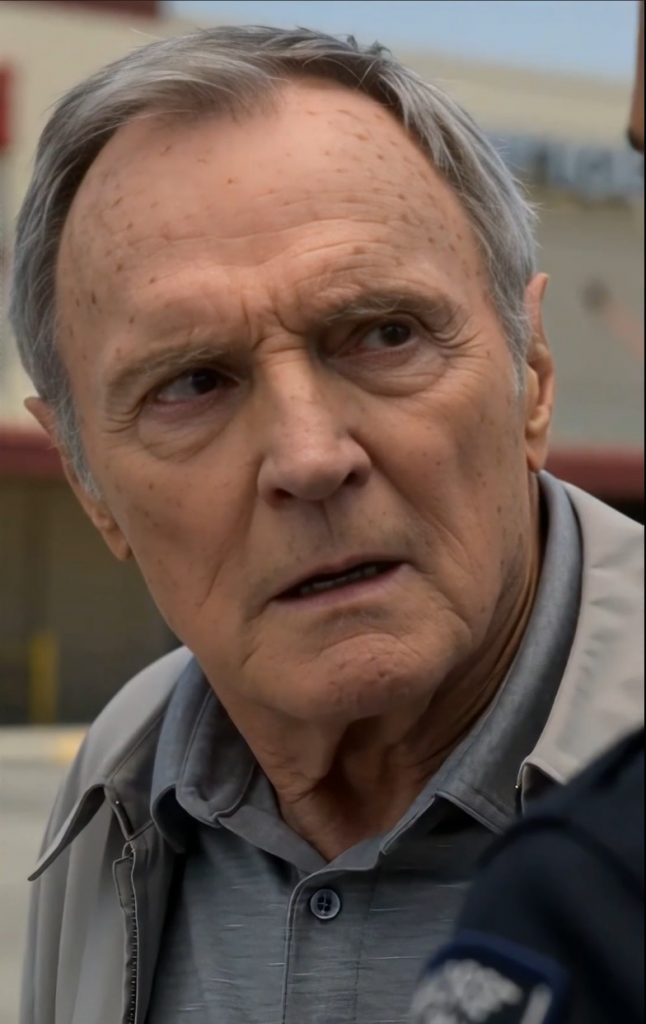
His name was Elias Monroe.
Most people who passed him on the street saw only the age.
The cane.
The stiff gait.
The windbreaker jacket.
The careful way he lowered himself into chairs and held railings before taking steps.
They did not see the man he had been.
Three-star Army general.
Forty-one years of service.
A battlefield commander whose name had once appeared in classified briefings, presidential ceremonies, and folded letters delivered to families when sons did not come home.
Elias hated the word hero.
He had buried too many better men to wear it comfortably.
After retirement, he disappeared from public life on purpose. No paid speeches. No political panels. No memoir ghostwritten by someone who wanted to make war sound clean. He bought a modest house two counties over, drove his own sedan, and spent his mornings at a diner where the waitress called him Mr. Eli and refilled his coffee without asking.
But retirement did not mean silence.
A year earlier, the governor had asked him to lead a quiet review board investigating police misconduct against veterans, seniors, and unhoused residents in suburban counties.
Elias almost refused.
Then he read the complaints.
An elderly veteran shoved outside a pharmacy.
A disabled man ticketed repeatedly for sitting too long near a bus stop.
A woman with dementia handcuffed after forgetting where she parked.
And again and again, one officer’s name appeared.
Officer Grant Keller.
Young.
Decorated.
Aggressive.
Protected.
Every complaint had been dismissed. The same phrases repeated in every report.
Subject was noncompliant.
Officer acted within policy.
No further action recommended.
Elias knew the language of cover.
He had seen men hide cowardice behind procedure and cruelty behind discipline. He had also commanded real officers, real soldiers, real professionals who understood that authority was not license. It was responsibility under pressure.
So he came to the shopping center that day without ceremony.
No driver.
No assistant.
No suit.
Just his old silver sedan, his cane, and the gold ring his unit had given him when he retired.
The three stars did not mean arrogance to him.
They meant burden.
They meant every decision had witnesses, whether the powerful wanted to admit it or not.
He had planned to meet a store manager who had reported seeing Officer Keller harass an elderly man in the same parking lot weeks earlier. Elias had arrived early, parked near the entrance, and stepped out slowly.
Then Keller saw him.
Maybe the officer mistook him for someone else.
Maybe he recognized a vulnerable target.
Maybe he simply saw age and assumed weakness.
It did not matter.
The cruelty came out too easily to be new.
And as Elias’s cane rolled across the asphalt, he understood the truth.
The complaints had been real.
The reports had been lies.
And this officer had just made the mistake of showing Elias Monroe exactly who he was.
Act III
People had started recording.
That was the first thing Officer Keller noticed after he saw the ring.
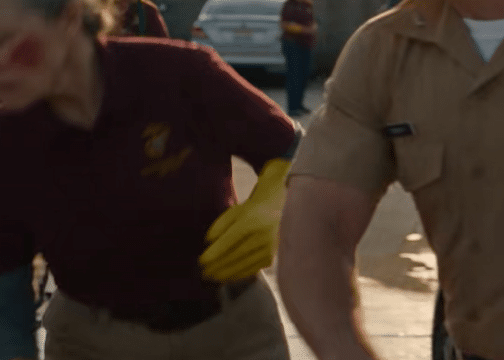
Phones lifted near parked cars. A woman stood frozen beside a shopping cart. A teenage boy near the store entrance held his phone with both hands, mouth slightly open. Two employees in red-trimmed uniforms stepped outside and stopped under the awning.
The parking lot suddenly had witnesses.
Keller looked from the ring to Elias’s face.
The old man did not smile.
That somehow made it worse.
“Sir,” Keller said, voice shifting, “I need you to remain calm.”
Elias’s eyes narrowed.
“Interesting. A moment ago, I was deaf.”
The woman with the shopping cart let out a small sound. Not quite a laugh. Not quite a gasp.
Keller’s jaw tightened.
“You were failing to comply with instructions.”
“What instructions?”
“I asked you to step away from the vehicle.”
“This is my vehicle.”
Keller glanced at the silver sedan, then at the license plate.
He had not checked.
Everyone understood it at the same time.
The officer had approached first and verified later.
A second police cruiser turned into the lot, lights off but moving fast. Another officer stepped out, older, heavier, with gray at his temples. Sergeant Lowell.
His face changed the moment he saw Elias.
Not because of the ring.
Because he knew the man.
“General Monroe,” he said.
The parking lot went silent.
Keller looked like someone had taken the ground from under him.
Elias did not take his eyes off Keller.
“Sergeant.”
Lowell looked at the cane lying beneath the front of the sedan.
Then at Keller.
“What happened?”
Keller opened his mouth.
Elias answered first.
“Your officer approached me without identifying a lawful cause, knocked away my cane, and attempted to intimidate me while I was standing beside my own car.”
Keller snapped, “That’s not accurate.”
The teenager near the storefront lifted his phone higher.
“I recorded it.”
So did the woman with the cart.
So did a man in a delivery van.
One by one, the phones became louder than the badge.
Sergeant Lowell’s face tightened with the pain of a man recognizing an institutional problem in public.
“Officer Keller,” he said, “step back.”
Keller did not move.
That was the second mistake.
Elias watched it happen: the refusal, the pride, the split-second calculation of a man deciding whether ego mattered more than order.
Lowell’s voice sharpened.
“Now.”
Keller stepped back.
Elias reached for his cane, but before he could bend, the blonde woman with the shopping cart rushed forward and picked it up for him.
Her hands trembled as she returned it.
“I’m sorry,” she whispered.
Elias accepted it gently.
“You didn’t knock it down.”
Her eyes filled.
“No. But I almost walked away.”
That sentence stayed in the air longer than anyone expected.
Because almost walking away was how men like Keller survived.
Act IV
The body camera footage should have cleared everything up.
Instead, it exposed everything.
Keller’s camera had been muted for the first part of the encounter.
Against policy.
His incident log claimed he had approached a “suspicious elderly male attempting vehicle access.” But dispatch had no call about a suspicious person. No store complaint. No report from the parking lot.
He had invented suspicion after choosing a target.
That was bad enough.
Then Elias asked for the previous complaint files.
The department resisted.
Not directly. Never directly.
They delayed. Misplaced. Claimed personnel matters. Mentioned privacy. Sent summaries instead of originals.
Elias had spent his life inside institutions. He knew when a wall was being built from paper.
So he called in the review board.
Within forty-eight hours, Officer Grant Keller’s history began to surface.
Dashcam videos.
Witness statements.
A pattern of stopping elderly drivers near shopping centers.
Questioning veterans outside clinics.
Threatening citations to people who looked too poor, too confused, too slow, or too unlikely to complain effectively.
One report stood out.
A seventy-eight-year-old veteran named Arthur Bell had been shoved against a pharmacy wall after trying to explain he had misplaced his keys. Keller wrote that Arthur had been “agitated and combative.”
Arthur died three months later.
His daughter had filed a complaint.
Dismissed.
Elias read the file twice, then sat alone in his office with the ring in his palm.
The three stars looked different under the desk lamp.
Not like honor.
Like accusation.
How many people, he wondered, had been telling the truth while the system demanded the right kind of victim?
Strong enough to be believed.
Calm enough to be respectable.
Educated enough to document.
Healthy enough to fight.
Elias had been believed because of a ring.
That angered him more than the shove.
At the disciplinary hearing, Keller arrived with an attorney and the expression of a man who still believed the right language could repair the wrong behavior.
He apologized for “any perceived distress.”
Elias interrupted him.
“Perceived?”
The room went still.
Keller’s attorney leaned toward him, whispering quickly.
Keller swallowed.
“I regret the interaction.”
Elias looked at the panel.
“No, he regrets the identity of the person he mistreated.”
Keller’s face hardened.
For a moment, the mask slipped again.
“You don’t know what it’s like out there,” Keller said. “People lie. They resist. They act confused to avoid consequences.”
Elias leaned forward.
“I know exactly what it is like to hold authority over frightened people. That is why I know the difference between command and abuse.”
No one spoke.
Elias placed the cane on the table.
The sound was soft.
Still, everyone heard it.
“You did not know my rank when you kicked this away. That is the only honest part of what happened.”
Keller looked down.
Elias’s voice dropped.
“And that is why it matters.”
Act V
Keller was removed from patrol first.
Then suspended.
Then charged after investigators found falsified reports tied to multiple complaints. More officers came under review. So did supervisors who had signed off on clean files because clean files made departments look good and old men on sidewalks look forgettable.
The parking lot video spread fast.
People watched it for the reversal.
The boot hitting the cane.
The old man catching himself on the sedan.
The line.
Looks like you picked the wrong man.
Then the ring.
Three stars.
Millions shared it as a satisfying moment of instant karma.
Elias hated that version.
It made the story too easy.
It allowed people to believe the problem was one arrogant officer and one secretly powerful old man. It ignored the more painful truth: the officer had likely picked the kind of man he picked every day.
He had only been unlucky enough to choose one with a history the world respected.
At a press conference, reporters asked Elias how it felt to be vindicated.
He stood at the podium with his cane in one hand and the ring visible on the other.
“I was not vindicated by being recognized,” he said. “I was protected by it. There is a difference.”
The room quieted.
“The question is not why he treated me that way before he knew who I was,” Elias continued. “The question is how many people he treated that way because he thought no one would care who they were.”
That became the headline.
Not the flashy one.
The important one.
Months later, the shopping center installed more cameras and created a public complaint station inside the main entrance. Elias insisted it be simple enough for elderly customers to use without needing a lawyer or a grandson with a smartphone.
Arthur Bell’s daughter attended the opening.
She brought her father’s old military cap.
Elias held it with both hands before returning it to her.
“I’m sorry,” he said.
She looked at him with tired eyes.
“You didn’t do it.”
“No,” he said. “But I wore stars while men like your father were ignored. I have to carry some of that.”
She studied him for a long moment.
Then she nodded.
Not forgiveness.
Recognition.
That was enough.
Elias never stopped using the silver sedan.
His aides offered a driver. His doctor suggested it might be safer. His daughter begged him to at least stop going places alone.
He listened politely and ignored everyone.
One afternoon, nearly a year after the parking lot incident, Elias returned to the same shopping center.
He parked in the same row.
The asphalt had been repainted. The old white lines were sharp again. The sunlight was gentler this time, softened by thin clouds. People walked in and out of the stores, pushing carts, carrying bags, arguing with children, living ordinary lives in a place that had once become a courtroom without walls.
Elias opened his door, set his cane on the asphalt, and stood slowly.
A young officer near the storefront noticed him.
For one second, Elias saw the officer glance at the cane.
Then the ring.
Then his face.
Elias braced himself for recognition.
Instead, the officer walked over and stopped at a respectful distance.
“Good afternoon, sir,” he said. “Would you like a hand with the curb?”
Elias looked at him.
The officer did not seem to know him.
Not really.
No sudden panic.
No stiff salute.
No performance.
Just a young man seeing an old man and offering help without making it humiliating.
Elias felt something in his chest ease.
“No, thank you,” he said. “But I appreciate you asking.”
The officer nodded and stepped back.
Elias walked toward the store.
Slowly.
Carefully.
Not weakly.
At the entrance, he paused and looked down at the gold ring.
Three stars.
For most of his life, they had meant command.
Now they meant something else.
A reminder that status should never be the price of dignity.
That no badge, no rank, no uniform, no old glory carved into gold mattered if it only protected the people who already looked important.
Elias closed his hand around the cane and stepped inside.
This time, nobody moved out of fear.
Nobody clattered to the ground.
Nobody had to reveal who they were to be treated like someone worth protecting.
And to Elias Monroe, after a lifetime of medals, that felt closer to honor than anything a ring could ever prove.