Act I
The red wine hit the little girl’s dress before anyone understood what the bride had done.
It splashed across the pale floral fabric in a violent burst, soaking through the front and running down toward her white socks and sneakers. Droplets scattered over the polished black-and-white marble floor, bright and ugly beneath the ballroom chandeliers.
For one frozen second, no one spoke.
The girl stood perfectly still.
She was small, maybe eleven, with long brown hair pulled neatly back from her face and the rest falling over her shoulders. Her dress was simple. Her shoes were plain. In a room full of diamonds, tuxedos, lace, and champagne, she looked like she had wandered in from an entirely different world.
That was exactly what the bride thought.
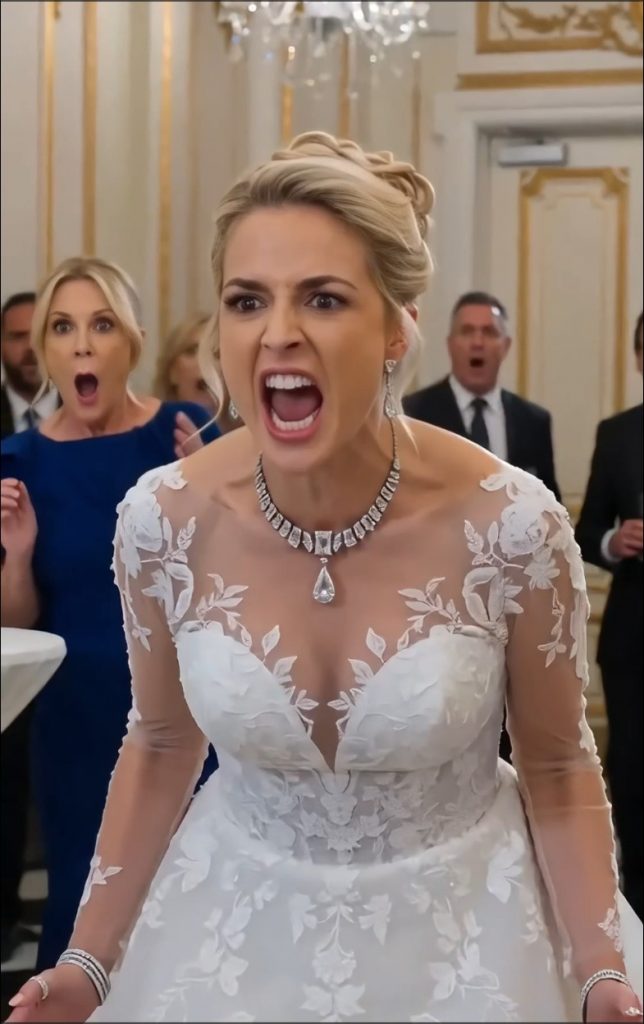
Vanessa Whitmore turned on her, white lace gown flashing under the crystal lights, one hand still gripping a champagne flute. Her red lipstick curled with disgust.
“Security!” she screamed. “Get this woman out!”
The guests gasped.
The girl did not move.
Vanessa stepped closer, her diamond necklace trembling at her throat. Her face was twisted with rage, but beneath it was something sharper: fear of being upstaged, fear of losing control, fear that even one imperfect thing in the room might stain the flawless image she had spent a fortune building.
“Look at yourself,” Vanessa spat. “You’re disgusting.”
The child looked down at her ruined dress.
Then back at the bride.
The security guard moved in from the crowd, his black uniform cutting through a wall of tuxedos and evening gowns. A blonde woman in a blue dress covered her mouth. A man near the cocktail table stiffened but said nothing.
Nobody wanted to challenge the bride at her own wedding reception.
Nobody wanted to become the next spectacle.
The guard stopped beside the girl.
“Miss,” he said carefully, “you need to come with me.”
Only then did the girl lift her chin.
Her eyes were not wet.
That unsettled Vanessa more than tears would have.
The child looked directly at her, calm as stone.
“What a shame,” she said softly, “because I’m the owner of the building.”
Vanessa’s grip loosened.
The champagne flute slipped from her jeweled fingers.
It fell beside the girl’s white sneakers and shattered across the marble, pale champagne spreading through the red wine like a secret finally breaking open.
And somewhere near the back of the ballroom, an old man whispered, “Oh God. She found out.”
Act II
The ballroom had belonged to the Whitmore family for exactly sixteen days.
At least, that was what Vanessa believed.
Her father, Charles Whitmore, had told everyone the acquisition was complete. He bragged about it at the engagement dinner. He mentioned it to the wedding planner in a tone designed to make her nervous. He even instructed the hotel staff to treat Vanessa not as a bride renting a venue, but as a future mistress of the property.
“After the wedding,” he said, “this will all be under the Whitmore name.”
Vanessa loved that.
She loved the way staff lowered their voices around her. She loved walking through the grand reception hall and imagining herself in photographs beneath the chandeliers. She loved telling guests that no expense had been spared.
The hotel was called The Maribel.
It had been built nearly a century earlier by an immigrant widow named Sofia Alcott, who turned a struggling boarding house into the most elegant reception hall in the city. Presidents had slept there. Opera singers had performed in its ballroom. Families had celebrated, mourned, reunited, and made terrible mistakes beneath its gold-trimmed arches.
But by the time Vanessa booked her wedding, The Maribel was in legal limbo.
Its owner, Eleanor Alcott, had died two years earlier, leaving behind no public heir and a mountain of disputed paperwork. Investors circled like birds over a battlefield. Charles Whitmore was the boldest among them.
He did not buy The Maribel.
He bought a claim.
A stack of old debt notes. A questionable management contract. A temporary operating order. Enough paper to act powerful in front of people who did not ask careful questions.
But there was one problem.
Eleanor Alcott had not died without an heir.
She had hidden one.
Her name was Lily Hart.
She was the child standing in the ballroom with red wine dripping from her dress.
Lily had not grown up in luxury. She grew up in a small apartment above a pharmacy with her foster grandmother, Ruth Hart, a retired seamstress who believed children should learn to read contracts before they learned to trust rich smiles.
Ruth had taken Lily in at six months old after her mother disappeared. For most of Lily’s childhood, the story was simple: her mother had been young, frightened, and unable to care for her.
Then Ruth died.
Inside the lining of Ruth’s old sewing basket, Lily found an envelope marked For Lily when she is brave enough.
It contained a birth certificate.
A photograph of Eleanor Alcott holding Lily as an infant.
And a letter from Eleanor herself.
My darling girl,
If this reaches you, it means I failed to protect you publicly. But I protected what I could. The Maribel is yours. Not because buildings matter more than people, but because this one carries the truth of who tried to erase you.
Trust Mr. Harlan. Trust no Whitmore.
Lily was eleven when she read those words.
Old enough to understand betrayal.
Too young to understand how many documents it takes to undo one.
Mr. Harlan, Eleanor’s former attorney, had been searching for her for years. Ruth had hidden Lily not from Eleanor, but from the people trying to control Eleanor’s estate. By the time Lily was found, Charles Whitmore had already begun moving aggressively to take The Maribel.
The court hearing was scheduled for the following Monday.
Vanessa’s wedding was Saturday.
Mr. Harlan wanted to wait.
Lily refused.
“My grandmother said the building carries the truth,” she told him. “Then I want to see what they’re doing inside it.”
So she came quietly to the reception with Harlan waiting near the back, expecting to observe.
She did not expect the bride to spill wine on her.
And she did not expect the whole room to hear the truth before the first dance.
Act III
Vanessa stared at the child as if the sentence had been spoken in another language.
The owner of the building.
For several seconds, her mind rejected it.
Impossible.
Absurd.
A dirty little girl in cheap sneakers did not own ballrooms. Children did not threaten women in couture lace. People like Lily stood outside velvet ropes. They did not decide who stayed inside them.
Then Vanessa looked toward her father.
Charles Whitmore stood near the far column, champagne glass frozen halfway to his mouth. His face had gone gray.
That was when Vanessa knew.
Not everything.
But enough.
“Daddy?” she said.
The word came out smaller than she intended.
The crowd turned.
Charles stepped forward with the careful walk of a man approaching a cliff in polished shoes.
“Vanessa,” he said quietly, “don’t speak.”
The bride’s face tightened.
“Who is she?”
Mr. Harlan emerged from the crowd before Charles could answer. He was an elderly man in a black tuxedo with silver hair, a cane, and the calm expression of someone who had spent decades watching liars underestimate paper.
He walked to Lily’s side.
The security guard immediately stepped back.
Good instincts.
Harlan removed a folded document from inside his jacket and held it out toward the guard.
“This young lady is Lily Hart Alcott,” he said. “Legal heir to the Alcott estate and majority owner of The Maribel, pending formal transfer already recognized under probate review.”
The blonde woman in blue gasped.
A murmur moved through the room.
Vanessa looked from Harlan to Lily, then to her father again.
Charles’s jaw hardened.
“This is not the time.”
Lily’s voice stayed soft.
“You made it the time when you let her call me disgusting.”
A few guests looked away.
Not because they disagreed.
Because shame often arrives first as discomfort.
Vanessa’s cheeks flushed.
“I didn’t know who you were.”
Lily tilted her head.
“That’s what makes it worse.”
The words landed quietly, but the ballroom heard them.
Vanessa’s mouth opened, then closed.
For the first time in her life, she seemed to understand that an apology offered only after discovering someone’s status is not remorse. It is calculation.
Charles tried to regain control.
“This is a private family matter being handled by the court.”
Harlan turned to him.
“The Alcott estate is not your family matter.”
Charles smiled thinly.
“I have operating authority.”
“Temporary,” Harlan said. “And obtained using a disputed debt assignment now under investigation.”
The word investigation moved through the guests like wind through candle flames.
Vanessa looked suddenly sick.
Lily glanced down at the red stain spreading across her dress.
Then she looked at the chandeliers.
“My grandmother worked in a laundry room under this hotel,” she said. “She told me rich people can make stains disappear if everyone agrees not to see them.”
Her eyes returned to Vanessa.
“I’m tired of pretending I don’t see them.”
Act IV
Charles Whitmore made the mistake of reaching for Lily’s arm.
He did not grab her hard.
He did not need to.
The gesture itself was enough.
Harlan’s cane struck the marble once.
“Do not touch her.”
The security guard moved, this time placing himself between Charles and the child.
Vanessa stared as if the room were betraying her one person at a time.
“This is my wedding,” she said, voice trembling.
The blonde woman in blue finally spoke.
“No, Vanessa. It’s a ballroom you rented.”
That broke something open.
Guests began whispering openly now. Some pulled out phones. Others stepped away from Charles, as if proximity itself might become evidence. The groom, Adrian Vale, who had been standing near the archway in stunned silence, finally walked forward.
“Vanessa,” he said, “did you know about this?”
Vanessa turned on him.
“Of course not!”
Adrian looked at Charles.
“Did you?”
Charles did not answer quickly enough.
Adrian’s face changed.
The marriage had already happened earlier that afternoon in a private ceremony. But receptions have a way of revealing what vows conceal.
Harlan handed Lily a clean white napkin from a cocktail table. She accepted it but did not wipe the stain.
Everyone noticed.
She wanted them to see it.
Harlan then opened a leather folder.
“Since Mr. Whitmore has chosen a public room for private misconduct, I will clarify one thing publicly. The Maribel was never sold to the Whitmore family. Ms. Alcott’s late grandmother, Eleanor, placed the hotel into a protected trust once she learned Charles Whitmore had attempted to pressure her into signing over control during medical treatment.”
Charles snapped, “That is a lie.”
From the back of the ballroom, a woman’s voice answered.
“No, it isn’t.”
A woman in a black dress stepped forward. She looked nervous but determined, clutching a small envelope in both hands.
The guests parted for her.
Harlan looked surprised.
“Ms. Bell?”
The woman swallowed.
“I worked at Saint Aurelia Care when Eleanor Alcott was there. Mr. Whitmore visited her twice. He brought papers. She refused to sign. After the second visit, her access to visitors was restricted.”
Charles pointed at her.
“You’re making a serious accusation.”
She lifted the envelope.
“I kept copies.”
The ballroom went silent again.
Not shocked this time.
Listening.
The woman looked at Lily.
“I’m sorry,” she said. “I should have come forward sooner.”
Lily’s expression softened for the first time.
“Thank you for coming now.”
Vanessa’s breathing became shallow. Her eyes darted around the circle of guests, searching for sympathy and finding judgment instead.
Then Lily stepped toward her.
The red stain on her dress had begun to dry darker around the edges. She looked smaller than everyone in the room and somehow more powerful than any of them.
“You called me disgusting,” Lily said. “But you didn’t know me.”
Vanessa’s lips trembled.
“I was upset.”
“No,” Lily said. “You were comfortable.”
That sentence took the last excuse from the room.
Lily looked at the champagne and wine spreading across the marble.
“My grandmother used to say a building remembers how people behave inside it.”
She lifted her eyes to Vanessa.
“Tonight, The Maribel will remember you.”
Act V
The wedding ended without a toast.
There was no grand announcement. No dramatic music cue. No formal dismissal. The guests simply began leaving in clusters, their whispers trailing through the gold-trimmed halls like smoke after a fire.
Adrian removed his wedding ring before stepping outside.
Vanessa saw him do it.
That was when she began to cry.
Not because she had hurt Lily.
Not yet.
Because humiliation had finally reached her own skin.
Charles Whitmore left through a side exit with his attorneys calling him every thirty seconds. By dawn, the story had reached the local press. By Monday morning, it had reached the court.
The video of the red wine splash became unavoidable.
So did the audio of Vanessa screaming.
Look at yourself, you’re disgusting.
Then Lily’s calm reply.
What a shame, because I’m the owner of the building.
People shared it because they loved the reversal.
But Lily hated watching it.
She hated seeing herself small and stained in a room of adults who waited too long to care. She hated the way the internet turned pain into a neat little victory. She hated that some people only defended her after learning she owned something valuable.
Harlan understood.
“Power does not make what happened acceptable,” he told her. “It only made them stop doing it openly.”
Lily kept that sentence.
The court confirmed her ownership six months later.
Not full control immediately. She was still a minor. The trust would be managed by Harlan and a board until she came of age. But legally, publicly, finally, The Maribel belonged to the Alcott heir.
Charles Whitmore’s operating claim collapsed under investigation.
The care home records surfaced.
Witnesses came forward.
Financial transfers were traced.
By the end of the year, Whitmore’s company was facing lawsuits large enough to make even his friends stop answering his calls.
Vanessa disappeared from society pages for a while.
When she eventually sent Lily a handwritten apology, Harlan asked if she wanted to read it.
Lily said no.
Then, after a long silence, she changed her mind.
The apology was not perfect.
It had too many explanations. Too much shame about being embarrassed. Too little understanding of what it meant to humiliate a child in a public room.
But one line felt honest.
I thought kindness was something people owed me because I was important. I did not know I had become cruel until everyone saw it.
Lily folded the letter and placed it in a drawer.
She did not forgive Vanessa that day.
But she kept the letter, because sometimes the first honest sentence from a cruel person is not enough to heal the wound, but it is enough to prove the lie cracked.
The Maribel changed slowly.
Lily insisted on it.
The first new policy was simple: no child would ever be removed from a private event by security unless there was a real safety issue and a trained staff advocate was present.
The second was stranger, but Harlan allowed it.
In the ballroom, near the entrance beneath the gold arch, Lily placed a small framed card.
This room is not made beautiful by chandeliers.
It is made beautiful by how people treat those with the least power.
Some guests found it charming.
Some found it uncomfortable.
Lily preferred the second group.
Years passed.
The stained dress was never thrown away.
Harlan offered to have it cleaned, but Lily refused. She placed it in a preservation box, red mark and all, and stored it in the hotel archive beside old menus, photographs, guest ledgers, and the original blueprints Sofia Alcott had drawn by hand.
“It’s part of the building now,” Lily said.
At sixteen, she began attending trust meetings.
At eighteen, she took formal control.
At twenty-one, she opened part of The Maribel as a foundation for children aging out of foster care. Not a charity with sad posters and donor applause. A real program. Housing support. Legal help. Education grants. Emergency rooms for kids who needed a safe night more than a lecture.
On opening day, Lily stood in the same ballroom where Vanessa had spilled wine on her.
The marble floor had been polished until it shone. The chandeliers glowed. Flowers filled the cocktail tables. But the room felt different now, softer around the edges.
Not because it was less grand.
Because it had finally learned whom grandeur should protect.
The blonde woman in blue attended the opening and cried through most of it. The security guard came too, older now, still serious, still embarrassed by how close he had come to escorting Lily out.
“I should have asked questions,” he told her.
Lily smiled gently.
“Yes,” she said. “You should have.”
He nodded, accepting it.
That mattered to her.
Not every apology needed to be rewarded with comfort.
Some only needed to be heard.
Near the end of the evening, Harlan approached Lily with his cane and two glasses of sparkling water.
“No champagne?” she teased.
He looked down at the marble.
“I thought we had enough symbolic liquids in this room for one lifetime.”
Lily laughed.
It was easy now.
That surprised her sometimes.
For years, she believed the moment in the ballroom would always live in her as shame. The splash. The shouting. The circle of adults. The shattered glass near her shoes.
But memory can change when power changes hands.
Not because the past becomes good.
Because it becomes owned by the person who survived it.
Lily looked around the ballroom that had once watched her be humiliated.
Now it watched young people in borrowed suits and simple dresses dance under chandeliers, laughing with the strange, cautious joy of those who were still learning that safety could be real.
Harlan followed her gaze.
“Your grandmother would be proud.”
Lily touched the small Alcott locket at her neck.
“No,” she said softly. “She’d be busy correcting the flower arrangements.”
Harlan smiled.
Then Lily looked toward the entrance, where the framed card caught the light.
She thought of the little girl in the stained dress. The one who had stood still because she did not know what else to do. The one who did not cry because crying would have given the bride another weapon. The one who said she owned the building before she even knew what it meant to own her own story.
Lily raised her glass toward the chandeliers.
Not to wealth.
Not to revenge.
To every child who had ever been mistaken for powerless because their clothes were simple, their shoes were plain, or their voice was quiet.
The ballroom glittered around her.
This time, it did not look like a place built to judge her.
It looked like a place finally worthy of her name.