Act I
The dog would not let go of the paper.
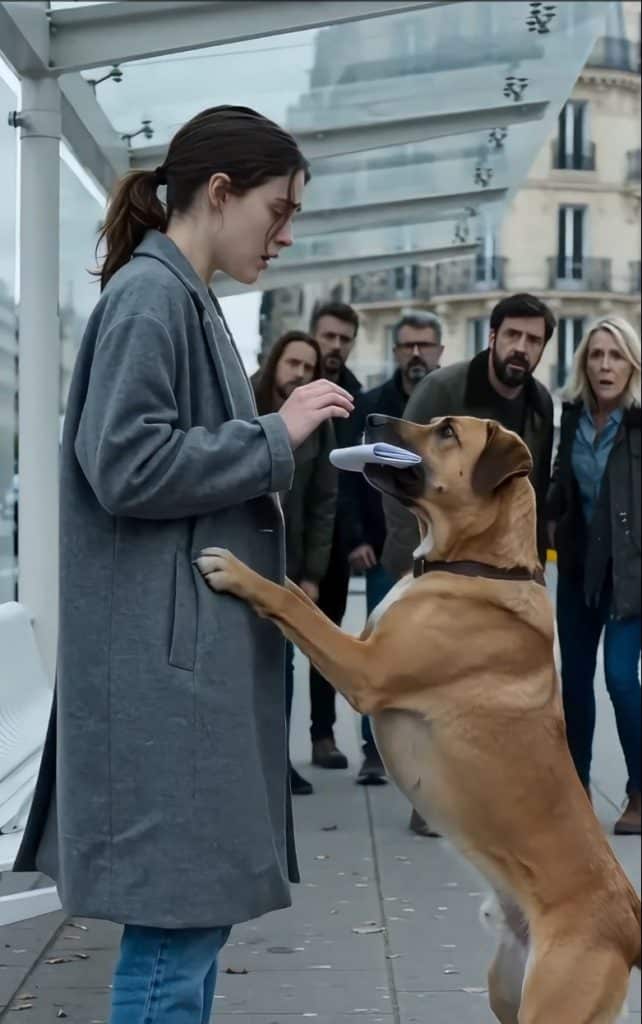
It stood beneath the glass canopy with rain still clinging to its golden-brown fur, its front paws pressed against Mara Ellison’s gray wool coat. Around them, people waiting for the tram had gone strangely quiet.
No one moved.
Not the bearded man in the dark jacket.
Not the blonde woman clutching her bag with both hands.
Not the seated woman on the white bench who had looked up from her phone and forgotten to look down again.
The dog stared at Mara with amber eyes and held the white document gently between its teeth.
Mara looked at it as if it might burn her.
Her hand rose, stopped, and hovered over the folded edge. Loose strands of dark hair stuck to her cheeks. Her eyes were red from a morning spent crying in a records office where a clerk had told her, for the third time that month, that the file she wanted did not exist.
She had been told that sentence her entire life.
No file.
No mother.
No family.
No proof.
Then a dog walked out of the gray afternoon carrying proof in its mouth.
The animal leaned harder against her coat, not begging for food, not asking for shelter. Asking her to take the paper.
Mara’s fingers finally touched the top edge.
The dog released it.
A few people gasped softly.
The document was damp at one corner, marked with a blue official stamp and several lines of blurred black print. Mara unfolded it with shaking hands.
At first, she could not understand what she was seeing.
A hospital seal.
A date.
A birth record.
Then her eyes found the name.
Amélie Vasseur.
Female child.
Mother: Juliette Vasseur.
Mara stopped breathing.
Because Amélie was the name written on the silver bracelet found in the cardboard box where she had been abandoned twenty-four years ago.
The name social workers told her probably meant nothing.
The name every foster family mispronounced.
The name she had buried because wanting it had hurt too much.
The dog whined once.
Mara turned the page.
A handwritten note had been folded inside the certificate.
The ink was shaky but clear.
They told your mother you died.
Mara’s knees weakened.
The crowd seemed to tilt around her.
And at the bottom of the note was one more sentence.
She is still alive.
Act II
Mara had grown up in rooms that were never quite hers.
Temporary bedrooms. Fold-out couches. Bunk beds with other girls’ names scratched into the wood. Plastic bins instead of dressers because no one wanted to unpack a child who might be moved again by Friday.
Her file said she had been found at three weeks old outside a train station, wrapped in a blue blanket and wearing a hospital bracelet with the name Amélie.
No last name.
No parent.
No explanation.
The social worker told her, when she was old enough to ask, that some mothers disappeared because they were scared. Some because they were sick. Some because life had cornered them and they made the only choice they thought they had.
Mara tried to be compassionate.
Then she tried to be angry.
Mostly, she was tired.
By twenty-four, she had become a woman who expected doors to close before she reached them. She worked at a small restoration shop repairing old furniture, piecing broken wood back together with patience she did not always extend to herself.
At night, she searched archives.
Birth registries. Hospital records. Missing person notices. Old newspaper clippings. Any mention of a baby named Amélie.
One name kept appearing at the edges of her search.
Vasseur.
The Vasseurs were old money in the city. Shipping, hotels, art foundations, private clinics, charitable boards. Their name was carved over museum wings and whispered in rooms where people wore watches worth more than Mara’s yearly rent.
Juliette Vasseur had vanished from public life twenty-four years ago.
The official story was brief.
A private health crisis.
A retreat abroad.
No interviews.
No photographs.
No obituary.
Nothing.
Mara did not know why the name pulled at her until she found one grainy gala photo from the year before she was born. Juliette Vasseur stood near a marble staircase, young and unsmiling, one hand resting protectively over a barely visible pregnancy.
The photo vanished from the archive the next day.
That was when Mara knew someone was watching.
She went to the civil records office three times. Each time, the clerk became colder. The last time, a man in a dark suit stepped from a side office and told her she was risking legal trouble by pursuing “fantasies about families she did not belong to.”
His name was Henri Vasseur.
Juliette’s older brother.
He smiled as he said it.
That smile followed Mara into the street.
She had walked to the tram stop afterward with nothing left but humiliation, a dead phone battery, and the terrible feeling that maybe everyone had been right.
Maybe she was building a mother out of coincidence because the alternative was too lonely to survive.
Then the dog came.
And in its mouth was the first document that had ever told her she was not abandoned.
She was stolen.
Act III
The dog sat at Mara’s feet as if it had completed a mission and was waiting for her to understand the rest.
Mara unfolded the remaining papers with trembling fingers.
There was a letter.
Not addressed to Mara.
Addressed to whoever finds the girl.
My name is Renée Laurent. I was a maternity nurse at Saint Orlan Hospital in June of 2000. I am dying, and I have lied long enough.
The cold gray air seemed to vanish around Mara.
The crowd behind her leaned closer.
Renée’s letter continued.
Juliette Vasseur gave birth to a healthy daughter. The child was named Amélie. Juliette’s father and brother did not approve of the baby’s father, a musician named Samuel Ellis. They said the child would destroy the family name and the inheritance structure.
Mara’s hand flew to her mouth.
Ellis.
Her last name.
Not random.
Not given by the state.
Her father’s.
The letter blurred as tears filled her eyes.
I was paid to sign false records. Juliette was told the baby died. Samuel Ellis was told Juliette refused him and left the country. The child was taken from the hospital and later abandoned when the arrangement became too dangerous.
A sound moved through the bystanders.
Not a shout.
Not a gasp.
Something lower.
Collective horror.
Mara kept reading.
Juliette never believed her daughter was dead. She became “difficult.” Her brother used medical contacts to declare her unstable and placed her in Saint Elian Private Care, where she remains under restricted guardianship. She has asked for Amélie every day for twenty-four years.
Mara bent forward as if struck.
The dog pressed its head against her knee.
The final page was different. Neater. More recent.
A copy of a court petition.
Application for emergency review of guardianship: Juliette Vasseur.
Attached evidence: live birth certificate, false death certificate, witness statement, financial motive.
At the bottom was a signature.
Renée Laurent.
And beneath it, in shakier handwriting:
Give this to the girl with Juliette’s eyes. The dog knows her scent from the scarf she left at the records office.
Mara remembered then.
That morning, in the records office, she had removed her scarf while arguing with the clerk. She must have left it on the bench when Henri Vasseur walked in and told her to stop searching.
Someone else had been there.
An old woman in a wheelchair near the corner, half-hidden behind a plant, watching Mara with wet eyes.
Renée.
The dog had been waiting outside.
Mara looked down at him.
“What’s your name?” she whispered.
The dog’s collar had a small scratched tag.
Luc.
On the back was an address.
Saint Elian Private Care.
The bearded man in the crowd suddenly stepped forward.
“I know that place,” he said.
Everyone turned to him.
His face had gone pale.
“My wife worked there,” he said. “She quit because of a woman who kept screaming that her baby was alive.”
Mara stared at him.
The blonde bystander beside him covered her mouth.
The man swallowed.
“She said the woman’s name was Juliette.”
Act IV
Mara did not go to Saint Elian alone.
That was the first miracle.
All her life, she had gone into offices alone. Courtrooms alone. Social service meetings alone. She had learned to carry her evidence in folders and her disappointment in silence.
But when she stepped away from the tram stop that day, the crowd moved with her.
Not all of them.
Enough.
The bearded man, Tomas, called his wife, who still had copies of emails she sent after resigning from Saint Elian. The blonde woman, Claire, turned out to be a local journalist who had been waiting for the tram after an interview nearby. She photographed every document before Mara could think to hide it.
“You need witnesses,” Claire said. “Powerful families love closed rooms.”
Mara looked at the dog.
Luc stayed pressed against her leg.
They called the police.
Then Ruth Calder.
Mara did not know who Ruth was until Tomas explained that she was a retired judge famous for taking guardianship abuse cases no one else wanted.
“She scares men in expensive suits,” he said.
“That sounds useful,” Mara whispered.
By the time they reached Saint Elian, dusk had begun to settle over the city.
The care home stood behind iron gates on a quiet hill, too beautiful to look like a prison. White stone façade. Trimmed hedges. Soft lights glowing behind tall windows.
A receptionist tried to stop them.
Then the journalist began recording.
Then the police arrived.
Then Ruth Calder walked in wearing a black coat and an expression that made the receptionist step backward without being asked.
“We are here to see Juliette Vasseur,” Ruth said.
“She is not receiving visitors,” the receptionist replied.
“She is receiving a court officer, police, a journalist, and possibly her daughter,” Ruth said. “Choose your next sentence carefully.”
They found Juliette in a room overlooking the garden.
She was fifty-two, though grief had made her look older. Her dark hair was streaked with silver. Her hands were thin. A sketchbook lay open on her lap.
Every page held the same face.
A baby.
A child.
A young woman imagined and reimagined through years of not knowing.
When Luc entered, Juliette looked up first at the dog.
Then at Mara.
The room went utterly still.
Juliette’s lips parted.
For a moment, no one breathed.
Then she whispered one word.
“Amélie?”
Mara clutched the birth certificate to her chest.
“I don’t know,” she said, crying now. “I think so.”
Juliette stood too quickly and nearly fell.
Mara crossed the room before anyone could stop her.
They did not embrace at first. They stopped inches apart, both afraid that touching would make the other vanish.
Juliette lifted a trembling hand to Mara’s cheek.
“You have his freckles,” she whispered.
Mara broke.
She folded into her mother’s arms with a sound that seemed to come from the child she had been in every room that was never hers.
Juliette held her as if twenty-four years had been waiting in her bones for that exact weight.
In the hallway, Henri Vasseur arrived with two attorneys and a face carved from rage.
“What is this?” he demanded.
Ruth turned slowly.
“This,” she said, “is the end of your closed room.”
Act V
Henri fought.
Men like him always do.
He claimed Renée was confused. Claimed Mara was a fraud. Claimed Juliette was too fragile to understand what was happening. Claimed the birth record was forged, the letter unreliable, the journalist irresponsible, the witnesses misled.
Then the DNA test came back.
Mara Ellison was Amélie Vasseur.
Daughter of Juliette Vasseur and Samuel Ellis.
Samuel had died five years earlier, never knowing the daughter he had searched for under the wrong story. That grief hit Mara in a delayed wave. She had found a mother and lost a father in the same breath.
Juliette wept over his photograph.
“He wrote songs for you,” she told Mara. “Before you were born. He said babies should have lullabies waiting.”
Henri’s empire did not fall overnight.
It cracked first.
The guardianship was suspended. Juliette was released from Saint Elian and moved into a private apartment with real locks, open windows, and a balcony where Luc slept in the sun. The Vasseur Foundation came under investigation. Hospital records were seized. Saint Orlan’s old maternity files were reopened.
Renée Laurent died before the trial.
But her statement survived.
So did the documents.
So did the crowd from the tram stop.
Tomas testified about his wife’s reports. Claire published the first article with photographs of Luc holding the document beneath the glass canopy. The seated woman from the bench came forward with video of the handoff. The bald man in the crowd admitted he had heard Henri threaten Mara outside the records office days earlier.
A moment that could have vanished into city noise became a public record.
The trial exposed more than one stolen child.
That was the second horror.
The Vasseur network had quietly controlled medical declarations, guardianships, and inheritance disputes for years. Not always with babies. Sometimes with elderly relatives. Sometimes with inconvenient daughters. Sometimes with people whose signatures became useful once their voices were dismissed.
Mara attended every hearing.
Not because it was easy.
Because absence had already cost her enough.
Juliette sat beside her, one hand holding Mara’s, the other resting on Luc’s head. The dog had become famous by then, though he seemed unimpressed by it. He still preferred bread crusts, garden naps, and pressing his nose into Mara’s coat pocket whenever she cried.
Henri was convicted on charges tied to fraud, unlawful confinement, falsified records, and conspiracy. Others fell with him. Doctors. Administrators. Lawyers who had turned paperwork into a weapon and called it procedure.
When the verdict came, Juliette did not cheer.
Mara did not either.
Justice, they learned, was not the opposite of grief.
It was only a door grief could walk through without being shoved back into silence.
Months later, Mara returned to the transit stop.
The canopy looked ordinary again. People hurried beneath it with bags, coffees, headphones, strollers, umbrellas. The benches were full. The city moved on because cities always do.
Mara stood near the place where Luc had first risen on his hind legs and pressed the document into her coat.
Juliette stood beside her.
She looked nervous in public, but free. Her hair was shorter now. Her cheeks had color. Around her neck, she wore the baby bracelet Mara had kept all her life, the one with Amélie written in faded letters.
Luc sat between them, calm and watchful.
Claire arrived with a photographer, but Mara asked for no ceremony.
Just a small plaque fixed to one of the white metal beams.
It read:
For the truth that finds us in public places,
and for the witnesses who do not look away.
Juliette touched the words.
“I missed everything,” she whispered.
Mara looked at her mother.
Not the imagined mother of childhood fantasies.
The real one.
Wounded. Stolen from. Still learning how to laugh without apology.
“No,” Mara said softly. “You waited.”
Juliette’s eyes filled.
“I didn’t know where you were.”
“I know.”
“I called for you.”
“I know.”
“I thought I had failed you.”
Mara took her hand.
“You survived long enough for me to find out I was loved.”
That was when Juliette cried.
Luc leaned against both of them, as if annoyed by human sadness but willing to supervise.
The tram arrived with a sigh of brakes.
Doors opened. People stepped off. People stepped on. Lives crossed for seconds and separated again.
Mara looked at the city street, the gray pavement, the cream-colored buildings, the ordinary crowd under the ordinary sky.
For most of her life, she had thought truth would arrive like lightning.
Loud.
Bright.
Impossible to miss.
Instead, it had come gently, held in the mouth of a dog who refused to drop it until the right woman finally reached out her hand.
Mara bent and kissed Luc’s head.
“Good boy,” she whispered.
He wagged his tail once, as if that had been obvious all along.
Then Mara boarded the tram with her mother beside her, carrying the name that had been stolen from her and the life that was finally allowed to begin.