Act I
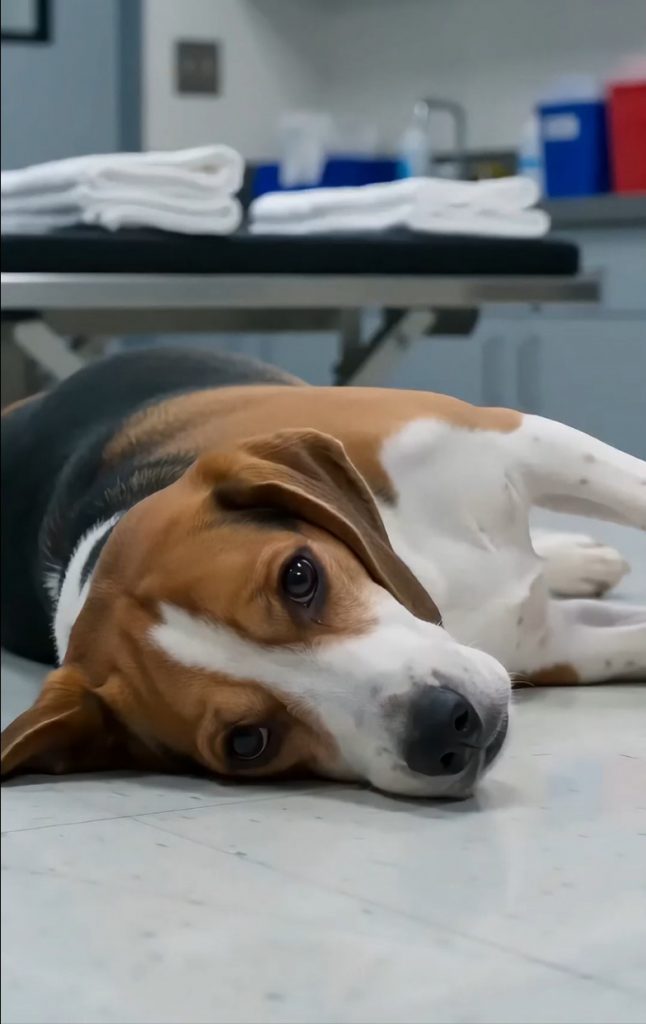
The beagle would not stop crying.
It lay on its side on the cold white tile, too weak to lift its head, its sad brown eyes fixed on the woman standing above him in a hospital gown. Every whimper seemed to pull the air from the room.
The clinic was too bright for that kind of grief.
White cabinets. Chrome handles. Folded towels on a black exam table. Blue and red supply bins lined neatly along the counter, as if order could make fear less real.
Clara Wren stood barefoot in the middle of it all, her light-brown hair tangled over her shoulders, the patterned hospital gown hanging loosely from her frame. Her eyes were swollen from crying. A plastic medical bracelet still circled her wrist.
She had run from the hospital next door the moment they told her the dog had been found.
“Milo,” she whispered.
The beagle’s tail twitched once.
That broke her.
She covered her mouth with both hands as Dr. Harold Meade knelt beside the dog. He was a calm man, old enough to have seen panicked owners, injured animals, and miracles that came too late. But even he looked unsettled.
“There’s something here,” he said.
Clara froze.
His gloved fingers moved gently along the beagle’s side, stopping near a raised fold beneath the white fur of Milo’s abdomen. The dog whimpered again, but did not bite. He only looked at Clara, as if asking her to understand before it was too late.
Dr. Meade leaned closer.
“What is that?” Clara asked, her voice thin.
The vet did not answer.
With careful fingers, he parted the small fold of skin and fur. Something bright caught the clinical light.
A silver ring.
Perfectly hidden.
Perfectly polished.
Impossible.
Dr. Meade jerked back, eyes wide behind his glasses.
Clara stared at the glinting band, and the room tilted beneath her.
Because she knew that ring.
She had placed it on her husband’s finger three years earlier under an arch of white roses, laughing because her hands were shaking so badly he had to help her slide it over his knuckle.
The ring had disappeared the night Daniel Wren vanished.
Police said he took it off before leaving her.
His family said it proved he wanted out.
Clara had believed none of them.
Now Daniel’s wedding band was hidden against the body of the dog that had also disappeared that night.
Clara stepped backward, one hand pressed to her chest.
Dr. Meade looked at her.
“Mrs. Wren?”
She could barely speak.
“That’s my husband’s ring.”
Milo whimpered again.
And for the first time in fourteen months, Clara understood that Daniel had not abandoned her.
He had sent the only witness home.
Act II
Before the hospital gown, before the missing husband, before the sleepless nights when everyone told Clara grief had turned into obsession, there had been a small yellow house at the edge of town and a beagle who stole socks.
Milo had belonged to Daniel first.
He found the dog behind an auto shop during a rainstorm, muddy, hungry, and stubborn enough to bark at the tow truck driver trying to rescue him. Daniel brought him home wrapped in his jacket and announced to Clara that the dog was “temporary.”
Milo chewed three shoes, escaped twice, and fell asleep on Clara’s pillow by the end of the week.
Temporary became family.
Daniel was a public records attorney, which sounded dull until Clara learned what he really did. He helped people fight quiet abuses. Wrongful evictions. hidden hospital bills. forged elder-care contracts. Cases that never made headlines because the people harmed by them rarely had enough money to make anyone nervous.
Then came the Marlow Foundation.
It ran two private hospitals, a senior care network, and a charity program praised at every gala in the county. Daniel spent six months digging through complaints from families who said medical decisions had been made without consent, estates had been redirected, and vulnerable patients had been pressured into signing documents they did not understand.
Clara begged him to be careful.
Daniel would kiss her forehead and say, “Careful is not the same as quiet.”
One week before he vanished, he came home different.
He locked his office door for the first time in their marriage. He stopped answering unknown numbers. He took Milo on long walks at odd hours. Once, Clara woke at 2 a.m. and found him at the kitchen table, turning his wedding ring slowly between his fingers.
“What’s wrong?” she asked.
He smiled too quickly.
“Nothing.”
“Daniel.”
He looked at her then, and the lie disappeared.
“If anything happens,” he said, “trust Milo.”
She almost laughed because it sounded absurd.
“What does that mean?”
Daniel only shook his head.
“I hope it never has to mean anything.”
The next night, he did not come home.
Milo was gone too.
Police found Daniel’s car near the river. His laptop was missing. His phone was dead. There were no signs of struggle, no body, no proof of anything except absence.
Then Daniel’s brother, Victor, arrived.
Victor Wren had never liked Clara. He called her sentimental, dramatic, too emotional for a man like Daniel. He stood in her living room two days after the disappearance and told her she needed to accept the truth.
“My brother left,” he said.
Clara stared at him.
“Daniel would never leave Milo.”
Victor’s face tightened.
“Maybe he took the dog because he loved it more than this marriage.”
That was the first time Clara slapped him.
After that, the story formed around her like a cage.
Daniel had been stressed.
Daniel had debts.
Daniel had been unhappy.
Daniel had removed his wedding ring.
People preferred that version because it was clean. A missing man becomes less frightening if everyone agrees he chose to disappear.
Clara never agreed.
For fourteen months, she searched until exhaustion became illness. She stopped sleeping. Stopped eating properly. Walked the river paths with Daniel’s photo until strangers avoided her eyes.
Two days before Milo was found, Clara collapsed outside the courthouse where Daniel’s final case files had been sealed by court order.
The hospital called it stress.
Victor called it proof.
Clara called it not finished.
Then a clinic assistant ran into her hospital room and said a beagle had been brought in from the highway.
Older. Weak. Wearing no collar.
But responding to the name Milo.
Clara pulled out her IV line and ran.
Act III
Dr. Meade did not remove the ring immediately.
He understood, before Clara did, that it was no longer just jewelry.
It was evidence.
He stabilized Milo first. Warm fluids. Pain relief. Gentle hands. A technician brought blankets while Clara sat on the floor beside the dog, still wearing the hospital gown, whispering apologies into his soft ear.
“I looked everywhere,” she cried. “I’m sorry. I’m so sorry.”
Milo’s eyes closed under her touch.
Dr. Meade called the police.
Clara called Daniel’s old partner, Ruth Ellison.
Ruth arrived in twenty minutes wearing a black coat over court clothes, her silver hair pinned tight and rain on her shoulders. She had worked beside Daniel for years and had been the only person who never told Clara to move on.
When she saw the ring, her face changed.
Not shock.
Recognition.
“Daniel told me he had a backup,” Ruth whispered.
Clara looked up.
“What?”
Ruth swallowed.
“He said if the files disappeared, the proof would come home on four legs.”
Dr. Meade looked between them.
“There’s more,” he said.
He pointed to the inner edge of the ring. Under magnification, faint markings appeared inside the band. Not only the engraving Clara remembered.
D + C. Always.
Beside it was a tiny sequence of numbers.
10-10.
Clara frowned through tears.
“Our anniversary.”
Ruth’s eyes sharpened.
“No. Drawer ten. Box ten.”
Clara’s breath caught.
Daniel had rented an old safe deposit box years earlier when they first married. It was a joke at the time. Box 10. Drawer 10. He said it sounded like a spy movie.
Clara had forgotten.
Daniel had not.
The police officer who arrived was young, polite, and visibly uncertain. He asked whether Clara was sure the ring belonged to Daniel. Whether Milo could have picked it up somewhere. Whether memory under stress could be unreliable.
Ruth’s voice turned cold.
“Officer, this woman has been called unreliable for over a year. Choose your next question carefully.”
He did.
By evening, they had a warrant for the safe deposit box.
Inside was a waterproof envelope.
Inside the envelope was a flash drive, Daniel’s handwritten affidavit, and a letter addressed to Clara.
She read it in the bank’s private room while Ruth sat beside her.
My Clara,
If you are reading this, I failed to come home before they reached me.
I did not leave you.
I did not stop loving you.
And I did not take off my ring because our marriage was over. I took it off because Milo was the only one they would not search.
Clara pressed the paper to her mouth.
Ruth placed a hand on her shoulder.
The letter continued.
Victor is involved. So is Dr. Marlow. The foundation is not only stealing estates. They are using guardianship petitions to take control of patients, then moving assets through shell charities. I have records. Names. payments. death reviews. They will try to make me look unstable or corrupt. They will try to make you look worse.
Trust Ruth.
Trust Milo.
Do not trust my brother.
Clara’s tears hit the page.
For fourteen months, everyone had asked her to accept a lie because it was easier than believing a man could be erased by people with money, signatures, and patience.
But Daniel had left her a map.
And Milo had carried the key.
Act IV
Victor Wren arrived at the clinic before the police finished reviewing the files.
No one had called him.
That was how Clara knew Ruth was right.
He came in wearing a camel coat and a face arranged into concern, the same performance he had used at Daniel’s memorial service, though there had been no body to bury.
“Clara,” he said gently. “You should be in the hospital.”
She stood in the waiting room, now dressed in clothes Ruth had brought her, Daniel’s ring sealed in an evidence bag on the counter behind Dr. Meade.
Milo slept in the treatment room.
Clara did not move toward Victor.
“How did you know I was here?”
His expression flickered.
“Small town.”
“Not that small.”
Ruth stepped out from the hall.
Victor’s jaw tightened.
“Ruth.”
“Victor.”
He looked at the police officer, then at Dr. Meade, then at the sealed bag.
For one fraction of a second, he stopped pretending.
His eyes went to the ring.
Clara saw fear.
Not grief.
Fear.
“You found something,” he said.
Ruth folded her arms.
“Daniel found it first.”
Victor exhaled through his nose.
“My brother was paranoid.”
“No,” Clara said. “He was right.”
Victor looked at her with pity so rehearsed it made her sick.
“You’re not well.”
For months, that sentence had weakened her.
Now it did nothing.
Clara stepped closer.
“You told everyone Daniel left me because of that ring. You said he took it off because he wanted out.”
Victor’s voice hardened.
“He was my brother. I knew him better than you did.”
“No,” Clara said softly. “You knew where to hit.”
The clinic door opened again.
This time, two detectives entered with Ruth’s associate and a representative from the attorney general’s office. Behind them came a woman Clara did not recognize, older, pale, clutching a folder to her chest.
Ruth leaned toward Clara.
“That’s Nora Bell. Her mother was one of Daniel’s clients.”
Nora Bell’s mother had been declared incompetent after a brief hospital stay at Marlow Medical. Her house was sold. Her accounts were emptied through a charity fund. Nora had been told the paperwork was legal, compassionate, final.
Daniel had believed otherwise.
Now his files proved it.
And not only for Nora.
For eighteen families.
Victor had helped move the assets through real estate accounts. Dr. Marlow had supplied medical declarations. Foundation administrators had buried complaints. Judges had trusted paperwork that looked official because nobody wanted to imagine signatures could become weapons.
Victor backed toward the door.
The detective spoke his name.
He stopped.
“I want an attorney.”
Ruth smiled without warmth.
“Daniel assumed you would.”
The flash drive contained more than documents.
It held one video.
Daniel had recorded it the night before he vanished. He stood in his office, tired and unshaven, Milo visible in the background asleep on a chair.
“If this is being played,” he said, “then my brother is probably still pretending to grieve me.”
Clara sobbed once at the sound of his voice.
Victor stared at the floor.
Daniel continued on-screen.
“Victor, I gave you chances. I know you told yourself you were only moving money. Only signing what smarter men asked you to sign. But you knew what happened to those families. You knew what Marlow was doing. And if I disappear, my wife will find this.”
Daniel looked into the camera then.
Not at Victor.
At Clara.
“I’m sorry I couldn’t tell you everything. I was trying to keep you safe. I was wrong to carry it alone.”
The video ended.
Victor was arrested before Milo woke up.
And when Clara finally slipped Daniel’s ring onto a chain around her neck, she did not feel closure.
She felt the first clean breath after drowning.
Act V
They found Daniel three weeks later.
Not alive.
Clara had known, deep down, before anyone told her. Hope can survive almost anything, but it changes shape when truth gets close.
The detectives recovered enough from the foundation’s hidden records to locate where Victor’s hired men had left Daniel after a staged accident outside the county. The details were handled gently. Clara asked only what she needed to know.
Had he suffered long?
No one answered quickly enough.
So she stopped asking.
At the memorial, Milo sat beside her feet wearing a blue collar and a small silver tag shaped like a heart. He was still thin. Still recovering. But when the church doors opened and sunlight crossed the aisle, he lifted his head as if expecting Daniel to walk in late with an apology and a bad joke.
Clara placed one hand on his back.
“I know,” she whispered.
Ruth gave the eulogy.
She did not call Daniel perfect. He would have hated that. She called him stubborn, brilliant, impossible to intimidate, terrible at organizing paper files, and brave in the way that mattered most.
“He believed vulnerable people are not weak,” Ruth said. “They are targeted. And when a system targets them, someone has to target the system back.”
Clara cried quietly.
Nora Bell sat in the front row.
So did other families Daniel had tried to help. Some held photographs. Some held old legal folders. Some simply held hands because the story that had taken their dignity was finally being told with names attached.
The prosecutions took months.
Dr. Marlow resigned first, then was indicted. Victor pleaded not guilty until the financial records made pretending too expensive. The foundation collapsed under investigation, its charity plaques removed from hospital walls one by one.
The families recovered some money.
Not all.
Never all.
But enough to prove the theft had been theft, not paperwork, not confusion, not the acceptable cost of being old, sick, poor, or alone.
Clara sued too.
Not for revenge, though people called it that.
For record.
For the legal sentence Daniel had tried to write with his life.
My husband did not leave. He was silenced because he found the truth.
Milo became famous in the way animals sometimes do when humans need a pure heart to make unbearable things easier to understand. Reporters called him the dog who carried a dead man’s secret. A television producer offered Clara money for an interview. She refused.
Milo did not carry a secret.
He carried love.
That was different.
A year after the ring was found, Clara returned to Dr. Meade’s clinic.
This time she wore a green dress, not a hospital gown. Her hair was brushed. Her eyes still carried grief, but it no longer looked like a room she was trapped inside.
Milo trotted beside her, tail wagging, though he stopped at the tile floor and looked suspiciously toward the exam room.
Dr. Meade laughed softly.
“I don’t blame you, buddy.”
Clara smiled.
She had brought something for the clinic wall.
A small framed photograph of Daniel and Milo on the porch of the yellow house, Daniel laughing while Milo stole one of his socks.
Beneath it was a plaque.
For the animals who cannot speak,
and the people who finally listen.
Dr. Meade read it twice.
Then he removed his glasses.
“I almost missed it,” he said.
Clara shook her head.
“But you didn’t.”
He looked down at Milo.
“No,” he said. “He made sure I couldn’t.”
After the clinic visit, Clara drove to the river path where Daniel’s car had been found. For a long time, she had hated that place. It had been the beginning of everyone else’s lie.
Now she walked it with Milo under a pale afternoon sky.
At the bend near the water, she knelt and took Daniel’s ring from beneath her collar. The silver band caught the light, polished again, the engraving clear.
D + C. Always.
She did not throw it into the river.
That would have been dramatic.
Daniel had liked useful things more than dramatic ones.
So she held it, kissed it once, and placed it back against her heart.
Milo leaned into her side.
Clara looked down at him.
“You brought him back,” she said.
The beagle wagged his tail.
Not understanding the sentence.
Understanding her voice.
That was enough.
Life did not become simple after truth.
The house was still too quiet. The bed still too wide. Some mornings Clara reached for Daniel before waking fully and had to lose him again in the space between sleep and daylight.
But there were also good days.
Days when Milo barked at squirrels with renewed outrage. Days when Ruth called about a family whose stolen home had been returned. Days when Clara opened Daniel’s old files and continued the work, not because she owed grief productivity, but because love had left her tools.
On the anniversary of Daniel’s disappearance, Clara hosted dinner.
Not a memorial.
A dinner.
Ruth came. Dr. Meade came. Nora Bell came with her mother, who had gotten her house back. People brought food and stories and awkward laughter. Milo moved from guest to guest like a host inspecting emotional stability.
At the end of the night, Clara stood in the kitchen alone for a moment.
Daniel’s photograph sat on the windowsill.
His ring rested warm against her chest.
Milo slept at her feet.
For fourteen months, people had told her to let the dead rest.
Now she understood.
The dead do not rest inside lies.
They rest when the truth is carried home, even if it comes limping, whimpering, and hidden beneath the fur of a faithful dog who never forgot the way back.