Act I
The front door did not open.
It exploded inward.
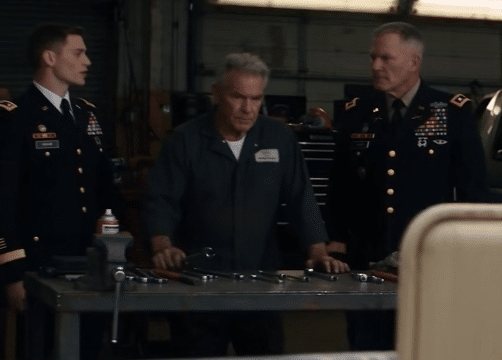
Ethan Wilson came through it still wearing his Army uniform, his duffel bag sliding from his shoulder and hitting the hallway floor with a heavy thud. He had expected silence. Maybe the faint smell of coffee. Maybe his wife asleep on the couch with one hand resting on the small, round curve of her belly.
Instead, he heard screaming from the kitchen.
Not anger.
Fear.
Ethan moved before he understood what he was seeing.
The kitchen lights were bright enough to make everything look unreal. White cabinets. Marble island. Stainless steel refrigerator. A stack of papers spread across the counter like some ordinary family document waiting for a signature.
But nothing about the room was ordinary.
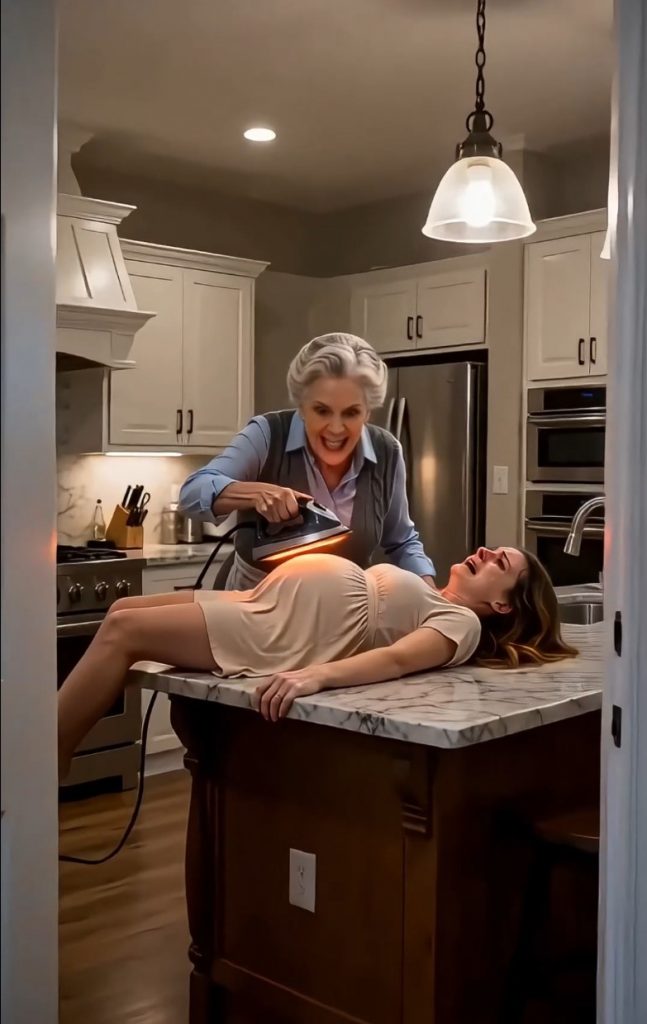
His wife, Lily, was lying back across the marble island, one hand gripping the edge so hard her knuckles had gone white. Her beige maternity dress was wrinkled beneath her. Her face was wet with tears and sweat.
And standing over her was Ethan’s mother.
Margaret Wilson held a hot iron in one hand, its red glow casting a cruel light across her face.
“Sign them,” Margaret hissed. “Sign these and walk away.”
Ethan’s heart stopped.
For one impossible second, he was a boy again, standing in his mother’s spotless kitchen, watching her smile at neighbors while crushing everyone inside the house with her rules.
Then Lily saw him.
“Ethan,” she sobbed.
Margaret turned.
The wicked certainty on her face cracked, but only for a moment. Then she smiled, quick and sharp, as if she could still control the room if she found the right tone.
“You’re home early,” she said.
Ethan stepped into the kitchen slowly.
“Put it down.”
Margaret laughed.
“It’s not what it looks like.”
Lily shook her head, trembling. “She made me lie down. She said if I didn’t sign—”
“Quiet,” Margaret snapped.
That single word changed Ethan’s face.
He had heard commanders shout. He had heard men lose control under pressure. He had seen fear wear many masks.
But this was his wife.
This was his child.
His hand moved to the holstered sidearm at his hip. He drew it only because the threat was still in Margaret’s hand and Lily was trapped beneath it.
“Drop it,” he ordered, his voice cutting through the kitchen. “Now.”
Margaret’s smile twitched.
“Don’t be dramatic, Ethan.”
He did not blink.
“The joke is over,” he said. “You’re going to jail.”
For the first time in his life, Margaret Wilson looked at her son and realized he was no longer a child she could frighten into obedience.
But the papers on the island were the real weapon.
And Ethan had not yet seen whose name was written at the bottom.
Act II
Lily had never been enough for Margaret Wilson.
Not on the first day.
Not on the wedding day.
Not even after the pregnancy test turned positive and Ethan cried so hard he had to sit down on the bathroom floor.
Margaret had smiled when they told her about the baby. She had touched Lily’s stomach with cold fingers and said, “Well, let’s hope she inherits the Wilson strength.”
Lily remembered the word she.
Not the joy of it.
The claim.
From the beginning, Margaret acted as if the baby belonged to the Wilson family, while Lily was only the temporary inconvenience carrying her.
Ethan did not see it clearly at first.
He loved his mother in the complicated way children often love difficult parents. He knew she was controlling. He knew she could be cruel. But he had spent his life translating her behavior into softer language.
She worries.
She means well.
She has been alone a long time.
Lily tried to believe that too.
She tried through the wedding, when Margaret changed the seating chart without asking.
She tried when Margaret criticized her dress, her cooking, her apartment, her job at the library.
She tried when Margaret called her “sensitive” every time she reacted to an insult.
Then Ethan deployed for six months, and Margaret stopped pretending.
At first, she came over to “help.”
She organized the pantry. She moved furniture. She threw away Lily’s old college mugs because they were chipped. She told Lily that pregnancy made women irrational and that Ethan needed a calm home, not drama waiting for him when he returned.
Then the visits became inspections.
Margaret checked the refrigerator. The laundry. The bills. The nursery.
One afternoon, Lily came home from a doctor’s appointment and found Margaret standing in the half-painted baby room with a folder in her hand.
“I noticed your name is still on the house paperwork,” Margaret said.
Lily frowned. “Because it’s our house.”
Margaret smiled.
“Yes. For now.”
That was when the papers began.
At first, they were framed as practical things. Military benefits. Emergency planning. Financial organization before the baby arrived.
“Ethan is in a dangerous job,” Margaret said. “Responsible wives prepare.”
Lily refused to sign anything without Ethan.
Margaret’s face hardened.
“You’re selfish,” she said. “You want access to everything my son built, don’t you?”
That accusation followed Lily through the next three months.
Greedy.
Unstable.
Dependent.
A burden.
An anchor.
Margaret said the words so often Lily began hearing them even when the house was silent.
But the worst part was that Margaret seemed to know things she should not have known.
She knew when Ethan called.
She knew when Lily cried afterward.
She knew which doctor Lily saw.
She knew the password to the family email account, because Ethan had given it to her years earlier and forgotten. Through it, Margaret read everything she could.
Then she began deleting messages.
Lily would send Ethan long updates about the baby kicking, about swollen ankles, about being lonely in the house.
Ethan would reply with one-line answers that sounded strangely cold.
Take care of it.
I can’t deal with this right now.
Ask Mom.
Lily did not know Margaret had been answering from his account.
Ethan did not know Lily’s messages had stopped reaching him.
By the time he came home early, Lily had spent weeks believing her husband was tired of her.
That morning, Margaret arrived with a lawyer’s envelope and no warning.
“You’re going to sign today,” she said.
Lily backed away from the kitchen island. “I told you, I’m not signing anything until Ethan comes home.”
Margaret placed the documents on the marble.
“He is coming home to a clean life. Not to you.”
The first page said separation agreement.
The second transferred Lily’s share of the house into a trust controlled by Margaret.
The third gave Margaret emergency authority over the baby’s care if Lily was deemed “medically or emotionally unfit.”
Lily stared at the pages until the words blurred.
“You can’t do this.”
Margaret plugged in the iron.
The sound of it heating filled the kitchen.
And outside, unknown to both women, Ethan’s rideshare had just pulled into the driveway two days ahead of schedule.
Act III
Ethan did not lower his weapon until Lily was off the island and behind him.
Even then, his eyes stayed on Margaret.
The iron lay on the floor where she had dropped it, unplugged now, its heat fading against the tile. The papers remained spread across the marble, corners fluttering slightly from the air conditioning.
Lily clung to Ethan’s arm with one hand and held her belly with the other.
“I’m sorry,” she whispered.
Ethan looked at her like the words hurt him.
“For what?”
“For everything. For not handling it. For making you come home to this.”
His expression broke.
Then hardened again.
He took his phone from his pocket and called 911.
Margaret’s face changed instantly.
“Ethan,” she said softly. “Honey, don’t humiliate this family.”
He laughed once, but there was no humor in it.
“This family?”
“I lost my temper,” she said. “That’s all. She has been difficult for months. Hormonal. Paranoid. You know how women can get when they’re pregnant.”
Lily lowered her eyes automatically.
Ethan noticed.
And suddenly dozens of small memories rearranged themselves in his mind.
Lily’s shorter calls.
Her tired voice.
The way she stopped sending photos of the nursery.
The strange messages from his own email that he did not remember writing when he checked them later.
His mother telling him Lily was overwhelmed, Lily was needy, Lily was becoming unstable.
His mother offering to “manage the household” until he returned.
Ethan stepped toward the island and picked up the first document.
Margaret moved quickly. “You don’t need to read that.”
He read it anyway.
Then another.
Then another.
With every page, the kitchen seemed to grow colder.
“You were trying to take the house from her,” he said.
“I was protecting you.”
“You were trying to take our baby.”
Margaret’s eyes flashed. “Your baby. A Wilson baby. Do you think I was going to let that girl raise my granddaughter to be weak?”
Lily made a small wounded sound.
Ethan turned fully toward his mother.
“That girl is my wife.”
Margaret’s jaw tightened.
“She trapped you.”
“No,” Ethan said. “You did.”
For the first time, the room went silent.
Margaret stared at him as if he had spoken a language she refused to learn.
Ethan picked up the last page.
It was not a legal form.
It was a letter.
Printed. Unsigned. Written as if from Lily to Ethan.
I can’t be a military wife anymore. I don’t want this baby tied to your family. Your mother will know what to do.
Ethan looked up slowly.
Lily stared at the letter, horrified.
“I didn’t write that.”
“I know,” Ethan said.
Margaret’s mouth tightened.
“It was a draft,” she said. “A possible explanation. People need explanations when marriages fail.”
Ethan’s voice dropped.
“You planned to make it look like she left.”
Margaret said nothing.
That silence told him enough.
Then Lily whispered, “There’s more.”
Ethan turned.
Her hands shook as she pointed toward the wooden cabinet beside the refrigerator.
“She keeps a blue folder in there. She said if I went to the police, she would show everyone proof I was unstable.”
Ethan opened the cabinet.
Behind cleaning supplies and neatly stacked dish towels was a folder with Lily’s name written on the tab.
Inside were printed screenshots, medical appointment notes, private emails, photographs of Lily crying through the kitchen window, and a fake psychiatric evaluation form that had never been completed by any real doctor.
At the bottom was a copy of Ethan’s deployment schedule.
Marked in red.
Lily covered her mouth.
Ethan looked at his mother, and the last softness in him disappeared.
“You didn’t snap today,” he said. “You prepared.”
Margaret lifted her chin.
“A good mother prepares for threats to her son.”
The sirens began in the distance.
Margaret’s face finally showed fear.
But not remorse.
And that was when Ethan understood this had never started with Lily.
Act IV
The police arrived to a kitchen that looked too clean for the truth it held.
That bothered Ethan most.
The white cabinets. The shining marble. The neat stack of forged documents. The iron cooling on the floor.
A stranger walking in five minutes earlier might have seen a wealthy suburban home and an overbearing mother who had lost control during an argument.
But the evidence told a different story.
Lily gave her statement wrapped in Ethan’s field jacket, sitting at the breakfast nook while a paramedic checked her and the baby. Her voice shook, but she spoke. Every threat. Every deleted message. Every document Margaret had tried to force her to sign.
Ethan stood nearby, close enough for Lily to see him, far enough not to speak over her.
Margaret tried three different versions of the story before the officers finished the first round of questions.
First, it was a joke.
Then, it was a misunderstanding.
Then, it was Lily’s fault.
“She is unstable,” Margaret insisted. “Ask anyone. She cries constantly. She forgets things. She manipulates my son with the pregnancy.”
One officer held up the forged letter.
“Did she manipulate you into typing this?”
Margaret went still.
The officer turned the page.
“Or this transfer document?”
No answer.
“And this evaluation form from a clinic that says they have no record of treating her?”
Margaret’s lips pressed into a thin line.
The room watched the mask slip.
Not all at once.
People like Margaret did not collapse easily. They adjusted. They recalculated. They searched for someone weak enough to believe them.
So she turned to Ethan.
“You are making a mistake,” she said. “Blood matters.”
Ethan looked at Lily, then at the paramedic listening to the baby’s heartbeat.
A small, fast rhythm filled the kitchen.
Alive.
Steady.
Real.
He looked back at Margaret.
“Yes,” he said. “It does.”
For one flicker of a second, Margaret thought she had won something.
Then he continued.
“That’s why I’m protecting my daughter from you.”
The officer stepped forward.
Margaret’s face twisted. “Ethan.”
He did not answer.
When they took her out, she did not cry. She did not apologize. She walked stiffly, pearl earrings flashing under the kitchen lights, still trying to look dignified while the truth followed her in evidence bags.
At the door, she turned one last time.
“She will ruin you,” Margaret said.
Ethan stood beside his wife.
“No,” he said. “You almost did.”
The door closed behind her.
Only then did Lily break.
Ethan caught her before she could sink to the floor. He held her carefully, one hand at the back of her head, the other around her shoulders, as if he was afraid she might vanish if he held too tightly.
“I thought you didn’t believe me,” she sobbed.
“I didn’t know,” he said, voice rough. “But I should have seen it.”
Lily shook her head against his chest.
“She made me think I was losing everything.”
Ethan closed his eyes.
For years, he had believed surviving his childhood meant leaving his mother’s house.
Now he understood something worse.
He had left the house, but he had never fully questioned the rules she built inside him. The loyalty. The silence. The instinct to explain away cruelty when it came from family.
That ended in the kitchen.
But the real war started after Margaret was gone.
Act V
The baby was born six weeks later.
A girl.
Small, furious, perfect.
They named her Grace, not because the months before her birth had been gentle, but because she arrived anyway. Because her heartbeat had filled that kitchen when everything else felt broken. Because Lily cried when the nurse placed her daughter in her arms and whispered, “She’s here,” as if she had been afraid to believe it until that exact second.
Ethan stood beside the hospital bed, one hand covering his mouth.
He had seen strong men fall silent before.
But nothing had ever humbled him like his daughter opening her eyes.
Lily looked up at him.
“She has your frown,” she said.
Ethan laughed through tears. “Poor kid.”
For a while, that tiny hospital room became the safest place in the world.
No marble island.
No papers.
No threats dressed up as love.
Just Lily, Ethan, and Grace beneath soft white blankets while morning light moved slowly across the wall.
Margaret was not there.
She had tried to be.
Through an attorney, she requested contact. Through relatives, she sent messages. Through old family friends, she framed herself as a heartbroken grandmother punished for “one mistake.”
But one mistake did not create forged documents.
One mistake did not build a folder full of surveillance, lies, and stolen emails.
One mistake did not heat an iron and call it discipline.
The case moved forward.
Not quickly. Not cleanly. But steadily.
Investigators found that Margaret had accessed Ethan’s email for months. She had intercepted messages, forged replies, and contacted a shady document preparer to draft papers Lily never agreed to sign. The fake medical form became the detail that turned sympathy away from Margaret for good.
Even the relatives who first defended her grew quiet.
Because cruelty can hide behind family loyalty only until someone lays the paperwork on the table.
Ethan gave his statement. Lily gave hers. Their attorney filed for a permanent protective order. The house locks were changed. The email accounts were secured. The old family group chat, once Margaret’s favorite stage, went silent after Ethan sent one message.
My wife and daughter are my family. Anyone who helps my mother reach them loses access to us.
He did not explain further.
He did not negotiate.
That was new for him.
Lily noticed.
Healing did not look dramatic most days. It looked like Ethan waking for night feedings without being asked. It looked like Lily leaving her phone unlocked on the table because she no longer feared someone reading her fear and using it against her. It looked like counseling appointments, hard conversations, apologies that did not demand forgiveness, and quiet mornings where Grace slept against Ethan’s chest while coffee cooled on the counter.
Still, the kitchen remained hard.
For months, Lily avoided the marble island.
She cooked at the stove and ate in the living room. She placed flowers on the counter once, then moved them after ten minutes. Ethan offered to sell the house, but Lily said no.
“I don’t want her to decide where we can live,” she said.
So they changed the room instead.
The marble island was removed.
Not because stone could be guilty, but because memory needed somewhere to go.
In its place, they installed a warm wooden table with rounded edges, big enough for family dinners, homework, birthday cakes, and Grace’s tiny hands smacking mashed bananas across the surface.
White cabinets became pale green.
The harsh lights were replaced with softer ones.
The cabinet where Margaret had hidden the folder was emptied and turned into a shelf for baby bottles, cookbooks, and a little framed ultrasound photo.
The first night they ate there, Lily made pasta.
Nothing fancy.
Just pasta, salad, and bread slightly too crisp at the edges because Grace started crying halfway through.
Ethan looked at the bread and smiled.
“Perfect,” he said.
Lily raised an eyebrow. “It’s burnt.”
“No,” he said gently. “It’s dinner.”
That was when Lily began to cry.
Not from fear.
From the sudden, aching realization that the room had changed because they had changed it. That safety could be built in the exact place where terror once stood. That love, real love, did not demand signatures under threat. It did not call control protection. It did not make a woman prove she deserved kindness.
Months later, Margaret’s trial began.
She arrived in court with styled grey hair and a pale blue blouse, looking every inch the respectable grandmother she wanted strangers to see. But Lily was no longer the shaking woman on the island.
She walked in holding Ethan’s hand.
Grace was safe with a friend outside the courthouse.
When Lily testified, Margaret stared at her with the same cold hatred she had worn in the kitchen. But the look did not work anymore.
Lily told the truth.
Clearly.
Steadily.
When the prosecutor showed the forged documents, the jury leaned forward. When the email records were displayed, Margaret looked down. When the fake letter appeared on the screen, Ethan closed his eyes.
Then came the photograph of the iron on the kitchen floor.
No one needed graphic details.
The threat was enough.
Margaret was convicted on multiple charges. The sentence did not give Lily back the months of fear. It did not erase what Ethan had failed to see soon enough. It did not make Grace’s first home untouched by shadows.
But it did something.
It named the truth.
And sometimes, after years of manipulation, naming the truth is the first real justice.
On Grace’s first birthday, the house was full of sunlight.
Balloons bobbed near the ceiling. A crooked pink cake sat on the new wooden table. Lily wore a yellow dress. Ethan wore jeans and a shirt Grace had already smeared with frosting.
Friends filled the kitchen, laughing too loudly, passing plates, stepping over toys.
At one point, Lily stood by the refrigerator and watched Ethan hold Grace above the cake while everyone sang. Grace stared at the candle with serious suspicion, then grabbed a fistful of frosting instead.
The room erupted in laughter.
Ethan looked over at Lily.
Across the kitchen, over the table they had chosen, in the home they had reclaimed, his eyes asked the same silent question they had asked every day since that night.
Are you okay?
Lily smiled.
Not perfectly.
Not without scars.
But truly.
Yes.
Later, after the guests left and Grace fell asleep with frosting still hidden behind one ear, Lily found Ethan standing alone in the kitchen.
He was looking at the spot where the marble island used to be.
“She won’t remember any of it,” Lily said softly.
Ethan turned. “Grace?”
Lily nodded.
“No,” he said. “She won’t.”
“Good.”
Ethan walked over and took her hand.
“But we will,” he said. “And we’ll remember what we chose after.”
Lily leaned into him.
Outside, the neighborhood was quiet. Inside, the dishwasher hummed. A baby monitor glowed on the counter, carrying the soft sound of Grace breathing in the next room.
The kitchen was no longer a battlefield.
It was just a kitchen.
A place where bread could burn and no one had to be afraid.
A place where papers on a table were only grocery lists, birthday cards, and drawings waiting for magnets.
A place where Margaret Wilson’s power had ended the moment her son finally saw the difference between the woman who gave him life and the woman who taught him what love was worth protecting.
And in that warm, ordinary room, Lily rested one hand over Ethan’s and understood something she had once been too terrified to believe.
The nightmare had entered through family.
But so had the rescue.