Act I
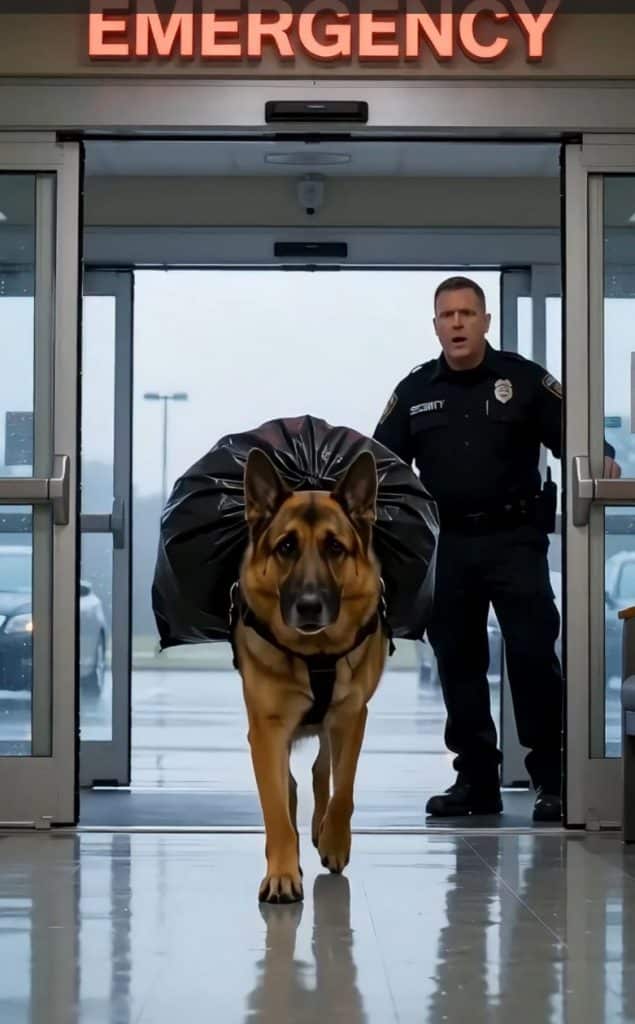
The German Shepherd came through the emergency doors like he knew exactly where he was going.
Rain hammered the parking lot behind him. The red EMERGENCY sign glowed above the sliding glass doors, bleeding color across the wet pavement outside. Inside, the polished gray tile reflected every fluorescent light with cold precision.
The security guard stepped forward too late.
“Hey!” he shouted. “Where are you going?”
The dog did not stop.
He was large, tan and black, soaked from the rain, his ears sharp and forward. A bulky black plastic bag was strapped across his back with a harness, swaying heavily with every purposeful step.
Nurse Claire Rowan looked up from the reception desk and froze.
For half a second, nobody moved.
Then the dog trotted straight toward the nurses.
“Who let this dog in here?” one of them cried, stepping back.
The others scattered to either side of the hallway, white sneakers squeaking against the tile. A nurse behind the desk reached for the phone. The security guard hurried after the animal, still bewildered, still not sure whether to grab him or call animal control.
The dog stopped in the exact center of the emergency reception area.
Then he barked twice.
Sharp.
Commanding.
Not frightened.
Not aggressive.
A message.
Claire stared at the black bag on his back.
It was tied badly, the plastic stretched tight over something large and uneven. Rainwater dripped from it onto the floor, forming dark circles around the dog’s paws.
The dog looked directly at her.
Then he lowered his body slightly, as if offering the bag.
Claire’s throat tightened.
“Don’t touch it,” another nurse whispered.
But Claire was already moving.
She had seen dogs afraid before. She had seen dogs injured, defensive, lost. This one was none of those things.
This dog had come to the hospital for help.
Claire knelt slowly.
“It’s okay,” she whispered. “I’m not going to hurt you.”
The dog held still as she reached for the harness strap. His wet fur trembled beneath her gloved fingers, but he did not back away.
The security guard stopped beside her.
“Ma’am, we don’t know what’s in there.”
Claire looked at the dog’s eyes.
“No,” she said. “But he does.”
She untied the first knot.
The plastic loosened.
A small sound came from inside the bag.
Not a machine.
Not a phone.
Not the rustle of trash.
A cry.
Tiny.
Weak.
Human.
Claire ripped the bag open.
And every nurse in the emergency room went silent.
Act II
Inside the black bag was a baby.
Not loose. Not carelessly thrown away. Wrapped tightly in a clean hospital blanket, tucked inside a second layer of plastic to keep out the rain, with a small knit cap pulled over her head.
The baby’s face was red from crying, her eyes squeezed shut, her fists pressed beneath her chin.
She was alive.
Barely warm.
But alive.
Claire scooped her up with a sound that was half gasp, half prayer.
“Pediatric bay now,” she said.
The room exploded into motion.
One nurse ran for warm blankets. Another called the attending physician. The guard grabbed a rolling cart and cleared a path. The German Shepherd followed them all the way to the treatment bay, refusing to leave the child’s side.
“Someone get this dog out,” one nurse said.
Claire turned sharply.
“No. He stays where I can see him.”
The dog sat beside the door.
Waiting.
Watching.
As if he had already done the impossible and now trusted the humans not to fail.
The baby had no name on her blanket.
No note.
No hospital bracelet.
Only one thing had been tucked beside her.
A laminated ID badge.
Claire picked it up with two fingers.
The photo showed a woman in blue scrubs, smiling gently at the camera.
MAYA ELLIS
LAB TECHNICIAN
ST. CATHERINE’S MEDICAL CENTER
Claire stared at the badge.
She knew that name.
Everyone did.
Maya Ellis had disappeared eight months earlier.
She had worked in the hospital lab for six years. Quiet, punctual, kind to new nurses, famous for leaving granola bars in the break room when night shift ran long.
Then one night, she vanished after clocking out.
The hospital said she had quit under personal stress.
Her fiancé said she would never leave her dog.
The dog had been missing too.
A German Shepherd named Ranger.
Claire slowly looked toward the doorway.
The dog was staring back at her.
“Ranger,” she whispered.
His ears lifted.
The guard’s face drained of color.
“That’s the missing woman’s dog?”
Claire looked down at the baby.
Then at Maya’s ID badge.
Then at the black bag lying collapsed on the floor, rainwater pooling around it.
“No,” she said softly. “He didn’t just come back.”
Her voice shook.
“He brought someone with him.”
Act III
Maya Ellis had tried to tell people something was wrong before she disappeared.
Claire remembered it now with an ache that felt like guilt.
A month before Maya vanished, she had stood beside the vending machine at 2:00 a.m. with a paper cup of tea shaking in her hands. Claire had asked if she was okay.
Maya smiled too quickly.
“Just tired.”
But her eyes kept moving toward the hallway camera.
The next week, a rumor spread that Maya had been caught accessing restricted records. The week after that, administration announced she had resigned. Nobody saw her leave. Nobody packed her locker. Her name simply vanished from the schedule.
People talked for three days.
Then the hospital swallowed the story.
Hospitals are good at swallowing things.
Mistakes. Whispers. Grief. People who ask questions at the wrong time.
Maya’s fiancé came to the front desk twice. The second time, security escorted him out after he shouted that Maya would never abandon Ranger.
The hospital director, Dr. Harold Voss, issued a statement about respecting privacy.
That was the end of it.
Or it should have been.
But Ranger had walked through the emergency doors in the rain with Maya’s badge and a newborn child strapped to his back.
Claire found the second item inside the bag while the baby was being stabilized.
A small waterproof pouch.
Inside was a flash drive and a folded note sealed in plastic.
The handwriting was rushed, but legible.
If Ranger makes it to St. Catherine’s, believe him.
Claire’s hands began to tremble.
She unfolded the note farther.
My name is Maya Ellis. I did not quit. I found altered newborn records, missing lab samples, and private adoption files hidden under false patient numbers. Dr. Voss knows. So does administration.
The baby’s mother was told her child died.
She didn’t.
Her name is Lily.
Please don’t let them take her again.
Claire stopped reading.
The room tilted.
Behind her, the baby cried weakly from the warmer.
Lily.
The nurse beside the warmer whispered, “Claire?”
Claire folded the note and put it back into the pouch.
“Call the police,” she said.
The nurse hesitated.
“Hospital police?”
Claire’s voice hardened.
“No. City police. And don’t tell administration.”
Too late.
The automatic doors behind reception opened again.
Dr. Harold Voss walked in wearing a dark overcoat over his suit, rain shining on his shoulders. He was not supposed to be there at midnight. He rarely came to the ER unless a donor was present or cameras were nearby.
His eyes went first to the dog.
Then to the black bag.
Then to Claire’s hand.
“What,” he asked calmly, “is going on?”
Ranger stood.
A low growl rolled through his chest.
Act IV
Dr. Voss smiled as if the growl amused him.
“Someone remove that animal.”
Nobody moved.
That was the first sign that something had changed.
The nurses who had stepped aside in fear now stood between Voss and the pediatric bay. The security guard, still pale, shifted closer to Claire instead of the director.
Claire held the waterproof pouch against her chest.
“Where is Maya Ellis?”
Voss blinked once.
Not enough for most people to notice.
Enough for Claire.
“Maya resigned months ago.”
“No,” Claire said. “She didn’t.”
His gaze sharpened.
“Claire, you’re upset. A strange dog just brought an abandoned infant into the ER. Let’s not create wild stories before we understand the facts.”
Ranger barked once.
Voss flinched.
This time, everyone noticed.
The attending physician stepped out of the pediatric bay.
“The baby is stable for now,” he said. “Cold, dehydrated, but responsive.”
Voss’s jaw tightened.
“Good. I’ll contact child services.”
“No,” Claire said.
He turned toward her slowly.
“I beg your pardon?”
“You won’t touch her paperwork. You won’t enter her chart. You won’t call anyone until police arrive.”
The room went silent.
Voss’s face cooled into something harder.
“You are a nurse speaking to the director of this hospital.”
“And you are standing in my emergency room while a baby with falsified records is fighting for her life.”
For one second, Voss’s mask slipped.
Then his phone rang.
He looked down.
He did not answer.
But Claire saw the caller name before he turned the screen away.
Board Chair — Whitmore.
Her stomach sank.
This was bigger than Voss.
The police arrived twelve minutes later.
Not hospital security. Real officers in rain-dark jackets, followed by a detective with tired eyes and a voice that made people answer questions without realizing they had decided to.
Detective Elena Marsh listened to Claire. Read Maya’s note. Took the flash drive. Then asked to see the baby.
Ranger followed.
No one tried to stop him now.
When Detective Marsh saw the German Shepherd sit beside the warmer, her expression changed.
“That dog brought her here?”
Claire nodded.
“He carried her through a storm.”
Ranger rested his chin near the edge of the warmer, close enough to hear Lily breathe.
The flash drive unlocked the first door.
It contained lab records, internal emails, scanned birth certificates, and audio files. Maya had copied everything before she vanished. The files showed a pattern spanning years: babies marked as deceased, grieving mothers discharged, newborns transferred through shell agencies into private adoptions arranged for wealthy clients.
Not many.
Just enough to hide.
Just enough to destroy lives quietly.
Lily was the newest.
Her mother, a nineteen-year-old named Sofia Reyes, had given birth two nights earlier after a complicated labor. She had been told her daughter did not survive. She was still upstairs, sedated, grieving a child who was breathing three floors below her.
Claire covered her mouth.
Detective Marsh looked at Voss.
He had gone gray.
“Dr. Harold Voss,” she said, “you need to come with me.”
Voss tried to speak.
Ranger growled again.
And for once, the man who had controlled an entire hospital understood what it felt like to be cornered by the truth.
Act V
Sofia Reyes met her daughter at 3:41 a.m.
Claire would remember the exact time for the rest of her life.
The young mother was brought down in a wheelchair, still weak, still pale, still moving through the fog of a grief that had been forced on her like a sentence. When she saw the baby in the warmer, she did not reach for her at first.
She looked terrified to believe.
“Is that…” Her voice failed.
Claire knelt beside her.
“Yes.”
Sofia shook her head as tears spilled down her face.
“They told me she was gone.”
“I know.”
“They let me hold a blanket.” Sofia’s voice broke. “They said she was already gone.”
The room went still.
Even Detective Marsh looked away.
Claire lifted Lily carefully and placed her in Sofia’s arms.
The baby fussed once.
Then settled.
Sofia folded over her daughter with a sob so deep it seemed to come from every mother who had ever been lied to by someone in a white coat.
Ranger sat beside the wheelchair.
Sofia noticed him through tears.
“Who is he?”
Claire looked at the dog.
“He brought her back.”
Sofia reached down with one shaking hand and touched Ranger’s head.
The German Shepherd closed his eyes.
For the first time since he entered the hospital, his body relaxed.
The arrests began before sunrise.
Voss first.
Then an administrator.
Then a private adoption broker.
Then two board members whose names had been carved into plaques throughout the hospital for their “generosity.”
By noon, reporters filled the sidewalk outside St. Catherine’s. By evening, families were calling hotlines, asking about babies they had buried only in paperwork.
The hospital called it a tragedy.
Claire called it what it was.
A machine.
And Maya Ellis had tried to stop it.
Three days later, police found Maya.
Alive.
Weak, hidden in an abandoned caretaker’s cottage outside the city, where she had been held after refusing to give up the drive. Ranger had escaped during a transfer, found the place where Lily was hidden, and carried her through the rain to the only building Maya had trained him to find.
St. Catherine’s emergency entrance.
When Maya woke in a guarded hospital room, Ranger was there.
He put his head gently on the blanket near her hand.
Maya opened her eyes and whispered, “Good boy.”
The story spread everywhere.
People called Ranger a hero.
They were right.
But Claire knew the dog had not acted alone. He had followed love, training, memory, and trust. He had carried a child because the humans around that child had forgotten what medicine was supposed to be.
Months later, St. Catherine’s changed its name.
Not for branding.
For shame.
The old board was removed. New policies were forced into place. Every newborn record from the last fifteen years was reviewed by outside investigators. Some families found answers. Some found heartbreak. Some found children who had grown up elsewhere, loved by families who had no idea they had been handed someone else’s stolen grief.
Nothing about justice was simple.
It rarely is.
But Lily Reyes grew.
That was simple.
She grew warm, loud, hungry, loved. Sofia took her home under the protection of people who had finally learned to believe her. Maya visited often after recovering enough to walk with a cane. Claire became the aunt nobody officially assigned but everyone accepted.
And Ranger?
Ranger never liked the hospital again.
He would stand outside the sliding doors and stare at the red EMERGENCY sign, ears forward, as if remembering the storm.
One year later, the hospital unveiled a small plaque near the entrance.
For those who come seeking help,
and for those brave enough to bring them.
Sofia brought Lily to the ceremony in a yellow dress.
Maya brought Ranger.
Claire stood beside the glass doors, watching the crowd gather where the dog had once walked in dripping rainwater onto the tile.
A security guard approached her.
The same one from that night.
He looked at Ranger and shook his head.
“I still hear myself yelling, ‘Where are you going?’”
Claire smiled faintly.
“He knew.”
The guard nodded.
“Yeah,” he said. “He did.”
During the ceremony, Lily began to fuss.
Ranger lifted his head immediately.
The crowd laughed softly.
Sofia bent down and let the little girl pat his fur with clumsy hands. Ranger sat perfectly still, solemn as a soldier, gentle as a promise.
Maya wiped her eyes.
Claire looked through the glass doors into the bright reception area.
She could still see it.
The wet paw prints.
The black bag.
The nurses stepping back.
The two sharp barks that turned a hospital’s silence into a reckoning.
That night had begun with fear.
A dog where he should not be.
A bag nobody wanted to open.
A truth too terrible to fit inside one room.
But sometimes help does not arrive in the form people expect.
Sometimes it walks through automatic doors on four paws, soaked from the rain, carrying the life everyone else tried to throw away.
And sometimes, when the whole world asks where are you going, love keeps walking until it reaches the people who will finally listen.